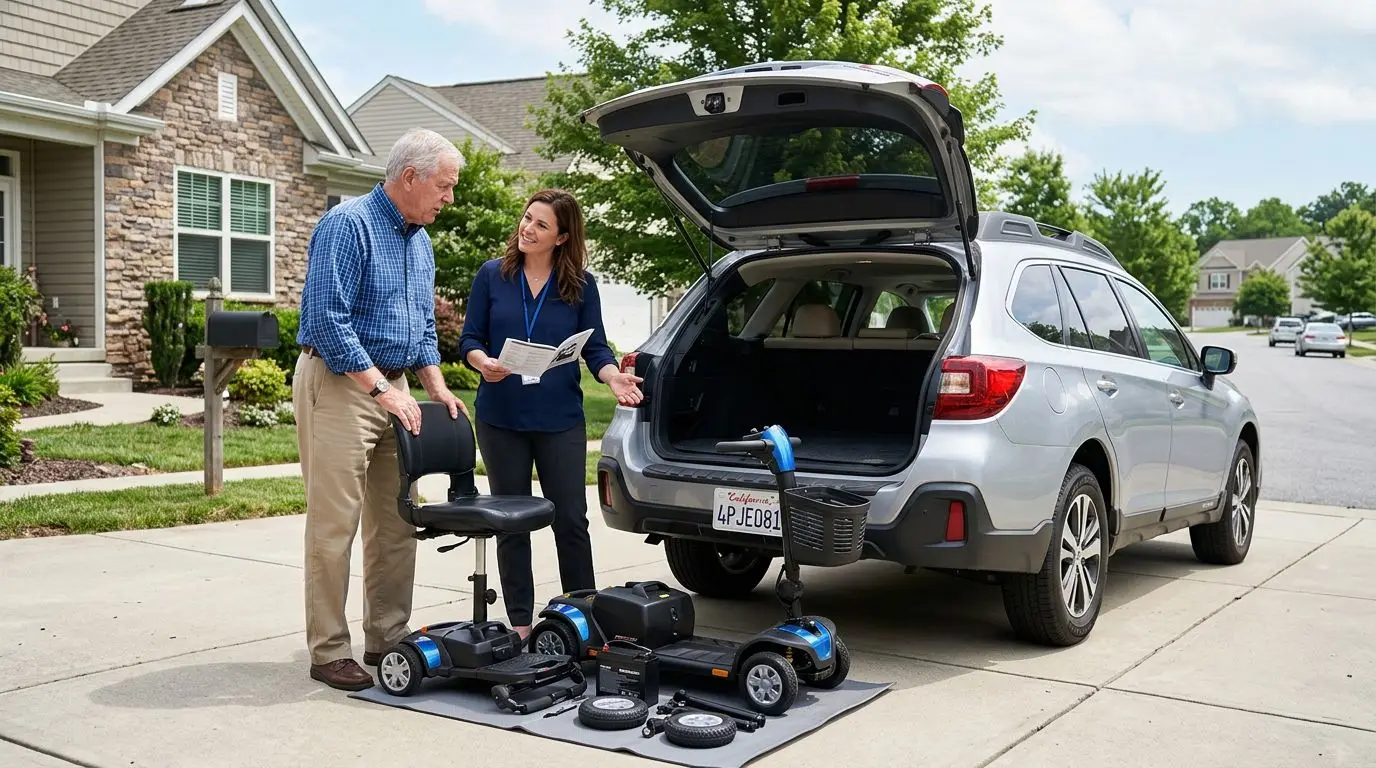
A mobility scooter will fit in a car, SUV, or van only when its folded or disassembled dimensions are smaller than the vehicle’s usable cargo opening and cargo floor. Most travel scooters are built to break down for transport, while many full-size and heavy-duty scooters require a ramp, lift, hitch carrier, or van with enough interior height. The right answer begins with measuring the scooter’s length, width, tallest piece, heaviest piece, and total weight before you buy it or load it.
Do not rely on “it looks like it should fit.” A scooter that is 42 inches long may still be hard to load if the trunk opening is only 28 inches wide, or if the heaviest section is 50 pounds and the person loading it cannot safely lift that much. Use the steps below to confirm fit before committing to a scooter or transport setup.
The 5 measurements that decide whether your scooter fits
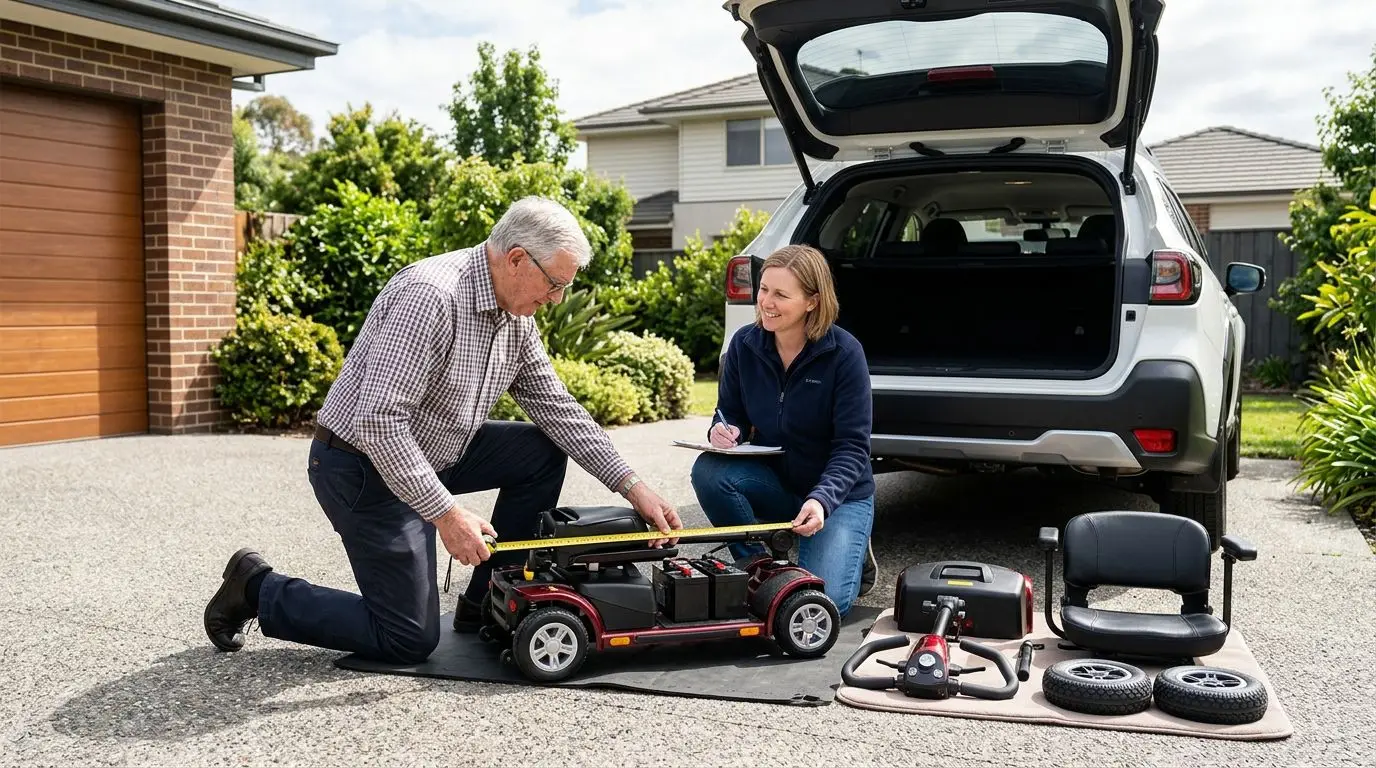
Five numbers matter more than the brochure photo: overall length, overall width, folded or disassembled height, heaviest-piece weight, and total scooter weight. Write them down in inches and pounds. If the scooter has a basket, armrests, headrest, cane holder, oxygen holder, or rear accessory bracket, measure it with those items removed and again with them installed.
For many compact travel scooters, overall length commonly falls in the 36- to 45-inch range, with widths around 19 to 23 inches. Mid-size and full-size scooters can be closer to 45 to 55 inches long and 23 to 27 inches wide. Heavy-duty scooters may be longer, wider, and much heavier, which changes the transport plan even when the cargo area looks roomy.
| Measurement | Why it matters | How to check it |
|---|---|---|
| Overall length | Determines whether the scooter fits on the cargo floor | Measure from front tire or bumper to the furthest rear point |
| Overall width | Must clear the trunk, hatch, or sliding door opening | Measure the widest point, often the rear wheels or armrests |
| Folded or broken-down height | Affects fit under a trunk lid or rear hatch glass | Fold the tiller down and measure the tallest remaining point |
| Heaviest piece | Shows whether hand loading is realistic | Weigh or confirm the base section weight after disassembly |
| Total weight | Matters for ramps, lifts, hitch carriers, and payload limits | Add all scooter parts, batteries, and accessories |
The heaviest-piece number is often the deal breaker. A scooter that separates into 4 or 5 parts may sound easy to transport, but the base section can still weigh 35 to 70 pounds depending on size and battery type. If lifting that piece from the ground to a cargo floor feels risky, plan on a ramp or powered lift instead of repeated hand loading.
Car, SUV, or van: what usually works with 30 to 60 inches of cargo space
Different vehicles solve different problems. A sedan may have enough trunk volume for a small disassembled scooter, but the trunk opening can be narrow and high. An SUV often provides a larger hatch and a flatter cargo floor. A van usually gives you the most interior height, especially when the scooter rolls in through a rear hatch, sliding door, or lowered ramp.
Measure the vehicle the same way you measure the scooter. The key dimensions are the narrowest cargo opening width, the opening height, cargo floor depth, floor-to-ground lift height, and usable space with seats folded. A rear cargo floor may be 25 to 34 inches above the ground, which is a major lift when handling a 45-pound scooter base.
| Vehicle type | Often works best for | Common limitation | Likely transport method |
|---|---|---|---|
| Sedan | Compact scooters that disassemble into small pieces | Trunk opening height and awkward lift angle | Disassemble and lift pieces into trunk or back seat |
| Hatchback | Travel scooters with folded tillers | Rear seat may need to fold flat | Disassemble, or load folded scooter if light enough |
| Small SUV | Compact to mid-size scooters | Cargo floor height can make lifting difficult | Disassemble, use a short ramp, or consider a lift |
| Large SUV | Mid-size scooters and some full-size scooters | Interior height and total payload must be checked | Ramp, interior lift, or hitch carrier |
| Minivan or full-size van | Frequent transport and larger scooters | Seat configuration and ramp storage space | Ramp, platform lift, or drive-in accessible setup |
A practical rule is to leave at least 1 to 2 inches of clearance on each side of the tightest opening. That margin helps prevent scraped panels, pinched fingers, and frustrating angles. It also accounts for carpet, weather stripping, plastic trim, and the reality that loading is rarely perfectly straight.
When disassembly into 3 to 5 parts is enough
Disassembly is usually the simplest option for occasional transport. Many travel scooters are designed so the seat lifts off, the battery pack removes, the basket detaches, the tiller folds, and the front or rear section separates from the base. That can reduce a scooter into 3 to 5 pieces that fit into a trunk, hatchback, or SUV cargo area.
This approach works best when each piece can be lifted safely by the person doing the loading. For many households, that means the heaviest piece should be comfortably below what the loader can lift from knee height to waist height without twisting. A 30-pound battery box may be manageable for one person; a 65-pound rear drive section may not be.
- Seat: Usually removed first; some seats weigh around 15 to 25 pounds.
- Battery pack: Often removable; weight varies widely by battery size and chemistry.
- Basket and accessories: Remove these to reduce snagging and save several inches.
- Tiller: Folds down to lower the scooter’s height and improve clearance.
- Base sections: Some travel scooters separate into front and rear sections; not all do.
Before buying, ask for the broken-down dimensions, not just the assembled dimensions. If that information is unavailable, test the scooter with a tape measure in the exact transport position you plan to use. A folded tiller may stick up higher than expected, and armrests may add 3 to 6 inches of width unless they are removed or folded inward.
Disassembly is not ideal for everyone. It requires hand strength, balance, memory for the order of parts, and a clean area to set pieces down. If the scooter will be transported daily, repeated lifting may matter more than the scooter’s driving range or top speed.
Ramps, hitch carriers, and lifts: choosing a transport aid rated for 300 pounds or more
A transport aid can reduce or eliminate lifting, but it must match both the scooter and the vehicle. Check the scooter’s total weight with batteries installed, then compare it with the ramp, carrier, or lift capacity. Many mobility scooters weigh well over 100 pounds, and larger models can exceed 250 pounds, so capacity ratings are not a detail to overlook.
| Transport aid | Best for | Key number to check | Important caution |
|---|---|---|---|
| Portable ramp | Rolling a scooter into an SUV or van | Ramp capacity and ramp length | Usually for unoccupied loading unless instructions state otherwise |
| Hitch carrier | Carrying scooter outside the vehicle | Vehicle tongue weight and carrier capacity | May block rear camera, hatch, lights, or license plate |
| Interior platform lift | Lifting scooter into cargo area | Scooter weight and cargo opening size | Requires room for the lift mechanism and scooter |
| Hoist-style lift | Loading pieces or smaller scooters | Lift rating and reach | Scooter may need secure attachment points |
| Accessible van ramp or lift | Frequent transport of larger scooters | Door height, ramp width, and floor layout | Professional assessment is often needed |
Ramp length matters because the shorter the ramp, the steeper the climb. For example, loading into a cargo floor 24 inches off the ground with a very short ramp can create a steep angle that causes scraping, loss of traction, or loss of control. Many people find a 6- to 8-foot ramp more workable for SUV and van loading, but the correct length depends on the ramp instructions, vehicle height, scooter clearance, and user ability.
Never assume it is safe to ride the scooter up a portable ramp into a vehicle. Many portable ramps and vehicle ramps are intended for unoccupied loading only. If a ramp is not specifically rated for an occupied scooter and the setup is not designed for that use, walk beside the scooter if safe to do so, use the lowest speed setting, or choose a powered lift.
Hitch carriers can help when interior space is limited, but they place weight on the rear of the vehicle. Check the vehicle’s hitch class, tongue weight limit, carrier weight, scooter weight, and local rules about lights and license plate visibility. A 250-pound scooter plus a 75-pound carrier equals 325 pounds hanging behind the vehicle, before considering leverage and road movement.
How to measure at home in 15 minutes before you buy or load
You can do a realistic fit check in about 15 minutes with a tape measure, painter’s tape, and a notepad. If possible, do it with the person who will actually load the scooter. The measurements are more useful when they reflect real reach, real lifting ability, and the real vehicle parked on level ground.
- Measure the vehicle opening. Record the narrowest width and lowest height of the trunk, hatch, or door opening. Measure inside the trim, not just the outer body opening.
- Measure cargo floor depth. Start at the inside edge of the closed hatch or trunk and measure to the back of the seats. Then measure again with seats folded.
- Measure lift height. Measure from the ground to the cargo floor. A 30-inch lift height is very different from a 20-inch lift height.
- Measure diagonal clearance. Some scooters fit only if angled. Measure the diagonal of the cargo opening and floor, but leave at least 1 inch for maneuvering.
- Mark the scooter footprint. Use painter’s tape on the garage floor to outline the scooter’s length and width. This helps you visualize turning and loading space.
- Test the heaviest lift. If you do not have the scooter yet, safely test with a similar weight, such as a packed suitcase. Do not strain to prove a point.
- Check where parts will go. Plan a place for the seat, batteries, basket, and base so they do not slide into passengers or block the driver’s view.
Measure your storage path, too. A scooter may fit in the SUV but not through a 28-inch apartment doorway, a narrow garage aisle, or the space beside a parked vehicle. If your transport routine includes elevators, porch steps, tight hallways, or curbside loading, include those obstacles in your decision.
Who each transport setup is best for: 4 practical examples
The best transport method depends on frequency, strength, vehicle size, and scooter design. Here are 4 common scenarios that show how the decision often plays out.
1. Occasional errands with a compact scooter
A person who transports a scooter once or twice a week may do well with a lightweight travel scooter that disassembles into manageable pieces. This setup can work with a sedan trunk, hatchback, or small SUV if the heaviest piece is comfortable to lift and the cargo opening clears the folded tiller or base.
2. Daily use with limited lifting ability
If the scooter is loaded every day, even a 40-pound base can feel like too much over time. A small SUV or van with a ramp or powered lift may be more practical than a scooter that technically fits but requires repeated lifting, twisting, and bending.
3. Larger scooter for outdoor distances
Full-size scooters are often chosen for stability, seat comfort, ground clearance, or outdoor range, but they are rarely easy trunk-loaders. A hitch carrier, interior lift, or van-based setup is usually more realistic than disassembly, especially when the scooter exceeds 150 pounds.
4. Shared vehicle with passengers
If the vehicle also carries groceries, a walker, oxygen equipment, grandchildren, or luggage, measure the remaining usable space after the scooter is loaded. A scooter that fills all 40 inches of cargo depth may fit on paper but leave no safe room for other essentials.
Think about the whole trip, not just the loading moment. Where will you park? Can the rear hatch open fully? Is there room behind the vehicle for a ramp? Will the scooter be exposed to rain on an outside carrier? These small details determine whether the setup is comfortable enough to use regularly.
Safety checks before driving 1 mile with a scooter onboard
Once the scooter is in or on the vehicle, secure it before driving even a short distance. A scooter is heavy cargo. In a sudden stop, loose parts can move forward, damage the vehicle, or injure passengers.
- Turn the scooter off. Remove the key if it has one, and make sure the throttle cannot be bumped.
- Lock or secure the tiller. A loose tiller can swing and damage trim or glass.
- Secure all parts. Use tie-down straps, cargo nets, or the vehicle’s anchor points where appropriate.
- Protect batteries. Keep removable battery packs upright and away from sharp cargo. Follow the battery instructions for transport.
- Check visibility. Do not block mirrors, rear glass, brake lights, or the license plate.
- Recheck after 5 minutes. Stop safely and make sure straps, ramps, or carrier pins have not shifted.
For outside transport, weather matters. Road spray, salt, heat, and rain can affect electronics, upholstery, and moving parts. Use a cover only if it is secured so it cannot flap loose, cover lights, or interfere with the carrier. After driving in wet conditions, inspect the scooter and let it dry according to the owner’s manual.
Insurance and roadside assistance policies vary, so review coverage if the scooter will be carried on a hitch carrier or lift. Some vehicle modifications may also affect warranties or require professional installation. When in doubt, ask a qualified mobility equipment installer or vehicle upfitter to check fit, weight ratings, and securement.
Common mistakes that add 2 inches, 20 pounds, or a lot of frustration
Small oversights often cause transport problems. A rear basket can add several inches of length. Armrests can make the scooter too wide for a trunk opening. A battery upgrade can add weight that changes whether one person can lift the scooter safely.
- Measuring the cargo area but not the opening. The inside may be wide, while the hatch opening is narrower.
- Forgetting the seat post height. Even with the seat removed, the post may be the tallest point.
- Ignoring the ground clearance. Low scooter parts can scrape at the top of a ramp.
- Assuming all ramps are the same. Width, length, surface grip, side edges, and capacity vary.
- Loading on a slope. A driveway slope can change ramp angle and make control harder.
- Underestimating fatigue. A lift that feels fine once in a showroom may feel different after appointments or errands.
If you are between two scooter sizes, transport should be part of the buying decision. A slightly smaller scooter that is easy to load may support more real-world independence than a larger scooter that stays home because transport is too difficult. Balance comfort, terrain needs, user weight rating, battery range, and portability together.
FAQ: 5 answers about transporting a mobility scooter
Can a mobility scooter fit in a regular car trunk?
Some compact travel scooters can fit in a regular trunk when disassembled into 3 to 5 pieces. Full-size and heavy-duty scooters usually will not fit in a sedan trunk because of length, width, weight, and trunk opening limitations.
What is the most important measurement?
The heaviest-piece weight is often the most important number for hand loading. For physical fit, the tightest vehicle opening width and height matter as much as the cargo floor size.
Can I lay a scooter on its side during transport?
Only do this if the scooter’s manual allows it. Laying a scooter on its side may stress the tiller, seat post, body panels, controls, or battery connections. Remove the battery and loose accessories first if the instructions permit side loading.
Do I need a ramp or a lift?
You may need a ramp or lift if the scooter is too heavy to lift safely, if it does not disassemble into manageable pieces, or if loading happens often. A powered lift is often the better choice when repeated lifting would create strain.
Can I ride the scooter up a vehicle ramp?
Not unless the ramp and vehicle setup are specifically rated for occupied loading. Many portable ramps are intended for rolling an unoccupied scooter only, and riding up a steep ramp can be unsafe.
How much clearance should I leave around the scooter?
Aim for at least 1 to 2 inches on each side of the tightest opening, with more space if the loader has limited reach or strength. Extra clearance makes loading easier and helps prevent damage.
Frequently asked questions
Can a mobility scooter fit in a regular car trunk? +
Some compact travel scooters can fit in a regular trunk when disassembled into 3 to 5 pieces. Full-size and heavy-duty scooters usually need an SUV, van, ramp, lift, or hitch carrier.
What should I measure before transporting a mobility scooter? +
Measure the scooter’s length, width, folded or disassembled height, heaviest-piece weight, and total weight. Also measure the vehicle’s cargo opening width, opening height, cargo floor depth, and lift height from the ground.
Do I need a ramp or lift for my scooter? +
You may need a ramp or lift if the scooter is too heavy to lift safely, does not break into manageable pieces, or will be loaded often. Always check weight ratings for the scooter, ramp, lift, carrier, hitch, and vehicle.
Can I transport a mobility scooter on a hitch carrier? +
Yes, if the vehicle, hitch, and carrier are rated for the combined weight of the scooter and carrier. Check tongue weight, rear visibility, lights, license plate access, and secure tie-down points.
Is it safe to ride a scooter up a ramp into a van or SUV? +
Only if the ramp and vehicle setup are specifically rated for occupied loading. Many portable ramps are designed for unoccupied loading, meaning the scooter should be guided up without a rider if safe to do so.
Related guides
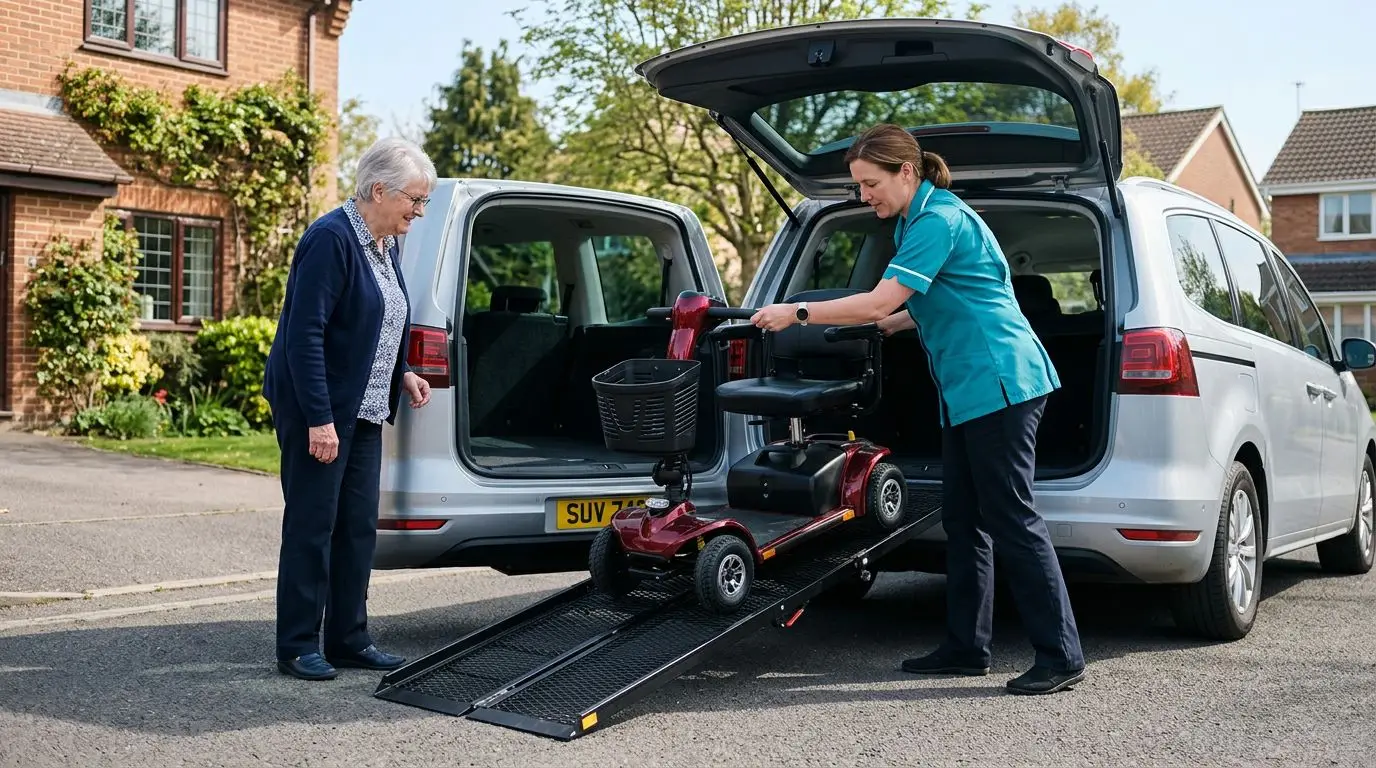
How to Transport a Mobility Scooter by Car: Lifts, Hitch Carriers, Ramps, and Portable Options
14 min read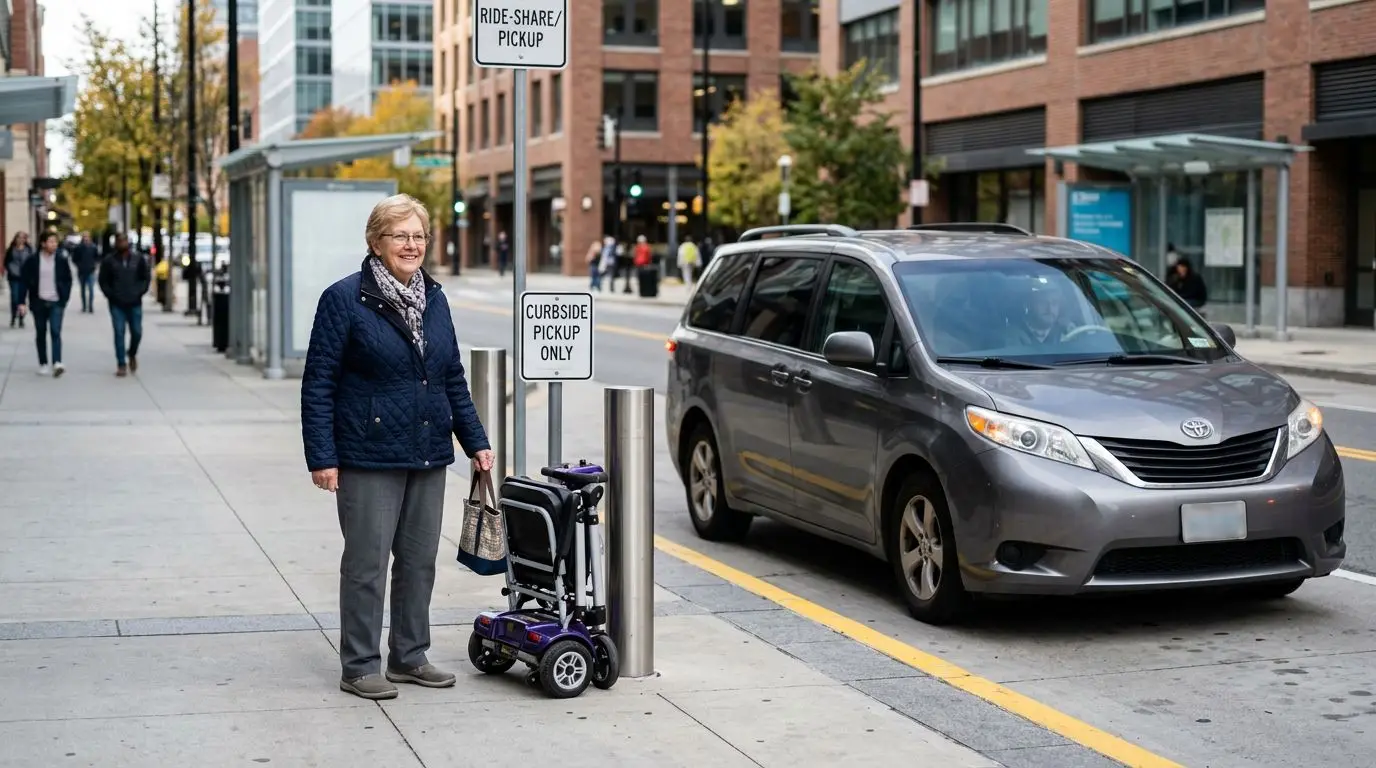
Mobility Scooters, Taxis, and Rideshares: What to Confirm Before You Book a Ride
14 min read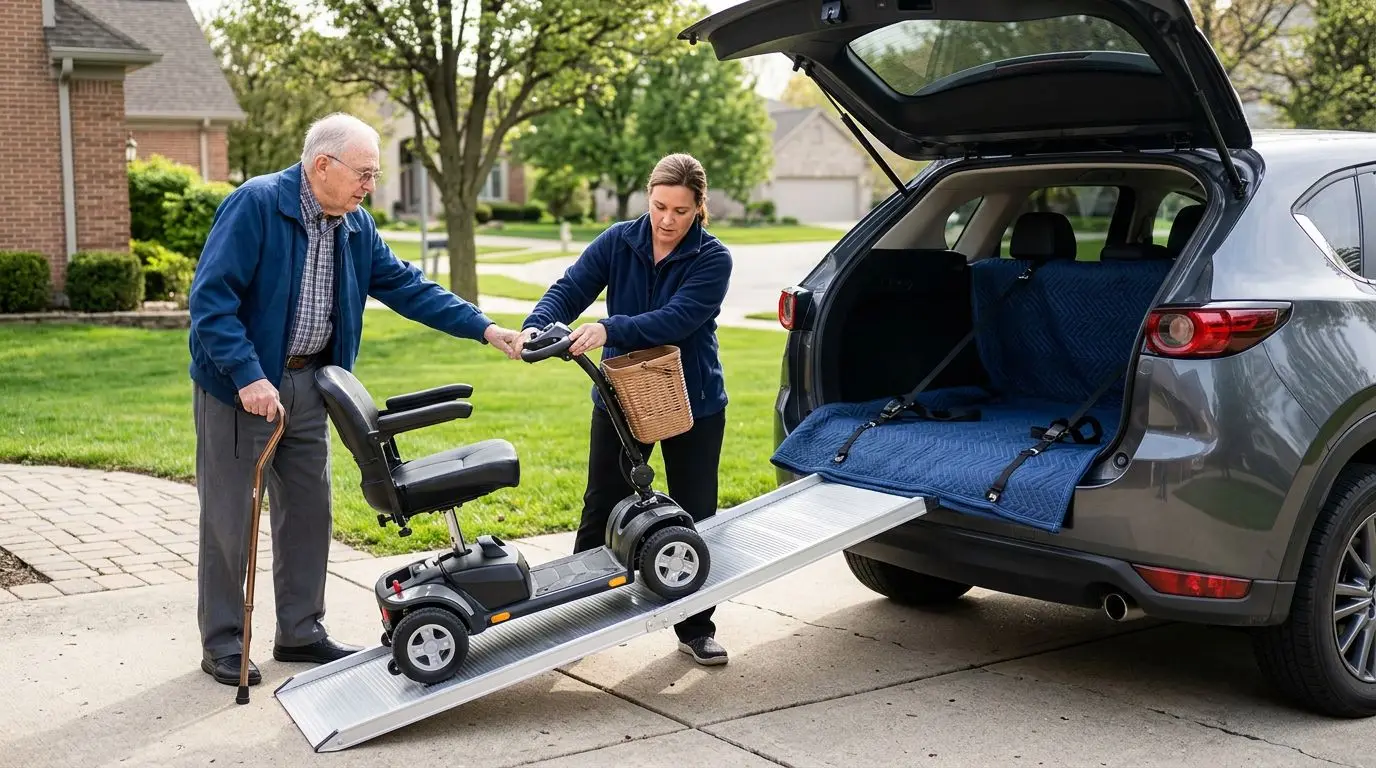
How to Load and Secure a Mobility Scooter in a Vehicle Without Damage or Injury
13 min read