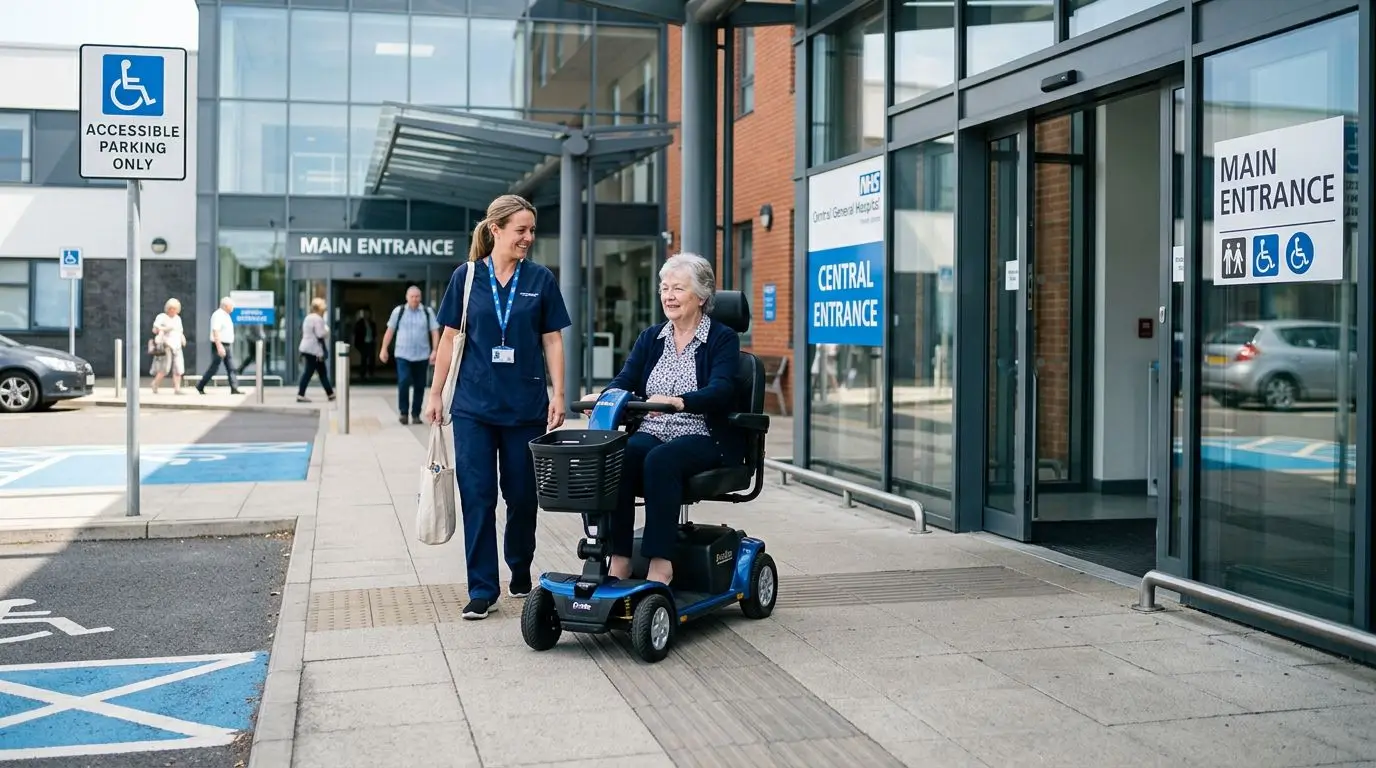
Yes, many employees can use a mobility scooter at work as a reasonable accommodation when it helps them perform the essential functions of the job. Under the ADA, covered employers must consider accommodation requests through an interactive process. They may set reasonable safety rules and can deny a request if it creates an undue hardship or a direct safety threat that cannot be reduced.
The practical question is not simply whether scooters are allowed. It is whether the scooter can travel the employee’s actual workplace route, fit at the workstation, charge safely, and be used in a way that protects the employee, coworkers, customers, and equipment.
ADA basics: the 15-employee rule and what it means
The federal Americans with Disabilities Act generally applies to private employers with 15 or more employees, as well as many state and local government employers. Some state disability laws cover smaller workplaces, so an employee in a 10-person office may still have rights under state law even if federal ADA coverage is less clear.
For workplace scooter use, the ADA issue is usually handled under Title I, which covers employment. The key concept is reasonable accommodation: a change to the work environment, equipment, policy, schedule, or process that enables a qualified employee with a disability to perform the essential functions of the job.
A mobility scooter may be part of that accommodation. So may a closer parking space, a cleared indoor route, a workstation adjustment, permission to charge the scooter, or a modified emergency evacuation plan. The scooter itself does not automatically solve every access issue, and the employer does not have to approve every requested detail exactly as written.
Employers and employees are expected to engage in an interactive process. In plain English, both sides discuss the job duties, the barrier, possible solutions, and any safety or operational concerns. The employee does not have to use special legal language, but a clear written request often helps.
This article is general information, not legal advice. If a job, termination, benefits decision, or formal denial is involved, consider speaking with an employment attorney, a disability rights agency, or the Equal Employment Opportunity Commission.
Who scooter access at work is best for: 4 common situations
Workplace scooter access is most useful when walking distance, standing time, fatigue, pain, balance, respiratory limits, or endurance make the worksite difficult to navigate. It is not only for people who cannot walk at all. Many scooter users can walk short distances, transfer to a chair, or stand briefly, but cannot reliably cross a 200-foot warehouse aisle, a large hospital campus, or a multi-building office site several times per day.
It may be a good fit for employees in these situations:
- Large worksites: Offices, schools, factories, hospitals, airports, and campuses where a shift may involve multiple trips longer than 100 to 300 feet.
- Jobs with mixed seated and mobile tasks: A worker may be able to perform computer, counter, inspection, or supervisory tasks but needs help moving between locations.
- Progressive or fluctuating conditions: Some employees have good and bad days. A scooter can reduce overexertion without taking the employee out of productive work.
- Temporary recovery periods: After surgery or injury, a scooter may be part of a time-limited accommodation for 6 weeks, 12 weeks, or another period supported by medical documentation.
Scooter use is usually less practical where the essential job requires constant hands-on physical work in tight, crowded, or uneven spaces. For example, a job that requires climbing ladders 20 times per shift cannot be made accessible by a scooter alone. That does not end the conversation, but it does shift the focus to whether job restructuring, reassignment, schedule changes, or assistive equipment are reasonable.
How to request a scooter accommodation in 5 practical steps
A strong request is specific. Instead of saying, “I need to use my scooter everywhere,” explain which job task or workplace barrier is involved and what change would help. A request can be made verbally, but putting it in writing creates a useful record.
Use these 5 steps:
- Identify the work barrier: Note where the difficulty happens, such as the 250-foot walk from parking to the time clock, the distance between a desk and conference rooms, or standing in a production area for 4 hours.
- Connect the request to the job: Explain how scooter access helps you arrive on time, attend meetings, reach equipment, supervise areas, or complete assigned duties.
- Describe the scooter in practical terms: Provide the approximate overall width, length, turning space, battery type if known, and whether it uses a standard 120-volt outlet for charging.
- Suggest reasonable routes and storage: Name the entrance, elevator, aisle, desk location, charging outlet, or parking spot that seems workable.
- Offer medical documentation if requested: Employers may ask for reasonable documentation when the disability or need for accommodation is not obvious, but they usually do not need a full medical history.
A brief request might say: “Because of my mobility impairment, I have difficulty walking from the employee entrance to my workstation and between the east conference room and my desk. I am requesting permission to use my mobility scooter on the first-floor route and to park it next to my workstation. The scooter is about 24 inches wide and uses a standard wall outlet for charging.”
The employer may respond with questions, suggest another route, or ask for a trial period. A 30-day trial can be helpful when both sides are unsure about traffic flow, elevator timing, or workspace fit. Trial periods should have clear review points and should not be used to delay a needed accommodation indefinitely.
Measuring workplace routes: 32-inch doors, 36-inch paths, and turning space
The best accommodation plan is built on measurements, not guesses. Many mobility scooters are about 21 to 28 inches wide, while larger models can be wider. Door clearance, hallway width, flooring, thresholds, elevator size, and turning areas all matter.
ADA design standards commonly reference a minimum 32-inch clear door opening and a 36-inch accessible route in many public-access settings. Work areas can be more complicated, especially in older buildings or employee-only spaces, but these numbers are still useful for planning. A 60-inch diameter turning area is often used as a reference point for a full turn, though some scooters need more space because their turning radius is larger than a manual wheelchair.
Measure the route the employee actually uses during the workday. Include the parking lot, entrance, security gate, time clock, break room, restrooms, elevator, desk, printer, meeting rooms, and emergency exit route. Check the narrowest points, not the average hallway width.
| Workplace area | What to measure | Why it matters |
|---|---|---|
| Doorways | Clear opening, often compared with 32 inches | Handles, trim, and door swing can reduce usable width |
| Hallways and aisles | Continuous clear route, often 36 inches or more | Boxes, carts, chairs, and displays can block travel |
| Turns | Turning radius or open floor space, such as 60 inches | Scooters may need more room than expected at corners |
| Thresholds and ramps | Height change, slope, surface grip | Small lips can jolt the scooter or affect stability |
| Workstation | Desk approach, knee space, parking footprint | The scooter must not block exits or coworker paths |
Do a route walk-through at the same time of day the employee will travel. A lobby that is open at 9 a.m. may be crowded at 4:45 p.m. A manufacturing aisle that is clear on Monday morning may fill with pallets before lunch.
Elevators, desks, restrooms, and charging: 6 access points to plan
Once the main route works, look at the details that make daily use realistic. A scooter accommodation often succeeds or fails at small bottlenecks: a chair left in a hallway, a desk that cannot be approached straight on, or a charging cord crossing a walking path.
Plan these 6 access points:
- Parking and building entry: If the employee drives, a closer accessible parking space may reduce the distance from vehicle to entrance. The route from parking to the door should be firm, stable, and free of curb barriers.
- Security and timekeeping: Badge readers, turnstiles, metal detectors, and time clocks should be reachable from a seated position or have an alternate process.
- Elevators: Confirm the scooter fits inside with the door closed and can enter and exit without backing into traffic. During peak times, an employee may need a few extra minutes between floors.
- Desk or workstation: A common planning space for wheelchair access is 30 by 48 inches of clear floor area. Scooters may need more length, so test the actual approach.
- Restrooms and break areas: The employee may transfer from the scooter or park it nearby. Make sure the scooter does not block restroom doors, break room aisles, or emergency equipment.
- Charging: Many scooters charge from a standard 120-volt outlet and may need several hours for a full charge. Charging should avoid extension cords across walkways and should follow workplace electrical rules.
Charging is often simple, but it should be addressed directly. Decide where the scooter can be plugged in, whether charging is allowed during work hours, whether the charger can remain on site, and who is responsible for unplugging it. If the workplace has strict fire, battery, or electrical policies, involve facilities or safety staff early.
Employers do not need to remove every inconvenience, but they should avoid creating unnecessary barriers. For example, if a route is technically wide enough but always blocked by supply boxes, the policy may need to require that the route stay clear.
Scooter type and workplace fit: 3-wheel, 4-wheel, compact, and heavy-duty options
Employers generally should avoid dictating a specific scooter unless there is a legitimate fit or safety reason. Still, the scooter’s type affects whether it can be used safely at work. A compact scooter that fits a 36-inch hallway may behave very differently from a longer outdoor scooter designed for rough pavement.
| Scooter type or feature | Workplace advantages | Possible limits |
|---|---|---|
| 3-wheel scooter | Often has a tighter turning radius for offices and reception areas | May feel less stable on uneven outdoor surfaces |
| 4-wheel scooter | Often offers a more stable feel over longer routes | Usually needs more turning space in small rooms |
| Compact travel scooter | Easier to store, park, and maneuver near desks | May have smaller wheels and less comfort for long shifts |
| Full-size or heavy-duty scooter | May support higher user weights and longer daily travel | Can be too wide or long for older buildings and crowded aisles |
| Speed control | Low-speed settings help in hallways and customer areas | Fast travel may be inappropriate indoors |
| Lights, horn, and mirrors | Can improve awareness at corners and warehouse crossings | Horns should be used respectfully in quiet office settings |
Indoor workplace use usually favors controlled speed, predictable braking, a comfortable seat, and a turning radius that matches the building. Outdoor-heavy jobs may require attention to ground clearance, tire type, range, and weather policies. Any scooter used at work should be maintained well enough that brakes, tires, steering, and controls are reliable.
Employer policies that help: 10 rules that are fair and specific
Employers can have scooter policies, but those policies should not be blanket bans or vague statements such as “no motorized devices allowed.” A better policy focuses on safety, access, and job-related needs. It should allow individualized accommodations and recognize that a scooter may be a necessary mobility aid.
Useful policy topics include these 10 items:
- Approved indoor routes, including alternate routes during maintenance or crowding.
- Maximum indoor speed, such as walking speed in hallways and shared areas.
- Parking locations that do not block exits, fire extinguishers, electrical panels, or aisles.
- Charging locations and rules for cords, chargers, and electrical safety.
- Elevator etiquette, including priority for safe entry and exit rather than rushing.
- Rules for customer areas, kitchens, laboratories, production floors, and warehouses.
- Incident reporting for collisions, near misses, battery problems, or equipment damage.
- Weather and floor-surface rules, such as wet entrances or icy outdoor routes.
- Emergency evacuation planning, including stair procedures when elevators are unavailable.
- Confidentiality, so medical information is shared only with those who need it for the accommodation.
Policies should be applied consistently, but not rigidly. For instance, a rule against storing personal equipment in a hallway may be valid, while an absolute refusal to identify any scooter parking location may be a problem if parking is the only barrier to an otherwise reasonable accommodation.
When safety concerns may limit scooter use: the direct-threat standard
Safety matters, but it must be handled carefully. Under the ADA, an employer may raise a direct-threat concern when there is a significant risk of substantial harm that cannot be reduced by reasonable accommodation. This should be based on objective evidence, not fear, stereotypes, or a coworker’s discomfort.
Real safety questions may include whether the scooter can stop safely on a sloped loading dock, pass through a crowded production aisle without striking workers, be used around flammable materials, or charge in compliance with fire and electrical rules. In a warehouse with forklifts moving at set traffic patterns, scooter routes may need separation, reflective markings, mirrors, or restricted crossing points.
The employer should consider risk level, duration, likelihood, and potential severity. A 5-foot shared hallway in a quiet office is not the same as a narrow machine area with rotating equipment. The right answer may be a modified route, a lower speed limit, a different workstation, a scooter parking area near the work zone, or a transfer to a standard chair for certain tasks.
Undue hardship is another limit. If an accommodation would create significant difficulty or expense in relation to the employer’s size, resources, and operations, the employer may not have to provide that exact accommodation. But the analysis should still look at alternatives. A denied route through a hazardous area may leave room for another entrance, remote meeting access, a relocated workstation, or job restructuring.
How to choose and measure a work-ready scooter setup in 20 minutes
If you already own a scooter, gather measurements before the accommodation meeting. If you are still choosing a scooter for work use, measure the workplace first. A scooter that feels perfect in a parking lot may be frustrating if it cannot turn into your office.
In about 20 minutes, record these numbers:
- Overall width: Measure the widest point, including armrests or mirrors.
- Overall length: Include the front basket or rear accessories if you use them.
- Turning space: Test a 90-degree corner and a full turn in a marked area.
- Seat height and transfer needs: Note whether you will remain on the scooter or transfer to a desk chair.
- Charging needs: Write down plug type, cord length, and typical charging time from your manual if available.
- Daily distance: Estimate total worksite travel, such as 0.5 mile, 1 mile, or more per shift.
Bring photos or a simple route map to human resources, your supervisor, or the accommodation coordinator. Mark the entrance, elevator, desk, restroom, break room, and any problem areas. If the employer has facilities staff, ask them to confirm doorway and aisle measurements.
The goal is not to win an argument over inches. The goal is to find a setup that lets you work safely and reliably with the least disruption necessary.
Documentation, privacy, and follow-up after 30 days
Employers may request medical documentation when the disability or accommodation need is not obvious. The documentation should usually confirm that the employee has a disability-related mobility limitation and explain why scooter access or related changes are needed. It does not need to include unrelated diagnoses, complete medical records, or personal details beyond the accommodation question.
After approval, put the plan in writing. Include the scooter route, workstation arrangement, charging location, parking location, safety rules, and review date. A 30-day or 60-day follow-up is practical because it lets both sides address problems before frustration builds.
If the request is denied, ask for the reason in writing and ask what alternatives were considered. A denial based only on “company policy” or “we have never allowed that” may not be enough. A denial based on a measured route that cannot be made safe may still require discussion of other accommodations.
Good workplace scooter access is a shared project. The employee brings information about mobility needs and equipment. The employer brings knowledge of the workplace, safety rules, and operational requirements. When both sides focus on real measurements, essential job duties, and specific risks, many scooter accommodations are workable.
Frequently asked questions
Can my employer ban all mobility scooters at work? +
A blanket ban can be legally risky for a covered employer because the ADA requires an individualized reasonable accommodation process. The employer can set legitimate safety rules, but it should consider your job duties, route, equipment, and possible alternatives before denying scooter use.
Do I have to provide a doctor's note to use a scooter at work? +
If your disability and need for the scooter are not obvious, your employer may request reasonable medical documentation. The documentation should focus on your mobility limitation and accommodation need, not your full medical history.
Can I charge my mobility scooter at work? +
Often, yes, if charging can be done safely and does not violate electrical, fire, or workplace rules. The plan should identify a specific outlet, avoid cords across walkways, and clarify when and where charging is allowed.
What if my scooter does not fit through part of the workplace? +
The next step is to look for alternatives, such as a different route, relocated workstation, cleared aisle, different entrance, adjusted schedule, or scooter parking with transfer to another chair. The employer does not always have to rebuild a space, but it should consider practical options.
Can coworkers complain about my scooter? +
Coworkers can report real safety concerns, such as blocked exits or near misses, but discomfort or personal preference is not enough to deny an ADA accommodation. Your medical information should remain confidential.
Can a safety concern justify denying scooter use? +
Sometimes. An employer may deny or limit scooter use if it creates a significant safety risk that cannot be reduced through reasonable measures. The decision should be based on objective facts, such as route width, traffic, equipment hazards, or fire and electrical rules.
Related guides

Can a Business Refuse a Mobility Scooter? ADA Rights, Safety Exceptions, and What to Do If Access Is Challenged
13 min read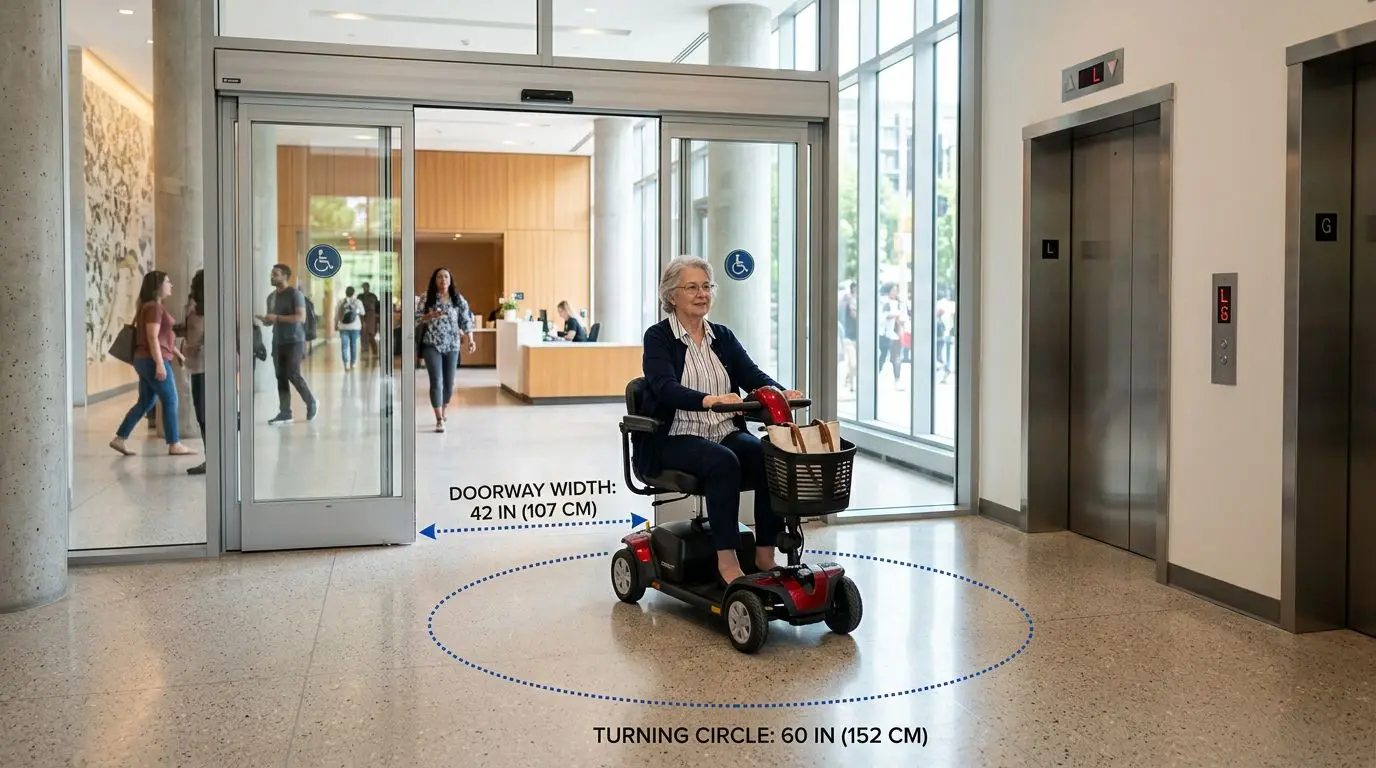
ADA Accessibility Dimensions for Mobility Scooters: Doorways, Ramps, Elevators, and Turning Space
14 min read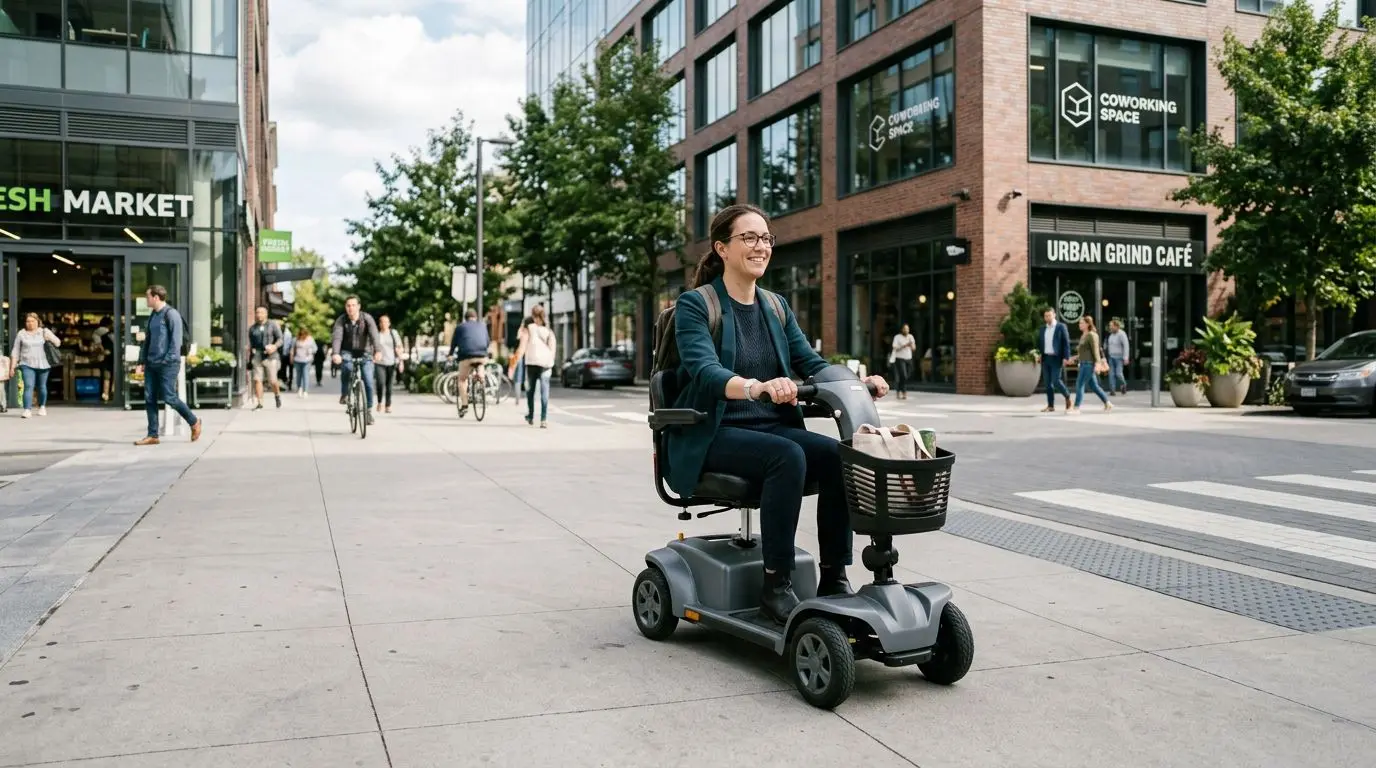
Mobility Scooters for Adults Under 65: Work, Errands, Fatigue, and Long-Term Mobility Needs
13 min read