
The best place to buy mobility scooter accessories depends on how quickly you need the item and how confident you are about fit. Buy locally if you need same-day help, installation, or a hands-on compatibility check. Buy online if you want a wider selection, written specifications, and time to compare measurements before ordering.
Most accessory problems come from small fit differences: a basket clamp that is 1/4 inch too narrow, a cover that does not clear the armrests, or a charger plug that looks right but has the wrong voltage or polarity. Before you shop, measure your scooter, write down the connection type, and confirm the return policy in plain language.
Local Stores vs Online Buying: Same-Day Help or 3–7 Day Selection
In the US, mobility scooter accessories are commonly sold through local medical equipment stores, mobility dealers, scooter repair shops, some pharmacies with durable medical equipment sections, and online retailers. Local stores are strongest when you need help right away. Online shopping is strongest when you need options, measurements, and customer reviews, often with delivery windows of about 3 to 7 business days for common accessories.
The right choice is not only about price. It is about risk. A cup holder or cane holder may be simple, but chargers, batteries, armrest bags, rear baskets, weather covers, ramps, and seating parts can be surprisingly specific. If an accessory attaches to the tiller, seat post, armrest, rear hitch, battery port, or charging port, fit matters.
| Buying option | Best use | Main advantage | Main caution |
|---|---|---|---|
| Local medical equipment store | Same-day accessories, in-person advice | Staff can inspect the scooter or photos | Selection may be limited to common sizes |
| Mobility scooter repair shop | Chargers, tires, batteries, mounting hardware | Better support for technical compatibility | May require an appointment or service fee |
| Pharmacy or general DME section | Simple items like flags, pouches, basic covers | Convenient and nearby | Fewer scooter-specific details on packaging |
| Online specialty retailer | Measured accessories and replacement parts | More specs, more sizes, wider selection | You must verify fit before ordering |
| Online marketplace | Budget-friendly accessories and reviews | Large inventory and quick shipping options | Listings can be vague or inconsistent |
If you search for accessories near me, call before you drive over. Ask whether the store carries scooter-specific accessories, whether they can check your scooter in the parking lot, and whether they accept returns on opened items. A 2-minute phone call can save a wasted trip.
Who Local Stores Are Best For: 5 Situations Where In-Person Support Wins
Local buying is best for shoppers who need immediate help, have limited hand strength for installation, or are unsure what type of scooter they own. If the scooter is your main transportation for daily errands, waiting 5 days for a replacement charger or tire tube may not be practical.
Choose a local store first if any of these apply:
- You need the accessory today or within 24 hours.
- You are buying a charger, battery, tire, tube, seat part, or mounting bracket.
- You cannot easily measure the scooter or read the label near the charging port.
- You want someone to install the item or test it before you leave.
- You have a heavy-duty, folding, travel, 3-wheel, or 4-wheel scooter with unusual attachment points.
Local support is especially useful for battery and charging items. A scooter may use a 24-volt battery system, but that does not mean every 24-volt charger is safe or compatible. The connector shape, amp rating, polarity, and battery chemistry must match the scooter requirements. When in doubt, bring the old charger, photos of the scooter label, and the battery compartment information to a qualified mobility equipment provider.
In-person help also matters with ramps and lifts. A threshold ramp for a 2-inch doorway lip is very different from a portable ramp used for a van or porch step. Ramp length, scooter weight, rider weight, and slope all affect safe use. Local stores may be able to explain load ratings and check whether the ramp is appropriate for your setting.
Who Online Shopping Is Best For: 3 Reasons to Compare Before You Buy
Online shopping is usually best when you already know the needed measurements and can wait a few days. It also helps when you want to compare several accessory types side by side, such as a soft basket liner, rear storage bag, sun shade, oxygen tank holder, phone mount, or weather cover.
There are 3 main advantages to buying online. First, online listings often show dimensions in inches, such as handlebar clamp range, basket width, seat-back height, or cover length. Second, you can read return rules before ordering. Third, you can compare the same accessory category across several sellers without driving from store to store.
Online buying works well for lower-risk accessories that do not affect braking, steering, power, or balance. Examples include seat-back bags, control panel covers, reflective flags, mirrors, cup holders, armrest pouches, and some weather covers. Even then, check measurements. A rear bag may fit a 15-inch seat back but not an extra-wide captain-style seat with thick padding.
Be more careful with online purchases that involve electricity, structural support, or weight bearing. Chargers, batteries, tires, ramps, and hitch-mounted carriers should be selected using exact specifications rather than appearance. If a listing does not show voltage, amp output, connector type, tire size, load rating, or mounting dimensions, keep looking or contact the seller before buying.
Compatibility Checks: 7 Measurements to Take Before Ordering
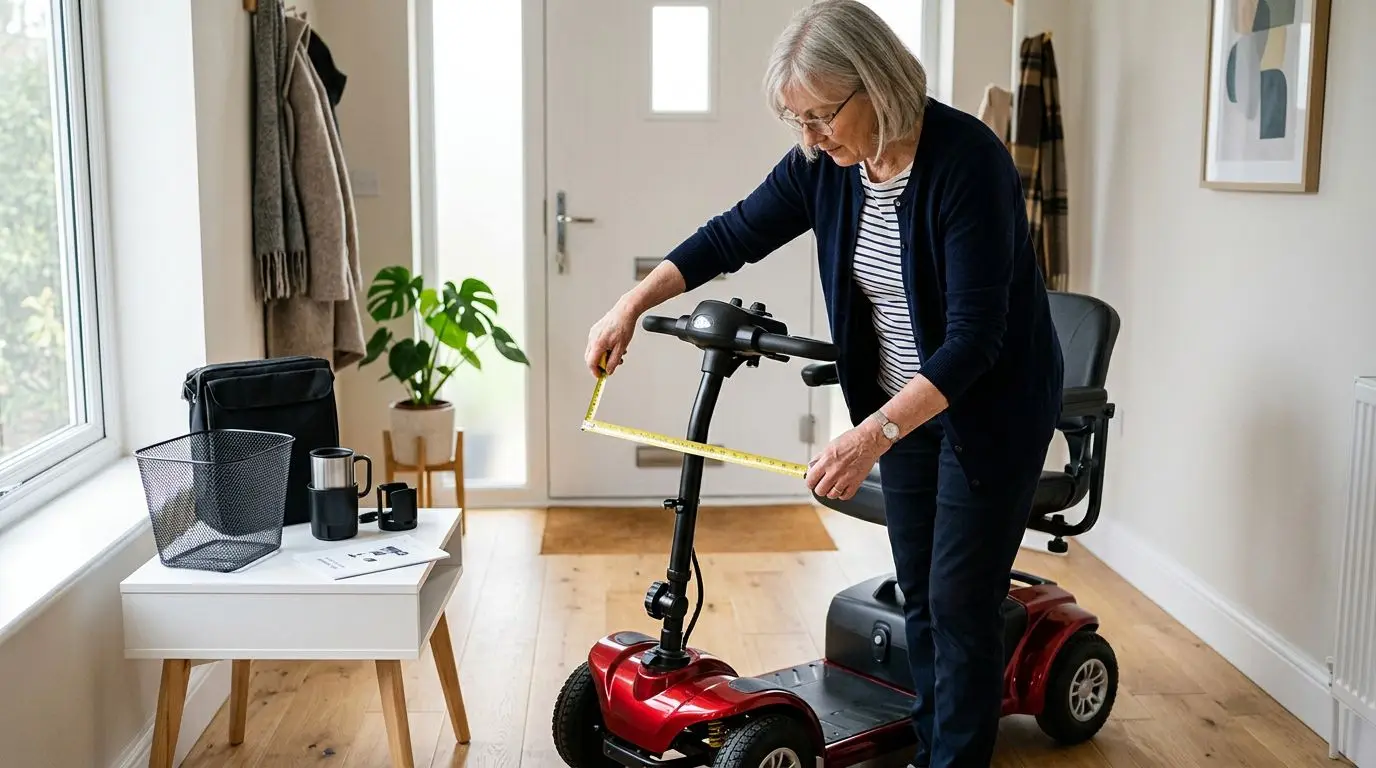
Most accessory fit problems can be prevented with 7 basic checks. Use a tape measure, a phone camera, and a notepad. Measure in inches, and take clear photos from straight-on angles so a store employee or online seller can help you confirm details.
| Measurement or detail | Why it matters | Common accessory examples |
|---|---|---|
| Seat width and seat-back height | Determines whether bags, covers, and cushions fit | Seat-back bags, weather covers, cushions |
| Armrest width and tube shape | Some pouches and trays attach to armrests | Armrest bags, side pouches, trays |
| Tiller diameter or handlebar shape | Clamp-on accessories need the right grip size | Phone holders, mirrors, cup holders |
| Rear accessory receiver or bracket size | Rear baskets and holders need secure mounting | Baskets, cane holders, oxygen holders |
| Overall scooter length, width, and height | Covers and storage items need enough clearance | Rain covers, dust covers, transport covers |
| Tire size printed on tire sidewall | Tires and tubes must match size and valve type | Replacement tires, inner tubes |
| Charging port shape and electrical specs | Chargers must match voltage, connector, and polarity | Battery chargers, charging adapters |
Write down the scooter type too. A compact travel scooter may have a narrow seat post and small rear frame, while a larger outdoor scooter may have wider tires, a taller seat, and a heavier rear section. Accessories described as universal are not truly universal in every case. Universal often means they fit a range, not all scooters.
Take photos of the attachment area with a ruler in the frame. For example, if you are buying a tiller-mounted cup holder, photograph the tiller tube and note whether it is round, oval, or molded plastic. If you are buying a rear basket, photograph the back of the seat and rear frame. Small details matter.
How to Measure for Common Accessories: 1/8-Inch Accuracy Helps
You do not need professional tools for most accessory shopping, but accuracy helps. A soft tape measure is fine for covers and bags, while a rigid ruler or caliper is better for tubes, clamps, and small connectors. For clamp-on accessories, being off by 1/8 inch can be the difference between a tight fit and a loose, unsafe mount.
Seat-back bags and pouches
Measure the width of the seat back at its widest point and the height from the top of the seat cushion to the top of the backrest. If the bag uses straps, check whether the straps can go around the seat back without blocking a headrest, armrest hinge, or adjustment lever. Leave room for comfort. A bag that pulls the seat backward or interferes with folding can become annoying quickly.
Cup holders, phone mounts, and mirrors
Measure the diameter of the tiller tube or handlebar where the clamp will sit. If the tiller is not round, measure the thickest point and take a photo. Avoid mounting anything where it blocks the throttle, speed dial, horn, lights, or battery indicator. You should be able to steer and brake normally with both hands.
Weather covers and storage covers
Measure total length, total width, and height from the ground to the highest point, often the seat back or headrest. Add a little room for mirrors, baskets, or armrests if those stay attached. A cover that is too small can tear at the seams; one that is much too large may drag on the ground or catch wind.
Chargers and battery-related items
Do not rely on plug shape alone. Confirm voltage, amp output, connector type, polarity, and battery chemistry. Many scooters use a 24-volt system, but charger output and connector details vary. If the original charger label is readable, photograph it. If it is missing or damaged, ask a qualified mobility equipment provider to identify the correct replacement.
Tires, tubes, and wheels
Read the tire size printed on the sidewall. It may appear as numbers separated by an x or dash. Match the size exactly, and check whether the scooter uses pneumatic tires, foam-filled tires, or solid tires. Inner tubes also need the correct valve style and stem angle. A tire that looks close may still rub the frame or sit poorly on the rim.
Return Policies and Warranties: Read These 6 Terms Before Paying
Return policies are not all the same. Some sellers allow 30-day returns on unused accessories, while others restrict returns on electrical parts, batteries, cushions, hygiene-related items, or installed hardware. Before you buy, look for 6 terms: return window, condition required, restocking fee, return shipping, opened-package rules, and warranty process.
A friendly return policy is valuable when you are buying an accessory that depends on fit. For online orders, save the packaging until you confirm the item works. Take photos before installation, especially if the item arrived damaged or missing hardware. If you install a bracket, scratch it, or cut a strap shorter, the seller may consider it used and nonreturnable.
Ask these questions before purchasing:
- Can I return it if it does not fit my scooter?
- Does the item have to be unused and in the original packaging?
- Who pays return shipping?
- Is there a restocking fee, such as 10% or 15%?
- Are electrical parts, batteries, or chargers final sale?
- If the item fails, do I contact the store, seller, or manufacturer?
For local stores, ask whether they will test-fit the accessory before the sale is final. Some stores may allow an exchange even if they do not offer refunds. Get the answer on the receipt or in writing when possible. Verbal promises are harder to rely on later.
Accessory Types Compared: 10 Common Add-Ons and Fit Risks
Some accessories are easy to buy. Others need careful checking. The table below ranks 10 common mobility scooter accessories by typical fit risk, not by usefulness. Your scooter design, body size, and daily routine still matter.
| Accessory type | Typical fit risk | Key compatibility check | Best buying route |
|---|---|---|---|
| Reflective flag | Low | Mounting point and pole height | Local or online |
| Cup holder | Low to medium | Tiller or armrest clamp size | Online if measurements are clear |
| Seat-back bag | Low to medium | Seat width and strap length | Local or online |
| Weather cover | Medium | Scooter length, width, and height | Online with full dimensions |
| Rear basket | Medium | Rear bracket or receiver style | Local if unsure |
| Cane or crutch holder | Medium | Rear mounting area and cane diameter | Local or online with photos |
| Oxygen tank holder | Medium to high | Tank size and secure rear mounting | Local support recommended |
| Tires or inner tubes | High | Exact tire size and valve type | Repair shop or careful online order |
| Battery charger | High | Voltage, amp rating, connector, polarity | Qualified local help if uncertain |
| Ramp | High | Weight rating, rise height, ramp length | Local advice recommended |
Think about balance and visibility too. A heavy rear basket or tank holder changes how weight is distributed. A tall flag improves visibility in parking lots but must be mounted securely. A front basket should not block the headlight or make steering feel heavy. Practical accessories should make the scooter easier to use, not harder to control.
Avoiding Incompatible Parts: 8 Red Flags in Listings and Stores
When shopping online or locally, slow down if you see vague claims without measurements. A seller may not be trying to mislead you, but incomplete information increases the chance of a mismatch. Watch for these 8 red flags:
- The listing says universal but gives no size range in inches.
- The photo shows only the front of the accessory, not the mount or connector.
- Electrical items do not list voltage, amperage, polarity, or connector details.
- A ramp has no weight rating or usable width.
- A cover has no length, width, or height measurements.
- Return rules are hidden, unclear, or say all sales final.
- The seller cannot answer basic fit questions.
- Reviews mention missing hardware, weak straps, or poor instructions.
Be cautious with look-alike parts. Two chargers can have similar plugs but different wiring. Two rear baskets can look nearly identical but use different receiver sizes. Two armrest bags can have the same pocket layout but straps too short for thick padded armrests.
If you already bought an accessory and it does not fit, do not force it. Over-tightening clamps can crack plastic tiller covers. Improvised electrical adapters can create safety risks. Drilling into the scooter frame can affect strength, wiring, and future service. Contact the seller, a mobility repair shop, or the scooter’s original documentation for the correct approach.
Smart Shopping Checklist: 12 Steps Before You Click or Drive
Use this 12-step checklist before you buy any mobility scooter accessory. It works whether you are visiting a store 5 miles away or ordering from a website across the country.
- Identify the scooter type: travel, folding, 3-wheel, 4-wheel, heavy-duty, or outdoor.
- Take photos of the scooter from the front, side, rear, and attachment area.
- Measure the seat, tiller, rear bracket, and overall scooter size as needed.
- Read labels on the charger, battery compartment, tire sidewall, or frame.
- Decide whether the accessory affects steering, braking, power, or balance.
- For electrical items, confirm voltage, amperage, connector, polarity, and battery type.
- For ramps, confirm rise height, ramp length, usable width, and weight rating.
- Compare the accessory dimensions against your measurements.
- Check whether installation requires tools, drilling, or special hardware.
- Read return policy details before paying.
- Keep packaging until the fit is confirmed.
- Test the accessory at low speed in a safe area before daily use.
One more tip: separate comfort accessories from safety-critical parts. A cushion that is too firm can be returned or exchanged if allowed. A wrong charger or poorly rated ramp can create a serious hazard. Spend more time verifying anything that carries weight, connects to electricity, or changes how the scooter handles.
FAQ: 5 Common Accessory Buying Questions
Can I buy mobility scooter accessories at a regular pharmacy?
Sometimes. Larger pharmacies or stores with durable medical equipment sections may carry basic accessories such as pouches, covers, flags, or cup holders. For scooter-specific parts like chargers, tires, rear brackets, or batteries, a mobility equipment store or repair shop is usually a better fit because compatibility details matter.
Are universal scooter accessories really universal?
No. Universal usually means the accessory fits a range of scooters, not every scooter. Check the stated size range, clamp diameter, strap length, receiver style, and weight limit before buying. If no measurements are listed, treat the item as a higher-risk purchase.
What should I bring to a local store?
Bring the scooter if you can. If not, bring photos, measurements, the old accessory, and any labels from the charger, tire, battery compartment, or frame. For many accessories, 4 clear photos and a few measurements are enough for staff to narrow the options.
Is it safe to use a different charger if the plug fits?
Not unless the specifications match. The plug shape is only one part of compatibility. The charger must match the scooter’s required voltage, amp output, connector wiring, polarity, and battery chemistry. If you are not sure, ask a qualified mobility equipment provider before using it.
What if an online accessory arrives and does not fit?
Stop before modifying it. Check the return policy, keep all packaging, and contact the seller with photos showing the fit problem. Do not drill, cut, bend, or force the accessory unless you are comfortable losing return eligibility and you know the modification is safe.
Frequently asked questions
Can I buy mobility scooter accessories at a regular pharmacy? +
Sometimes. Larger pharmacies or stores with durable medical equipment sections may carry basic accessories such as pouches, covers, flags, or cup holders. For scooter-specific parts like chargers, tires, rear brackets, or batteries, a mobility equipment store or repair shop is usually a better fit.
Are universal scooter accessories really universal? +
No. Universal usually means the accessory fits a range of scooters, not every scooter. Check the stated size range, clamp diameter, strap length, receiver style, and weight limit before buying.
What should I bring to a local store? +
Bring the scooter if possible. If not, bring clear photos, measurements, the old accessory, and any labels from the charger, tire, battery compartment, or frame.
Is it safe to use a different charger if the plug fits? +
Not unless the specifications match. The charger must match the scooter’s required voltage, amp output, connector wiring, polarity, and battery chemistry. Ask a qualified mobility equipment provider if you are unsure.
What if an online accessory arrives and does not fit? +
Do not modify it right away. Keep the packaging, review the return policy, and contact the seller with photos showing the fit issue before drilling, cutting, bending, or forcing the part.
Related guides
How to Choose Mobility Scooter Accessories That Actually Fit: Universal vs. Scooter-Specific Add-Ons
13 min read
Buying a Mobility Scooter Near You vs. Online: Test Rides, Delivery, Setup, Service, and Returns
12 min read
Best Mobility Scooter Accessories for Safety, Storage, and Everyday Comfort
13 min read