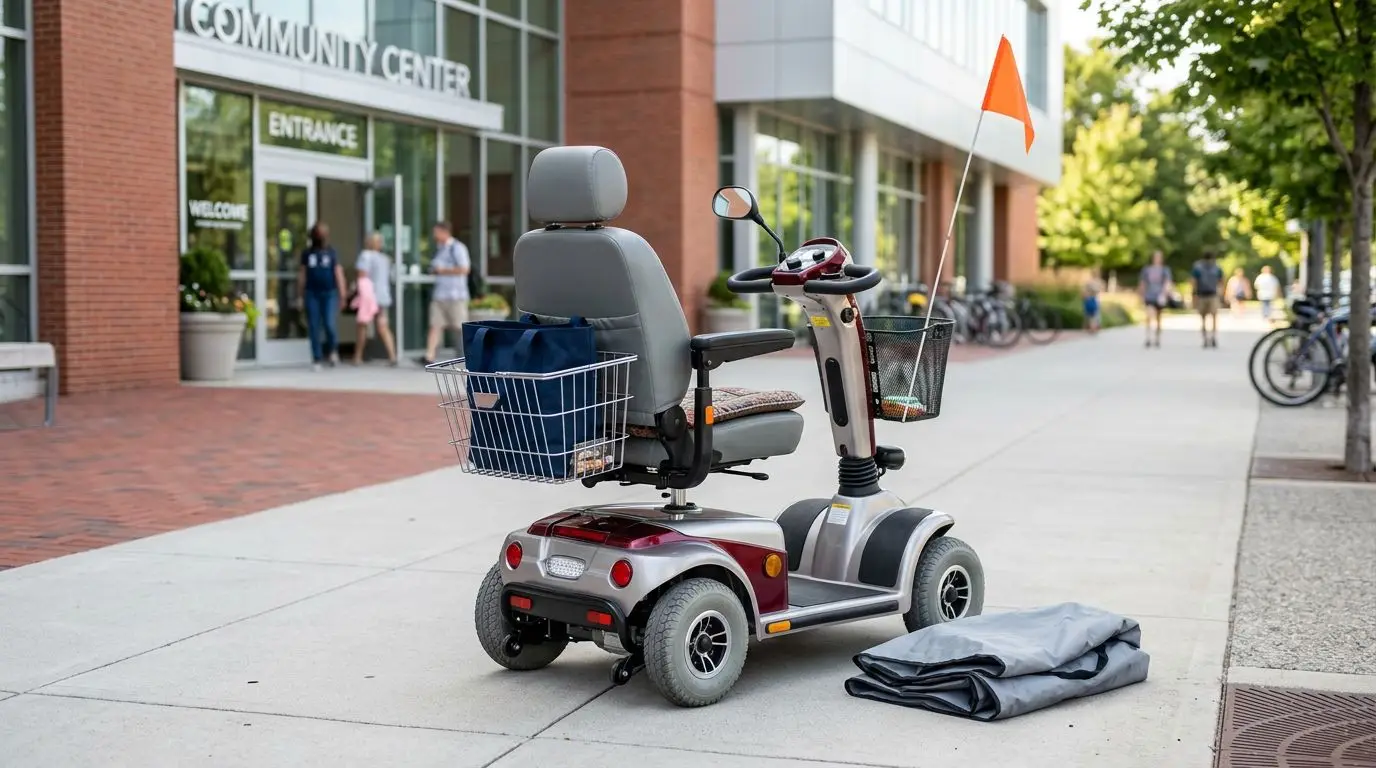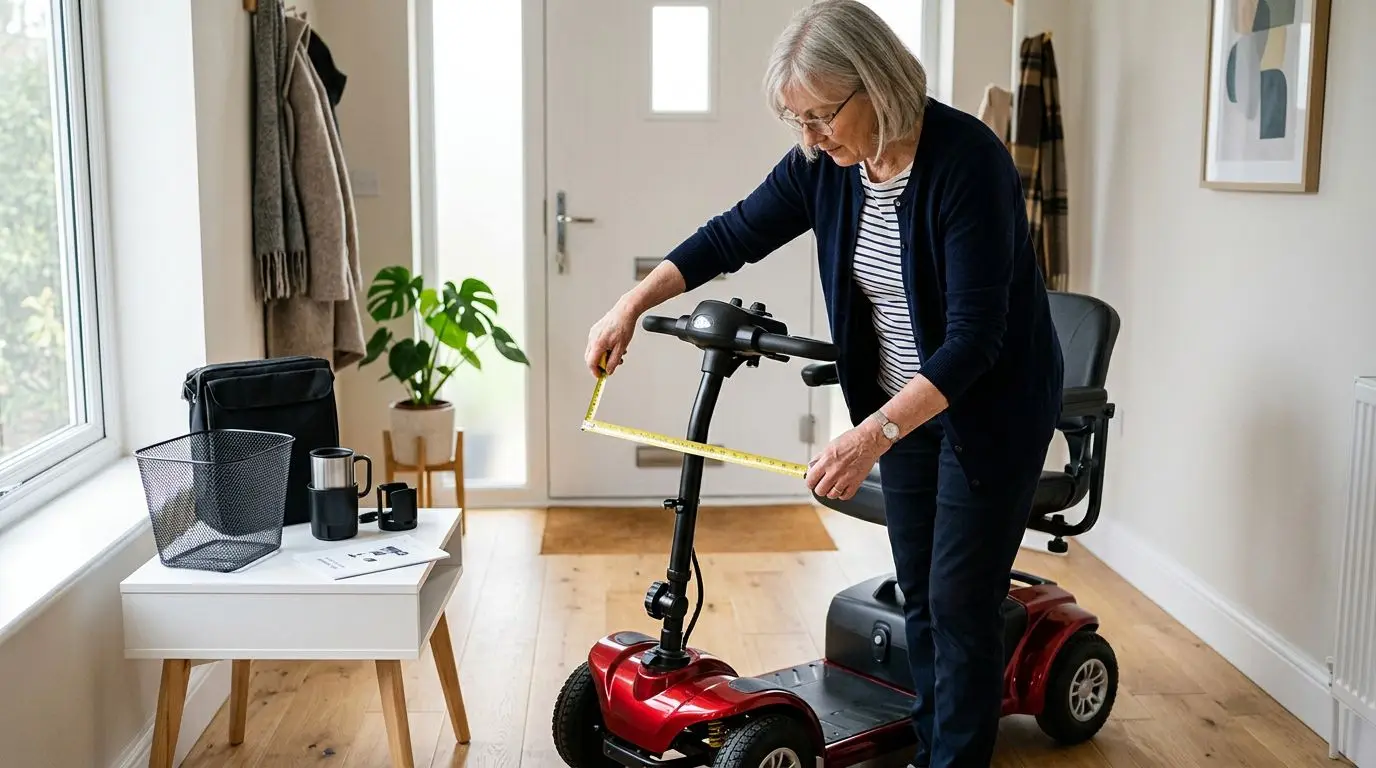
The best mobility scooter accessory is the one that fits your scooter securely, clears your controls, and stays within both the scooter and accessory weight limits. Before buying a universal or scooter-specific add-on, measure the mounting area, check the clamp or bracket range, confirm any seat-post or armrest dimensions, and read the return policy.
Universal accessories can work well when the mounting point is simple, such as a round handlebar-style tube or a standard armrest rail. Scooter-specific accessories are usually the safer choice when the part attaches to a shaped tiller, a rear receiver, the seat post, or any spot where 1 inch of difference can prevent a solid fit.
Universal vs. scooter-specific accessories: 2 fit paths
Most mobility scooter accessories fall into 2 broad fit categories: universal and scooter-specific. Universal accessories are designed to fit a range of scooters using adjustable clamps, straps, brackets, hook-and-loop panels, or expandable collars. Scooter-specific accessories are made for a defined frame style, seat post, tiller, or rear mounting point, even when the seller does not list a brand or model name.
Universal does not mean fits everything. It usually means the accessory fits within a stated range, such as round tubes from 0.75 to 1.25 inches in diameter, armrests up to 3 inches wide, or seat backs between 15 and 20 inches tall. If your scooter falls outside that range, the accessory may wobble, block a control, or fail to mount at all.
Scooter-specific does not always mean better, either. It can be more precise, but it may also be harder to return, less transferable to another scooter, and more dependent on correct measurements. The right choice depends on where the accessory mounts and how much weight it will carry.
| Accessory fit type | How it usually attaches | Best use | Main risk |
|---|---|---|---|
| Universal clamp-on | Adjustable clamp around a tube or tiller area | Mirrors, cup holders, phone holders, small bags | Clamp range may not match the tube size or shape |
| Universal strap-on | Hook-and-loop straps, buckles, or elastic | Seat-back bags, armrest pouches, weather covers | Can slip if straps are too short or the surface is tapered |
| Universal rear accessory | Bracket, receiver, or seat-post connection | Rear baskets, cane holders, small carriers | Weight and balance issues are more likely |
| Scooter-specific | Bracket matched to a frame, post, or mounting plate | Heavier storage, rear racks, certain holders | Incorrect scooter measurements may make it unusable |
Measure 5 points before adding a basket, holder, or mirror
A tape measure and 10 minutes can prevent most accessory mistakes. Before you compare online listings or local store options, write down 5 measurements: tube diameter, tiller width or shape, seat-post size, armrest width, and available clearance around the mounting area. If possible, take 3 photos: front tiller, side seat area, and rear of the scooter.
Tube diameter matters because many clamps close only within a narrow range. Measure straight across the tube, not around it. If you only have a soft tape, measure the circumference and divide by 3.14 to estimate diameter. For example, a tube with a 3.14-inch circumference is about 1 inch in diameter.
Tiller width and shape matter because many scooter tillers are not round. Some are oval, squared-off, angled, or covered by a plastic shroud. A clamp designed for a round bicycle-style tube may not tighten properly on a wide plastic tiller. Even if it grips, it may crush softer plastic or rotate when the scooter vibrates.
Seat-post size is critical for rear baskets, cane holders, oxygen-cylinder carriers, and some umbrella holders. Many seat posts are round, but the diameter, exposed length, and release-handle position can vary. Measure the visible straight section of the post. If there is less than 2 inches of clear vertical space, many clamp-style seat-post accessories will not sit securely.
Armrest width matters for pouches, trays, cup holders, and side bags. Measure the widest point of the armrest pad and the rail beneath it, if the accessory attaches below the pad. A 2.5-inch-wide armrest may fit a strap-on pouch, while a rigid clamp designed for a 1-inch rail may not.
- Measure diameter across the tube, not around it.
- Check for at least 0.5 inch of clearance from throttle levers, keys, charging ports, and folding joints.
- Turn the tiller fully left and right after a test fit.
- Confirm the accessory does not interfere with seat swivel, armrest lift, or battery removal.
- Keep the seller’s size chart open while you measure.
Clamp size and tiller shape: why 1 inch is not always 1 inch
Clamp size is one of the most common reasons a universal mobility scooter accessory does not fit. A listing may say it fits 1-inch tubing, but your scooter might have a 1-inch metal tube only in one small area, while the rest of the tiller is a molded housing closer to 2 or 3 inches wide. The accessory may be technically correct and still not fit your scooter.
Round clamps need even contact. If a clamp touches only 2 edges of an oval or squared surface, it can slide or twist. Rubber shims can help when the fit is slightly loose, such as a 1-inch clamp on a 0.875-inch round tube, but shims are not a good fix for a clamp that is too small, off-center, or pressing against a control cable.
Tiller angle matters, too. A cup holder on a nearly vertical tube may sit level, while the same holder on a 35-degree angled tiller may tip forward. Phone mounts and mirrors can often be adjusted, but baskets and drink holders usually need a more level base. Check whether the accessory has a rotating joint or only one fixed clamp position.
For mirrors and phone holders, vibration is another concern. Scooters may travel over sidewalk seams, curb cuts, thresholds, and rough asphalt. A long accessory arm can shake more than a short one. If the item uses a clamp and an adjustable arm, shorter is usually steadier.
| Tiller or tube shape | Accessory fit outlook | What to check |
|---|---|---|
| Round tube, 0.75 to 1.25 inches | Often compatible with universal clamps | Exact diameter and room to tighten the clamp |
| Oval tube | Possible, but less predictable | Clamp contact area and anti-slip padding |
| Wide plastic tiller shroud | Often poor for round clamps | Flat mounting area, strap length, control clearance |
| Angled tiller | Depends on accessory adjustment | Whether the holder can be leveled after mounting |
Seat post, armrest, and rear-hitch fit: check inches and pounds
Accessories mounted behind the seat need closer review because they can affect balance and turning space. A rear basket, cane holder, walker carrier, or oxygen-cylinder holder may attach to the seat post, the seat frame, a rear receiver, or a bracket behind the scooter. Each mounting style has its own measurements.
For a seat-post mount, measure the diameter of the post and the clear height available for the clamp. A clamp that needs 2.5 inches of straight post will not work if a seat-swivel lever, height pin, or plastic trim leaves only 1.5 inches exposed. Also check whether the seat rotates. Some rear accessories can block the seat from swiveling fully, which may make transfers harder.
Armrest accessories look simple, but they can still be tricky. Some armrests flip up, angle outward, or have a tapered pad. A tray, bag, or cup holder that straps to the armrest should allow the armrest to lift if you rely on that motion for entry or exit. Test with the accessory loaded, not empty.
Rear-hitch or receiver-style accessories require the most caution. Not every scooter has a receiver, and receiver dimensions are not universal across all scooters. Even a small mismatch can create wobble. If a listing mentions a square receiver size, measure inside width and height carefully. Do not assume a rear bracket from one scooter will slide into another.
- Measure the seat post diameter to the nearest 1/8 inch.
- Check for at least 2 inches of straight, unobstructed mounting space when possible.
- Measure rear clearance with the scooter parked near a wall to see how much length the accessory adds.
- Confirm the accessory does not block the charging port, manual freewheel lever, lights, reflectors, or battery access.
- Look for a stated load limit, such as 5, 10, or 15 pounds, and stay under it.
Weight limits and balance: add-ons can shift 10 pounds fast
Every accessory adds weight, and stored items add more. A rear basket that weighs a few pounds can easily hold 10 pounds of groceries, a lock, water, and personal items. That extra weight sits behind the seat, where it may change how the scooter feels on slopes, ramps, thresholds, and tight turns.
Check 3 limits: the accessory’s load limit, the scooter’s total user-and-cargo capacity, and any specific limit for the mounting point. If your scooter’s overall capacity is 300 pounds and the rider plus daily items already total 285 pounds, a 20-pound loaded rear basket would exceed that total even if the basket itself is rated for 25 pounds.
Front baskets need the same common-sense review. A front basket that blocks the headlight or makes the tiller harder to turn is not a good fit, even if it attaches securely. Heavy items in front can also affect steering feel. Keep dense items low and centered whenever possible.
Do not use accessories as grab bars unless they are specifically designed for that purpose. A basket, cup holder, or cane holder may feel sturdy while parked, but it may not be engineered to support body weight during transfers. When in doubt, use the scooter’s intended armrests, transfer points, or a separate assistive device recommended by a qualified professional.
| Loaded item | Typical added weight example | Fit concern |
|---|---|---|
| Water bottle and cup holder | 1 to 3 pounds | Clamp security and spill angle |
| Phone holder and phone | 0.5 to 1 pound | Vibration, control clearance |
| Small front basket contents | 5 to 10 pounds | Steering feel, headlight blockage |
| Rear basket contents | 10 to 20 pounds | Rear balance, turning clearance |
| Cane or crutch holder | 1 to 5 pounds | Side clearance, secure retention |
How to choose by accessory type: 8 common add-ons
Different accessories carry different fit risks. A soft seat-back bag may fit many scooters with only strap-length checks, while a rear carrier needs careful review of bracket dimensions and weight. Match your buying process to the accessory, not just the price or appearance.
| Accessory type | Best fit checks | Universal or scooter-specific? |
|---|---|---|
| Cup holder | Clamp range, angle adjustment, clearance from throttle | Universal often works if the clamp matches |
| Phone holder | Clamp diameter, vibration control, screen visibility | Universal often works on round tubes |
| Mirror | Tube size, arm length, left or right mounting | Universal can work, but tiller shape matters |
| Seat-back bag | Seat-back height, strap length, armrest movement | Universal often works |
| Front basket | Bracket style, tiller clearance, light visibility | Scooter-specific is often more reliable |
| Rear basket | Receiver or seat-post size, load rating, rear clearance | Scooter-specific or carefully measured universal |
| Cane or crutch holder | Seat-post fit, strap retention, side clearance | Either, depending on mount location |
| Weather cover | Scooter length, width, tiller height, wheelbase | Universal by size range is common |
For weather covers, measure the scooter’s full length and width, including baskets or rear accessories that stay attached while stored. If a scooter is 45 inches long with no basket but 52 inches long with a rear basket, buy based on the longer measurement if the basket stays on. A cover that is too tight can tear at mirrors, armrests, or tiller edges.
For cane and crutch holders, focus on retention. A holder should keep the mobility aid from bouncing out during a curb cut or driveway slope. Check whether the accessory supports the lower tip and secures the upper section. If it only holds the cane at one point, it may swing into your leg area or extend beyond the scooter’s side profile.
Return-policy checks to do within 30 days
Fit uncertainty is normal, especially when shopping online. A reasonable return policy is part of the purchase decision, not an afterthought. Before you buy, check the return window, who pays return shipping, whether opened items are accepted, and whether installed items can still be returned if they are clean and undamaged.
A 30-day window is common in many retail categories, but policies vary. Some sellers count from the order date, while others count from delivery. If the accessory is bulky, return shipping may cost enough to change the value of the purchase. Read the policy before cutting packaging or tightening bolts.
When the accessory arrives, test fit it before loading it with personal items. Keep all packing materials until you are sure. Use hand pressure first, then tighten according to the instructions. If the clamp requires tools, avoid over-tightening. A cracked plastic tiller shroud or stripped screw can turn a returnable item into a non-returnable problem.
- Confirm the return window in days before ordering.
- Save the packaging for at least 1 week after installation.
- Take photos of the mounting area before and after test fitting.
- Do not modify brackets, drill holes, trim straps, or add permanent adhesive until you are certain.
- Test in a safe flat area at low speed before using the accessory in public spaces.
Who universal accessories fit best—and who should avoid them
Universal accessories are best for scooter owners who have simple round mounting points, want light-duty add-ons, and can measure carefully before buying. If your scooter has a round tiller tube in the 0.75-to-1.25-inch range, a straight armrest rail, or a standard seat-back shape, many universal holders and bags may be worth considering.
They are also useful if you expect to change scooters later. A strap-on seat bag or adjustable cup holder may transfer more easily than a bracket built for one frame style. For renters, travelers, or people using more than 1 scooter in different settings, this flexibility can be practical.
Scooter-specific or measurement-specific accessories are better when the accessory carries heavier weight, mounts behind the seat, connects to a receiver, or sits near important controls. If you need a rear basket, walker carrier, oxygen-cylinder holder, or front basket with a hard bracket, do not rely on the word universal by itself. Verify the actual dimensions.
People with limited hand strength or vision should also think about installation. Tiny screws, hard-to-see brackets, or clamps that require precise alignment can be frustrating. A local mobility shop, repair technician, occupational therapist, or knowledgeable caregiver may be able to help check fit and safe placement. That support can be especially helpful when the accessory affects transfers or daily mobility routines.
- Best for universal: light items, simple clamps, soft bags, basic holders.
- Best for scooter-specific: rear loads, hard brackets, shaped tillers, receiver mounts.
- Use extra caution when any accessory sits within 2 inches of a throttle, brake, key, charging port, or release lever.
FAQ: 5 fit questions scooter owners ask
Are universal mobility scooter accessories truly universal?
No. Universal usually means adjustable within a stated size range, such as a clamp that fits tubes from 0.75 to 1.25 inches. Always compare that range with your scooter’s actual measurements.
Can I use rubber shims to make a loose clamp fit?
Sometimes. Thin rubber shims can improve grip when the clamp is only slightly loose on a round tube, but they should not be used to force a clamp onto the wrong shape or to support heavy accessories.
How do I know if a rear basket is too heavy?
Check the basket’s load rating, the scooter’s total weight capacity, and how the scooter handles when loaded. If steering, braking, turning, or ramp stability feels different, reduce the load or remove the accessory.
Will an accessory void my scooter warranty?
It depends on the warranty terms and how the accessory is installed. Non-permanent clamp or strap accessories are usually less concerning than drilled, modified, or hard-mounted parts, but you should read your scooter paperwork first.
What should I do if I cannot find my scooter’s measurements?
Measure the scooter directly with a tape measure or caliper, take photos of the mounting points, and ask the seller for the exact bracket or clamp range in inches before buying.
Frequently asked questions
Are universal mobility scooter accessories truly universal? +
No. Universal usually means adjustable within a stated size range, such as a clamp that fits tubes from 0.75 to 1.25 inches. Measure your scooter before buying.
What measurements should I take before buying an accessory? +
Measure the tube or tiller diameter, tiller shape and width, seat-post diameter, armrest width, and clearance around controls, ports, levers, and the seat swivel.
Is a scooter-specific accessory always better than a universal one? +
Not always. Universal accessories can work well for light holders and soft bags, while scooter-specific or measurement-specific options are often better for rear baskets, hard brackets, and heavier loads.
How much weight can I put in a scooter basket? +
Use the basket’s stated load limit and stay within the scooter’s total user-and-cargo capacity. Also watch how the added weight affects steering, turning, and stability.
What return-policy details matter most for scooter accessories? +
Check the return window, whether opened or test-fitted items are accepted, who pays return shipping, and whether modifications such as drilling or trimming straps make the item non-returnable.
Related guides

Where to Buy Mobility Scooter Accessories: Local Stores vs Online
14 min read
Mobility Scooter Cup Holders, Trays, and Phone Mounts: Safe Convenience Add-Ons
15 min read
Best Mobility Scooter Accessories for Safety, Storage, and Everyday Comfort
13 min read