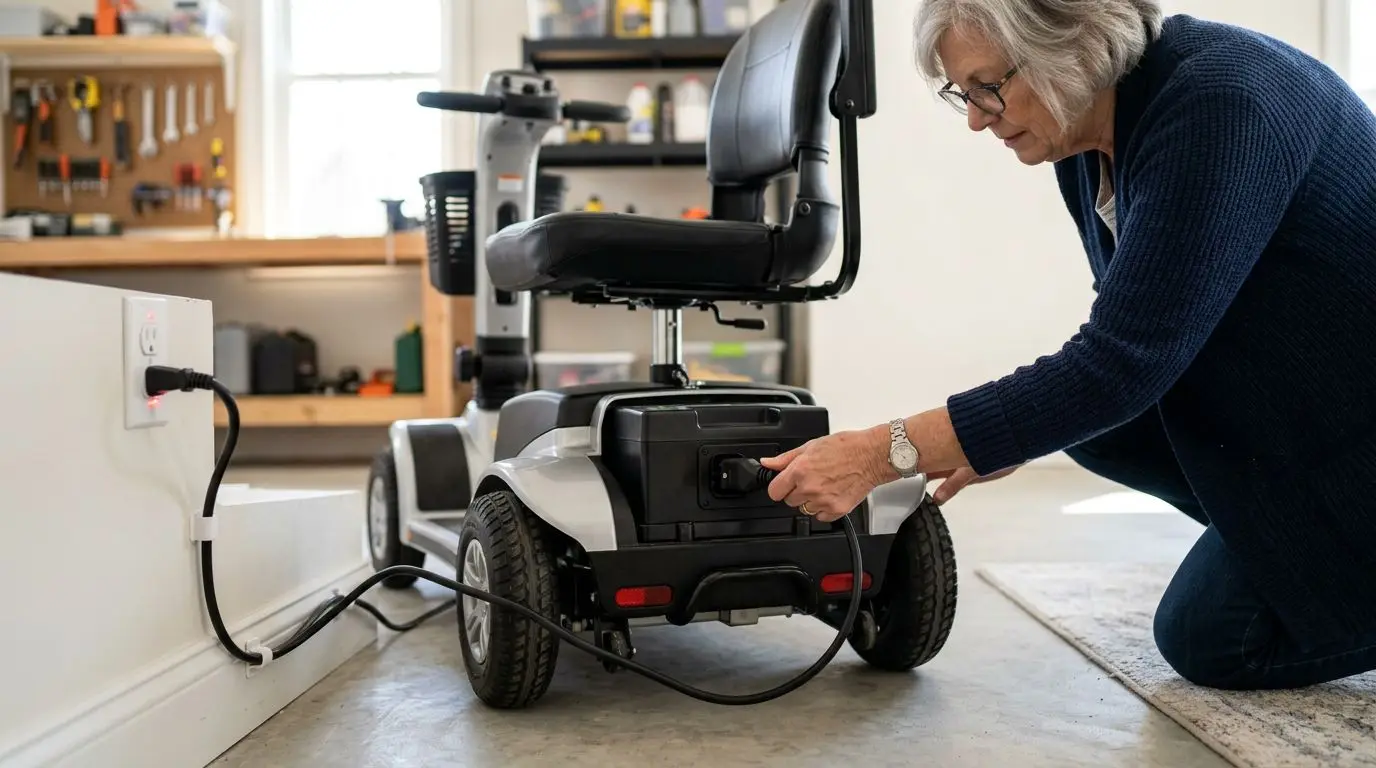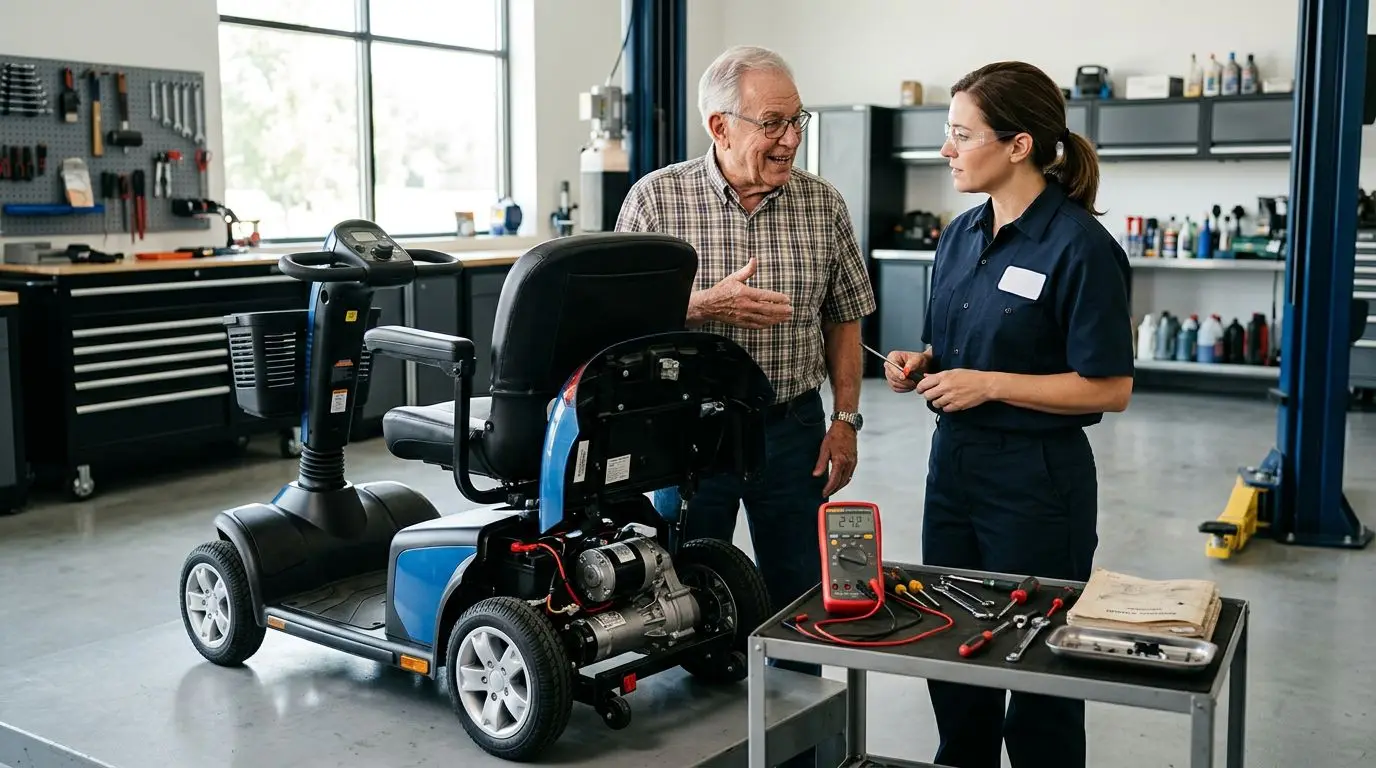
Yes, you can sometimes upgrade a mobility scooter motor, but it is rarely as simple as swapping one motor for another. The motor has to match the scooter’s controller, battery voltage, wiring, brakes, frame, gearing, and wheel setup. If it does not, the upgrade can damage components or make the scooter unsafe. In many cases, replacing worn parts or choosing a scooter built for higher torque or range is a better choice than forcing more power into an older frame.
The most realistic “upgrade” is often a like-for-like motor replacement, a better-condition transaxle, fresh batteries, or a controller repair—not converting a compact 4 mph scooter into a fast road vehicle. If you want more hill-climbing power, longer range, or steadier performance under load, the right solution depends on what is limiting the scooter now.
What a motor upgrade can realistically change on a 24V to 48V scooter
Most mobility scooters use electric motors built around a specific voltage system. Many travel and mid-size scooters commonly use 24V, while some larger units use higher-voltage systems such as 36V or 48V. The motor does not work by itself. It is part of a power chain that includes batteries, the controller, throttle, brake switch, wiring harness, fuses, thermal protection, gear reduction, and the drive wheels.
A motor upgrade may affect 3 things: top speed, torque, and heat management. Top speed is how fast the scooter travels on level ground. Torque is the turning force that helps the scooter start from a stop, carry rider weight, and climb inclines. Heat management determines whether the system can keep doing that work for more than a few minutes without shutting down or wearing out early.
Here is the catch: a higher-watt motor does not automatically make a scooter faster. If the controller limits output to 45 amps, for example, a motor that could accept more current still will not deliver its full potential. If the battery voltage and gearing stay the same, the speed gain may be small or nonexistent. If the controller is changed too, the batteries and wiring may become the weak link.
There is also a practical safety limit. Mobility scooters are designed for pedestrian environments, tight turns, ramps, elevators, sidewalks, and indoor spaces. A compact scooter with a short wheelbase and small 8-inch wheels may become unstable at speeds it was never designed to handle, even if a more powerful motor can physically move it faster.
Speed versus torque: why 5 mph more is not the same as better hill climbing
Speed and torque are related, but they are not the same goal. A scooter geared for higher top speed may feel weaker when starting on a ramp. A scooter geared for stronger torque may climb better while still having a modest top speed. That is why a motor upgrade should begin with the problem you want to solve.
If the scooter slows badly on a 6-degree ramp, the cause might be battery sag, controller limits, motor wear, rider-plus-cargo weight, tire pressure, or a grade beyond the scooter’s design. If it feels fine on flat ground but struggles during long climbs, heat may be building in the motor or controller. Sending more current through undersized wiring can make that problem worse.
| Upgrade goal | What people expect | What often limits it | Safer first check |
|---|---|---|---|
| Higher top speed | More mph on flat ground | Controller speed limit, gearing, wheel size, brake design | Confirm rated speed and tire size |
| More hill torque | Less slowing on ramps | Battery voltage sag, amp limit, motor heat, total weight | Load test batteries and inspect connectors |
| Better acceleration | Quicker starts from 0 mph | Controller programming, current limit, traction | Check throttle response and brake switch |
| Longer range | More miles per charge | Battery capacity, terrain, tire pressure, rider weight | Test battery capacity, not just voltage |
For many riders, torque matters more than speed. A scooter that starts smoothly, stays controlled on a curb-cut ramp, and does not overheat after 10 minutes of use is usually more useful than one that is faster but twitchy. Higher speed also increases stopping distance, especially on wet pavement or downhill surfaces.
Controller compatibility: amps, volts, and connectors must match within 1 system
The controller is the scooter’s power manager. It reads the throttle signal, checks safety interlocks, and sends power to the motor. It may also manage regenerative braking, speed settings, reverse speed, brake cutoffs, diagnostic codes, and current limits.
Compatibility is the most common reason motor upgrades fail. A 24V controller is not meant for a 36V or 48V battery pack. A brushed motor controller will not run a brushless motor unless it is specifically designed for that motor type. A controller built for one throttle signal range may not read another throttle correctly. Even connectors that look alike can have different pin positions.
Current matters too. If a controller is rated for 50 amps peak, that does not mean the scooter can safely pull 50 amps continuously through every wire, connector, fuse, and battery terminal. Peak ratings are for short bursts. Long hills, soft ground, and heavy loads can turn a short burst into sustained heat.
| Component | Must match | Common mismatch risk |
|---|---|---|
| Motor | Voltage, brushed/brushless type, mounting, shaft or transaxle style | Will not run, runs rough, overheats |
| Controller | Voltage, amp rating, throttle input, brake wiring, diagnostics | Loss of safety interlocks or sudden behavior |
| Battery pack | System voltage and discharge capability | Voltage sag, blown fuses, battery damage |
| Wiring harness | Connector pinout and wire gauge | Melted connectors, intermittent power loss |
| Brakes | Stopping ability at intended speed and weight | Longer stopping distance or rollback |
A technician will usually test the complete circuit before approving a change. That includes static voltage, loaded voltage, throttle output, brake switch function, motor resistance, controller fault history if available, and a road test under controlled conditions.
Motor types: hub motors, transaxles, brushed motors, and brushless motors over 250W
Mobility scooters generally use either a motor connected to a transaxle or a hub-style motor integrated near the wheel. Many traditional scooters use brushed DC motors because they are simple and provide strong low-speed control. Brushless systems can be efficient and durable, but they need compatible electronic control and sensor wiring.
The motor’s wattage rating gives a rough sense of output, but it is not the whole story. A 500W motor with proper gearing may climb better than a higher-watt motor installed poorly. Motor housing size, cooling, gear ratio, controller settings, and wheel diameter all change real-world performance.
| Motor or drive type | Typical use | Upgrade difficulty | Key concern |
|---|---|---|---|
| Brushed DC with transaxle | Common on many 3-wheel and 4-wheel scooters | Moderate if replacing like-for-like | Brush wear, gear ratio, mounting pattern |
| Brushless drive system | Some newer or higher-efficiency designs | High unless complete system is matched | Controller sensors and wiring compatibility |
| Hub-style motor | Wheel-integrated drive layouts | High | Wheel fit, brake fit, controller matching |
| Integrated motor/transaxle | Rear drive assemblies | Moderate to high | Axle width, frame mounts, brake location |
Mounting is often the deal-breaker. A motor that looks close in size may have a different bolt pattern, shaft length, axle position, brake mount, or gearbox orientation. Even a difference of 1 inch can interfere with the frame, suspension, shroud, or rear wheels. If the motor cannot sit squarely and securely, it is not a safe upgrade.
Battery limits: why a stronger motor can drain 2 batteries much faster
Many scooters use 2 batteries wired in series to create a 24V system. Larger scooters may use different battery arrangements, but the principle is the same: the battery must supply the voltage and current demanded by the controller and motor. When a stronger motor asks for more current, range can drop quickly.
Battery capacity is commonly described in amp-hours, such as 12Ah, 35Ah, or 55Ah. Those numbers do not guarantee a specific range because rider weight, hills, stops, tire pressure, temperature, and speed setting all matter. Higher current draw also reduces effective battery capacity, especially on older lead-acid batteries.
Old batteries can feel like a weak motor. A scooter may start normally, then slow under load because the pack voltage sags when current demand rises. A simple no-load voltage reading after charging is not enough. A proper load test shows whether the batteries can hold voltage while doing work.
Changing battery chemistry, capacity, or voltage should be treated as a system-level modification. Chargers, battery management, fuse protection, compartment size, tie-downs, and ventilation all matter. Batteries must be secured so they cannot shift during a turn or hard stop.
Safety risks: braking, steering, heat, and warranty issues at 8 mph and beyond
Increasing speed or torque can expose weaknesses in parts that were adequate at the original rating. Brakes are the first concern. A scooter designed around a lower top speed may not stop confidently if speed is increased. Downhill stopping is especially demanding because gravity adds load while the motor and brakes are already working.
Steering is another limit. Short scooters and 3-wheel designs can be easy to maneuver indoors, but that tight turning ability may feel less stable at higher speeds. Small wheels can also react harshly to sidewalk cracks, gravel, wet leaves, and driveway lips. At 8 mph, a small bump arrives much faster than it does at 4 mph.
Heat is less visible but just as important. Overheated controllers can shut down. Connectors can discolor or melt. Motors can lose efficiency or suffer internal damage if repeatedly pushed beyond their intended duty cycle. A scooter that smells hot after a hill climb is giving you useful information: stop and investigate before riding again.
- Do not bypass brake switches, fuses, thermal protection, or speed limiters.
- Do not test a modified scooter in traffic, crowded sidewalks, or tight indoor spaces.
- Do not assume larger wires or fuses solve an overload problem; they may only hide it.
- Do not exceed the scooter’s rated weight capacity to “test torque.”
- Do not modify safety-critical controls unless a qualified technician confirms proper operation.
Legal rules also vary by location. Some areas treat mobility scooters as pedestrian mobility devices only when used at pedestrian-like speeds and in appropriate spaces. If a modification makes the scooter behave more like a small motor vehicle, you may face sidewalk, road-use, insurance, or liability issues. Check local rules before changing performance.
Who a motor upgrade is best for after 3 diagnostic checks
A motor upgrade is best for a narrow group of owners: people with a mechanically sound scooter, a clear performance problem, access to compatible parts, and a qualified technician who can test the whole system. It is not ideal for someone hoping for a cheap way to make an older scooter much faster.
Before considering an upgrade, do these 3 checks. First, test the batteries under load. Second, inspect the wiring, connectors, brake switch, tires, and bearings. Third, compare the rider’s real use—weight, hills, surfaces, and distance—with the scooter’s original design limits. If the scooter is being asked to do work it was never built for, a motor upgrade may only move the failure to another component.
| User situation | Motor upgrade fit | Better option to consider |
|---|---|---|
| Scooter runs poorly after years of use | Usually low until diagnosis | Batteries, brushes, bearings, controller repair |
| Needs more power on mild ramps | Possible if system supports it | Torque-oriented scooter type or service check |
| Wants much higher speed | Poor fit | Choose equipment designed and rated for that use |
| Uses steep driveways daily | Risky without full evaluation | Higher-capacity scooter with proper brakes and tires |
| Has a damaged motor only | Good for like-for-like replacement | Original-spec motor or complete matching assembly |
If independence is the goal, reliability often matters more than raw power. A scooter that predictably finishes a grocery trip, handles a ramp smoothly, and charges correctly every night is more valuable than a modified scooter that needs constant troubleshooting.
How to choose and measure before ordering a motor within 1 inch tolerance
If you are replacing a motor, collect measurements before ordering anything. Do not rely on photos alone. Measure the overall motor length, diameter, mounting hole spacing, shaft length, shaft diameter, keyway or spline style, connector type, wire count, brake location, and clearance to the frame or shroud. Record measurements in inches and take photos from several angles.
Also document the electrical details. Note the system voltage, motor label information if present, controller label information, battery configuration, fuse rating, and connector pin positions. If the motor is part of a transaxle, measure axle width, wheel mounting style, brake mounting position, and the distance from the mounting bracket to the wheel centerline.
- Measure mounting holes center-to-center, not edge-to-edge.
- Check shaft diameter with calipers if possible; small differences matter.
- Count motor wires and note wire colors, but do not assume colors mean the same function.
- Photograph every connector before unplugging it.
- Confirm whether the brake is mechanical, electromagnetic, or integrated into the drive unit.
- Leave clearance for suspension travel, tire movement, and body panels.
If any key measurement is uncertain, pause. Guessing on a drive-system part can turn a repair into a safety problem. A technician may be able to identify whether the motor is replaceable as a separate part or only as part of a matched drive assembly.
When replacement is smarter than upgrading a 5-year-old scooter
Replacement becomes smarter when the scooter needs several major parts at once: motor, controller, batteries, brakes, tires, and wiring. On an older scooter, those repairs can stack up quickly, and the finished result may still have the same frame, suspension, steering geometry, and weight rating as before.
Age is not the only factor. Storage conditions matter. A scooter kept in a damp garage for 5 years may have corrosion in connectors and brake parts even if the mileage is low. A scooter used daily outdoors may have worn tires, tired batteries, and loose bearings. If you need stronger hill performance, outdoor stability, or longer range, buying a scooter designed around those needs is usually safer than pushing an undersized platform.
Think in terms of total system fit. A scooter built for heavier outdoor use may include larger wheels, a wider stance, stronger brakes, a higher-capacity battery system, and a controller matched to the motor from the start. Those features work together. They are difficult to recreate safely by changing one part.
Questions to ask a technician before changing 1 drive component
A good repair technician should be comfortable explaining limits, not just installing parts. Ask whether the proposed motor is an original-spec replacement, a compatible higher-output part, or an unverified modification. Ask what tests will be performed before and after installation.
- Is the controller rated for this motor’s voltage and current draw?
- Will the existing batteries support the load without excessive voltage sag?
- Are the brakes rated for the expected speed and total weight?
- Will any safety interlocks be changed or bypassed?
- Can the wiring harness and connectors handle sustained current?
- How will overheating be checked after a hill or ramp test?
- Could this affect warranty, serviceability, insurance, or local-use rules?
If the answer to several of these questions is “we will find out after it is installed,” be cautious. Testing after installation is important, but compatibility should not be guesswork.
FAQ: 5 common mobility scooter motor upgrade questions
Can I put a bigger motor in my mobility scooter?
Sometimes, but only if the motor physically fits and the controller, batteries, wiring, brakes, and frame can support it. A bigger motor alone may not improve performance if the controller limits current or the gearing is unchanged.
Will a new motor make my scooter faster?
Not always. Top speed depends on voltage, controller settings, gearing, wheel size, and safety limits. A like-for-like motor replacement may restore lost performance, but it usually will not raise the original rated speed.
Is it safe to change from 24V to 36V or 48V?
That is a major system conversion, not a simple upgrade. It may require a matched controller, motor, charger, batteries, wiring, fuses, and braking review. It should not be done by guessing or mixing parts.
Why does my scooter slow down on hills if the motor still runs?
Common causes include weak batteries, voltage sag under load, controller current limits, low tire pressure, worn motor brushes, bearing drag, excessive total weight, or a slope beyond the scooter’s rating.
Should I upgrade the motor or buy a different scooter?
If you only need to replace a failed motor with the same specification, repair can make sense. If you need more speed, more climbing ability, better outdoor stability, or longer range, a scooter designed for those needs is usually the safer choice.
Frequently asked questions
Can I put a bigger motor in my mobility scooter? +
Sometimes, but only if the motor physically fits and the controller, batteries, wiring, brakes, and frame can support it. A bigger motor alone may not improve performance if other parts limit output.
Will upgrading the motor make my mobility scooter faster? +
Not necessarily. Speed depends on voltage, controller programming, gearing, wheel size, and safety limits. A replacement motor often restores lost performance rather than increasing top speed.
Can I convert a 24V scooter to 36V or 48V? +
That is a major system conversion. It may require a matched motor, controller, charger, batteries, wiring, fuses, and brake review, and it should be evaluated by a qualified technician.
Why does my scooter lose power on hills? +
Common causes include weak batteries, voltage sag, controller current limits, low tire pressure, worn brushes, bearing drag, excess load, or a slope beyond the scooter’s intended rating.
When is replacing the scooter smarter than upgrading the motor? +
Replacement is often smarter when you need more speed, stronger hill performance, better outdoor stability, or longer range than the original scooter was designed to provide.
Related guides
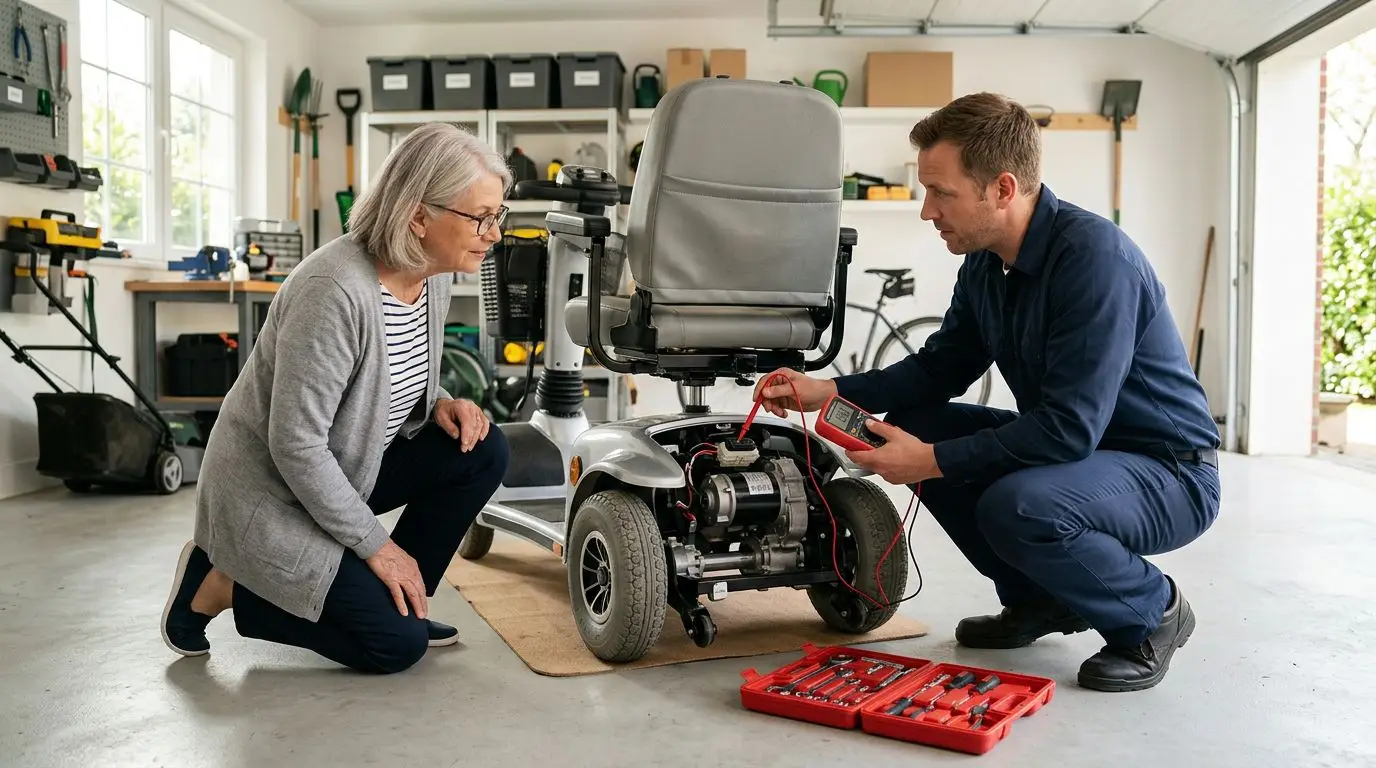
Mobility Scooter Motor Problems: Warning Signs, Common Causes, and Repair vs. Replacement Decisions
17 min read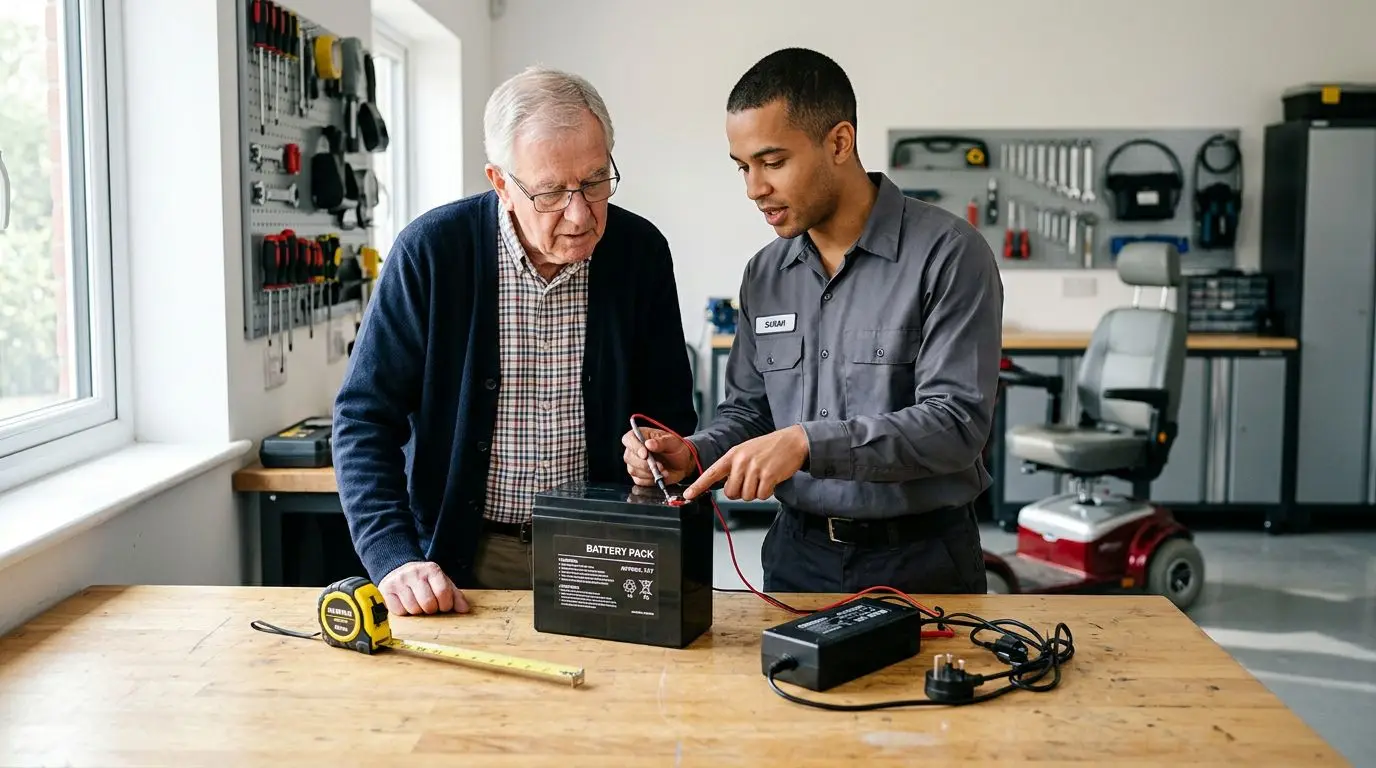
Can You Upgrade a Mobility Scooter Battery for More Range? Compatibility, Cost, and Safety Limits
14 min read
Mobility Scooter Batteries Explained: Types, Voltage, Amp-Hours, and Compatibility
15 min read