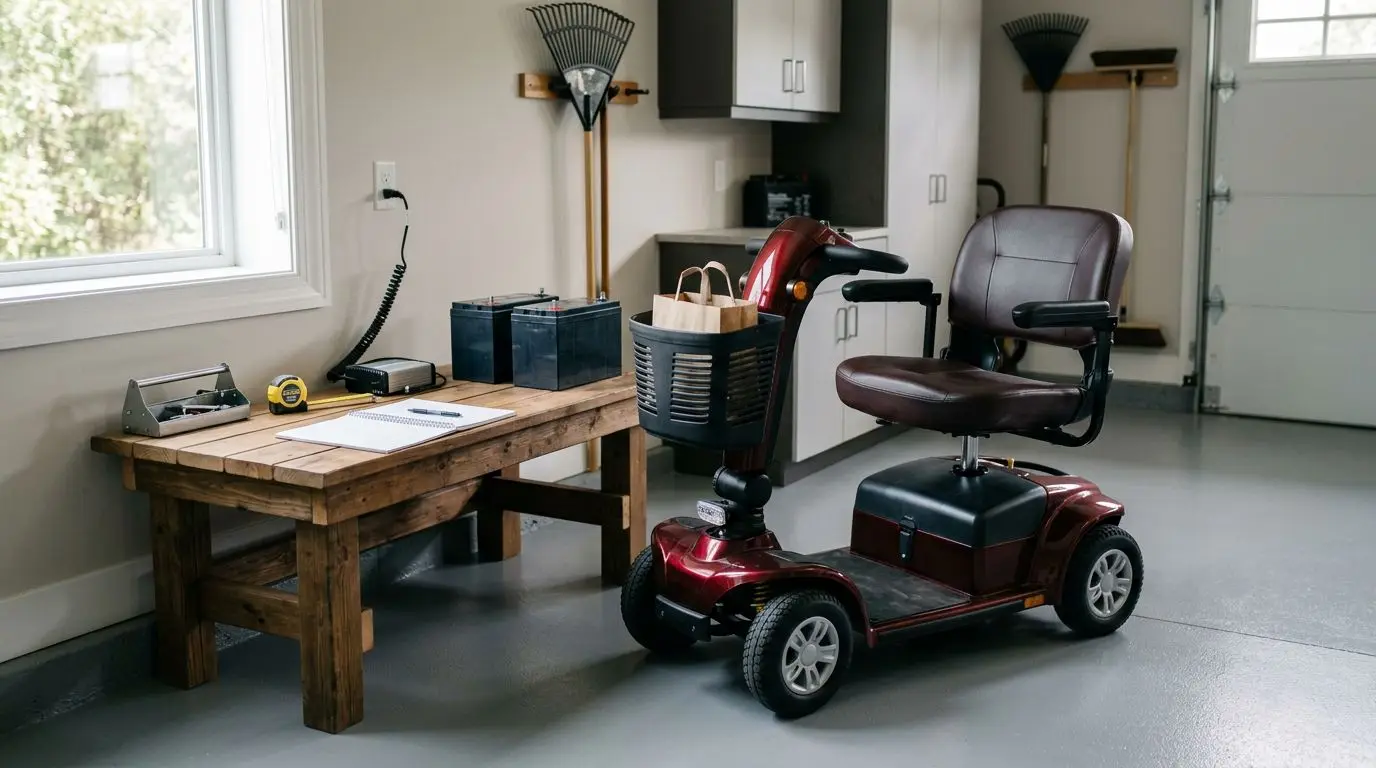
The right replacement battery for a mobility scooter must match the scooter’s required voltage, physical battery space, terminal style, charger compatibility, and safe amp-hour range. Most scooters use two 12-volt batteries wired together for a 24-volt system, while some use 36V or 48V packs. Before buying, verify the label, manual, or existing battery setup. Amp-hours affect expected range, but a battery with the wrong size, chemistry, or connection can lead to poor performance, charging problems, or unsafe operation.
Battery shopping can get confusing because the numbers look simple but work together. A 12V 35Ah battery is not the same as a 24V 35Ah battery system, and a lithium battery is not automatically a drop-in replacement for sealed lead-acid. This guide explains the terms in plain English so you can check compatibility before you spend money.
Start With the 5 Specs That Must Match
Before comparing battery types, write down 5 details from your current setup: voltage, amp-hours, chemistry, dimensions, and terminal style. A common small scooter battery may be about 7.7 inches long, 5.2 inches wide, and 6.6 inches tall. Larger batteries can be several inches bigger and much heavier. Even with the correct voltage, a battery may be unusable if it does not fit in the tray or if the terminals face the wrong way.
Look for labels on each battery and on the battery box. You may see markings such as 12V, 18Ah, 35Ah, AGM, gel, SLA, lithium-ion, or LiFePO4. Take a clear photo before removing anything. If the scooter has two batteries, photograph how the red and black wires connect, because many scooters use a series connection to create a higher total voltage.
| Spec to check | Why it matters | What to record |
|---|---|---|
| Voltage | The scooter controller is built for a specific system voltage. | 12V, 24V, 36V, or 48V system |
| Amp-hours | Helps estimate usable range and runtime. | Ah rating on each battery |
| Chemistry | Affects charger type, weight, lifespan, and safety requirements. | AGM, gel, SLA, lithium-ion, or LiFePO4 |
| Dimensions | The battery must fit the tray or removable case. | Length, width, height in inches |
| Terminals | Cables must attach securely without strain. | Spade, bolt, insert, or harness style |
If any one of these details is uncertain, slow down. A battery that is close is not always close enough.
Voltage Basics: 12V, 24V, 36V, and 48V Systems
Voltage is the electrical pressure the scooter is designed to use. Many mobility scooters run on a 24V system made from two 12V batteries connected in series. Some compact units use smaller 24V packs, while larger outdoor scooters may use 36V or 48V systems.
The most important rule is simple: match the scooter’s system voltage. Do not install a 12V battery where the scooter requires 24V, and do not connect extra batteries to increase speed or power. The motor controller, charger, wiring, and safety electronics are designed around a specific voltage. The wrong voltage can damage electronics and may create a fire or shock risk.
Series wiring adds voltage while the amp-hour rating stays the same. For example, two 12V 35Ah batteries wired in series create a 24V 35Ah system, not 24V 70Ah. Parallel wiring keeps voltage the same and increases amp-hours, but it is less common in standard scooter replacement battery boxes and should not be improvised unless the scooter was designed that way.
| Battery arrangement | Total voltage | Total amp-hours | Plain-English meaning |
|---|---|---|---|
| One 12V 18Ah battery | 12V | 18Ah | Used only in systems designed for 12V |
| Two 12V 35Ah batteries in series | 24V | 35Ah | Common scooter setup |
| Three 12V 22Ah batteries in series | 36V | 22Ah | Found on some higher-voltage designs |
| Four 12V 50Ah batteries in series | 48V | 50Ah | Used on some larger or heavier-duty systems |
If the label says the charger output is 24V, that is another clue the scooter uses a 24V battery system. Still, confirm with the manual or the existing battery wiring if possible.
Amp-Hours Explained: Why 18Ah, 35Ah, and 75Ah Affect Range
Amp-hours, often written as Ah, describe battery capacity. In simple terms, a higher Ah rating usually means more stored energy and longer possible riding time when voltage is the same. A 24V 35Ah system stores more energy than a 24V 18Ah system, but real-world range also depends on rider weight, hills, tire pressure, surface, speed, temperature, and battery age.
Do not treat amp-hours as guaranteed miles. A scooter may use far more energy climbing a 6-degree ramp than rolling across a flat indoor floor. Cold weather can also reduce usable capacity, especially with lead-acid batteries. Two people with identical batteries can see different results if one rides on smooth pavement and the other travels over grass, gravel, and curb cuts.
When replacing batteries, matching the original Ah rating is usually the safest path. A slightly higher Ah rating may be acceptable if the voltage, chemistry, dimensions, terminals, and charger requirements are correct, but bigger is not always better. Larger-capacity batteries may not fit, may exceed the battery box weight limit, or may need charging characteristics the original charger cannot provide.
- Lower Ah than original: may fit, but range will likely drop and voltage may sag sooner under load.
- Same Ah as original: usually the least complicated replacement path.
- Higher Ah than original: can increase possible runtime only if the scooter, space, wiring, and charger are compatible.
One more detail matters: amp-hour ratings are often measured under test conditions, such as a 20-hour discharge rate for lead-acid batteries. A scooter motor draws power in changing bursts, so usable capacity on the road can be lower than the label suggests.
Battery Types Compared: AGM, Gel, SLA, and Lithium in 2026
Most traditional mobility scooters use sealed lead-acid batteries, often abbreviated SLA. AGM and gel are both types of sealed lead-acid batteries. Lithium batteries, including lithium-ion and lithium iron phosphate, are lighter for the same energy storage but require compatible battery management electronics and charging.
AGM stands for absorbed glass mat. It is a sealed lead-acid design that is widely used because it is spill-resistant, maintenance-free, and generally tolerant of normal scooter use. Gel batteries use a thickened electrolyte and may handle deep cycling well, but they can be more sensitive to charging voltage. Lithium iron phosphate, often shortened to LiFePO4, is known for stable chemistry and long cycle life when properly managed, but it is not automatically compatible with every scooter designed around lead-acid batteries.
| Battery type | Typical strengths | Compatibility cautions | Weight note |
|---|---|---|---|
| AGM sealed lead-acid | Common, maintenance-free, widely supported by scooter chargers | Must match voltage, Ah, size, and terminal style | Often heavy; a 35Ah battery can weigh roughly 20 to 25 lb |
| Gel sealed lead-acid | Sealed design, good deep-cycle behavior when charged correctly | Needs a charger profile suitable for gel batteries | Similar weight range to AGM |
| General SLA | Broad category covering sealed lead-acid designs | Do not assume all SLA chargers fit every SLA subtype | Weight increases quickly above 50Ah |
| Lithium-ion or LiFePO4 | Lighter, often longer cycle life with proper electronics | Requires correct voltage, BMS, charger, enclosure, and scooter approval | Can be much lighter than lead-acid at the same usable capacity |
Changing from AGM to gel, or from lead-acid to lithium, should be treated as a compatibility project rather than a simple swap. The charger, controller, wiring, battery management system, and physical enclosure all matter.
Who It Is Best For: Matching Battery Type to 3 Common Riders
The best battery type depends on how the scooter is used. A rider who makes two short indoor trips per day has different needs than someone who rides several miles outdoors, carries groceries, and stores the scooter in a garage. Use patterns matter as much as the numbers on a label.
1. Occasional indoor and neighborhood users
For short daily use, a replacement battery that matches the original chemistry and Ah rating is often the simplest choice. Many users in this group are served well by standard sealed lead-acid batteries because the charger and battery tray were built for them. If the original setup was 24V 18Ah, staying close to that specification usually avoids surprises.
2. Heavier daily users
People who ride most days, travel over outdoor surfaces, or need more cushion between charges may look for higher capacity within the scooter’s approved range. For example, moving from a 24V 35Ah setup to a compatible higher-Ah setup may help range, but only if the tray, wiring, and charger can handle it. Weight also becomes important because two larger lead-acid batteries may add 10 lb or more compared with smaller ones.
3. Users who must lift or travel with the battery
Some scooters have removable battery boxes that are carried separately. In that case, weight and handle design are practical safety issues. A battery case that weighs 30 to 50 lb can be difficult for one person to lift safely. Lithium may reduce weight in some designs, but only when the scooter is built or approved for that battery type.
Battery choice should support safe, predictable mobility. It should not be used to modify a scooter beyond its rated limits.
How to Choose and Measure a Replacement Battery in 10 Minutes
A careful 10-minute check can prevent the most common buying mistakes. You need a tape measure, a phone camera, and a notepad. If the battery is hard to remove or the cables are tight, stop and ask a qualified technician or mobility equipment provider for help.
- Step 1: Turn the scooter off and remove the key. If the battery box is removable, place it on a stable surface.
- Step 2: Photograph the wiring. Take clear pictures from above and from the terminal side before disconnecting anything.
- Step 3: Read each label. Record voltage, Ah rating, chemistry, and any charging notes.
- Step 4: Measure the battery. Measure length, width, and height in inches, including any raised terminals if clearance is tight.
- Step 5: Check terminal type and position. Note whether the scooter uses spade terminals, bolt-down terminals, threaded inserts, or a molded plug.
- Step 6: Count the batteries. Two 12V batteries usually make a 24V system when wired in series.
- Step 7: Check the charger label. Record output voltage and chemistry notes, such as lead-acid only or lithium only.
- Step 8: Compare weight. A battery that adds several pounds can affect handling, lifting, and the battery box.
Do not guess based only on scooter size. Two scooters that look similar can use different battery capacities or terminal layouts. If the old label is worn off, measure the battery compartment and consult the owner’s manual or a repair professional.
Compatibility Mistakes to Avoid With 24V Scooter Battery Packs
Because 24V systems are so common, many mistakes happen with two-battery packs. The first is buying one 12V battery when the scooter needs two matching 12V batteries. The second is replacing only one old battery in a pair. In a series system, the weaker battery can pull down the stronger one, causing short runtime and uneven charging.
Replace batteries in matched sets when the scooter uses two or more batteries together. They should be the same voltage, same Ah rating, same chemistry, and similar age. Mixing an old 12V 35Ah battery with a new 12V 35Ah battery may seem economical, but it often leads to poor performance.
- Do not mix chemistries. AGM and lithium should not be combined in the same scooter battery system.
- Do not mix capacities. A 12V 18Ah battery should not be paired with a 12V 35Ah battery in series.
- Do not reverse polarity. Red usually indicates positive and black usually indicates negative, but always confirm markings.
- Do not force terminals. Loose or strained connections can heat up and fail.
- Do not bypass fuses. A fuse protects wiring and electronics from excessive current.
If a battery box contains a wiring harness, fuse holder, or charging port, treat it as part of the system. A generic-looking battery may still need a specific terminal orientation to fit safely inside the case.
Charger Matching: 2A, 5A, and Chemistry-Specific Charging
The charger must match the battery system voltage and chemistry. A 24V lead-acid charger is not the same thing as a 24V lithium charger, even though the voltage number looks similar. Charging profiles differ in cutoff voltage, current behavior, and safety communication.
Charger output current is often listed in amps, such as 2A, 3A, 5A, or higher. A lower-amp charger usually charges more slowly, while a higher-amp charger may charge faster if the battery and scooter charging port are rated for it. Do not assume a faster charger is safe. The scooter’s wiring, port, and battery all have limits.
Lead-acid batteries should be charged with a compatible lead-acid charger that reaches the correct absorption and float stages. Gel batteries may require a lower charging voltage than some AGM profiles. Lithium packs need a battery management system, often called a BMS, and a charger designed for that pack chemistry and voltage.
| Charger label item | What to check | Example of why it matters |
|---|---|---|
| Output voltage | Must match system voltage | A 24V scooter needs a 24V charger profile |
| Output current | Must be within allowed charging amps | A 5A charger may not be suitable for every small battery pack |
| Chemistry | Must match lead-acid, gel, AGM, or lithium requirements | A lithium charger may not properly charge SLA batteries |
| Connector | Must match the scooter charging port and polarity | Same shape does not always mean same wiring |
If the charger gets unusually hot, never completes charging, or the scooter range drops sharply after a battery change, stop using it until the battery and charger are checked.
Signs Your Battery Needs Replacement After 12 to 36 Months
Mobility scooter battery life varies widely, but many lead-acid scooter batteries show noticeable decline after 12 to 36 months depending on use, charging habits, storage temperature, and discharge depth. Lithium packs may last longer in many applications, but only when used with proper electronics and kept within recommended limits. No battery lasts forever.
Common signs include shorter range, slower hill climbing, the battery gauge dropping quickly under load, or the scooter cutting out even after a full charge. A charger that turns green very quickly can also be a clue that the battery is no longer accepting much capacity. On the other hand, a charger that never reaches full may point to a battery fault, charger fault, or wiring issue.
- The scooter used to handle a 2-mile errand but now struggles after a few blocks.
- The battery meter drops from full to half when climbing a modest ramp.
- The scooter feels normal indoors but loses power outdoors under load.
- One battery in a pair reads much lower voltage than the other after charging.
- The battery case is swollen, cracked, leaking, or smells unusual.
Swelling, leaking, melting, or strong odors are safety concerns. Stop using the scooter and have the battery inspected. Do not open sealed batteries.
Storage, Charging, and Disposal Rules for Safe Battery Use
Battery care can make a noticeable difference. For lead-acid batteries, avoid leaving the scooter discharged for days or weeks. Recharge after use when practical, and if the scooter is stored, check the manual for maintenance charging intervals. Many owners use a full charge before storage and then recharge every 30 days, but the best interval depends on the battery and charger design.
Temperature matters. Storing batteries in extreme heat or freezing conditions can shorten life. A dry, moderate location is better than a hot garage in summer or an unheated shed in winter. Keep the charging area clear of fabric, paper, and clutter so heat can dissipate.
Used scooter batteries should be recycled through appropriate battery recycling channels. Sealed lead-acid batteries are widely recycled, and lithium batteries require proper handling because damaged or mishandled packs can be hazardous. Do not place scooter batteries in regular household trash unless your local rules specifically allow a battery type, which is uncommon for these larger packs.
If you are not comfortable lifting batteries, ask for help. A single large sealed lead-acid battery can weigh more than 25 lb, and a pair can be awkward to move safely.
FAQ: 5 Common Battery Replacement Questions
Can I put a higher Ah battery in my mobility scooter?
Sometimes, but only if it matches the required voltage, chemistry, charger, terminal style, dimensions, and weight limits. A higher Ah rating may improve runtime, but it will not help if the battery does not fit or the charger cannot charge it correctly.
Can I replace two scooter batteries with just one larger battery?
Usually no. If your scooter uses two 12V batteries in series for a 24V system, one 12V battery will not provide the correct voltage. A single 24V pack may only be appropriate if it is designed for the scooter’s voltage, chemistry, wiring, enclosure, charger, and safety requirements.
Are lithium batteries better than lead-acid for mobility scooters?
Lithium batteries can be lighter and may offer longer cycle life in compatible systems, but they are not automatically better for every scooter. Many scooters are designed for sealed lead-acid batteries, and switching to lithium requires correct battery management, charging, and approval from the scooter documentation or a qualified technician.
Should I replace both 12V batteries at the same time?
Yes, if they operate as a matched pair in a 24V system. Replacing only one battery can cause uneven charging and weak performance because the older battery may limit the new one.
What happens if I use the wrong charger?
The wrong charger can undercharge, overcharge, overheat, or damage the battery. It may also create a safety hazard. Match charger voltage, chemistry, connector polarity, and allowed charging current.
Battery replacement is not difficult when you work from the scooter’s specifications instead of guessing. Match voltage first, then confirm amp-hours, chemistry, size, terminals, charger compatibility, and safe handling. When in doubt, use the original specifications or ask a qualified mobility equipment technician before installing a different battery type.
Frequently asked questions
Can I put a higher Ah battery in my mobility scooter? +
Sometimes, but only if the battery matches the scooter’s voltage, chemistry, charger requirements, terminal style, physical dimensions, and safe weight limits. Higher amp-hours can increase possible runtime, but they do not guarantee more range in every situation.
Can I replace two 12V scooter batteries with one battery? +
Usually not with a single 12V battery. Two 12V batteries are often wired in series to create a 24V system. A single 24V pack may only be appropriate if it is designed for the scooter’s voltage, wiring, charger, enclosure, and safety requirements.
Are lithium batteries compatible with all mobility scooters? +
No. Lithium batteries require the correct voltage, battery management system, charger, enclosure, and scooter compatibility. A scooter designed for sealed lead-acid batteries should not be converted to lithium unless the documentation or a qualified technician confirms it is safe.
Should I replace both batteries in a 24V mobility scooter? +
Yes. If the scooter uses two 12V batteries as a matched 24V pair, replacing both at the same time helps prevent uneven charging, weak range, and poor performance.
How do I know what voltage battery my scooter needs? +
Check the owner’s manual, the label on the existing batteries, the battery box, and the charger output label. Many scooters use two 12V batteries for a 24V system, but some use 36V or 48V, so confirm before buying.
Related guides

Mobility Scooter Battery Replacement: How to Match the Right Size, Voltage, and Connector
14 min read
Mobility Scooter Batteries and Chargers: Range, Replacement Cost, and Care Tips
14 min read
Where to Buy Mobility Scooter Batteries Near You: What to Check Before You Purchase
13 min read