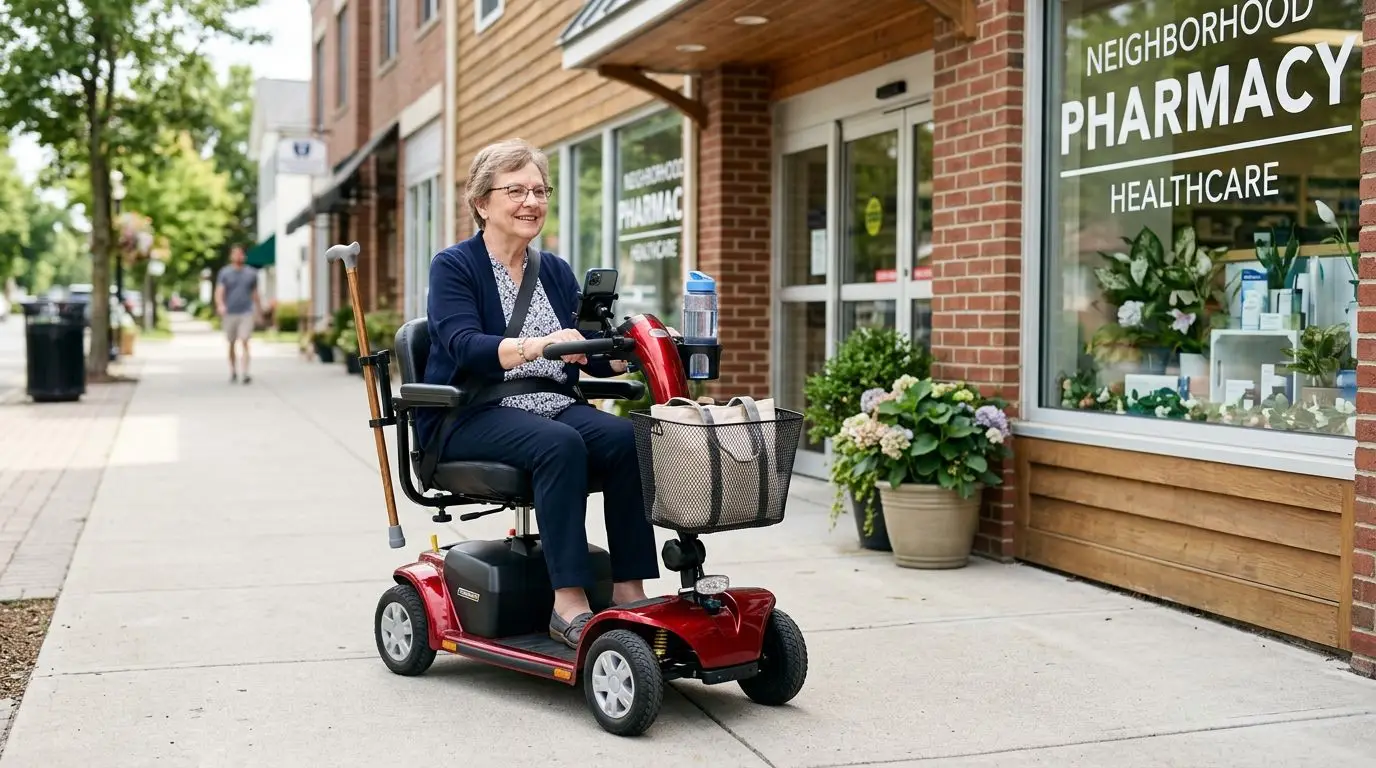
The best mobility scooter attachments for errands solve a specific daily problem without blocking your controls, seat swivel, visibility, or safe transfers. For most riders, the most useful add-ons are a cane holder, cup holder, phone mount, front or rear basket, weather bag, mirror, and extra lighting, as long as they fit securely and stay within the scooter's weight and size limits.
Start with what you carry on a normal outing: a cane, keys, wallet, phone, water bottle, grocery bag, or prescription pickup. Then measure your scooter and choose attachments that mount firmly, keep weight balanced, and do not turn a 10-minute errand into a safety hazard.
Why practical attachments matter on a 10-minute errand
A short trip can still involve a lot of handling. You may need to carry a phone, ID, payment card, house key, water bottle, cane, reading glasses, and a small bag, all while steering and watching curbs, doorways, pedestrians, and checkout lanes. If those items end up loose on your lap, tucked beside your hip, or hanging from the tiller, they can slide, snag, or distract you at the wrong moment.
Good attachments cut down on that juggling. A cane holder gives a walking aid a predictable place. A cup holder keeps a drink upright. A phone mount can keep navigation visible without making you hold the phone. A basket or bag keeps small purchases contained instead of swinging from the handlebar.
Attachments can also support independence in a practical way. They do not make a scooter safer by themselves, and they are not a substitute for good driving habits, a properly fitted scooter, or medical advice. Chosen well, they make ordinary tasks easier: picking up mail, going to a pharmacy, visiting a neighbor, riding through a senior living campus, or shopping for 2 or 3 small items.
The key is restraint. A scooter covered with add-ons can become harder to steer, wider in tight aisles, and heavier to lift into a vehicle. The right setup should feel simpler after 1 week of use, not cluttered.
Best mobility scooter attachment types for daily errands
Most errand-focused accessories fall into 6 categories: carrying, holding, visibility, weather protection, communication, and walking-aid storage. The table below compares common attachment types by the problem they solve, the typical mounting area, and the main safety check before use.
| Attachment type | Problem it solves | Common location | Safety check |
|---|---|---|---|
| Cane or crutch holder | Keeps a walking aid upright and reachable | Rear seat post, rear frame, or side bracket | Does not stick out into doorways or block seat swivel |
| Cup holder | Prevents spills and keeps water nearby | Tiller, armrest, or basket edge | Does not block throttle, key, speed dial, or brake lever |
| Phone mount | Holds phone for navigation or calls when parked | Tiller or handlebar area | Screen is visible without hiding the path ahead |
| Front basket | Carries small items like mail or a purse | Front tiller or front frame | Load stays below the basket limit and does not affect steering |
| Rear basket or cargo rack | Carries a grocery bag or larger errand items | Behind the seat | Does not overload the rear or reduce stability on ramps |
| Soft storage bag | Organizes keys, glasses, wallet, and medications | Armrest, seat back, or tiller | Straps are tight and cannot reach wheels or moving parts |
| Mirror | Improves awareness without twisting as far | Tiller or handlebar | Adjusted before moving; does not replace looking around |
| Extra lights or reflectors | Improves visibility in dim areas | Front, rear, or side | Mounted securely and charged if battery-powered |
| Weather cover or tiller cover | Protects hands and controls from light rain or wind | Over controls or parked scooter | Does not trap the throttle or block display visibility |
For many riders, the first 3 attachments to consider are a cane holder, a storage option, and a cup or phone holder. That combination covers mobility support, carrying needs, and communication without changing the scooter's footprint too much.
Heavier cargo accessories deserve more thought. A rear basket full of groceries can change how the scooter feels on a curb cut or sloped driveway. A front basket loaded with several pounds can make the tiller feel sluggish. If the scooter manual lists a basket or accessory weight limit, follow it; if it does not, keep loads light and balanced.
Who mobility scooter attachments are best for, and who should skip extras
Attachments are best for riders who repeat the same errands at least 2 or 3 times per week and want fewer loose items to manage. They are especially useful for people who use a cane for short standing transfers, carry a phone for emergency contact, bring a water bottle for longer outings, or need a predictable place for small personal items.
A cane holder is a good fit if you park the scooter and walk the final 10 to 30 feet into a restroom, exam room, mailbox area, or front desk. A cup holder helps if you are out for 30 minutes or longer and need easy access to water. A phone mount helps if you use maps on a campus, in a large retirement community, or around a shopping center, but it should never encourage texting while driving.
Some riders are better off keeping the scooter as simple as possible. If you drive through narrow apartment hallways, crowded stores, or doorways close to 32 inches wide, side-mounted accessories may snag. If you often transfer from the side, avoid anything that blocks the armrest, foot space, or seat swivel. If you lift the scooter into a car, every bracket and basket adds setup time and can make disassembly awkward.
Also skip attachments that encourage carrying more than the scooter was designed to handle. A mobility scooter is transportation, not a shopping cart. If a typical errand involves 20 to 30 pounds of groceries, a delivery service, a companion, or a different mobility plan may be safer than overloading baskets.
How to choose and measure before you buy
Before buying any attachment, take 10 minutes with a tape measure, your scooter manual, and the items you normally carry. Write down the scooter's overall width, the tiller or handlebar shape, the armrest width, the seat-back height, and the distance from the rear of the seat to the back edge of the scooter. If you use a lift, ramp, or vehicle trunk, measure that space too.
Start with mount compatibility. Many cup holders and phone mounts clamp around a round tube, but some scooter tillers are oval, angled, padded, or covered with plastic panels. A clamp meant for a 1-inch round bar may not fit a wider or flat tiller surface. Armrest-mounted pouches may need at least 2 straight sections for straps. Rear cane holders may require a seat post or accessory receiver, and not every scooter has one.
Next, measure reach. Sit in your normal driving position with your back against the seat. You should be able to reach the cup holder, phone, or pouch without leaning far forward or twisting. If reaching an item causes your hips to slide, your feet to lift, or one hand to pull hard on the tiller, the placement is too far away.
Use this quick checklist before installing anything:
- Control clearance: Keep the throttle, brake lever, key, horn, speed dial, and display fully visible and usable.
- Transfer clearance: Leave enough side space for your normal transfer method, especially if the armrest lifts or the seat swivels 90 degrees.
- Turning clearance: Turn the tiller fully left and right while parked to check for rubbing or cable pulling.
- Doorway clearance: Measure the widest point after installation, not before. Even 2 extra inches can matter indoors.
- Weight limit: Check the scooter and accessory instructions. Include the weight of the bag, drink, cane, or cargo.
- Disassembly: If you transport the scooter, confirm the attachment can be removed in under 1 minute or stays clear of the folding/lifting points.
Fit matters more than accessory count. One well-placed storage pouch can be more useful than 4 separate holders if it keeps items secure and leaves the scooter easy to operate.
Safe placement rules: keep 2 hands, controls, and sightlines clear
The safest attachments keep your hands free while you are moving and stay out of your main line of sight. A phone mounted too high can block a curb or child's shopping cart. A cup holder mounted too close to the throttle can interfere with fine speed control. A bag hanging from the tiller can swing during turns and tug the steering.
A simple rule works well: the attachment should not change how you start, stop, steer, or transfer. Test it indoors or in a quiet driveway at slow speed before taking it into a store. Practice a full stop, a tight turn, backing up a few feet, and parking beside a table or counter. If anything shifts, rattles loose, blocks a control, or makes you hesitate, adjust it.
Keep liquids away from electronics. A sealed water bottle is safer than an open cup. If you use a cup holder, choose placement that keeps spills off the key switch, display, charging port, and throttle. Even a small spill can make controls sticky or hard to use.
Phone mounts need special care. Use them for glanceable navigation or to keep the phone from falling, not for active texting or scrolling. If you need to make a call, read a message, or change a route, pull over and stop fully. A 15-second distraction is long enough to miss a doorway threshold, pedestrian, or display rack.
For cane and crutch holders, check height and angle. The tip should not drag, and the handle should not project far enough to catch a wall or elevator door. If the walking aid extends above the seat back, be mindful of low branches, door closers, and vehicle lifts.
Setup examples for common errands under 1 hour
Different errands call for different setups. A compact arrangement is usually better than loading every possible accessory onto the scooter.
Mailbox or lobby trip: 5 to 15 minutes
Best attachments: small front basket, key pouch, and possibly a cane holder. Keep the setup narrow because mailrooms and apartment lobbies often have tight turns. A cup holder or phone mount may be unnecessary for a quick trip unless you need the phone for building access or emergency contact.
Pharmacy or medical office visit: 20 to 45 minutes
Best attachments: phone mount or secure pouch, cane holder, small storage bag for wallet and paperwork, and a cup holder for a closed water bottle. Make sure the cane holder does not block the seat swivel when you arrive at a reception desk or exam room. If you carry medication, keep it in a secure bag rather than loose in an open basket.
Grocery or convenience store stop: 30 to 60 minutes
Best attachments: front basket for lightweight items, rear basket or soft rear bag for a small grocery load, and a mirror if you frequently back out of narrow aisles. Keep heavy items low and centered when possible. Avoid hanging plastic bags from the tiller because they can hit your knees, swing into controls, or change steering feel.
Outdoor community ride: 30 minutes or longer
Best attachments: cup holder with a closed bottle, lights or reflectors, phone holder, and weather-ready storage. A mirror can help with awareness on shared paths, but still look over your shoulder when safe. If the route includes slopes, uneven sidewalks, or curb cuts, use lighter cargo than you would on flat indoor floors.
These examples are starting points, not rules. Your own setup should match your strength, reach, storage needs, and the environments you use most often.
Feature comparison: convenience vs. risk in real use
Every attachment has a tradeoff. The goal is not to avoid all add-ons; it is to choose the ones that reduce more problems than they create. Use the table below to weigh common features before you install them.
| Feature | Convenience benefit | Possible drawback | Best practice |
|---|---|---|---|
| Clamp-on mounting | Easy to install and move | May loosen on angled or padded surfaces | Retighten after the first 3 rides |
| Quick-release holder | Helpful for transport or folding | Can be misplaced or not fully locked | Listen or feel for a secure click before driving |
| Large rear basket | Holds more errand items | Adds length and rear weight | Use for light, bulky items rather than heavy loads |
| Side-mounted bag | Keeps items near your hand | Can widen the scooter | Check doorway clearance after loading |
| Phone at eye level | Easier to see directions | Can block forward view | Mount low enough to keep the floor path visible |
| Hard cup holder | Stable for bottles | Can catch on counters or door frames | Place inside the scooter's natural width when possible |
If you are torn between 2 accessories, choose the one that solves a daily need rather than an occasional inconvenience. A rider who uses a cane every time they park will usually benefit more from a secure cane holder than from a phone mount used once a month.
Installation and maintenance checks every 30 days
Attachments are not set-and-forget items. Screws loosen, straps stretch, plastic clamps age, and hook-and-loop fasteners collect lint. A 5-minute check once a month can prevent many small problems.
Start by removing loose items from baskets and bags. Look for cracks, bent brackets, frayed straps, missing end caps, and sharp edges. Gently shake each attachment. If it moves more than it did when installed, tighten it or remove it until you can fix the mount.
Check after weather exposure. Rain, humidity, and road grit can affect clamps, zippers, and metal hardware. If you use a tiller cover, make sure it dries fully before storing the scooter. Do not cover a wet scooter in a way that traps moisture around controls or charging ports.
Battery-powered add-ons, such as small lights, need their own routine. Charge or replace batteries on a schedule rather than waiting until a late afternoon ride. If you use reflective strips, wipe them clean so they can do their job.
Reevaluate your setup after any change in health, balance, route, housing, or transportation. A basket that worked well in a wide garage may be frustrating in a narrow apartment hallway. A phone mount that was easy to reach last year may be too far forward now. Adapt the scooter to your current routine.
Smart buying checklist for 3 common scooter sizes
Scooters vary widely, but many fall into 3 broad groups: compact travel scooters, mid-size everyday scooters, and larger outdoor-oriented scooters. Attachment decisions should reflect those differences.
| Scooter type | Typical errand strength | Attachment priorities | Be careful with |
|---|---|---|---|
| Compact travel scooter | Easy transport and tight indoor spaces | Small pouch, light cup holder, compact cane holder | Large baskets, wide side bags, hard-to-remove mounts |
| Mid-size everyday scooter | Balanced indoor and outdoor use | Front basket, phone mount, cane holder, mirror | Overloading front steering or blocking transfers |
| Larger outdoor scooter | Longer rides and rougher paths | Lights, mirror, rear storage, weather-ready bag | Extra rear weight on slopes and longer overall length |
For any size, confirm 3 things before purchase: the mount fits your scooter, the item fits your body reach, and the final setup fits your home, vehicle, and errands. If one of those fails, the attachment may sit unused or create more work.
When possible, choose adjustable placements. A mount that can move 1 or 2 inches may make the difference between easy reach and awkward leaning. If you have limited hand strength, look for large knobs, simple buckles, and closures you can operate without pinching hard.
Ask for help with installation if you are unsure. A family member, occupational therapy professional, scooter technician, or knowledgeable mobility provider can often spot a blocked control or poor weight placement quickly. The final decision should still be based on how you use the scooter every day.
FAQ: mobility scooter attachments for errands
Can I put a cup holder on any mobility scooter?
Not always. Many cup holders need a round or straight mounting point, and some scooter tillers are shaped in ways that do not accept clamps securely. Measure the mounting area first and make sure the cup holder will not block the throttle, brake, key, or display.
Where is the safest place to carry a cane on a scooter?
A rear-mounted or frame-mounted cane holder is often safest because it keeps the cane off your lap and away from the controls. The cane should not drag, stick far out to the side, or block the seat from swiveling during transfers.
Is a phone mount safe to use while driving a mobility scooter?
A phone mount can be helpful for holding a phone, but it should not encourage active phone use while moving. Set navigation before you start, keep the screen low enough to preserve forward visibility, and stop fully before calling, texting, or changing settings.
How much weight can I carry in a scooter basket?
Use the limit listed in your scooter or basket instructions. If no clear limit is available, keep the load light and avoid heavy items that affect steering or stability. A few small purchases are very different from a full grocery run.
Will attachments make my scooter harder to transport?
They can. Baskets, cane holders, and clamps may interfere with folding, disassembly, vehicle lifts, or trunk loading. If you transport your scooter often, choose quick-release accessories and test removal before relying on them for a trip.
What attachment should I buy first?
Choose the attachment that solves your most frequent problem. If you use a cane every outing, start with a cane holder. If you struggle with loose keys, wallet, or glasses, start with a small storage pouch. Add more only after you know the first one works safely.
Frequently asked questions
Can I put a cup holder on any mobility scooter? +
Not always. Many cup holders need a round or straight mounting point, and some scooter tillers are shaped in ways that do not accept clamps securely. Measure the mounting area first and make sure the cup holder will not block the throttle, brake, key, or display.
Where is the safest place to carry a cane on a scooter? +
A rear-mounted or frame-mounted cane holder is often safest because it keeps the cane off your lap and away from the controls. The cane should not drag, stick far out to the side, or block the seat from swiveling during transfers.
Is a phone mount safe to use while driving a mobility scooter? +
A phone mount can be helpful for holding a phone, but it should not encourage active phone use while moving. Set navigation before you start, keep the screen low enough to preserve forward visibility, and stop fully before calling, texting, or changing settings.
How much weight can I carry in a scooter basket? +
Use the limit listed in your scooter or basket instructions. If no clear limit is available, keep the load light and avoid heavy items that affect steering or stability. A few small purchases are very different from a full grocery run.
Will attachments make my scooter harder to transport? +
They can. Baskets, cane holders, and clamps may interfere with folding, disassembly, vehicle lifts, or trunk loading. If you transport your scooter often, choose quick-release accessories and test removal before relying on them for a trip.
What attachment should I buy first? +
Choose the attachment that solves your most frequent problem. If you use a cane every outing, start with a cane holder. If you struggle with loose keys, wallet, or glasses, start with a small storage pouch. Add more only after you know the first one works safely.
Related guides
Best Mobility Scooter Accessories for Safety, Storage, and Everyday Comfort
13 min read
Best Mobility Scooter Accessories for Daily Use: Storage, Safety, Comfort, and Weather Protection
14 min read
Mobility Scooter Cup Holders, Trays, and Phone Mounts: Safe Convenience Add-Ons
15 min read