In the US, replacing mobility scooter batteries commonly costs about $90 to $300 for a pair of small sealed lead-acid batteries, $180 to $500 for larger lead-acid packs, and roughly $300 to $1,200 or more for lithium packs or battery cases, before labor or shipping. The final price depends on battery chemistry, voltage, amp-hour rating, whether the batteries are loose or built into a removable case, connector work, and service fees. Replacement is usually worth it when the scooter is otherwise in good condition, the total battery job is less than about 40% to 50% of the cost of a comparable replacement scooter, and the range loss is clearly battery-related.
That last point matters. A weak battery is common, but it is not the only reason a scooter slows down, quits early, or refuses to charge. This guide explains the real price drivers, how to read your current battery size, and when spending money on new batteries makes practical sense.
Typical US mobility scooter battery prices in 2026
Most mobility scooters use either a 24-volt battery system made from two 12-volt batteries or a single lithium pack designed to deliver the scooter’s required voltage. In practical shopping terms, you are usually buying a pair of lead-acid batteries or one complete lithium battery pack.
For many compact travel scooters, a pair of small sealed lead-acid batteries may cost about $90 to $180 for the batteries alone. Mid-size scooters often use larger batteries, with common battery-only costs around $150 to $350 per pair. Heavy-duty scooters with high amp-hour batteries can push the battery-only cost closer to $300 to $500 or more.
Lithium pricing varies more. A replacement lithium pack can cost several hundred dollars, and some removable battery cases are more expensive because the shell, internal wiring, battery management system, charging port, handle, and connectors are part of the assembly. If a shop installs the batteries, expect labor to add roughly 30 to 90 minutes, depending on access and wiring complexity.
| Battery situation | Common US price range | What is usually included |
|---|---|---|
| Small travel scooter, sealed lead-acid pair | About $90-$180 | Two 12V batteries, battery-only |
| Mid-size scooter, sealed lead-acid pair | About $150-$350 | Two larger 12V batteries, battery-only |
| Heavy-duty scooter, sealed lead-acid pair | About $300-$500+ | High amp-hour pair, battery-only |
| Lithium replacement pack or case | About $300-$1,200+ | Pack, case, wiring, or internal electronics may be included |
| Shop installation | Often 30-90 minutes of labor | Testing, opening case, wiring, installation, disposal |
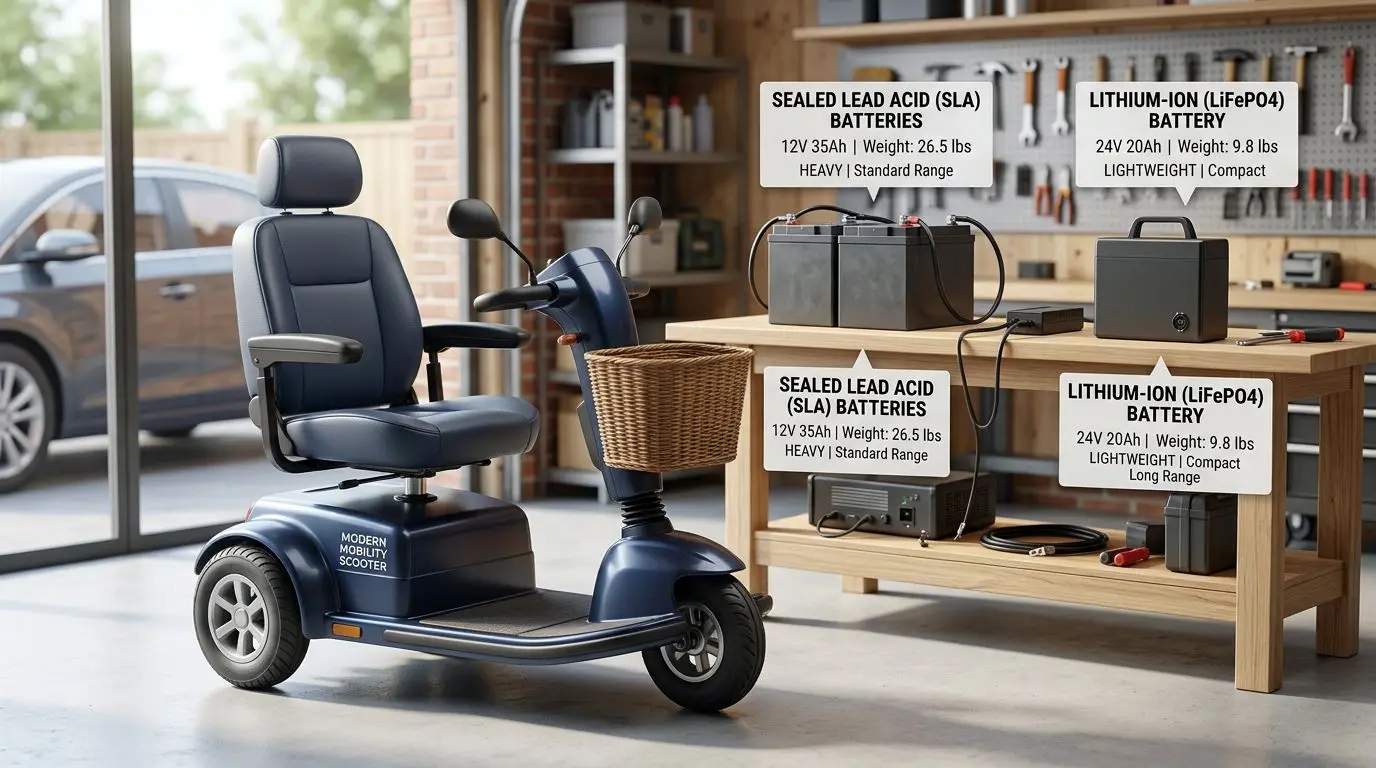
Prices shift by location, shipping weight, and availability. A pair of 35Ah lead-acid batteries can weigh about 45 to 50 pounds total, so freight and handling can matter almost as much as the sticker price.
5 factors that affect mobility scooter battery cost
The cheapest battery is not always the best value. The right battery must match the scooter’s voltage, physical space, charger compatibility, and discharge needs. A mismatch can shorten battery life or create a safety issue.
1. Battery chemistry
Sealed lead-acid batteries usually have the lowest upfront cost. The two common versions are AGM and gel. Both are sealed, spill-resistant, and widely used in mobility scooters. Lithium costs more to buy, but it is lighter and may last longer when used with the correct charger and electronics.
2. Amp-hour rating
A 12V 12Ah battery costs less than a 12V 35Ah battery because it stores less energy and uses less material. Amp-hours, often written as Ah, are a major price driver. Higher Ah can support longer range, but only if the battery physically fits and the scooter is designed for it.
3. Voltage and pack configuration
Many scooters use 24V systems, commonly built from two 12V batteries connected in series. Some larger or lithium systems use different pack designs. You cannot safely choose voltage by price; it must match the scooter’s electrical system exactly.
4. Case, wiring, and connectors
Loose batteries are usually cheaper than a complete removable battery box. A battery case may include a fuse, charging socket, handle, wiring harness, key-style connector, or internal circuit board. Those parts add cost, but they may also make installation easier and safer.
5. Shipping, labor, and recycling
Lead-acid batteries are heavy. Lithium batteries may require special shipping rules. Local shops may charge for testing, installation, and old-battery recycling. In many areas, old sealed lead-acid batteries should go to a recycling center, battery retailer, or service shop rather than into household trash.
Battery types compared: 12V, AGM, gel, and lithium
The battery type affects price, weight, charging habits, and long-term value. For example, two 12V 35Ah lead-acid batteries may weigh around 45 to 50 pounds together, while an equivalent lithium setup can weigh far less. That weight difference matters if you lift the battery box into a car trunk.
| Type | Typical cost position | Strengths | Trade-offs | Best fit |
|---|---|---|---|---|
| AGM sealed lead-acid | Usually lowest to moderate | Widely available, durable, maintenance-free | Heavy, range drops as it ages | Everyday users who want predictable cost |
| Gel sealed lead-acid | Moderate | Good deep-cycle behavior when charged correctly | May require charger compatibility; can cost more than AGM | Users whose scooter originally came with gel batteries |
| Lithium | Highest upfront | Lighter, often longer cycle life, holds voltage well | Higher price; must match scooter and charger requirements | Travel users, frequent lifters, and those prioritizing weight |
| Complete battery box | Moderate to high | Convenient swap, includes wiring and case | Costs more than loose batteries | Users who want simple removal and charging |
Do not assume lithium is a drop-in upgrade. Some scooters can use only the chemistry specified by the manufacturer’s electrical design. A lithium pack normally needs a battery management system, proper charger voltage, and correct connectors. If any of those are wrong, the savings from a “bargain” pack can disappear quickly.
When replacement is worth it: 3 practical cost tests
A battery replacement is often a smart repair when the scooter is less than 5 years old, has been well maintained, and has no major frame, motor, controller, or brake issues. For an older scooter, the decision should be based on total value, not just battery price.
Test 1: The 40% to 50% rule
Add the batteries, shipping, labor, and any needed connectors. If the total is under about 40% to 50% of the cost of a comparable replacement scooter, new batteries are often reasonable. If the battery job approaches the cost of another scooter in similar condition, pause and inspect the whole machine.
Test 2: The range-loss pattern
Batteries commonly show age through shorter range. A scooter that once handled 8 miles but now slows after 2 or 3 miles may have weak batteries, especially if they are 2 to 4 years old. Sudden shutdowns, a charger that never turns green, or a battery gauge that drops quickly under load can also point to battery problems.
Test 3: The scooter condition check
Look at tires, seat condition, throttle response, brakes, tiller movement, lights, wiring, and corrosion. If several expensive repairs are waiting, batteries alone may not restore dependable use. If the scooter drives smoothly, stops properly, and has a solid frame, batteries can give it a useful second life.
One more caution: low range can also come from dragging brakes, underinflated pneumatic tires, a failing charger, worn motor brushes on some designs, loose wiring, or excessive hills and weight load. If the symptoms are unclear, pay for a diagnostic check before buying batteries.
How to choose and measure the right battery in 10 minutes
You can gather the most important replacement information in about 10 minutes with the scooter turned off, the charger unplugged, and the battery case opened only if you can do so safely. If you are not comfortable around wiring, ask a repair shop or knowledgeable helper.
- Find the voltage. Many scooters use two 12V batteries for a 24V system. Replace both batteries at the same time, not just one.
- Read the amp-hour rating. Look for markings such as 12Ah, 18Ah, 22Ah, 35Ah, 55Ah, or 75Ah. Match the original rating unless the scooter documentation allows another size.
- Measure the battery space. Record length, width, and height in inches. A battery that is 0.5 inch too tall may prevent the cover from closing.
- Check terminal style. Common lead-acid terminals include tab-style quick connects and bolt-style terminals. Connector differences can add parts and labor.
- Confirm chemistry. AGM, gel, and lithium charging requirements are not always the same.
- Inspect the charger label. Note the output voltage and amperage. A charger mismatch can reduce battery life or prevent charging.
- Photograph the wiring. Before anything is disconnected, take clear photos from 2 or 3 angles.
For lead-acid batteries, never mix an old battery with a new one in the same pair. The older battery can pull down the newer one, and the pack may perform like the weakest battery. Matching capacity, chemistry, and age is part of getting fair value from the replacement.
Who battery replacement is best for after 2 to 5 years of use
Battery replacement is best for owners whose scooter still fits their daily needs and whose only serious complaint is reduced range after normal battery aging. Many sealed lead-acid scooter batteries last around 1.5 to 3 years with regular use, while some lithium packs may last longer depending on use, storage, charging habits, and system design.
New batteries make the most sense if you use the scooter for predictable trips: around the house, to the mailbox, through a senior community, at stores, or on short outdoor routes. If the scooter already has enough speed, seat comfort, turning radius, and ground clearance for your routine, batteries may be the most economical way to keep it useful.
Replacement may not be the best path if your needs have changed. For example, if you now need a scooter that handles a 2-inch doorway threshold, a steeper driveway, a higher weight capacity, or easier car transport, new batteries will not solve those fit problems. In that case, put the battery budget toward a scooter type that better matches your life.
| Your situation | Battery replacement likely? | Why |
|---|---|---|
| Scooter is 2 years old and range is half of normal | Often yes | Age and symptom pattern fit normal battery wear |
| Scooter is 8 years old with worn tires and brake issues | Maybe not | Other repairs can exceed battery value |
| You can no longer lift the battery box | Maybe | Lithium may help, but only if compatible and cost-effective |
| You need more ground clearance or capacity | No, not by itself | Batteries do not change scooter structure |
How to reduce battery costs without cutting safety by 20%
You may be able to reduce the total cost by 10% to 20% through careful shopping and maintenance, but do not cut corners on voltage, chemistry, or wiring. The wrong battery can cost more than the correct one after troubleshooting and replacement fees.
- Compare total delivered cost. Include shipping, core fees, taxes, and recycling, not just the battery price.
- Ask for a battery date code. Fresh stock is better than a battery that sat discharged on a shelf for months.
- Buy the correct pair together. Matched batteries help the pack charge and discharge evenly.
- Keep the charger plugged in as instructed. Many scooters are designed for regular charging, but follow the scooter and charger instructions.
- Avoid deep discharge. Frequently running batteries to empty shortens life, especially with lead-acid types.
- Store carefully. If the scooter sits for weeks, keep batteries charged according to the manual and avoid extreme heat or freezing storage.
A simple habit can protect the investment: charge after each day of use, even if the trip was short. For many owners, battery life is lost not from one long ride, but from repeated partial neglect over months.
Warning signs before you spend $300 or more
If the battery estimate is $300 or more, take a few minutes to rule out problems that imitate weak batteries. A failing charger can leave good batteries undercharged. A loose connector can cause sudden shutdowns. A brake that drags for 1 mile can drain the pack faster than expected.
Ask a service provider to load-test the batteries if possible. A resting voltage reading alone does not tell the whole story because a weak battery can show decent voltage with no load and then collapse when the scooter climbs a ramp. A load test checks how the battery behaves under demand.
Also check the charger indicator pattern. If the charger light never changes, changes instantly, or becomes unusually hot, the charger may need attention. Do not open a charger case yourself; internal components can be hazardous even after unplugging.
If the scooter has been unused for 6 months or more with discharged lead-acid batteries, replacement becomes more likely. Lead-acid batteries dislike sitting empty. A long idle period can cause permanent capacity loss, even if the scooter has low mileage.
FAQ: 6 mobility scooter battery price questions
How much does it cost to replace mobility scooter batteries?
In the US, many sealed lead-acid replacements cost about $90 to $500 for the battery pair, depending on size. Lithium packs or complete battery cases often cost more, commonly several hundred dollars and sometimes over $1,000. Labor, shipping, and recycling can add to the total.
Should I replace both 12V batteries at the same time?
Yes. If your scooter uses two 12V batteries, replace them as a matched pair. Mixing one new battery with one old battery usually reduces performance and can shorten the life of the new battery.
Is a lithium mobility scooter battery worth the higher price?
It can be worth it if the scooter is designed for lithium, you need lower weight, and you plan to keep the scooter long enough to benefit from the upgrade. It is not worth forcing into a scooter that lacks the correct charger, wiring, or battery management setup.
Why did my new batteries not restore full range?
Possible reasons include an incorrect charger, dragging brakes, tire pressure problems, loose wiring, hills, cold weather, rider and cargo weight, or batteries that were not fully charged before use. New batteries may also need several normal charge cycles before they deliver their best practical range.
Can I buy cheaper mobility scooter batteries online?
Often, yes, but compare the delivered price and return terms. Batteries are heavy, and returns can be expensive. Make sure the voltage, amp-hour rating, chemistry, physical size, and terminals match before ordering.
How long should mobility scooter batteries last?
Many sealed lead-acid batteries last around 1.5 to 3 years with regular use, while lithium may last longer in compatible systems. Charging habits, storage temperature, depth of discharge, terrain, and scooter load all affect battery life.
Frequently asked questions
How much does it cost to replace mobility scooter batteries? +
In the US, many sealed lead-acid replacements cost about $90 to $500 for the battery pair, depending on size. Lithium packs or complete battery cases often cost more, commonly several hundred dollars and sometimes over $1,000. Labor, shipping, and recycling can add to the total.
Should I replace both 12V batteries at the same time? +
Yes. If your scooter uses two 12V batteries, replace them as a matched pair. Mixing one new battery with one old battery usually reduces performance and can shorten the life of the new battery.
Is a lithium mobility scooter battery worth the higher price? +
It can be worth it if the scooter is designed for lithium, you need lower weight, and you plan to keep the scooter long enough to benefit from the upgrade. It is not worth forcing into a scooter that lacks the correct charger, wiring, or battery management setup.
Why did my new batteries not restore full range? +
Possible reasons include an incorrect charger, dragging brakes, tire pressure problems, loose wiring, hills, cold weather, rider and cargo weight, or batteries that were not fully charged before use. New batteries may also need several normal charge cycles before they deliver their best practical range.
Can I buy cheaper mobility scooter batteries online? +
Often, yes, but compare the delivered price and return terms. Batteries are heavy, and returns can be expensive. Make sure the voltage, amp-hour rating, chemistry, physical size, and terminals match before ordering.
How long should mobility scooter batteries last? +
Many sealed lead-acid batteries last around 1.5 to 3 years with regular use, while lithium may last longer in compatible systems. Charging habits, storage temperature, depth of discharge, terrain, and scooter load all affect battery life.
Related guides
Mobility Scooter Batteries and Chargers: Range, Replacement Cost, and Care Tips
14 min read
Mobility Scooter Batteries Explained: Types, Voltage, Amp-Hours, and Compatibility
15 min read
Where to Buy Mobility Scooter Batteries Near You: What to Check Before You Purchase
13 min read