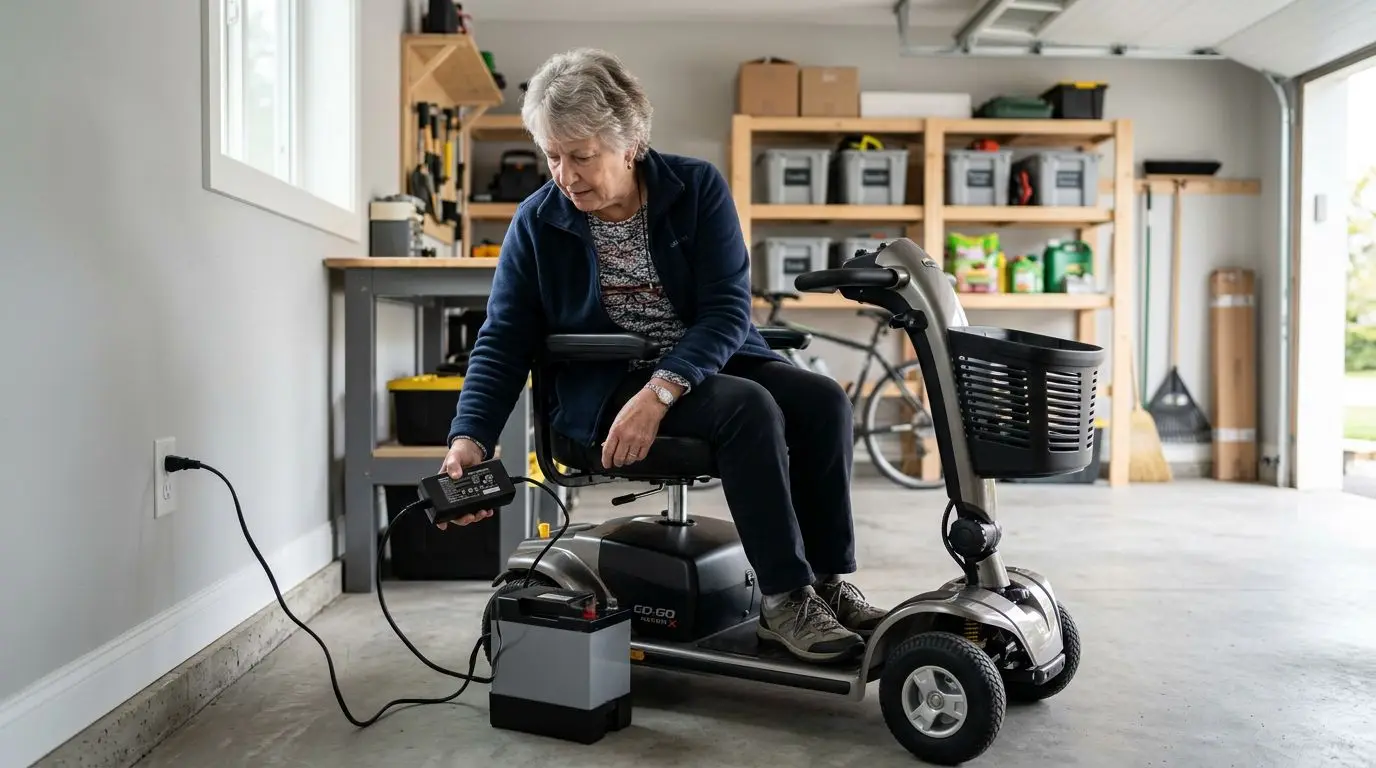
To replace a mobility scooter battery correctly, match the original battery’s voltage, physical dimensions, amp-hour capacity, chemistry, and connector style before you buy. Most scooters use two 12-volt batteries wired together for a 24-volt system, and the wrong size or terminal can stop the battery from fitting, charging, or operating safely.
The safest approach is to remove the old battery pack, read the label, measure the battery tray, photograph the wiring, and confirm that the charger works with the replacement battery type. If the battery compartment is tight, even a 0.25 in difference in height or terminal position can create a frustrating no-fit problem.
Start with the battery label: 12V, 24V, and amp-hours matter
Most mobility scooters are built around a 24-volt electrical system, commonly made from two 12V batteries connected in series. That does not mean any two 12V batteries will work. You also need the correct capacity, physical case size, and terminal layout.
Look for a label on each battery. It usually lists voltage, capacity, and chemistry. Common examples include 12V 12Ah, 12V 18Ah, 12V 22Ah, 12V 35Ah, or 12V 55Ah. The voltage must match. The amp-hour rating should usually match the original or stay within the scooter manufacturer’s approved range.
Voltage is not flexible. A 24V scooter needs a 24V battery pack. If that pack is made from two 12V batteries, replace both batteries together, even if only one seems weak. Mixing an old battery with a new one can reduce performance and shorten the life of the new battery.
| Label item | What it means | Why it matters |
|---|---|---|
| 12V | One 12-volt battery | Often used in pairs for a 24V scooter |
| 24V pack | Two 12V batteries wired in series or one complete 24V pack | Must match the scooter’s controller and charger |
| Ah rating | Amp-hour capacity, such as 18Ah or 35Ah | Affects range and required case size |
| Chemistry | AGM, gel, sealed lead-acid, or lithium type | Must be compatible with the charger and scooter design |
If the label is missing or worn away, do not guess based only on scooter size. Measure the batteries, then contact a qualified mobility equipment technician or battery supplier with the dimensions, photos, and voltage information from the scooter.
Measure the battery compartment before buying: even 0.5 in can matter
Battery fit is one of the most common replacement problems. A battery may have the correct voltage and amp-hour rating but still be too tall for the shroud, too wide for the tray, or shaped so it blocks the hold-down strap.
Measure the battery, not just the compartment. Use a tape measure and record length, width, and height in inches. Then measure the open space in the scooter battery box or tray. Leave room for cables, terminals, padding, straps, and the battery cover. In a tight compartment, a battery that is 0.25 to 0.5 in taller than the original may keep the cover from closing.
Common sealed lead-acid scooter battery sizes vary widely. A small travel scooter battery may be around 6 in long, while a larger U1-size battery is often about 7.75 in long, 5.18 in wide, and 7.25 in high. Heavy-duty scooters can use still larger cases. These are general sizes, not a substitute for measuring your own scooter.
How to measure correctly
- Turn the scooter off and remove the key.
- Disconnect the charger from the wall and scooter.
- Open the battery compartment and take photos before unplugging anything.
- Measure each battery: length, width, and total height including terminals.
- Measure the tray or battery box at its narrowest point.
- Check cable reach to the positive and negative terminals.
- Confirm whether the battery installs upright only or can sit inside a removable battery case.
Do not force a battery into a compartment. Pinched cables can overheat, covers can crack, and terminals can short against metal parts. If a battery does not sit flat with the cables routed naturally, it is not the right fit.
Match voltage exactly: two 12V batteries usually make one 24V pack
A scooter battery system is designed around a specific voltage. Many mobility scooters use 24V, created by connecting two 12V batteries in series. In a series connection, the positive terminal of one battery connects to the negative terminal of the other, and the scooter uses the remaining positive and negative leads for 24V output.
Do not replace a 24V pack with a single 12V battery. The scooter may not run at all. Do not connect extra batteries to raise the voltage beyond what the controller is designed for. A 36V or 48V pack belongs only in a scooter built for that voltage, and using the wrong voltage can damage electronics or create a safety hazard.
If your scooter uses a removable battery box, the two 12V batteries may be hidden inside the case. The outside may show a single charging port and scooter connector, but the internal batteries still need to match the original setup. Before opening a battery box, check whether it is designed for user service. Some boxes have screws and replaceable batteries; others are best handled by a technician.
| Scooter system | Typical battery arrangement | Replacement rule |
|---|---|---|
| 24V | Two 12V batteries in series | Replace both 12V batteries as a matched pair |
| 36V | Three 12V batteries in series or a dedicated pack | Use only the approved 36V configuration |
| 48V | Four 12V batteries in series or a dedicated pack | Confirm controller and charger compatibility |
When in doubt, stop and verify. Battery wiring mistakes can create sparks, blown fuses, damaged controllers, or melted connectors. One simple photo before disassembly can save a service call later.
Choose the right amp-hour capacity: 18Ah is not the same as 35Ah
Amp-hours, written as Ah, describe battery capacity. In general, a 35Ah battery can store more energy than an 18Ah battery of the same voltage and chemistry. That may support longer range, but only if the scooter is designed to carry the larger battery and the charger is suitable.
Capacity is closely tied to physical size and weight. A pair of small 12Ah batteries may fit a compact travel scooter, while a pair of 35Ah batteries may be used in a mid-size scooter with a larger battery tray. A 35Ah sealed battery can weigh around 20 to 25 lb each, while smaller 12Ah batteries are much lighter. Exact weight varies by construction.
You should not reduce capacity unless you understand the trade-off. Replacing 35Ah batteries with 18Ah batteries may fit electrically, but it can shorten range and may not support the scooter’s intended load and terrain use. Going larger is not automatically better, either. Larger batteries may not fit, may exceed the scooter’s battery compartment limits, and may affect portability.
Who is best served by each capacity range?
| Typical capacity | Common use | Best for | Watch out for |
|---|---|---|---|
| 10Ah to 15Ah | Compact travel scooters | Short errands, indoor use, car transport | Limited range and smaller cases |
| 18Ah to 22Ah | Travel and light mid-size scooters | Moderate daily use on smoother surfaces | Must match battery box dimensions |
| 30Ah to 35Ah | Mid-size scooters | Longer outings and more frequent outdoor use | Heavier batteries, larger trays |
| 50Ah and above | Large or heavy-duty scooters | Extended use where approved by scooter design | Weight, charging time, and fit constraints |
Range also depends on rider weight, speed, hills, tire pressure, temperature, surface type, and battery age. A new battery does not guarantee a specific distance unless it is tested under the same conditions.
Match the chemistry: AGM, gel, sealed lead-acid, and lithium are not interchangeable by default
Many scooters use sealed lead-acid batteries, often AGM or gel. Both are sealed, maintenance-free styles, but they can require different charging profiles. Some scooters use lithium-based packs, usually with a battery management system. Chemistry is more than a label; it affects charging, safety protection, weight, and wiring.
If your scooter came with sealed lead-acid batteries, do not switch to lithium unless the scooter manufacturer or a qualified technician confirms compatibility. Lithium packs often need a compatible charger, built-in protection circuitry, and correct communication or connector design. A lithium battery may be much lighter, sometimes saving several pounds per battery compared with lead-acid, but weight savings alone is not enough reason to convert.
AGM and gel batteries are closer to each other, but they still should not be mixed in the same battery pack. Use two batteries of the same chemistry, voltage, capacity, age, and type. If one 12V battery is AGM and the other is gel, the pair can charge and discharge unevenly.
| Chemistry | Common scooter use | Key replacement concern |
|---|---|---|
| AGM sealed lead-acid | Common in many travel and mid-size scooters | Use a compatible sealed lead-acid charger |
| Gel sealed lead-acid | Used where gel charging profile is specified | Do not assume an AGM charger is ideal |
| Lithium-based pack | Common in some newer or lightweight designs | Requires compatible charger and protection system |
Air travel adds another layer. Lithium mobility batteries may be subject to watt-hour limits and airline approval rules. If you fly, check current airline and transportation regulations before changing battery type.
Check connector and terminal type: F1 is 0.187 in and F2 is 0.250 in
The connector is where many otherwise good replacements go wrong. Small sealed batteries often use flat blade terminals. The two common sizes are F1, about 0.187 in wide, and F2, about 0.250 in wide. They look similar at a glance, but the scooter’s wiring clips may fit one and not the other.
Larger scooter batteries may use bolt-in terminals, insert terminals, posts, or a wiring harness attached inside a battery box. Some removable battery boxes use an external plug to connect the entire box to the scooter. The internal battery terminals still need to match the harness.
Before disconnecting the old batteries, take clear photos from several angles. Mark the positive cable with tape if needed. Positive is usually red and marked with a plus sign. Negative is usually black and marked with a minus sign. Never rely only on wire color if the scooter has been repaired before.
Connector checklist before ordering
- Terminal size: F1 0.187 in, F2 0.250 in, bolt, insert, or post.
- Terminal position: same end, opposite corners, left positive, or right positive.
- Cable length: enough slack to connect without pulling.
- Battery box plug: same shape, pin count, and orientation if replacing a full pack.
- Fuse location: note any inline fuse, rating, and holder placement.
Adapters exist for some terminal differences, but they are not always the best answer in a mobility scooter. Extra adapters can add height, create loose connections, or interfere with the battery cover. A direct-match terminal is usually cleaner and safer.
Use the correct charger: a 24V battery pack needs a 24V charger
The charger must match the battery pack voltage and chemistry. A 24V sealed lead-acid scooter pack needs a 24V charger intended for sealed lead-acid batteries. A 12V automotive charger is not a substitute for a 24V scooter charger.
Charging current also matters. A compact scooter may use a lower-output charger, while a larger scooter battery pack may use a higher-output charger. For example, a small charger may take many hours to recharge a 35Ah pack, while a charger designed for that battery size can be more appropriate. Do not use a high-output charger unless it is approved for the scooter and battery type.
If the old batteries failed early, inspect the charger and charging port. A weak charger, damaged connector, loose port, or corroded terminal can mimic battery failure. After installing new batteries, charge them fully before the first long ride. Many sealed lead-acid batteries perform best when kept charged and not repeatedly drained to empty.
A practical habit helps: plug in after daily use, unplug according to the charger instructions, and store the scooter in a moderate-temperature place when possible. Extreme heat and freezing temperatures can reduce battery performance and life.
How to replace the batteries safely in about 30 to 60 minutes
A careful battery replacement often takes 30 to 60 minutes for a simple scooter battery box, and longer if the compartment is hard to access. Work slowly. Batteries are heavy, and a dropped tool across both terminals can cause a short.
Basic replacement steps
- Park the scooter on a level surface and turn it off.
- Remove the key and unplug the charger.
- Take photos of the battery layout, wiring, fuse, and connectors.
- Disconnect the negative cable first when practical, then the positive cable.
- Lift batteries using proper body mechanics; a 35Ah battery may weigh over 20 lb.
- Place the new batteries in the same orientation as the old ones.
- Reconnect cables exactly as photographed, checking polarity twice.
- Secure straps, covers, and battery box lids before powering on.
- Charge fully before normal use.
If you see swollen battery cases, melted connectors, burned smells, leaking material, or corroded wiring, stop. Those signs call for professional service. Sealed lead-acid batteries should be recycled at an appropriate battery recycling location; do not place them in household trash.
Who should choose an exact replacement versus an upgrade by 10Ah or more?
An exact replacement is best for most users because it preserves the scooter’s designed fit, weight balance, wiring, and charging setup. If the original batteries were 12V 22Ah AGM with F2 terminals, replacing them with the same voltage, capacity, chemistry, case size, and terminal type is the least risky route.
A capacity upgrade may make sense only when the scooter’s battery tray, wiring, charger, and manufacturer guidance allow it. For example, moving from a smaller battery to one that is 10Ah higher may require a larger case and more charging time. If the battery cover cannot close or the hold-down strap cannot secure the battery, it is not a safe upgrade.
Choose an exact match if you transport the scooter often, remove the battery box by hand, or use a compact travel scooter. Choose a reviewed, approved higher-capacity option only if you need more range, have enough compartment space, and understand the added weight. For many riders, good charging habits and properly inflated tires improve real-world range more reliably than squeezing in an oversized battery.
Final pre-purchase checklist: confirm 5 details before you click buy
Before ordering replacement mobility scooter batteries, confirm these 5 details: voltage, amp-hour capacity, physical size, chemistry, and connector type. Write them down from the old battery label and your own measurements. Do not rely on appearance alone.
- Voltage: 12V individual batteries, 24V total pack, or another approved system voltage.
- Capacity: same Ah rating or an approved range, such as 18Ah, 22Ah, or 35Ah.
- Dimensions: length, width, and height including terminals, with enough clearance for the cover.
- Chemistry: AGM, gel, sealed lead-acid, or lithium type as approved for the scooter and charger.
- Connector: F1, F2, bolt terminal, insert terminal, post, or complete harness plug.
If any one of those details is uncertain, pause before buying. A battery that is almost right can still leave you with a scooter that will not run, a charger that will not work, or a cover that will not close. Careful matching is the simplest way to protect your mobility, your budget, and your safety.
FAQs: 4 common battery replacement questions
Can I replace just one battery in a 24V scooter?
It is usually best to replace both 12V batteries at the same time. A new battery paired with an old one can charge unevenly, reduce range, and shorten the life of the new battery.
Can I use a higher Ah battery in my mobility scooter?
Only if the higher-capacity battery is approved for the scooter and fits the battery tray, wiring, and charger setup. A higher Ah rating often means a larger and heavier battery.
What happens if I choose the wrong terminal size?
The cable may not connect securely, or it may not connect at all. For small sealed batteries, F1 terminals are about 0.187 in wide and F2 terminals are about 0.250 in wide, so measure before buying.
Do I need a new charger when replacing scooter batteries?
Not always. If you replace batteries with the same voltage and chemistry, the existing charger may be correct if it is working properly. If you change chemistry, especially to lithium, you may need a compatible charger.
How long should I charge new mobility scooter batteries before first use?
Charge the new batteries fully before your first normal ride. Many scooter chargers indicate full charge with a light change, but follow the charger instructions for timing and safe use.
Frequently asked questions
Can I replace just one battery in a 24V mobility scooter? +
It is usually best to replace both 12V batteries together. A new battery paired with an older weak battery can charge unevenly, reduce range, and shorten the new battery’s service life.
Can I install a higher amp-hour battery for more range? +
Only if the scooter’s battery compartment, wiring, weight limits, and charger are compatible. Higher Ah batteries are often larger and heavier, so fit and approval matter as much as capacity.
How do I know whether I need F1 or F2 terminals? +
Measure the flat blade terminal width on the old battery. F1 is about 0.187 in wide, while F2 is about 0.250 in wide. Photos and measurements help prevent ordering the wrong connector.
Can I switch from sealed lead-acid to lithium batteries? +
Do not switch chemistry unless the scooter and charger are confirmed compatible. Lithium packs need proper protection circuitry and a compatible charger, and they are not a drop-in replacement for every scooter.
What should I check if new batteries do not power the scooter? +
Check polarity, fuse condition, terminal tightness, battery box seating, charger status, and whether the pack voltage matches the scooter. If wiring looks damaged or hot, stop and get professional service.
Related guides

Mobility Scooter Batteries Explained: Types, Voltage, Amp-Hours, and Compatibility
15 min read
Can You Upgrade a Mobility Scooter Battery for More Range? Compatibility, Cost, and Safety Limits
14 min read
Where to Buy Mobility Scooter Batteries Near You: What to Check Before You Purchase
13 min read