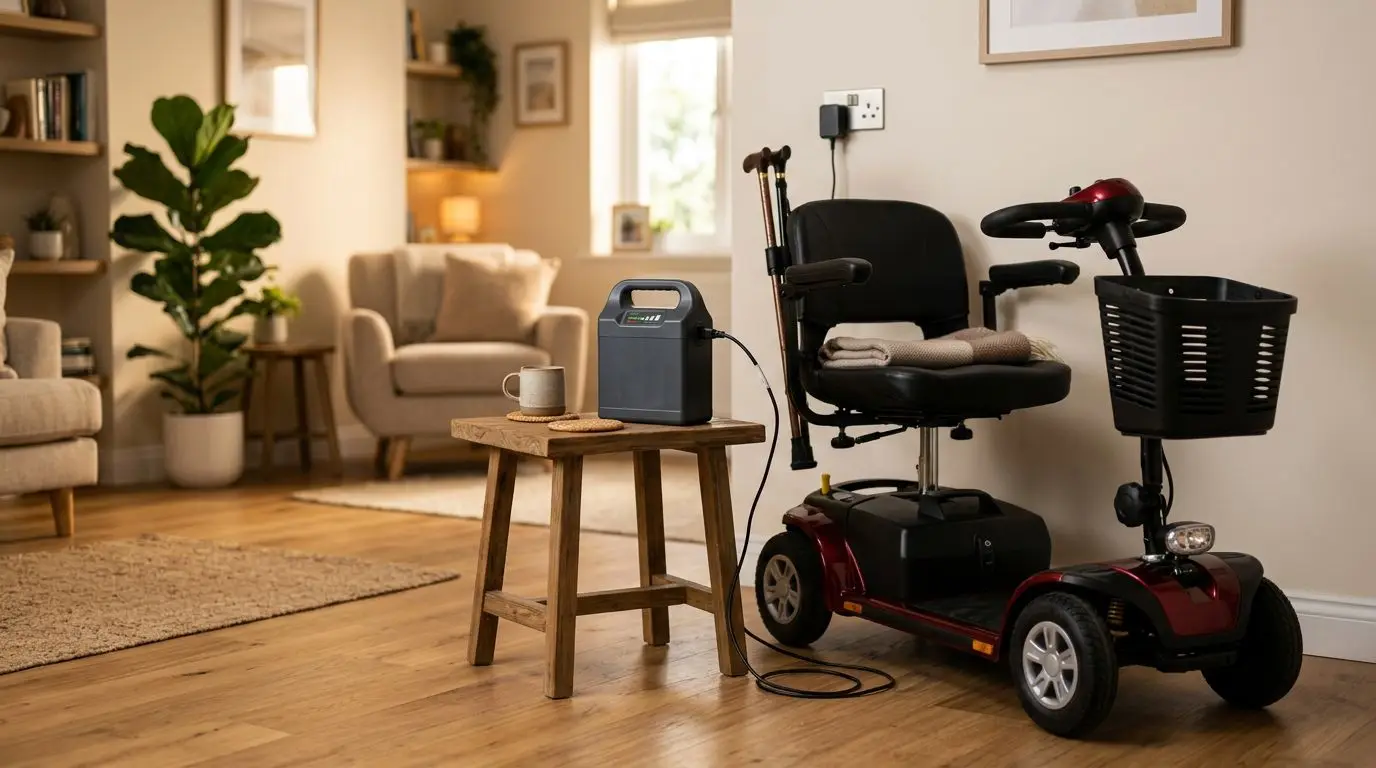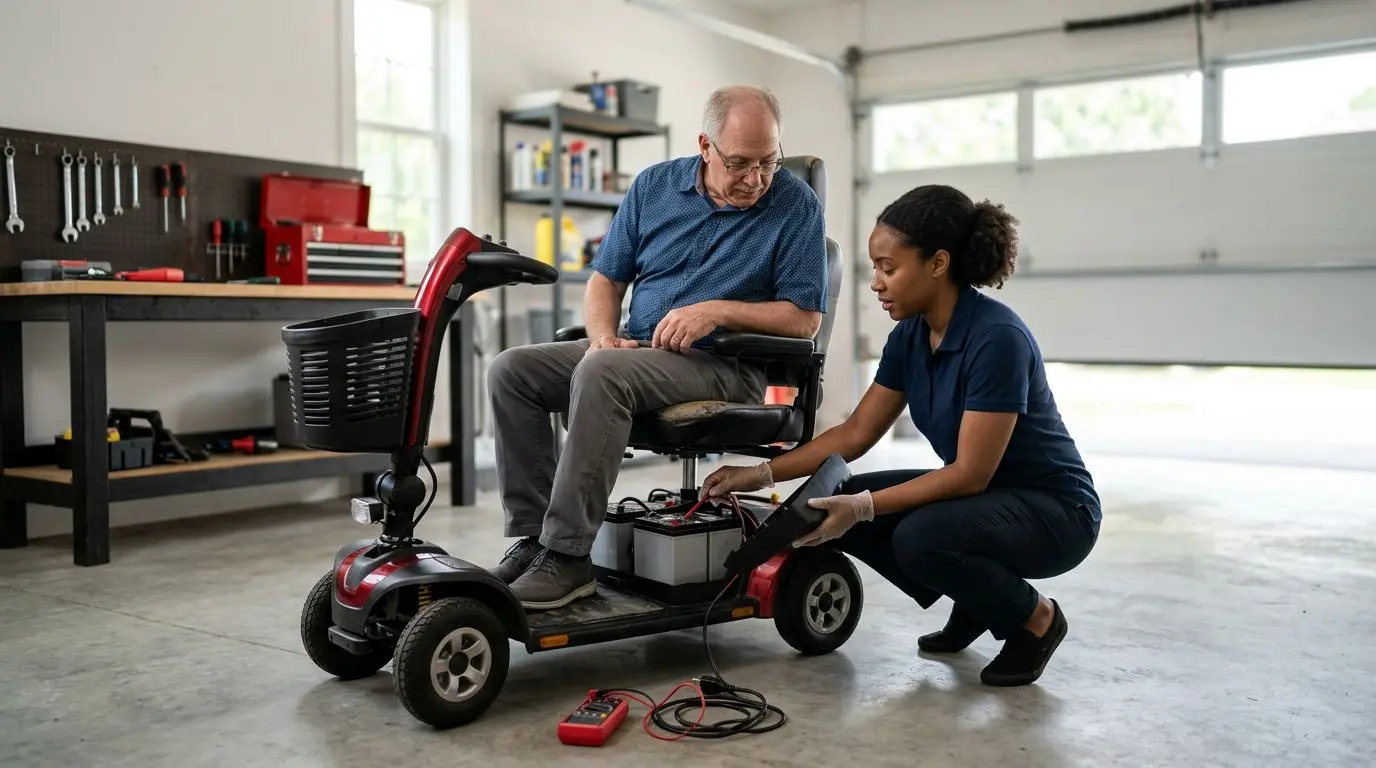
A mobility scooter battery reset may help when the scooter suddenly will not power on, the battery gauge behaves oddly, or the controller needs to clear a temporary fault after charging or storage. It will not fix a worn-out battery, damaged charger, loose wiring, corrosion, a blown fuse, or a failed controller. Before trying any reset, turn the scooter off, unplug the charger, check for heat, swelling, burning smells, and damaged cables, and stop if anything looks unsafe.
Battery resets are often misunderstood. On many scooters, there is no dedicated reset button for the battery itself; the practical reset is usually a safe power-down, disconnect, wait, reconnect, and full recharge process. Some scooters also have a circuit breaker reset button, and some lithium battery packs have an internal battery management system that may wake up only under the right charging conditions.
What a battery reset may fix in 5 to 10 minutes
A reset can sometimes clear a temporary electrical lockout. For example, a scooter may shut down after a steep ramp, heavy load, sudden stop, or long period of storage. The controller may also refuse to drive if it has detected low voltage, charger connection, throttle position, or a brief surge.
Think of a reset as restarting the scooter’s electrical conversation between the battery pack, controller, throttle, brake release, and display. It is not a repair. If the battery cannot hold voltage or the charger is not working, the same fault will return.
| Symptom | Reset may help? | Why |
|---|---|---|
| Scooter was working, then went dead after a hill or curb | Maybe | A breaker or controller protection may have tripped |
| Battery gauge jumps from full to empty | Maybe | The display may need to relearn after charging or storage |
| Scooter beeps but will not drive | Maybe | A temporary controller fault may clear after power is removed |
| Batteries are 3 to 5 years old and range is poor | Usually no | Capacity loss is not reset by restarting the system |
| Charger light never changes after 12 hours | Usually no | The charger, battery, fuse, or charging circuit needs testing |
A reset makes the most sense when the problem started suddenly, the batteries are not hot or swollen, and the scooter was recently charged. If the issue has been getting worse for weeks, start with battery age, charging habits, and voltage testing instead.
6 safety checks before you try any reset
Do these checks before touching the battery compartment. Mobility scooter batteries can deliver high current, even on common 24-volt systems, and a short circuit can melt tools, damage wiring, or cause burns.
- Turn the scooter off and remove the key, if it has one.
- Unplug the charger from the wall and the scooter. Wait at least 60 seconds before opening anything.
- Check for heat. A battery, charger, or connector that is too hot to keep your hand on comfortably should not be reset.
- Look for swelling, cracked cases, leaking fluid, white or green corrosion, melted plastic, or a sharp sulfur or burning smell.
- Make sure the scooter is on a flat surface with the freewheel lever in drive mode before later testing.
- Remove rings, bracelets, and metal watchbands. Use insulated tools if a battery cover must be removed.
If you see leakage, smoke, melted wiring, or a battery case that has changed shape, stop. Do not charge it again indoors. Move people and pets away, keep the area ventilated, and contact a qualified mobility equipment technician or battery recycler for guidance.
Sealed lead-acid batteries should not be opened. Lithium packs should not be opened by a user either, because the internal battery management system, cell groups, and protection wiring require proper tools and training. A reset should never mean prying into a sealed battery case.
How to do a basic 10-minute power reset safely
This basic reset is the safest first step for many scooters. It does not require opening the battery case itself, and it avoids bypassing fuses or safety devices.
- Park on level ground and turn the scooter off.
- Remove the key and make sure the throttle is centered.
- Unplug the charger from the wall first, then from the scooter, unless your owner manual gives a different order.
- Wait 5 to 10 minutes. This gives the controller time to discharge stored power.
- If your scooter has an accessible main circuit breaker, check whether its button has popped out. Press it once firmly only if it is clearly tripped.
- Check that the battery box or battery connectors are fully seated. Do not force a plug that does not line up.
- Reconnect the battery pack or battery box if it was designed to be removable.
- Turn the scooter on without touching the throttle. Watch the battery gauge and listen for any fault beeps.
- If it powers up normally, charge it fully before relying on it for a longer trip.
If the scooter immediately clicks off, pops the breaker again, smells hot, or shows the same fault code, do not keep repeating the reset. Repeatedly resetting a tripping breaker is like repeatedly resetting a home electrical breaker; it can hide a short or overloaded component.
Lead-acid vs lithium: 12V, 24V, and 48V reset differences
Most mobility scooters use either sealed lead-acid batteries or lithium batteries. Many travel and mid-size scooters use a 24-volt system made from two 12-volt batteries in series. Some larger or newer designs may use a higher-voltage lithium pack, such as 36V or 48V, depending on the scooter design.
| Battery type | Common setup | What reset usually means | Important caution |
|---|---|---|---|
| Sealed lead-acid | Two 12V batteries for 24V | Power down, check breaker, reconnect pack, fully recharge | Low voltage after storage often means permanent capacity loss |
| Lithium | Single protected pack, often 24V to 48V | Power down and allow the battery management system to wake during proper charging | Do not bypass the battery management system or open the pack |
| Removable battery box | Pack lifts off scooter | Remove, reseat, check latch and contacts | Misalignment can prevent charging or driving |
| Built-in battery tray | Batteries under shroud or seat | Check accessible plugs and breaker only | Service may require tools and safe lifting technique |
Lead-acid batteries are sensitive to being left discharged. If a scooter sits for several months and the batteries fall very low, a charger may not start or may time out. A reset will not restore capacity lost to sulfation.
Lithium batteries work differently. Many include a battery management system, often called a BMS, that can shut the pack down to protect it from over-discharge, overheating, or overcurrent. In some cases, connecting the correct charger for several minutes can wake the pack. In other cases, a deeply discharged lithium pack must be evaluated by a technician because unsafe recovery charging can be hazardous.
When a reset will not help: 7 warning signs
Some problems look like simple battery glitches but are actually signs of component failure. If any of these 7 warning signs are present, resetting the scooter should not be your main plan.
- The battery or charger becomes hot within 15 to 30 minutes of charging.
- The charger fan never runs when it normally does, or the indicator lights never change.
- The scooter loses power under small loads, such as a 1-inch threshold or a slight driveway slope.
- The battery gauge drops quickly after a full overnight charge.
- The main breaker trips repeatedly after you reset it once.
- You see corrosion, loose terminals, cracked housings, or melted connectors.
- The scooter displays a fault code or beep pattern that returns every time.
Age matters too. Sealed lead-acid scooter batteries commonly lose useful range after a few years, especially if they are stored discharged or used in hot conditions. Lithium batteries can last longer in many uses, but they still age, and their protection electronics can fail.
A reset also will not fix a charger with the wrong voltage, a damaged charge port, a broken key switch, a bad throttle potentiometer, a stuck brake lever, or a motor controller fault. If the scooter moves only when the tiller is turned a certain way, suspect a wiring harness or connector issue rather than the battery alone.
How to measure a 12V battery and a 24V pack
A digital multimeter can help you decide whether a reset is worth trying, but use one only if you are comfortable and steady with small probes. Set the meter to DC volts. Never set it to amps and place the probes across a battery; that can create a short circuit.
For a common 24V sealed lead-acid setup, you may find two 12V batteries connected in series. After charging and resting for at least 30 minutes, a healthy fully charged 12V sealed lead-acid battery often reads roughly in the upper 12-volt range at rest. A 24V pair will read approximately double the combined voltage. Exact readings vary by battery chemistry, charger behavior, temperature, and resting time, so use the numbers as a screening tool, not a final diagnosis.
- Measure each 12V battery separately if the terminals are safely accessible.
- Compare the two readings. A difference of more than about 0.5V can point to an imbalanced or failing battery.
- Measure the full pack at the output connector only if you can do so without slipping probes or touching metal tools to both terminals.
- If voltage looks normal at rest but collapses when driving, the batteries may have poor capacity under load.
If you are not comfortable removing a cover or identifying positive and negative terminals, skip the meter test. A mobility equipment shop can load-test batteries, inspect the charger, and check the controller without guesswork.
Who it’s best for, and who should call within 24 hours
A basic battery reset is best for a user or caregiver who can safely park the scooter, unplug the charger, inspect visible parts, and reseat a removable battery box without lifting more than they can handle. Many removable scooter battery boxes weigh 20 to 35 pounds, and larger battery assemblies can be heavier.
It is also reasonable for a scooter that was operating normally yesterday, recently charged, and shows no physical battery damage. In that situation, a 10-minute reset and full recharge may get you moving again, though you should still test the scooter close to home before depending on it.
Call a technician, dealer service department, or qualified battery shop within 24 hours if the scooter is your main mobility device and the fault returns. You should also get help right away if you notice heat, odor, visible damage, repeated breaker trips, or batteries that are difficult to access. Do not risk a fall, burn, or electrical injury to save a service call.
How to choose the right next step in 3 questions
If the reset does not solve the issue, use these 3 questions to choose your next step instead of replacing parts at random.
| Question | If yes | If no |
|---|---|---|
| Does the charger show normal lights within 1 hour? | Let the scooter complete a full charge cycle | Test charger output, charge port, fuse, and battery voltage |
| Does the scooter power on after the reset? | Check range with a short, supervised test ride | Inspect breaker, battery connections, key switch, and controller fault code |
| Do the batteries hold voltage after resting 30 minutes? | Look for controller, brake, throttle, or wiring faults | Have the batteries load-tested or replaced as a matched set if appropriate |
For lead-acid scooters that use two 12V batteries, replacement is usually done as a matched pair with the same battery type and capacity recommended for the scooter. Mixing old and new batteries, or mixing different capacities, can shorten battery life and cause uneven charging.
For lithium scooters, replacement should match the scooter’s specified voltage, connector type, charger requirements, mounting method, and safety approvals. Do not substitute a pack just because it physically fits. The controller, charger, and battery management system must be compatible.
Simple prevention: charge after every ride and inspect every 30 days
Prevention is easier than emergency troubleshooting. Charge the scooter according to the owner manual, especially after use, and avoid letting it sit discharged. If storing the scooter, check the battery at least every 30 days unless the manual gives a different schedule.
- Keep the charger in a dry, ventilated area and away from bedding, rugs, and clutter.
- Use the charger specified for the scooter’s battery type and voltage.
- Let the scooter finish charging before long trips when possible.
- Inspect the charge port, battery box contacts, and power cable monthly.
- Keep tires properly inflated if the scooter uses air-filled tires, because low tire pressure increases battery strain.
- Plan a short test ride after any battery service before using the scooter in traffic, parking lots, or long indoor corridors.
A reset can be useful, but it should be a controlled safety step, not a routine habit. If you need to reset the scooter every few days, the scooter is telling you something is wrong.
5 common questions about mobility scooter battery resets
Is there always a battery reset button on a mobility scooter?
No. Many scooters do not have a battery reset button. Some have a main circuit breaker button, usually near the battery compartment or under the seat, while others rely on the controller and charger to manage faults.
How long should I leave the scooter off during a reset?
For a basic power reset, 5 to 10 minutes is usually enough time for the controller to power down. If the scooter has been charging, unplug it safely and wait at least 60 seconds before accessing connectors.
Can a reset revive completely dead batteries?
Usually not. If sealed lead-acid batteries have been left discharged for months, they may be permanently damaged. If a lithium pack is deeply discharged, it may require professional evaluation rather than repeated reset attempts.
Should I reset the breaker every time it trips?
No. Reset it once only if you believe the cause was temporary, such as a brief overload. If it trips again, stop using the scooter until the short, overload, motor, wiring, or controller issue is found.
Can I use a car battery charger to wake up scooter batteries?
Do not use an automotive charger unless a qualified technician confirms it is appropriate for the exact battery type and voltage. The wrong charger can overheat batteries, damage electronics, or create a fire risk.
Frequently asked questions
Is there always a battery reset button on a mobility scooter? +
No. Many scooters do not have a dedicated battery reset button. Some have a main circuit breaker button, and others require a safe power-down, wait, reconnect, and recharge process.
How long should I leave the scooter off during a reset? +
A basic power reset usually takes 5 to 10 minutes. Turn the scooter off, remove the key, unplug the charger, wait, then reconnect and test without touching the throttle.
Can a reset fix batteries that no longer hold a charge? +
No. A reset may clear a temporary fault, but it cannot restore lost battery capacity. Batteries that drop quickly after a full charge should be voltage-tested and load-tested.
What should I do if the breaker trips again after resetting it? +
Stop using the scooter and get it inspected. A breaker that trips repeatedly can indicate a short, overload, damaged wiring, motor issue, or controller fault.
Is it safe to open a lithium mobility scooter battery pack? +
No. Users should not open sealed lithium packs. The internal battery management system and cell wiring require proper tools and training, and unsafe handling can create fire or injury risks.
Related guides

Mobility Scooter Won’t Turn On: Battery, Key Switch, Fuse, Brake, and Freewheel Checks
15 min read
How to Tell If Your Mobility Scooter Battery Is Bad
14 min read
What to Do If Your Mobility Scooter Breaks Down Away From Home
14 min read