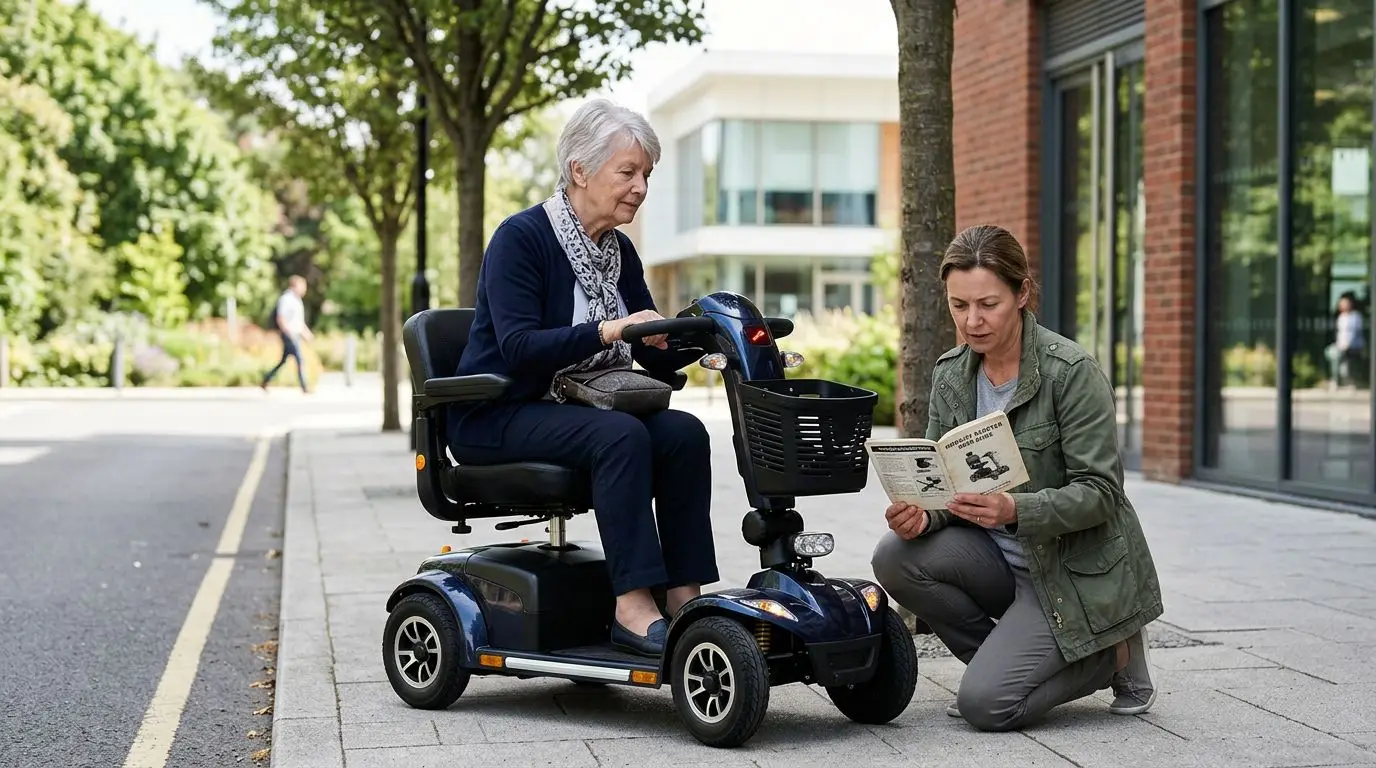
If your mobility scooter breaks down away from home, get yourself out of traffic first, turn the scooter off, and make one careful check of the basics: battery gauge, freewheel lever, key, throttle, and visible cables. If the scooter does not restart within a few minutes, stop troubleshooting and call a helper, building staff, a local mobility repair service, or non-emergency transportation. Do not push the scooter into traffic, bypass safety switches, or keep riding if you smell burning, see smoke, or notice a hot battery case.
A breakdown can be stressful, especially if you are alone in a parking lot, store, sidewalk, medical campus, or apartment complex. The goal is not to become a repair technician on the spot. It is to stay safe, identify simple user-correctable issues, and get you and the scooter home without turning a small problem into a larger one.
The first 5 minutes: get safe before you troubleshoot
Your first 5 minutes matter more than any repair step. If the scooter stops in a driveway, crosswalk, parking aisle, curb ramp, or store entrance, focus on visibility and personal safety before touching the controls. If you can coast or steer to the side safely, do so. If you cannot, wave to someone nearby and ask for help creating space around you.
Turn the key or power button off. Wait 10 to 20 seconds. Turn it back on once. Many scooters use basic controller protections that may reset after a brief power cycle, especially after a sudden stop, overload, or throttle error. If the scooter immediately beeps, flashes, or stays dead, do not keep cycling the power again and again.
Next, check whether the scooter is blocking vehicles or pedestrians. If it is, call for help right away. A scooter that weighs 90 to 300 lb or more, depending on type and battery size, can be hard to move without power. Do not let strangers lift it by the seat, tiller, armrests, or plastic shrouds, because those parts may not be designed as lifting points.
- Move yourself away from moving cars, slopes, doorways, and curb edges.
- Set the parking brake if your scooter has one.
- Turn on lights or hazard flashers if available.
- Call a family member, caregiver, building desk, store manager, or local non-emergency number if you are stuck in an unsafe spot.
- If you are injured, overheated, confused, or in immediate danger, call 911.
Short version: people first, scooter second.
Read the warning signs: 6 common clues and what they may mean
Most mobility scooter breakdowns away from home fall into a few practical categories: low power, freewheel mode, throttle or brake lockout, loose connection, controller fault, or mechanical obstruction. Many scooters communicate problems through beeps, flashing lights, or a display symbol. The exact code varies by manufacturer, so your owner manual is the final reference, but the field clues below can help you decide what to check next.
| What you notice | Possible cause | What to do away from home |
|---|---|---|
| No lights, no display, no horn | Main battery connection, depleted battery, fuse or breaker issue | Check that the battery pack is seated and the charger port cover is not interfering. Call for help if it is still dead. |
| Lights on, scooter will not move | Freewheel lever engaged, throttle not centered, brake lockout | Confirm drive mode, release throttle fully, power cycle once. |
| Repeated beeps or flashes | Controller fault or safety lockout | Count the pattern if safe. Record it for repair service. |
| Scooter slows sharply on a small hill | Low battery, overload, overheating protection | Stop on level ground and avoid forcing the motor uphill. |
| Grinding, rubbing, or dragging sound | Debris, brake issue, tire problem, loose trim | Stop riding. Look for visible debris around wheels, but do not put fingers near moving parts. |
| Burning smell, smoke, unusual heat | Electrical or battery hazard | Turn off power, move away if safe, and call for urgent help. |
When you call for help, describe the warning sign in plain terms. For example: the display turns on, I hear 5 beeps, but the scooter will not move. That is more useful than saying it is broken.
Battery trouble away from home: 3 checks you can do safely
Battery problems are among the most common reasons riders search for help from a parking lot or sidewalk. A scooter may show 2 bars at rest and still drop to empty when climbing a ramp, crossing thick carpet, or carrying a heavy load. Battery gauges are estimates, not fuel gauges, and they can fall quickly under strain.
Start with 3 safe checks. First, look at the battery gauge after the scooter has been sitting still for 30 seconds. If it rebounds upward, the pack may be weak under load. Second, make sure a removable battery pack is fully latched in place. A pack that is off by a fraction of an inch may power the display but fail under vibration. Third, check the charger port area. Sometimes a loose cover, dust, or a partially inserted charging plug can prevent normal operation.
Do not open a battery case in a public place. Do not bridge terminals with metal tools, keys, foil, or a pocketknife. If the battery case is cracked, swollen, leaking, unusually hot, or smells sharp or chemical, move away and ask for professional help. Lead-acid and lithium-based scooter batteries are different internally, but both deserve caution when damaged.
If you still have partial power, reduce demand. Turn off extra lights if safe, avoid steep ramps, and head toward a staffed location within a few hundred feet instead of trying to make it several blocks. A weak battery can quit suddenly after one more hill.
Freewheel, throttle, and brake lockouts: 4 simple fixes to try
Many no-move situations are not true breakdowns. They are safety lockouts. Scooters are designed not to drive when certain controls are in the wrong position. Four checks are worth trying before you call it a failure.
- Freewheel lever: Make sure the scooter is in drive mode, not manual push mode. The lever is usually near the rear wheels or motor area. If it is in freewheel, the scooter may roll but not drive.
- Throttle centered: Release the wig-wag paddle, thumb lever, or twist control completely before turning the scooter on. If the throttle is pressed during startup, many scooters refuse to move.
- Seat and tiller position: Confirm the seat is locked and the tiller is not folded or loose. Some scooters have interlocks or wiring that can be disturbed by folding.
- Brake release: If the scooter has a manual parking brake, make sure it is fully released before driving.
After each check, turn the scooter off, wait 10 seconds, and turn it on again. Try the throttle gently. If the scooter jerks, chatters, or moves unpredictably, stop. A controlled tow or transport is safer than forcing it.
Who this breakdown plan is best for: 4 rider situations
This guide is for riders who use a mobility scooter for everyday errands, appointments, travel, and community access. It is especially useful in 4 common situations: riding alone, using a scooter in a large facility, traveling more than 1 mile from home, or depending on a removable battery pack.
If you ride alone, your plan should focus on communication. Carry a charged phone, an emergency contact card, and any access codes a helper may need, such as a building gate or lobby number. If you ride in large facilities, such as hospitals, senior communities, shopping centers, or transit stations, learn where customer service desks and security phones are located.
If you travel more than 1 mile from home, range planning matters. A scooter that can handle a short trip on a perfect day may struggle when the return route includes ramps, wind, cracked sidewalks, cold weather, or repeated stops. If you use a removable battery, practice removing and reseating it at home before you need to do it in a parking lot.
| Scooter type | Breakdown concern | Preparedness tip |
|---|---|---|
| Portable travel scooter | Battery pack not fully seated after transport | Check the latch before every trip and after loading. |
| 3-wheel scooter | More attention needed on uneven surfaces | Avoid sharp turns on slopes and cracked curb cuts. |
| 4-wheel scooter | Heavier to move if power fails | Carry contact numbers for transport help, not just repair. |
| Heavy-duty scooter | Harder for one helper to push or lift | Know safe tie-down points and accessible pickup areas. |
No scooter type is breakdown-proof. The right plan depends on where you ride, how far you go, and who can help if the scooter cannot be driven home.
How to choose and measure your backup plan: use the 1-mile rule
A good backup plan is measured, not guessed. Start with the 1-mile rule: if you ride more than 1 mile from home or your vehicle, have a clear way to contact help and a place where you can wait safely for at least 30 to 60 minutes. That waiting place might be a store entrance, lobby, shaded bench, clinic desk, or transit office.
Measure your regular routes in 3 parts: distance, slopes, and safe stopping points. You can use a phone map, a pedometer app, or a car odometer for rough distance. Write down the longest one-way trip you normally take. Then mark any ramps, steep driveways, rough sidewalks, railroad crossings, gravel sections, or long stretches without seating.
Also measure your scooter in practical terms. Know the overall length, width, and approximate weight with batteries installed. Many full-size scooters are roughly 24 to 28 inches wide, while portable scooters may be narrower. The exact measurement matters if someone needs to bring a vehicle, use a lift, or meet you at a narrow doorway.
- Keep a card with scooter width, length, battery type, and total weight if known.
- List 2 emergency contacts, not just 1.
- Note whether your scooter can be pushed in freewheel mode.
- Mark the safest pickup point for your 3 most common destinations.
- Ask your local repair provider what information they want when you call.
This is not overplanning. It is a way to protect your independence by reducing uncertainty.
Roadside-style scooter kit: 12 items worth carrying
A mobility scooter roadside kit should be small, light, and realistic. You are not packing a workshop. You are carrying items that help you communicate, be seen, document the problem, and wait safely. A small pouch under the seat or in a front basket is usually enough.
| Item | Why it helps | Notes |
|---|---|---|
| Charged phone | Calls, maps, photos, emergency contacts | Keep it on your person, not only in the scooter basket. |
| Portable phone power bank | Backup if the phone battery is low | A 5,000 to 10,000 mAh size is often compact. |
| Emergency contact card | Helps others assist you quickly | Include medications only if you are comfortable doing so. |
| Small flashlight | Helps locate levers and dropped keys | Useful in garages and evening trips. |
| Reflective band or clip light | Makes you more visible | Especially helpful near parking lots. |
| Owner manual quick sheet | Identifies beep or flash codes | Photocopy only the important pages. |
| Seat-size rain poncho | Keeps you dry while waiting | A compact poncho is lighter than a coat. |
| Water bottle | Prevents discomfort during delays | Important in warm weather. |
| Basic ID and insurance card | Useful if medical help is needed | Carry separately from the scooter if possible. |
| Small notepad and pen | Record beeps, location, repair details | Works even if your phone dies. |
| Lightweight gloves | Protects hands if checking wheels | Do not reach into moving parts. |
| Local contact list | Repair, transport, building desk, family | Print it in large type. |
Skip heavy tools unless your manual specifically recommends them and you know how to use them. Extra weight reduces range, and public troubleshooting should stay simple.
Getting help without making damage worse: 3 call options
Once you decide the scooter will not safely restart, choose the right kind of help. There are usually 3 call options: a personal helper, on-site staff, or mobility equipment service. In some areas, accessible taxi or paratransit providers may also help you get home, though policies vary and may require advance registration.
A personal helper may be best if the scooter is close to home and can be pushed safely in freewheel mode. Before anyone pushes, confirm the route is flat, short, and away from traffic. Pushing a powered scooter for more than a few blocks can be difficult, and some scooters do not roll freely when the brake or motor is engaged.
On-site staff can be very helpful in shopping centers, medical offices, apartment communities, airports, and transit hubs. They may have a wheelchair, a safe waiting area, or a maintenance cart. Ask for a supervisor if the first person is unsure. Be clear: you need help getting out of an unsafe location, not someone to repair the scooter.
A mobility equipment service is the better call for electrical faults, brake problems, repeated codes, damaged tires, or battery concerns. When you call, give 5 details: your exact location, scooter type, whether the display turns on, any beep or flash pattern, and whether it can be pushed in freewheel. If the scooter must be transported, ask how they prefer it positioned and whether the battery should remain installed.
Do not let anyone tow the scooter behind a car, pickup, golf cart, bicycle, or another scooter. The drive system, brakes, and frame are not made for that kind of pull.
After you get home: a 30-minute follow-up checklist
Once you and the scooter are home, set aside 30 minutes for a calm follow-up. Write down where the breakdown happened, the weather, the battery reading, the surface you were riding on, and any warning lights or sounds. Details fade quickly, and they are useful when speaking with a technician.
Recharge the scooter fully according to the owner manual. After charging, check whether the charger shows its normal complete indicator. If the scooter died unusually fast, avoid assuming the battery is the only issue. Dragging brakes, underinflated pneumatic tires, a failing charger, worn connectors, cold temperatures, heavy loads, or steep routes can all reduce range.
Inspect the scooter visually. Look for loose knobs, cracked plastic, low tires, debris around axles, bent anti-tip wheels, damaged charger ports, and frayed cables. Do not remove covers unless your manual says to and you are comfortable doing it. If a fuse, breaker, or reset button is mentioned in the manual, follow the instructions exactly.
If the scooter broke down in a risky location, update your travel habits before the next long ride. That may mean charging sooner, choosing a flatter route, adding a phone power bank, or scheduling preventive service. A single breakdown is a warning sign worth respecting.
FAQ: 5 questions riders ask after a scooter breakdown
Can I push my mobility scooter home if it stops working?
Maybe, but only if the scooter can be placed in freewheel mode and the route is short, flat, and safe. Many scooters are heavy, and pushing on slopes or near traffic can be dangerous. Never push by fragile parts such as the tiller, basket, armrests, or seatback.
What should I do if my scooter battery dies in a store?
Ask store staff for help moving to a safe waiting area, then call your contact or a mobility service provider. Do not plug the scooter into a random outlet unless staff gives permission and the area is safe for the charger cord.
Why does my scooter show battery bars but still will not move?
The display may have enough power to light up even when the battery cannot deliver enough current to drive the motor. A safety lockout, freewheel lever, throttle startup error, or loose battery connection can cause the same symptom.
Is it safe to reset the breaker on a scooter away from home?
If your manual identifies a reset button or breaker and you can reach it safely, one reset may be reasonable. If it trips again, stop using the scooter and arrange service. Repeated resets can hide a real electrical problem.
Should I call emergency services for a broken mobility scooter?
Call 911 if you are injured, stranded in traffic, exposed to dangerous heat or cold, or in immediate danger. If you are safe but need transportation or repair, use non-emergency contacts, family, building staff, or a mobility equipment service.
Frequently asked questions
Can I push my mobility scooter home if it stops working? +
Only if it can be placed in freewheel mode and the route is short, flat, and safe. Avoid slopes, traffic, and pushing by fragile parts such as the tiller, armrests, or seatback.
What should I do if my scooter battery dies in a store? +
Ask store staff to help you move to a safe waiting area, then call a family member, caregiver, accessible transportation provider, or mobility equipment service. Do not use an outlet unless staff approves it.
Why does my scooter show battery bars but still will not move? +
The display may light up even when the battery cannot deliver enough power to the motor. A freewheel lever, throttle startup error, brake lockout, or loose battery pack can cause the same symptom.
Is it safe to reset the breaker on a scooter away from home? +
If your owner manual identifies the reset button and you can reach it safely, one reset may be reasonable. If it trips again, stop using the scooter and arrange professional service.
Should I call emergency services for a broken mobility scooter? +
Call 911 if you are injured, stuck in traffic, exposed to dangerous weather, or in immediate danger. If you are safe, use non-emergency contacts, on-site staff, transportation help, or a mobility repair provider.
Related guides
Where to Get Mobility Scooter Repairs Near You: Local Shops, In-Home Service, and What to Ask
14 min read
Mobility Scooter Won’t Turn On: Battery, Key Switch, Fuse, Brake, and Freewheel Checks
15 min read
Mobility Scooter Keeps Beeping or Won’t Move? Brake, Battery, and Error-Code Checks
13 min read