A mobility scooter carrier or vehicle lift can work well when your vehicle’s hitch tongue weight rating is higher than the combined weight of the scooter, carrier, and any mounting hardware. The key is to compare real numbers: scooter weight, platform size, hitch rating, rear clearance, and your ability to load and secure the scooter safely every time.
For many drivers, the safest choice is not the largest carrier available. It is the setup that fits the vehicle without overloading the hitch, blocking lights or the license plate, dragging on steep driveways, or requiring unsafe lifting. If the math is close, the scooter is heavy, or electrical wiring is needed, professional installation is usually worth considering.
The 3 numbers that decide fit: tongue weight, scooter weight, and platform size
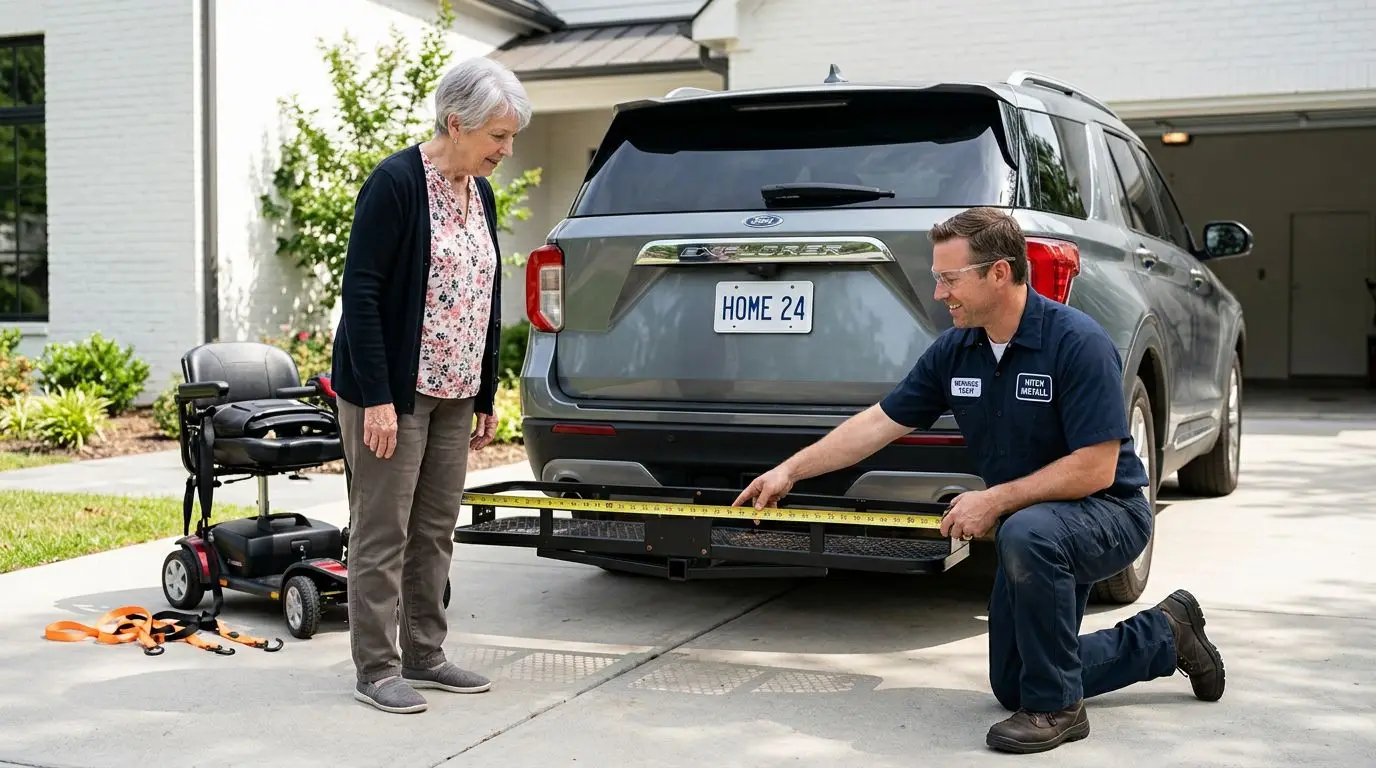
Start with three measurements: hitch tongue weight rating, actual scooter weight, and usable platform dimensions. A common mistake is checking only the vehicle’s towing capacity, such as 3,500 pounds, while ignoring tongue weight, which may be 300 to 500 pounds depending on the hitch and vehicle. For a rear-mounted scooter carrier, tongue weight is the number that matters most.
Tongue weight is the downward force placed on the hitch. With an external carrier, that force includes the scooter, the carrier or lift, tie-downs, and sometimes a swing-away adapter or anti-rattle device. For example, a 250-pound scooter on an 85-pound carrier creates at least 335 pounds of tongue weight before accessories. Because the load sits behind the bumper, leverage can make the vehicle handle differently than the same weight placed inside the cargo area.
Scooter weight varies widely. Lightweight travel scooters may weigh about 85 to 130 pounds when fully assembled. Standard full-size scooters often fall around 150 to 250 pounds. Heavy-duty scooters can run 250 to 400 pounds or more, especially with larger batteries, wider seats, and reinforced frames. Always use the fully assembled weight, including batteries, seat, basket, and any accessories you will leave on during transport.
Platform size matters just as much. Many mobility scooters are roughly 40 to 55 inches long and 20 to 30 inches wide, but some 4-wheel and heavy-duty scooters are longer and wider. The scooter’s wheelbase and tire width must sit securely on the platform or tracks. If the wheels barely fit, tying the scooter down becomes harder and the risk of shifting increases.
| Fit number | What to check | Why it matters |
|---|---|---|
| Hitch tongue weight | Often 200, 300, 350, or 500 lb depending on vehicle and hitch | Sets the maximum downward load at the rear of the vehicle |
| Scooter weight | Use fully assembled weight, not frame-only weight | Batteries, seat, and accessories can add meaningful pounds |
| Carrier or lift weight | Manual carriers may be lighter than powered lifts | Counts against the same tongue weight limit |
| Platform length and width | Compare to scooter overall length and tire track | Prevents overhang, poor tie-down angles, and unstable loading |
| Ground clearance | Check clearance at the lowest rear point | Reduces scraping on driveways, ramps, and curbs |
If you cannot find the hitch rating, look for a label on the hitch receiver and check the vehicle owner’s manual. If the ratings disagree, use the lower number. Do not assume a larger receiver opening automatically means a higher safe load; receiver size, hitch construction, vehicle frame, and manufacturer limits all matter.
Carrier and lift types compared: manual ramps, powered platforms, and hoists
Most external scooter transport systems fall into 3 broad groups: manual ramp carriers, powered platform lifts, and hoist-style lifts. They all move the scooter outside the vehicle, but they differ in effort, cost complexity, and fit requirements. The right choice depends on the scooter’s weight, your strength and balance, and the vehicle’s hitch capacity.
A manual ramp carrier uses a platform attached to the hitch receiver and a folding or sliding ramp. You push or carefully drive the scooter onto the platform, then secure it with tie-downs. This can be practical for lighter scooters, but the ramp angle can be steep on taller vehicles. A ramp that rises 20 inches over a short distance may require more strength and control than expected.
A powered platform lift raises and lowers the scooter with an electric motor. This reduces pushing and lifting, which can help with heavier scooters or users with limited upper-body strength. Powered lifts usually weigh more than simple carriers and may require a vehicle power connection, so hitch capacity and installation quality become more important.
Hoist-style lifts are often used when the scooter is stored inside a cargo area, van, or truck bed rather than fully exposed behind the vehicle. A hoist lifts the scooter by a secure point and swings or guides it into place. This style can protect the scooter from road spray better than an outside platform, but it requires enough interior space and a suitable lifting path.
| Type | Typical use | Strengths | Watch-outs |
|---|---|---|---|
| Manual ramp carrier | Lighter scooters, drivers comfortable with loading | Simple, no vehicle wiring in many cases | Ramp angle, pushing effort, tie-down access |
| Powered platform lift | Mid-size to heavy scooters | Less physical loading effort | Heavier unit, electrical connection, hitch limits |
| Hoist-style lift | Interior cargo areas, vans, some truck beds | Keeps scooter inside the vehicle | Needs headroom, cargo length, and secure mounting |
| Hybrid or fold-up carrier | Occasional use where storage length matters | Can reduce rear extension when empty | Still adds rear weight and may block access |
There is no single best type for everyone. A 110-pound travel scooter and a low vehicle may pair well with a manual ramp. A 300-pound scooter on a tall SUV may call for a powered lift, provided the vehicle and hitch are rated for the full load.
How to measure your scooter and vehicle in 15 minutes
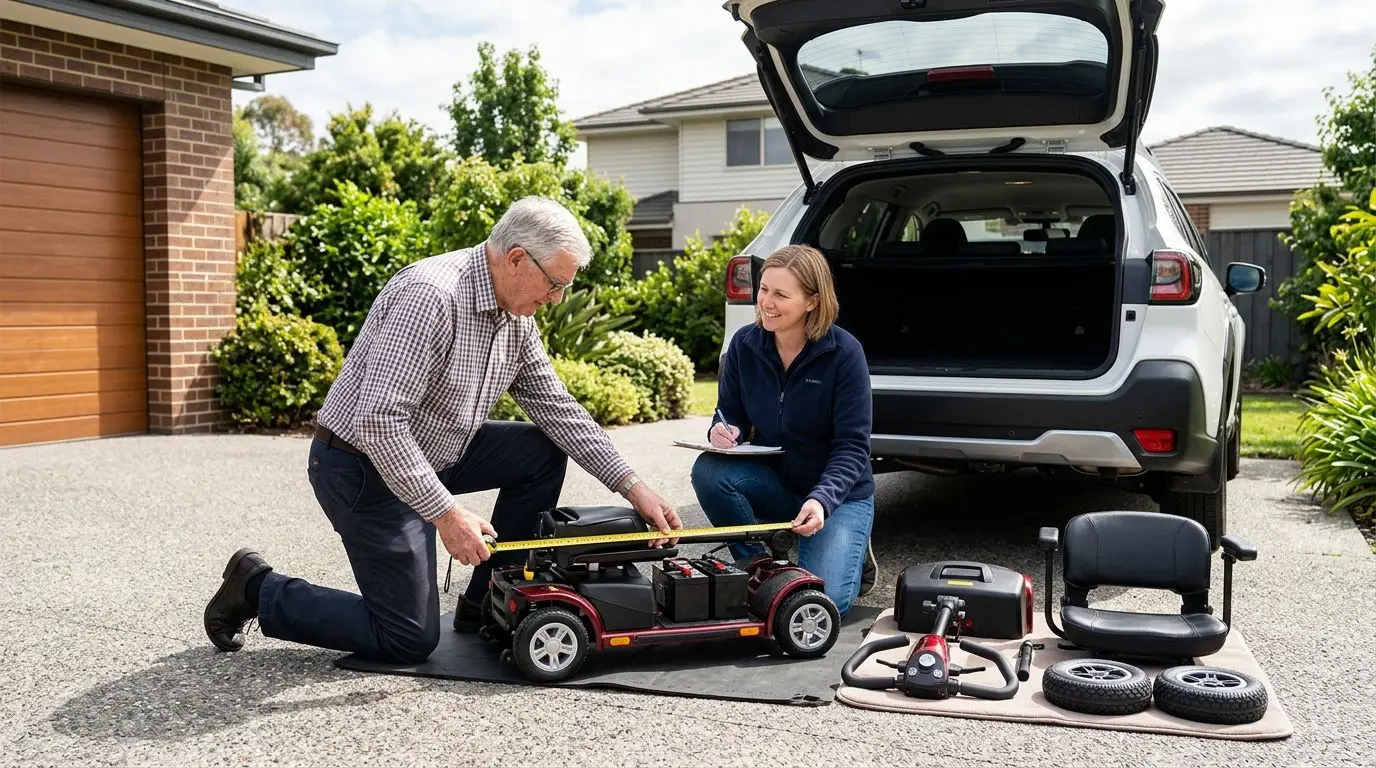
You can do a useful fit check in about 15 minutes with a tape measure, a bathroom or platform scale if available, and the vehicle manual. Write the numbers down. Guessing by sight is where many carrier problems begin.
Measure the scooter
- Overall length: Measure from the front-most point to the rear-most point, including anti-tip wheels, basket, or rear accessories.
- Overall width: Measure the widest point, often the armrests, rear wheels, or fenders.
- Wheel track: Measure the outside-to-outside distance across the tires that will sit on the carrier tracks or platform.
- Ground clearance: Note the lowest point under the scooter, especially if using a ramp.
- Actual transport weight: Include batteries and the seat unless you plan to remove them every trip.
If your scooter is listed at 180 pounds without batteries and each battery weighs 22 pounds, the transport weight may be closer to 224 pounds before baskets or cane holders. That difference can decide whether a 300-pound tongue weight limit is enough.
Measure the vehicle
- Hitch receiver height: Measure from the ground to the inside top edge of the receiver opening.
- Rear bumper depth: Measure how far the bumper extends beyond the hitch pin hole.
- Hatch or trunk swing: Open the hatch and note whether a raised carrier would block it.
- Exhaust location: Check whether hot exhaust points toward the scooter, tires, batteries, or controls.
- Light and plate visibility: Stand 20 to 30 feet behind the vehicle and check whether the carrier would block lights or the license plate.
Ground clearance is especially important on small cars, minivans with long rear overhangs, and vehicles that sit low when loaded. A carrier that has 12 inches of clearance while empty may have less after a 250-pound scooter is added. Test the route out of your driveway before taking a longer trip.
Hitch classes and weight limits: use the lower number every time
Many passenger vehicles use receiver hitches grouped by class, but the class alone is not enough. As a general reference, lighter hitches may have around 200 pounds of tongue weight capacity, some mid-range setups may be around 300 to 350 pounds, and heavier receiver hitches may be rated around 500 pounds or more. Your actual vehicle limit may be lower.
Use the lowest rating among the vehicle, hitch, carrier, lift, hitch adapter, and any extension. If the vehicle manual says 300 pounds of tongue weight and the hitch label says 350 pounds, treat 300 pounds as the limit. If an adapter reduces capacity by 50 percent, include that reduction in your math.
Hitch extensions deserve caution. They move the load farther from the vehicle, increasing leverage on the hitch and rear structure. Even a short extension can reduce the effective capacity. Avoid stacking adapters unless a qualified installer confirms the complete setup is suitable.
Here is a simple worksheet:
| Item | Example weight | Your number |
|---|---|---|
| Fully assembled scooter | 240 lb | |
| Carrier or powered lift | 90 lb | |
| Tie-downs, cover, small accessories | 10 lb | |
| Total rear load | 340 lb | |
| Lowest tongue weight rating | 350 lb |
In this example, the numbers are too close for comfort. A 340-pound load against a 350-pound limit leaves little margin for measurement error, added accessories, road bounce, or a future scooter change. Looking for a lighter transport setup or another vehicle may be safer than operating at the edge of the rating.
Loading safety checks before every trip: a 10-point routine
A carrier is only safe if the scooter is loaded and secured correctly each time. Use the same 10-point routine before every trip, even for a 5-mile errand. Repetition helps catch small problems before they become serious.
- 1. Park on level ground. Avoid loading on a slope where the scooter can roll unexpectedly.
- 2. Turn scooter power off. Remove the key if possible after positioning.
- 3. Confirm the freewheel lever is locked. A scooter left in freewheel can move during transport.
- 4. Center the scooter. Keep weight balanced left to right on the platform.
- 5. Use rated tie-down straps. Secure the frame, not only the basket, seat post, or plastic shrouds.
- 6. Use at least 4 tie-down points when possible. Front and rear restraint helps prevent rocking and shifting.
- 7. Fold or remove loose items. Baskets, cushions, flags, and covers can flap or detach at highway speed.
- 8. Check lights and plate visibility. Use auxiliary lighting or a plate relocation solution if required in your state.
- 9. Check ground clearance. Look under the loaded carrier before pulling away.
- 10. Recheck after 5 to 10 miles. Straps can settle after the first few bumps.
Do not ride the scooter while it is on the carrier, and do not let anyone stand behind the vehicle during loading. If a ramp feels too steep or the scooter feels hard to control, stop and reassess. A powered lift or professional help may be the better fit.
When professional installation is worth it: wiring, hitch, and clearance
Professional installation is worth serious consideration when the total load is near the hitch limit, when a powered lift needs a direct electrical connection, or when the vehicle requires a new hitch. Many powered lifts draw power from the vehicle battery through wiring that must be protected, fused, and routed away from heat and moving parts. A poor electrical connection can leave the lift stuck in the raised or lowered position.
A professional installer can also check whether the hitch is appropriate for the vehicle’s frame or body structure. Some vehicles, especially compact cars and certain crossovers, may not be good candidates for a heavy external scooter lift even if a hitch can physically be attached. Rear suspension sag, reduced steering feel, and headlight aim changes can occur when several hundred pounds are added behind the rear axle.
Clearance is another reason to get help. A lift that works on flat pavement may scrape entering a driveway with a 10-degree slope or a sharply angled curb cut. Installers who regularly fit mobility equipment can often identify whether a riser, different carrier style, or inside-the-vehicle lift is more practical.
Professional help is also smart if you need auxiliary lights, a license plate bracket, or wiring to keep the setup legal and visible. State rules vary, but brake lights, turn signals, and the plate generally need to remain visible from behind the vehicle.
Who it is best for: 4 common situations
External carriers and lifts are best for people who have a compatible vehicle, a scooter that fits within the weight rating, and a repeatable loading routine. The best setup changes by scooter size and daily needs. These 4 situations cover many shoppers.
1. Lightweight travel scooter and occasional trips
A manual ramp carrier may work if the scooter is around 100 to 130 pounds, the ramp angle is manageable, and the user or caregiver can load it without strain. It is often simpler than a powered lift, but it still requires careful tie-downs and enough hitch capacity.
2. Full-size scooter used several times a week
A powered platform lift may reduce physical effort for scooters in the 150 to 250-pound range. Check the lift weight and electrical needs carefully. The convenience can be meaningful, but only if the vehicle has enough tongue weight capacity after adding the lift itself.
3. Heavy-duty scooter or bariatric scooter
Heavy-duty scooters can exceed the practical limits of many cars and small SUVs. If the scooter is 300 pounds or more, the combined rear load may require a stronger vehicle, a different transport method, or an interior lift in a van or truck-style setup. Do not assume a standard hitch carrier will be enough.
4. Driver who cannot bend, push, or manage straps easily
The transport system must match the person using it. If securing 4 straps, folding a ramp, or reaching the rear tie-down points is difficult, a caregiver, powered lift, or different vehicle arrangement may be needed. Independence is important, but the process should be realistic on a rainy day, in a parking lot, and after a medical appointment.
Feature comparison: 8 details that affect daily use
Beyond weight ratings, compare the practical features you will use every week. A carrier that saves 2 minutes during loading may not be worth it if it blocks the hatch, drags on your driveway, or takes two people to fold.
| Feature | Why it matters | Good question to ask |
|---|---|---|
| Ramp length | Longer ramps usually reduce loading angle | Can I control the scooter on this incline? |
| Platform width | Must support tire position and tie-down angles | Do all wheels sit fully on the platform? |
| Fold-up position | Reduces length when empty | Does it block the hatch, camera, or sensors? |
| Anti-rattle hardware | Reduces movement and noise | Is the carrier stable after tightening? |
| Raised rail or wheel stops | Helps keep tires positioned | Does it fit my scooter’s wheel size? |
| Tie-down access | Affects safe securement | Can I reach all 4 points comfortably? |
| Lighting compatibility | Maintains visibility | Are lights and plate clear from 20 feet back? |
| Weather exposure | Scooter rides outside in rain and road spray | Should I remove the battery or protect controls? |
Weather deserves a practical note. Outdoor carriers expose the scooter to water, salt, dust, and road debris. A cover may help protect the seat and controls, but it must be tight enough not to flap loose. Some users remove baskets, cushions, or portable batteries before travel to reduce exposure and weight.
FAQ: 5 answers before you buy a scooter carrier or lift
Can I use towing capacity instead of tongue weight?
No. Towing capacity and tongue weight are different ratings. A vehicle may tow 3,500 pounds but allow only 350 pounds of downward tongue weight. For a rear scooter carrier or lift, use the tongue weight rating and include the scooter, carrier, and accessories.
Is a 2-inch hitch always strong enough for a mobility scooter lift?
Not always. A 2-inch receiver is common on heavier-duty hitch setups, but the receiver size alone does not guarantee capacity. Check the vehicle manual, hitch label, and any carrier or adapter limits, then follow the lowest rating.
Should I remove the scooter batteries before transport?
It depends on the scooter and battery design. Removing batteries can reduce weight, sometimes by 20 to 50 pounds or more, but only do this if the batteries are designed to be removed safely and you can lift and secure them inside the vehicle. Follow the scooter manual for battery handling.
Will an external carrier affect how my vehicle drives?
Yes, it can. Adding 200 to 400 pounds behind the rear axle may change steering feel, braking distance, rear suspension height, and headlight aim. Drive slowly at first, avoid abrupt maneuvers, and stay within all weight ratings.
When should I choose an interior lift instead of an outside carrier?
Consider an interior lift if you have enough cargo space and want better protection from weather and road debris. Interior lifts can be a good fit for vans, larger cargo areas, or truck beds, but they still require weight checks, secure mounting, and enough room for the scooter’s length and height.
The bottom line is simple: a scooter carrier or lift is a fit problem before it is a convenience purchase. Measure the scooter, verify the vehicle’s lowest weight rating, check clearance, and make sure the loading routine is safe for the person who will actually use it. If any number is close or any step feels uncertain, get qualified installation advice before putting the scooter on the road.
Frequently asked questions
Can I use towing capacity instead of tongue weight? +
No. Towing capacity and tongue weight are different ratings. For a rear scooter carrier or lift, use the tongue weight rating and include the scooter, carrier, lift hardware, tie-downs, and accessories.
Is a 2-inch hitch always strong enough for a mobility scooter lift? +
Not always. Receiver size does not guarantee safe capacity. Check the vehicle manual, hitch label, carrier or lift rating, and any adapter limits, then follow the lowest number.
Should I remove the scooter batteries before transport? +
Only if the scooter is designed for safe battery removal and you can lift and secure the batteries inside the vehicle. Removing batteries can reduce rear weight, but the scooter manual should guide battery handling.
Will an external carrier affect how my vehicle drives? +
Yes. Several hundred pounds behind the rear axle can affect steering feel, braking distance, suspension height, and headlight aim. Stay within ratings and test the setup carefully at low speeds first.
When should I choose an interior lift instead of an outside carrier? +
An interior lift may be better if you have enough cargo space and want more protection from weather and road debris. It still requires proper weight checks, mounting, and enough room for the scooter.
Related guides
Mobility Scooter Carriers vs. Vehicle Lifts: Which Transport Option Makes Sense?
16 min read
Before You Buy a Mobility Scooter Hitch Carrier: Vehicle, Hitch, Ramp, and Weight Checks
13 min read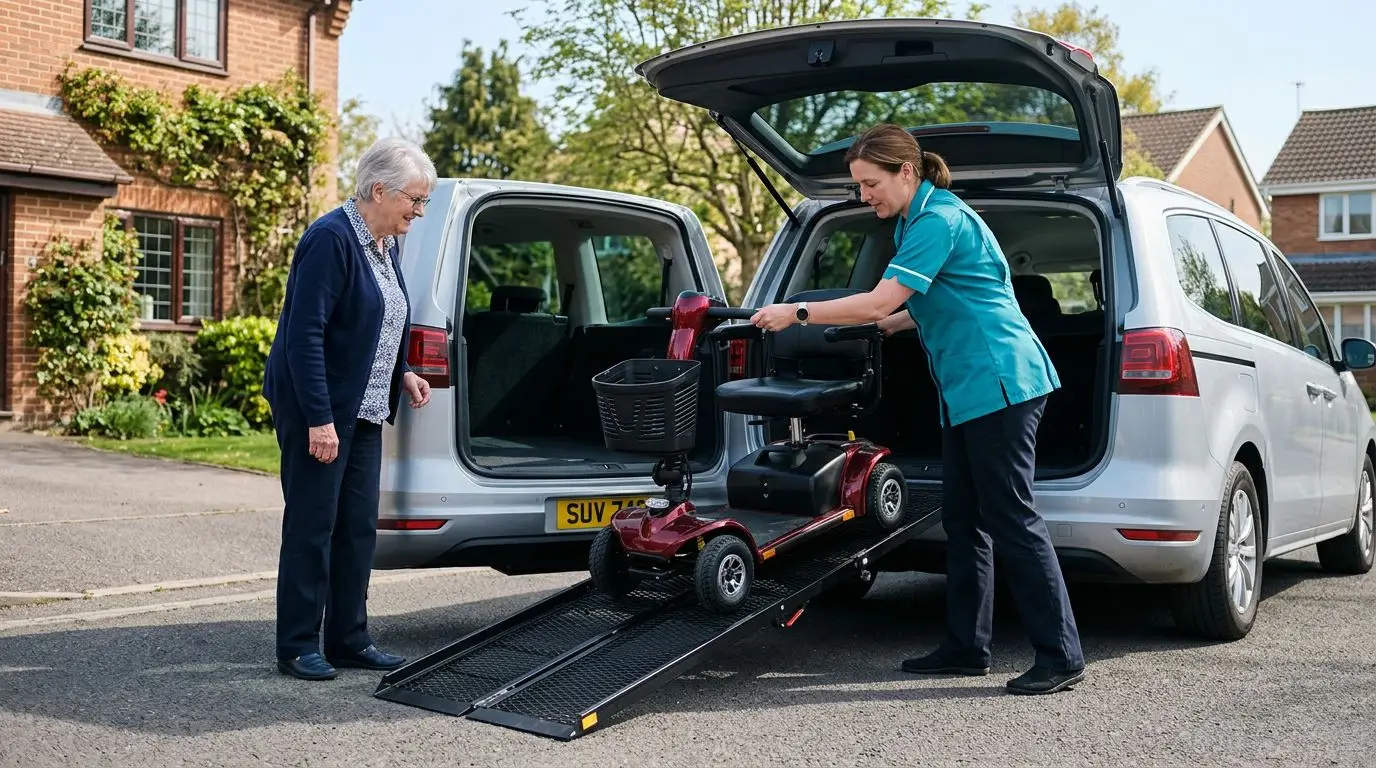
How to Transport a Mobility Scooter by Car: Lifts, Hitch Carriers, Ramps, and Portable Options
14 min read