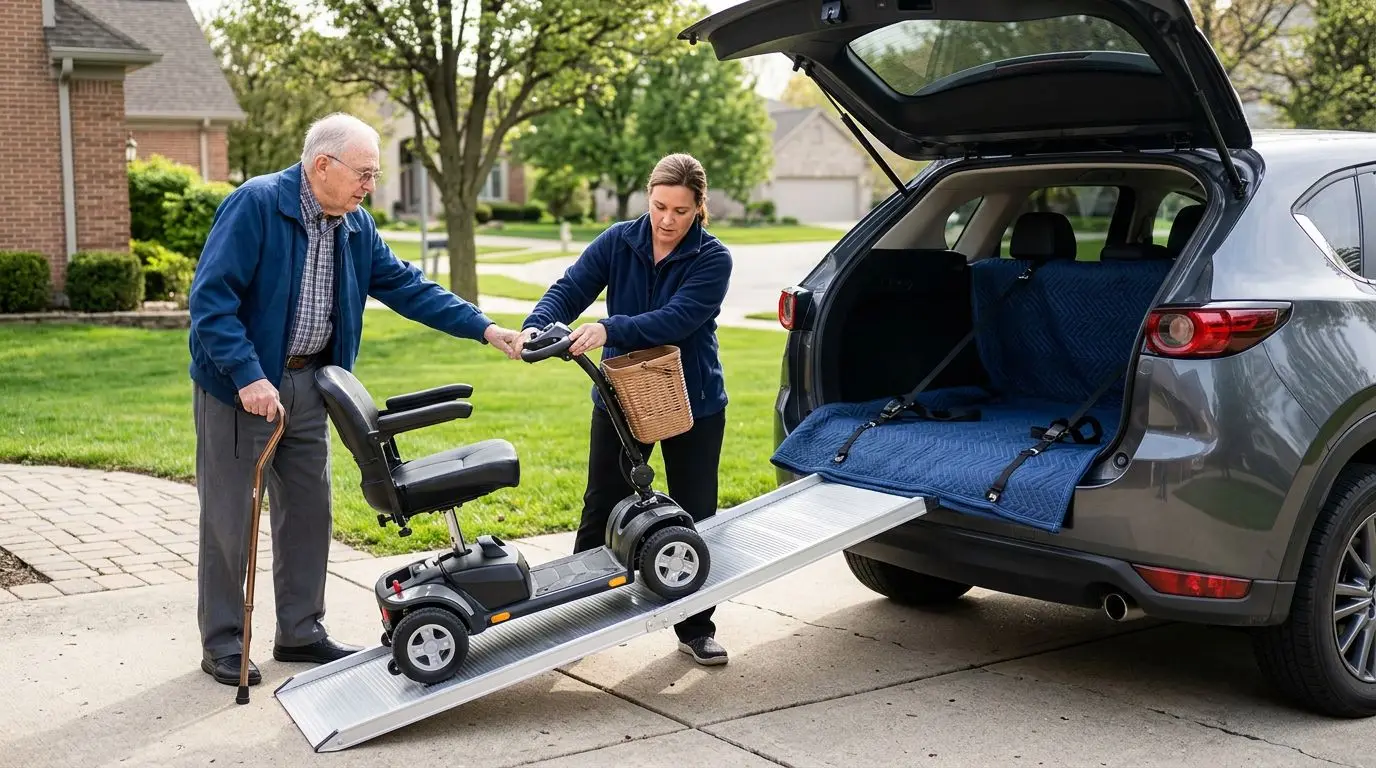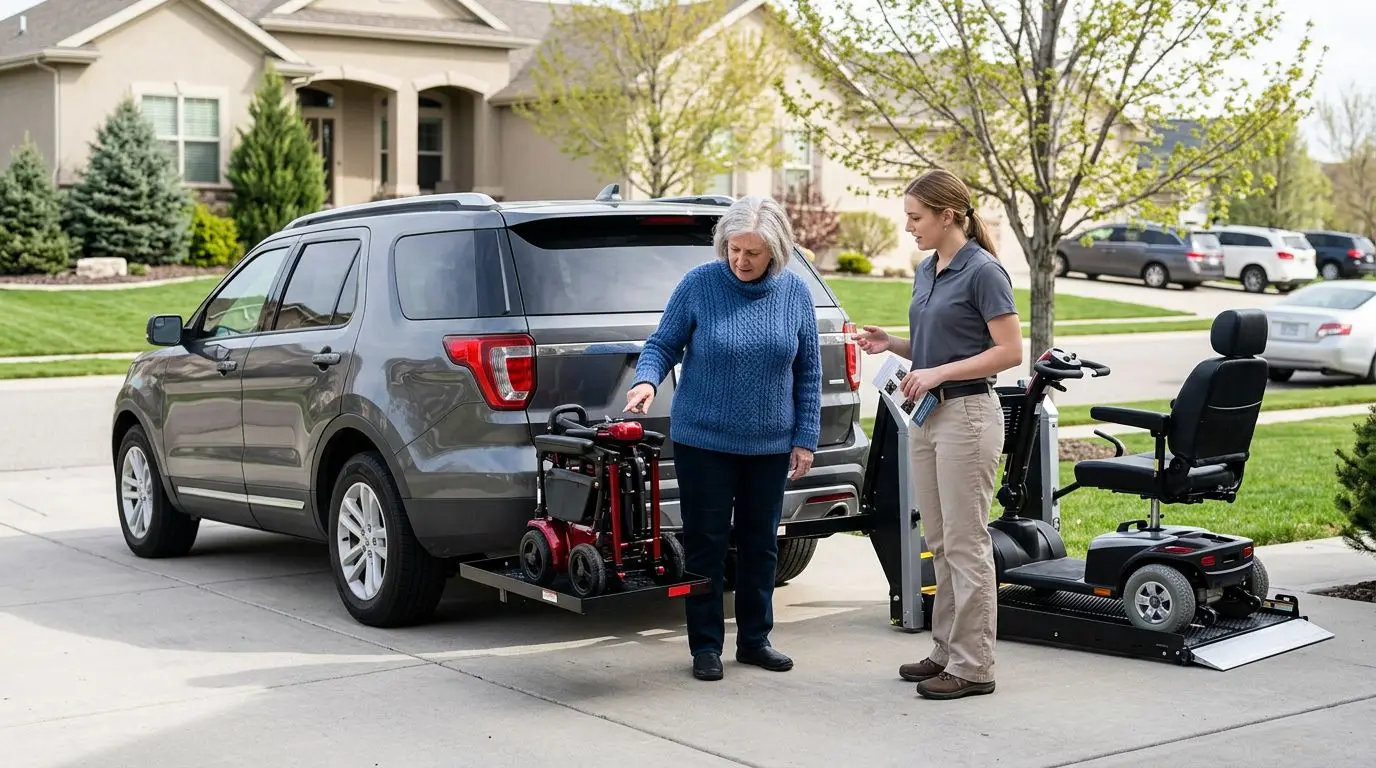
A mobility scooter carrier is usually the simpler, lower-cost choice if your scooter is light enough, your vehicle has the right hitch rating, and you can safely manage a ramp or platform. A vehicle lift makes more sense when the scooter is heavier, the user cannot push it up a ramp, or the scooter needs to ride inside the vehicle. The right choice comes down to four numbers: scooter weight, vehicle tongue weight capacity, hitch class, and the user’s safe loading ability.
Both options can work well. The wrong one can be frustrating, unsafe, or incompatible with your vehicle. This guide compares hitch carriers, exterior scooter lifts, and interior vehicle lifts so you can narrow your choice before talking with an installer or mobility equipment dealer.
Quick comparison: 3 common scooter transport options
Most scooter transport setups fall into one of three groups: a manual hitch carrier, a powered exterior lift, or an interior vehicle lift. A compact travel scooter may weigh under 100 lb without its battery, while a full-size or heavy-duty scooter can be 250 lb or more. That weight difference changes everything.
| Option | How it works | Best fit | Loading effort | Main trade-off |
|---|---|---|---|---|
| Manual hitch carrier | Scooter rolls onto a rear platform using a ramp | Smaller scooters and stronger caregivers | Moderate to high; user must guide scooter up a ramp | Lowest complexity, but requires physical control |
| Powered exterior lift | Motorized platform raises scooter behind the vehicle | Mid-size to heavier scooters | Low; user steers onto platform, lift does the raising | More cost and installation, exposed to weather |
| Interior lift or hoist | Lift arm or platform stores scooter inside cargo area | SUVs, vans, and users who want protected storage | Low to moderate; may require removing seat or tiller folding | Uses cargo space and needs enough rear opening height |
A hitch carrier is not automatically safer because it is simpler, and a powered lift is not automatically better because it is easier. Compatibility matters more than category. A carrier that exceeds tongue weight limits is a poor fit, even if the scooter fits on the platform.
How scooter carriers work: ramp length, platform size, and 2-inch receivers
A scooter carrier is a platform mounted to the vehicle’s trailer hitch receiver. Many are designed around a 2-inch hitch receiver because that size is common on SUVs, vans, crossovers, and some trucks. The scooter is rolled or driven onto the platform using a ramp, then secured with straps, wheel stops, or tie-down points.
Manual carriers are mechanically simple. There is no lift motor, no wiring to the vehicle battery, and usually no need to alter the cargo area. That simplicity is why many people look at a hitch carrier first.
The catch is the loading angle. A shorter ramp creates a steeper climb. For example, a ramp that rises 12 inches over 48 inches is much steeper than one that rises 12 inches over 72 inches. A steep ramp can be difficult if the scooter has small front wheels, low ground clearance, or a user who cannot walk steadily beside it.
Platform size matters too. A small travel scooter may have an overall length around 40 inches, while larger scooters can be 55 inches or longer. The platform should support the wheelbase properly without the tires sitting on an edge. If a basket, rear anti-tip wheels, or a wider captain’s seat changes the footprint, measure the scooter as you actually use it.
Who it is best for
- People with lighter scooters who can safely guide them up a ramp.
- Caregivers who can manage the scooter without lifting it.
- Drivers who want a less complex setup and do not need indoor scooter storage.
- Vehicles with a properly rated hitch and enough rear clearance.
Manual carriers are often a practical match for folding and travel scooters. They are less appealing for scooters that are heavy, long, low to the ground, or hard to steer when powered off.
How vehicle lifts work: powered platforms and interior hoists for 100-plus lb scooters
A vehicle lift uses a motorized mechanism to raise the scooter, reducing the need to push it up a ramp. Exterior lifts typically mount at the hitch and raise a platform behind the vehicle. Interior lifts or hoists load the scooter into the rear cargo area of an SUV, minivan, van, or hatchback.
For many users, the biggest benefit is reduced effort. If a scooter weighs 150 lb, pushing it up even a modest ramp can be awkward. A powered lift may only require positioning the scooter on the platform, securing it, and pressing a switch. That can make transport realistic for someone who drives alone or has limited upper-body strength.
Exterior lifts keep the scooter outside the vehicle. This preserves interior space, but the scooter is exposed to rain, road spray, salt, dust, and sun. A weather cover can help, but it does not fully protect the scooter. Interior lifts solve that problem by storing the scooter inside, where it is less visible and better sheltered.
Interior systems require careful cargo-room measurements. Rear opening height, floor-to-ceiling height, cargo depth, and seat-folding layout all matter. A scooter that fits on paper may still require removing the seat, folding the tiller, or using a smaller battery pack before loading.
Who it is best for
- Users who cannot safely push or guide a scooter up a ramp.
- Heavier scooters that exceed the practical limits of manual loading.
- Drivers who travel alone and need a repeatable loading process.
- People who want the scooter stored inside the vehicle, if cargo space allows.
A powered lift is not maintenance-free. It adds wiring, moving parts, and installation requirements. For the right user, though, it can be the difference between occasional transport and reliable day-to-day access.
Vehicle compatibility: hitch class, tongue weight, ground clearance, and rear doors
Compatibility starts with the vehicle, not the scooter. A carrier or exterior lift places weight behind the rear axle. That load includes the scooter, the platform or lift itself, and any accessories attached to the scooter. If the scooter weighs 180 lb and the carrier weighs 80 lb, the total load at the hitch area is 260 lb before you add a cover or tie-down gear.
The key number is tongue weight capacity. This is the maximum downward force the hitch and vehicle are rated to carry at the receiver. It is not the same as towing capacity. A vehicle may be able to tow a trailer yet still have a tongue weight limit that is too low for a scooter carrier.
Hitch class matters too. Smaller hitch receivers may not accept many scooter carriers or lifts. A 2-inch receiver is commonly used for heavier carrying equipment, but that does not guarantee the vehicle itself can handle the load. Always check the vehicle owner’s manual, hitch label, and installer guidance.
Rear suspension can also become an issue. When weight is added behind the bumper, the back of the vehicle can sag. That can reduce ground clearance, change headlight aim, and make driveways or speed bumps harder to navigate. Low cars and small crossovers may have trouble even when the hitch technically fits.
Rear access may change as well. Many carriers fold upright when empty, but they can still block a tailgate, hatch, or rear camera. Some vehicles with side-hinged rear doors need extra clearance because the door swings into the carrier area. Interior lifts have their own fit questions: a rear opening height under 30 inches may be tight for many scooters unless parts are removed or folded.
Vehicle fit checklist
- Confirm hitch receiver size and rating, including tongue weight.
- Add scooter weight plus carrier or lift weight before comparing limits.
- Measure rear ground clearance with passengers and cargo loaded.
- Check whether the rear hatch, tailgate, or door can still open.
- Ask whether wiring, lighting, or license plate relocation is needed.
If any of these points are close to the limit, get a professional fit check. A small measurement error can turn into a daily annoyance or a safety problem.
Weight limits: why 50 lb can change the right answer
Scooter weight is not just a catalog number. You need the transport weight: the scooter as it will be loaded. That may include batteries, seat, armrests, basket, canopy hardware, oxygen holder, or rear accessories. A battery can add noticeable weight, and two batteries can change the calculation quickly.
For manual carriers, the issue is not only the carrier’s rated capacity. The user must control the scooter on the ramp. A 90 lb folding scooter may be manageable for one caregiver, while a 140 lb scooter can feel very different on an incline, especially if the ramp is wet or the user is standing on uneven pavement.
For hitch-mounted lifts, weight ratings should be treated conservatively. If a lift is rated for a certain capacity, that rating assumes correct installation, proper hitch support, and a scooter that fits the platform as intended. A scooter that is within the weight rating but too long or too wide may still be unsafe to carry.
For interior lifts, scooter weight affects the lift mechanism and the vehicle structure where the lift is mounted. The cargo area must also tolerate repeated loading. Interior hoists often require a stable mounting location and enough swing clearance to bring the scooter inside without scraping trim or seats.
Measure the scooter in transport form
- Weigh or confirm the scooter weight with battery installed.
- Measure overall length from front tire or basket to rear-most point.
- Measure the widest point, often at the armrests or rear wheels.
- Measure height with seat installed, then again with the seat removed or folded.
- Note ground clearance; some scooters have only a few inches under the frame.
A 50 lb difference can move you from a manual ramp to a powered lift, or from a small crossover to a van. Weight also affects braking, rear visibility, and how the vehicle handles on rough roads.
Loading effort and safety: ramps, switches, straps, and 3-point contact
Loading is where the real-life difference shows up. A carrier may look easy in a driveway demonstration, but daily use can involve rain, sloped parking lots, dim lighting, or traffic beside the vehicle. If loading takes 10 minutes and leaves the user exhausted, the equipment may not be the right match.
Manual ramp loading requires balance and control. The safest approach is usually to walk beside the scooter, use the lowest practical speed, and avoid riding the scooter onto a rear carrier unless the carrier is specifically designed and rated for that use. Riding up a narrow ramp can be risky because the rider’s weight adds to the load and changes balance.
Powered lifts reduce pushing, but they still require safe positioning. The scooter should be centered on the platform, wheels should sit where intended, and the power should be off before travel. Tie-downs or built-in securement points must be used every time, even for short trips.
Good loading habits matter with either option. Keep 3 points of contact when stepping around the vehicle, avoid twisting while holding the scooter, and do not rush. A flashlight, gloves, and a simple loading checklist can make the process safer for older adults and caregivers.
| Feature | Why it matters | Best for |
|---|---|---|
| Longer ramp | Reduces loading angle | Manual carriers and low-clearance scooters |
| Powered raise/lower control | Reduces pushing and lifting effort | Solo users and heavier scooters |
| Wheel chocks or stops | Helps position scooter consistently | All exterior platforms |
| Multiple tie-down points | Limits scooter movement during turns and braking | Highway travel and larger scooters |
| Interior storage | Protects scooter from weather and road debris | Frequent travelers and wet climates |
If you cannot load and secure the scooter on a bad-weather day without strain, choose a lower-effort solution. Safety should beat convenience claims every time.
Cost trade-offs: upfront price, installation, maintenance, and resale value
Manual hitch carriers are usually the lowest-cost category because they have fewer parts and often do not need electrical installation. Powered exterior lifts cost more because they include a motor, wiring, controls, and a heavier structure. Interior lifts may add more complexity because the vehicle cargo area must fit and support the system.
Instead of shopping by price alone, compare total cost over 3 to 5 years. A manual carrier may look economical, but it is not a good value if the user avoids trips because loading is too hard. A powered lift may cost more at the start, yet still make sense if it prevents repeated caregiver strain or allows the scooter to be transported several times each week.
Installation is part of the equation. A hitch may need to be added. Electrical wiring may be required for a powered lift. Rear lights, license plate visibility, parking sensors, and backup cameras may need attention. Some setups may affect vehicle warranty questions, insurance reporting, or lease restrictions, so check before installing permanent equipment.
Maintenance also differs. A manual carrier needs inspection for rust, loose hardware, ramp hinges, and tie-down wear. A powered lift needs those checks plus attention to wiring, switches, moving joints, and battery draw. Interior lifts may require periodic adjustments if the scooter or cargo layout changes.
Cost decision guide
- Choose a manual carrier if the scooter is light, loading is easy, and the vehicle is hitch-ready.
- Choose a powered exterior lift if ramp loading is unsafe but outdoor transport is acceptable.
- Choose an interior lift if weather protection, theft deterrence, or garage clearance is a priority.
- Budget for the hitch, wiring, installation labor, covers, straps, and maintenance—not just the carrier or lift.
The least expensive option is the one that works reliably without creating risk. If two choices are close, prioritize easier loading and proper vehicle fit.
How to choose and measure: a 15-minute fit check before you buy
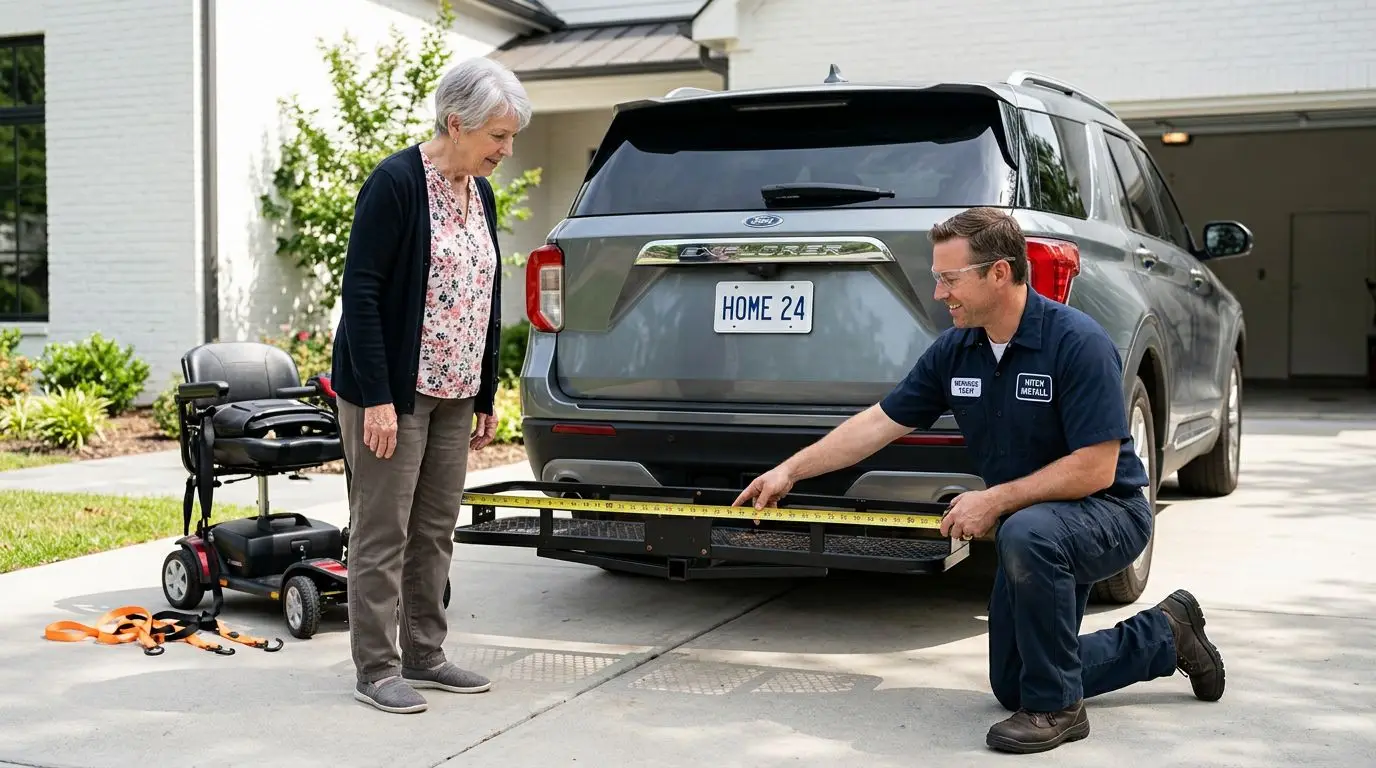
Before buying any carrier or lift, take 15 minutes to gather measurements. Write them down. If you speak with an installer, these numbers will make the conversation more accurate and reduce the chance of ordering equipment that does not fit.
Step 1: Measure the scooter
- Weight in transport form, including battery and common accessories.
- Overall length, width, and height.
- Wheelbase and tire width if the platform has tracks or channels.
- Lowest ground clearance point under the scooter.
- Whether the seat removes easily and how much weight that subtracts.
Step 2: Measure the vehicle
- Hitch receiver size and tongue weight rating.
- Height from the ground to the hitch receiver opening.
- Distance from hitch pin hole to rear bumper edge.
- Rear hatch or door swing clearance.
- Cargo opening width, cargo opening height, and cargo floor depth for interior lifts.
Step 3: Match the loading method to the user
Ask the practical question: can the user load, secure, unload, and store the equipment on an ordinary day? If the answer depends on a strong helper being present every time, the setup may not support independence. If the user has dizziness, poor balance, shoulder pain, or limited grip strength, powered loading deserves serious consideration.
Think about where the vehicle is parked too. A garage with a 7-foot door may not leave much room for a tall vehicle plus rear-mounted equipment. A tight apartment lot may make it hard to unfold a ramp behind the vehicle. A steep driveway can change the loading angle enough to matter.
Best choice by situation: 6 real-world examples
Different households reach different answers. Here are six common situations that show how the decision usually tilts.
| Situation | Likely best option | Reason |
|---|---|---|
| Travel scooter under 100 lb and a caregiver can guide it | Manual hitch carrier | Lower complexity and manageable loading effort |
| Mid-size scooter around 150 lb and user travels alone | Powered exterior lift | Reduces ramp effort and makes solo loading more realistic |
| Full-size scooter and small sedan | Reconsider vehicle or scooter choice | Tongue weight and rear clearance may be limiting |
| SUV with roomy cargo area and frequent highway trips | Interior lift | Protects scooter from weather and road debris |
| Driver needs rear hatch access several times daily | Interior lift or swing-away-compatible setup | Fixed rear platforms can block cargo access |
| Wet or snowy climate with road salt | Interior lift if space allows | Exterior equipment needs more cleaning and corrosion checks |
When in doubt, test the loading motion. Even a borrowed ramp or a showroom demonstration can reveal whether manual loading feels controlled or stressful.
FAQ: 5 questions people ask before transporting a scooter
Can I put any mobility scooter on a hitch carrier?
No. The scooter must fit the platform, stay within the carrier rating, and keep the total hitch load within the vehicle’s tongue weight capacity. Length, width, ground clearance, and securement points all matter.
Is a powered lift safer than a ramp carrier?
It can be safer for users who cannot control a scooter on a ramp, but only if it is properly installed and used as directed. A powered lift still needs correct positioning, tie-downs, and routine inspection.
Will a rear carrier block my backup camera or license plate?
Often, yes. A rear-mounted carrier or lift can block cameras, sensors, tail lights, or the license plate, especially with the scooter loaded. Some setups need added lighting or plate relocation to remain road legal.
Can I ride the scooter up the carrier ramp?
Usually, that is not recommended unless the carrier is specifically designed and rated for that use. Riding up a narrow ramp adds body weight, raises the center of gravity, and increases the chance of tipping or slipping.
Do I need a professional installer?
For powered lifts, professional installation is strongly recommended because wiring, hitch rating, and vehicle structure must be handled correctly. For manual carriers, many people still benefit from a fit check to confirm tongue weight, clearance, and securement.
Bottom line: match the transport option to the weakest link
The best scooter transport option is the one that fits the vehicle, carries the scooter within rated limits, and can be loaded safely every time. For many light scooters, a manual hitch carrier is practical. For heavier scooters or users with limited strength, a powered exterior or interior lift is often the better long-term choice.
Use the weakest link rule: if the hitch rating, scooter weight, ramp effort, or cargo space does not work, the setup does not work. Measure first, compare total weight, and choose the option that supports safe mobility without turning every trip into a struggle.
Frequently asked questions
Can I put any mobility scooter on a hitch carrier? +
No. The scooter must fit the platform, stay within the carrier rating, and keep the total hitch load within the vehicle’s tongue weight capacity. Measure scooter length, width, weight, and ground clearance before choosing.
Is a powered scooter lift better than a manual hitch carrier? +
A powered lift is better when the scooter is heavy or the user cannot safely guide it up a ramp. A manual carrier can still be a good choice for lighter scooters, proper hitch ratings, and users or caregivers who can load confidently.
What vehicle measurements matter most? +
Check hitch receiver size, tongue weight rating, hitch height, rear bumper clearance, hatch or door swing, and cargo opening dimensions if considering an interior lift.
Will a scooter carrier affect driving? +
It can. Rear-mounted weight may reduce ground clearance, block the backup camera, affect rear visibility, and change handling. The effect is greater with heavier scooters and smaller vehicles.
Do powered vehicle lifts need professional installation? +
Professional installation is strongly recommended for powered lifts because wiring, hitch rating, structural mounting, and safe operation all need to be verified.
Related guides
Mobility Scooter Carriers and Vehicle Lifts: Hitch Weight Limits, Scooter Weight, and Safety Checks
14 min read
How to Transport a Mobility Scooter by Car: Lifts, Hitch Carriers, Ramps, and Portable Options
14 min read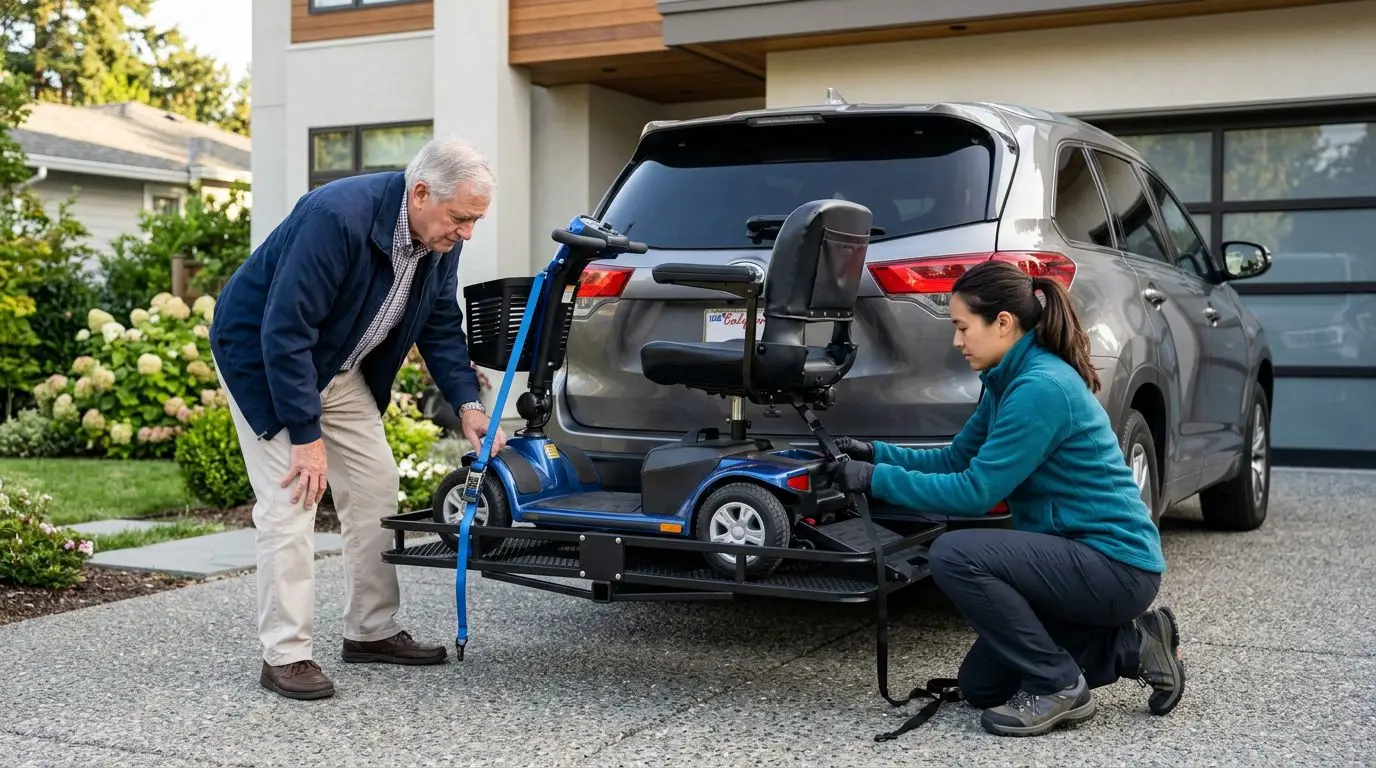
Before You Buy a Mobility Scooter Hitch Carrier: Vehicle, Hitch, Ramp, and Weight Checks
13 min read