
Mobility scooter insurance may be worth paying for if your scooter is expensive to replace, stored in a shared or outdoor area, used often in public, or not clearly covered by your homeowners or renters policy. The main ownership risks to ask about are liability, theft, accidental damage, and damage during transport. Before you buy a separate policy, compare your current coverage, deductible, exclusions, and the scooter’s replacement value.
What mobility scooter insurance can cover: 4 ownership risks
When people hear “mobility scooter insurance,” they often think of medical coverage, but ownership insurance is different. It protects the scooter itself and reduces your financial exposure if something happens while you use it. The 4 common risk areas are liability, theft, accidental damage, and transit or travel-related damage.
Coverage varies by insurer and policy type. Some protection may already exist under a homeowners, renters, condo, umbrella, or travel policy. Other situations may require a rider, scheduled personal property endorsement, or separate mobility scooter policy. The policy label matters less than the written language: whether it covers your actual scooter, where you use it, where you store it, and which losses are excluded.
| Risk area | What it may involve | Why it matters |
|---|---|---|
| Liability | Injury to another person or damage to property | A scooter can weigh well over 100 lb, and a bump in a store aisle can still cause damage |
| Theft | Scooter stolen from a garage, lobby, porch, vehicle, or public location | Standard personal property coverage may have limits or exclusions |
| Accidental damage | Tip-over, curb impact, rain exposure, or collision with a doorway | Repair bills can include batteries, controls, tires, body panels, and labor |
| Transport damage | Damage while loading, unloading, flying, cruising, or using a lift | Travel and carrier coverage can be narrow and time-sensitive |
A good first step is simple: call your current insurance agent and ask for a written explanation of how your policy treats a mobility scooter used as an assistive mobility device. Use the words “mobility scooter,” “motorized mobility aid,” and “personal property” to reduce confusion.
Liability coverage in public places: why 4 mph still matters
Many mobility scooters are designed for walking-speed use, often around 4 mph on sidewalks or indoor surfaces, while some larger outdoor scooters can travel faster. Even at modest speeds, liability can become an issue if the scooter injures someone or damages property. A tight turn in a grocery aisle, a crowded elevator, or a small ramp at an apartment entrance can create risk.
Liability coverage is not about assuming you are careless. It recognizes that scooters operate around pedestrians, doors, displays, parked cars, pets, and uneven surfaces. If you accidentally strike a person, scrape a parked vehicle, knock over merchandise, or damage a door frame, someone may ask you to pay.
Homeowners or renters liability coverage may help in some situations, but policy language matters. Some policies exclude certain motorized vehicles. Others make exceptions for motorized mobility devices used by a person with a mobility limitation. Do not rely on a verbal guess. Ask whether liability follows you away from home and whether the scooter is included when used in stores, medical offices, apartment common areas, sidewalks, and parking lots.
- Ask if personal liability applies when the scooter is used off your property.
- Ask whether a motorized mobility aid is treated differently from a recreational vehicle.
- Ask whether damage to rented property, hotel property, or assisted living property is covered.
- Ask if an umbrella liability policy would apply above the primary policy limit.
Public-use concerns are especially important for riders who use a scooter several days a week outside the home. A person who only uses a scooter in a private residence has a different liability profile than someone who rides through a senior community, shopping center, medical campus, and bus terminal every week.
Theft protection: 3 places scooters are commonly vulnerable
Theft risk depends less on the scooter type than on storage. The 3 places that deserve extra attention are shared residential spaces, vehicles or exterior lifts, and public parking spots. A scooter kept inside a locked home is in a different risk category than one parked overnight in an apartment hallway or stored on a covered porch.
Homeowners and renters policies often include personal property coverage, but the details can be frustrating. There may be a deductible, a limit for certain property, a requirement for forced entry, or restrictions when property is away from the residence. If the scooter is stored in a garage, storage room, lobby, or vehicle, ask specifically about those locations.
Documentation matters. Keep the purchase receipt, serial number, photos from 4 sides, battery details, and any repair or upgrade receipts. If the scooter is stolen, an insurer may ask for proof of ownership and proof of value. Photos also help show its condition before the loss.
| Storage location | Theft concern | Questions to ask |
|---|---|---|
| Inside a locked home | Usually lower risk | Is it covered as personal property? Is replacement cost available? |
| Apartment hallway or common room | Access by many people | Is common-area theft covered? Is there a storage requirement? |
| Garage or shed | May depend on locking and policy terms | Does coverage apply to detached structures? |
| Vehicle lift or cargo carrier | Visible and easier to target | Is theft from a vehicle or attached lift covered? |
| Public scooter parking | Harder to prove details | Is away-from-home theft covered, and what proof is needed? |
Security habits still matter, even with insurance. Use a lock that fits the scooter frame, remove the key, avoid leaving removable batteries unattended when practical, and choose well-lit storage. Insurance can help after a loss, but it cannot prevent the disruption of losing a mobility device you rely on.
Damage coverage: 5 events that may or may not be insured
Mobility scooters are durable, but they are not indestructible. A scooter may have electronics, battery packs, chargers, lights, suspension parts, tires, tiller controls, seats, and body panels. Damage coverage is worth reviewing because 5 common events are handled differently from one policy to another: collision, tip-over, weather exposure, transport damage, and vandalism.
Accidental damage can happen in ordinary use. A curb cut may be steeper than expected. A doorway may be narrower than it looks. A lift may jolt during loading. A scooter may be left in heavy rain, or a battery may be damaged by improper charging or storage. Some insurance policies cover sudden accidental damage; others exclude wear and tear, mechanical breakdown, battery deterioration, corrosion, and gradual damage.
- Collision: Ask whether damage from hitting a wall, curb, post, vehicle, or doorway is covered.
- Tip-over: Ask if the scooter is covered when it tips during use, loading, or storage.
- Weather exposure: Ask how rain, flooding, heat, and moisture damage are treated.
- Transport damage: Ask if loading onto a vehicle lift or into a trunk is included.
- Vandalism: Ask whether deliberate damage in a garage, lobby, or public place is covered.
Also ask how the insurer values the scooter after a claim. Actual cash value usually accounts for age and condition. Replacement cost coverage may pay closer to the cost of replacing it with a comparable scooter, but it may cost more or require documentation. The deductible matters too. If the deductible is close to the scooter’s current value, the coverage may not be very useful for smaller damage claims.
Insurance by scooter type: 4 ownership profiles to compare
Not every scooter owner needs the same insurance approach. Scooter type, size, and use pattern affect both risk and coverage questions. A compact travel scooter that breaks into 4 pieces has different exposures than a heavy outdoor scooter stored on a vehicle lift.
| Scooter type | Typical ownership pattern | Insurance considerations |
|---|---|---|
| Travel or folding scooter | Frequent car, plane, or cruise travel; often moved by hand | Ask about airline, cruise, hotel, and transit damage; document removable parts |
| 3-wheel indoor/outdoor scooter | Tighter turning in apartments, stores, and clinics | Review liability for indoor public use and damage to doorways or fixtures |
| 4-wheel outdoor scooter | More outdoor use, sidewalks, ramps, and longer trips | Review theft, weather, liability, and storage outside the living space |
| Heavy-duty scooter | Higher weight capacity, larger frame, longer wheelbase | Review transport damage, lift storage, liability, and replacement value |
Transportable scooters may face more handling damage because they are lifted, folded, disassembled, and loaded repeatedly. Larger scooters may be harder to store indoors, which can increase theft and weather exposure. Heavy scooters may also create more potential for property damage if used in tight indoor spaces.
Think in terms of frequency. A scooter used outside the home 2 or 3 times a month may not justify the same coverage as one used daily for shopping, appointments, community activities, and transportation connections. Your habits matter as much as the scooter’s specifications.
When it may be worth paying: 7 situations to consider
Separate mobility scooter insurance, a policy endorsement, or scheduled personal property coverage may be worth considering in at least 7 situations. The goal is not to insure every minor scratch. It is to protect against losses that would be financially difficult or would interrupt your independence for weeks.
- Your scooter would be hard to replace out of pocket. If replacing it quickly would strain your budget, stronger coverage may be useful.
- You store it outside your locked living space. Shared hallways, garages, porches, and vehicle lifts can raise theft risk.
- You use it in public several times a week. More exposure means more chances for liability or accidental damage.
- You travel with it. Air travel, cruise travel, buses, paratransit, and hotel stays add handling risk.
- You live in a senior community or apartment building. Common areas create both storage and liability questions.
- Your current policy has unclear exclusions. If an insurer cannot clearly confirm coverage in writing, a separate option may be safer.
- You have custom accessories or special seating. Accessories may need to be listed to be covered.
It may be less worthwhile if your scooter has a low current value, is always stored inside your home, is rarely used outside, and your existing homeowners or renters policy clearly covers theft and liability. Insurance is a tradeoff. You are paying for risk transfer, not a guarantee that every problem will be covered.
Do not overlook service plans and warranties, but keep them separate in your mind. A warranty may cover certain defects for a stated period. A service plan may help with repairs or maintenance. Insurance is usually about covered losses such as theft, accidental damage, or liability. One does not automatically replace the other.
How to choose coverage: 8 measurements and documents to gather
Before you ask for quotes or policy changes, gather 8 practical details: purchase date, purchase receipt, serial number, current photos, storage location, use pattern, scooter dimensions, and transport method. These details help an agent or insurer give a more accurate answer.
Measurements can be useful because they show how and where the scooter is used. Note the overall length, width, turning needs, and weight if you have the manual or specification sheet. Many scooters are wider than 20 inches, and some hallways, apartment doors, elevators, and vehicle lifts have tight clearances. If damage happens during use or loading, those details may help explain the circumstances.
- Purchase date and receipt: Shows age and original value.
- Serial number: Helps identify the scooter if it is stolen.
- Photos: Take clear pictures of the front, back, both sides, controls, seat, batteries, charger, and accessories.
- Storage location: Note whether it is inside your unit, in a garage, in a common room, or on a vehicle lift.
- Use pattern: Estimate whether you use it daily, weekly, monthly, indoors, outdoors, or during travel.
- Dimensions and weight: Keep the specification sheet or manual if available.
- Transport method: Describe whether it rides in a trunk, van, trailer, bus, paratransit vehicle, or exterior lift.
- Accessories: List baskets, lights, cushions, covers, ramps, lifts, and battery upgrades if they are part of your setup.
When comparing coverage, ask for the answers in writing. A short email from an agent is better than memory after a phone call. Save the policy declarations page, endorsements, exclusions, deductible information, and claim phone number in the same folder as your scooter documents.
Policy options compared: 5 ways owners may get protection
There is no single best insurance setup for every scooter owner. In the United States, protection may come from several policy types. The 5 common places to look are homeowners insurance, renters insurance, condo insurance, umbrella liability insurance, and a separate or scheduled equipment policy.
| Coverage source | May help with | Watch for |
|---|---|---|
| Homeowners policy | Personal property, theft, some liability | Motorized vehicle exclusions, deductibles, away-from-home limits |
| Renters policy | Personal property and personal liability | Common-area storage limits, proof of ownership, deductible |
| Condo policy | Personal property and liability in unit or common areas | Building rules, storage rooms, master policy gaps |
| Umbrella liability policy | Higher liability protection above primary policies | Usually does not cover damage to your own scooter |
| Scheduled item or separate equipment policy | Theft, accidental damage, broader listed coverage | Premium, deductible, exclusions, required documentation |
Auto insurance can be confusing. A scooter transported in a vehicle may not be covered by the auto policy just because it is in or on the vehicle. Auto policies often focus on the vehicle itself and liability from driving the car, not personal property carried by it. Ask both your auto insurer and property insurer how a scooter on an exterior lift, in a cargo area, or in a trailer would be handled.
Travel insurance can also be limited. It may cover baggage or trip-related losses, but mobility equipment may have special limits, documentation rules, or exclusions. If you fly with a scooter, contact the airline before travel, take photos before handoff, and report damage promptly if it occurs. Time limits for carrier claims can be short.
Claims and prevention: 6 steps after theft or damage
If your scooter is stolen or damaged, act quickly and keep records. A clear 6-step process can make the claim less stressful and may improve your chance of a fair review.
- Make sure everyone is safe. If someone is injured, call for medical help first.
- Document the scene. Take photos of the scooter, location, lock, vehicle lift, doorway, ramp, weather conditions, or damaged property.
- Report theft or vandalism. File a police or property management report when appropriate.
- Contact the insurer promptly. Ask what documents, repair estimates, and deadlines apply.
- Get a repair assessment. Use a qualified repair provider when required by the policy.
- Keep receipts and communication. Save emails, claim numbers, photos, estimates, and replacement invoices.
Prevention is just as important. Charge batteries according to the manual, store the scooter dry, avoid leaving it in heavy rain, use reflective gear or lights where appropriate, and slow down in crowded spaces. Insurance may reduce financial loss, but safe habits reduce the odds of a loss in the first place.
If a claim is denied, ask for the specific policy language used to deny it. You may be able to provide additional documentation or clarify that the scooter is a mobility aid rather than a recreational motorized vehicle. If the issue remains unresolved, your state insurance department may provide consumer guidance.
FAQ: 5 common mobility scooter insurance questions
Is mobility scooter insurance legally required?
In most everyday personal-use situations, mobility scooter insurance is not legally required the way car insurance is. Rules can vary by state, facility, housing provider, or transportation program, so ask if you use the scooter in a senior community, campus, or managed property.
Will homeowners or renters insurance cover my scooter?
It might, but you should confirm in writing. Ask whether your scooter is covered as personal property, whether liability applies away from home, and whether motorized mobility devices are excluded or treated as an exception.
Does insurance cover scooter batteries?
Batteries may be covered if they are damaged in a covered event, such as theft or certain accidental damage. Normal wear, age-related loss of capacity, improper charging, or maintenance issues are commonly treated differently, so read the exclusions.
What if my scooter is damaged while traveling?
Coverage depends on where and how the damage occurred. Check your property policy, travel insurance, airline or carrier rules, and any separate equipment coverage before the trip. Take photos before travel and report damage as soon as possible.
How do I decide if the cost is worth it?
Compare the annual cost, deductible, covered risks, exclusions, and the scooter’s current replacement value. Coverage is more attractive when the scooter is essential for daily mobility, expensive to replace, stored in a higher-risk location, or used often in public.
Frequently asked questions
Is mobility scooter insurance legally required? +
In most everyday personal-use situations, mobility scooter insurance is not legally required the way car insurance is. Rules can vary by state, facility, housing provider, or transportation program.
Will homeowners or renters insurance cover my scooter? +
It might, but you should confirm in writing. Ask whether the scooter is covered as personal property, whether liability applies away from home, and whether motorized mobility devices are excluded.
Does insurance cover scooter batteries? +
Batteries may be covered if they are damaged in a covered event, such as theft or certain accidental damage. Normal wear, age-related capacity loss, and improper charging are commonly treated differently.
What if my scooter is damaged while traveling? +
Coverage depends on where and how the damage occurred. Check your property policy, travel insurance, carrier rules, and any separate equipment coverage before your trip.
How do I decide if mobility scooter insurance is worth it? +
Compare the cost, deductible, covered risks, exclusions, and the scooter’s current replacement value. It may be worth it if the scooter is essential, hard to replace, stored in a higher-risk location, or used often in public.
Related guides

Does Insurance Cover Mobility Scooter Repairs, Batteries, and Replacement Parts?
12 min read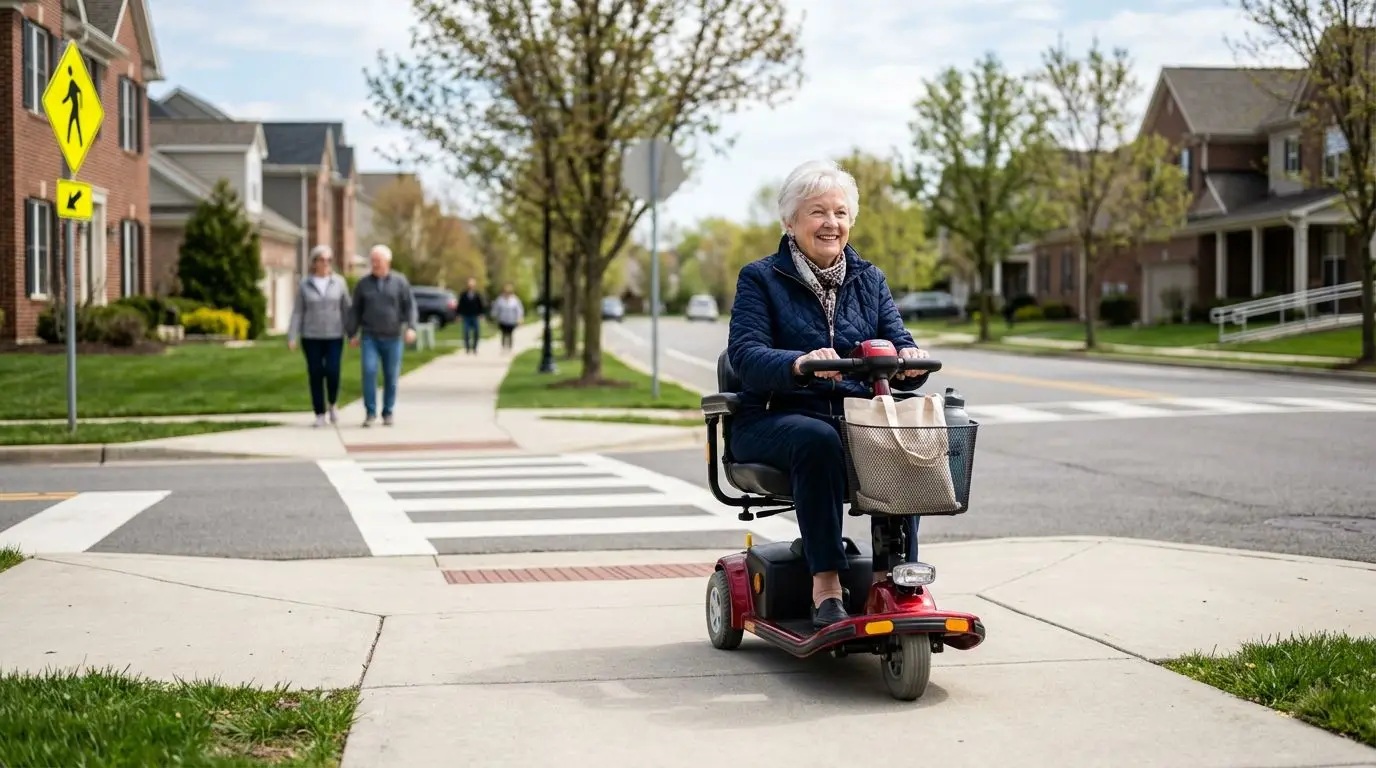
Do You Need a License, Registration, or Insurance to Use a Mobility Scooter?
15 min read
Why Insurance-Covered Mobility Scooters Must Be Needed at Home, Not Just Outdoors
12 min read