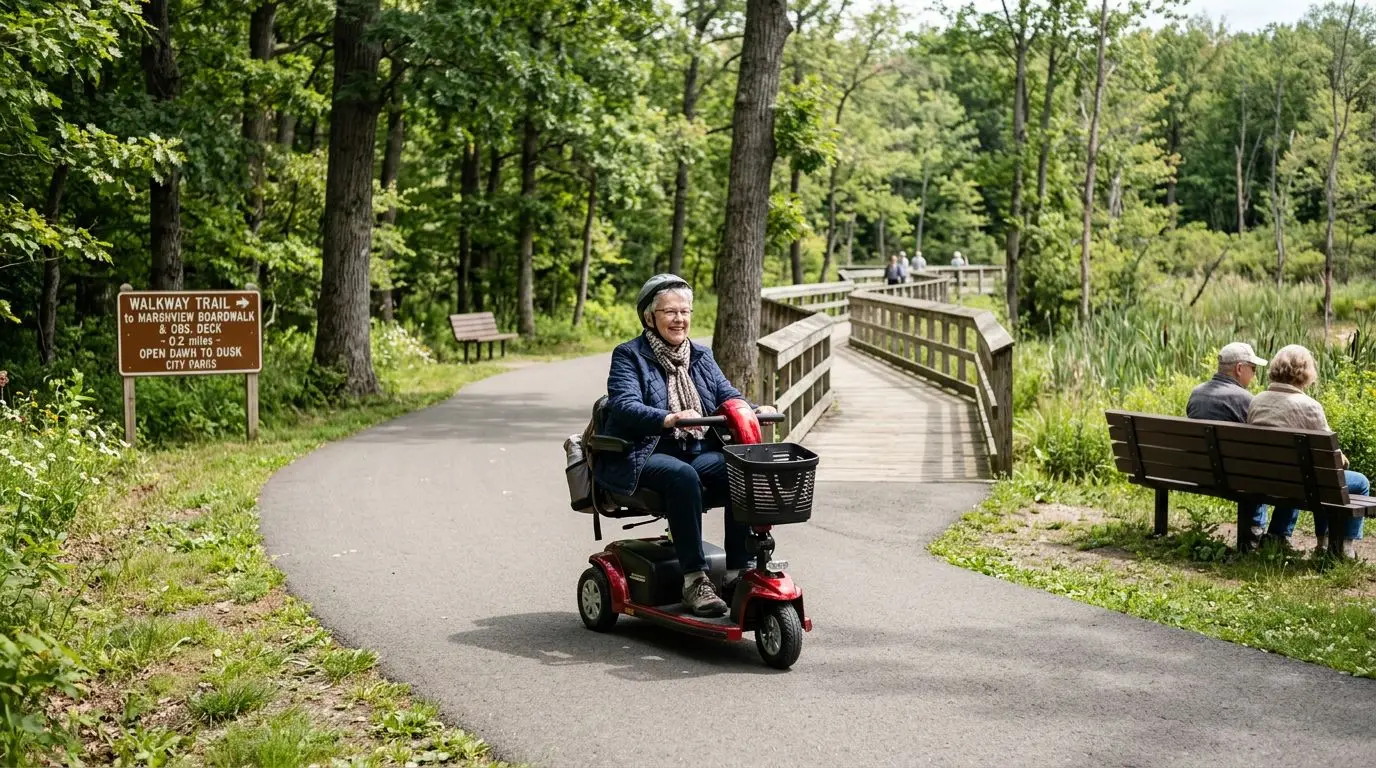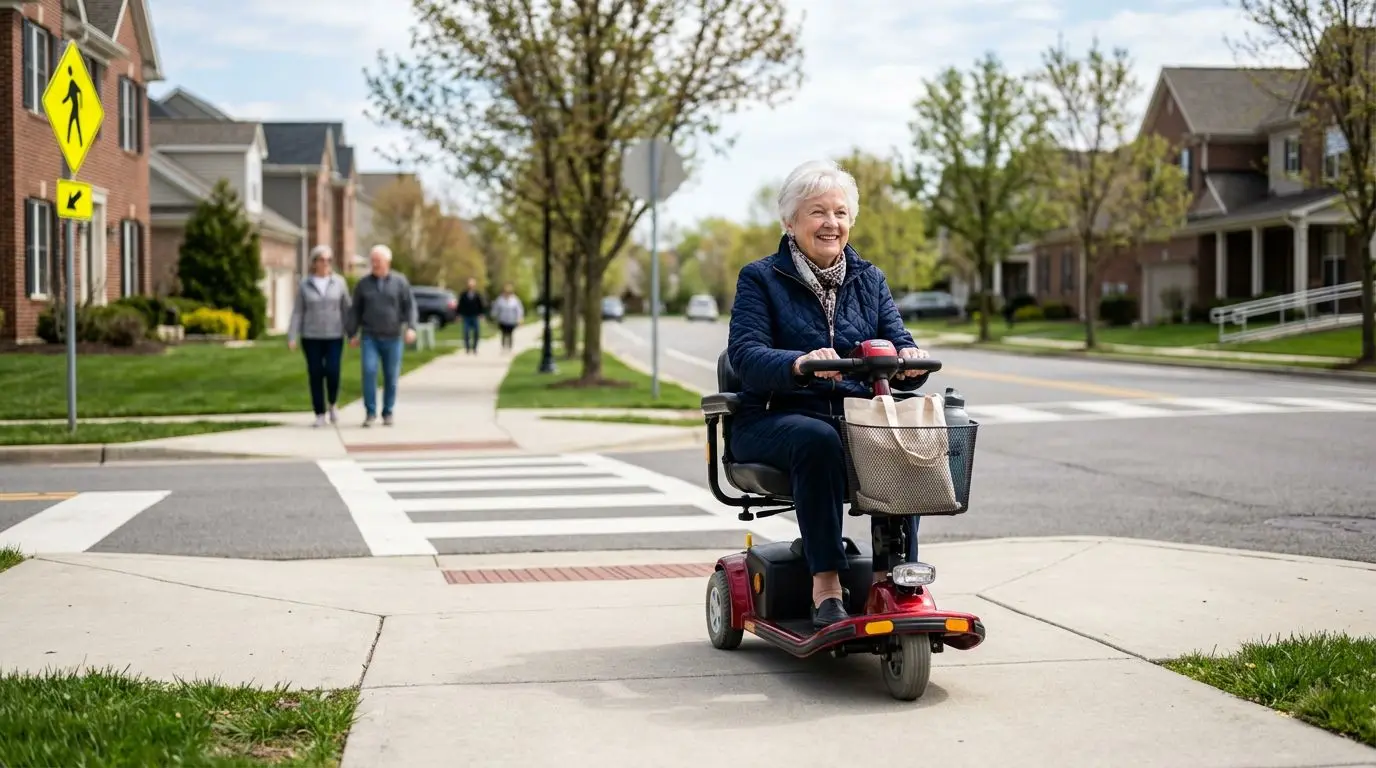
In most US states, you do not need a driver's license, vehicle registration, or mandatory auto insurance to use a mobility scooter when it is used as a personal mobility aid. Mobility scooters are generally treated differently from motor vehicles, mopeds, and golf carts because they are designed for walking-speed personal mobility, not roadway transportation. Local rules can still affect where you may ride, especially on streets, trails, transit, and private property.
That is the short answer. The practical answer is to understand how your scooter is classified, where you plan to use it, and whether optional insurance makes sense for your situation.
The 3-part answer: license, registration, and insurance
For a typical mobility scooter used by a person with a mobility limitation, the legal burden is usually light. These devices are commonly grouped with pedestrian mobility aids or power-driven mobility devices rather than motor vehicles. That distinction matters: motor vehicles are regulated for public roads, while mobility scooters are usually governed by access, safety, and pedestrian rules.
| Requirement | Usually required for a mobility scooter? | Important note |
|---|---|---|
| Driver's license | No | A mobility scooter is not normally treated like a car, motorcycle, or moped. |
| State vehicle registration | No | Most mobility scooters do not receive license plates or titles. |
| Mandatory auto insurance | No | Optional liability or personal property coverage may still be worth considering. |
The word usually is doing real work here. State statutes, city ordinances, park rules, senior housing policies, and transit rules can all add limits. For example, a city may allow mobility scooters on sidewalks but restrict powered devices in certain recreation areas, downtown pedestrian zones, or multi-use paths during crowded events.
Speed often enters the discussion. Many mobility scooters operate around walking or jogging speed, often in the range of about 4 to 8 mph depending on type and setting. A device built or modified to travel much faster, carry multiple passengers, or function like a small vehicle may be treated differently by local authorities.
Why mobility scooters are not usually treated as motor vehicles: 4 key differences
Mobility scooters are meant to help a person move through daily life: the grocery store, medical office, sidewalk, apartment building, senior center, or paved path. Cars, mopeds, motorcycles, and golf carts are built for transportation in traffic or designated vehicle areas. That difference drives most license and registration rules.
| Device type | Typical purpose | License or registration issue | Common place of use |
|---|---|---|---|
| Mobility scooter | Personal mobility aid | Usually no license, registration, or auto insurance | Sidewalks, stores, medical offices, homes, some paved paths |
| Power wheelchair | Personal mobility aid | Usually no license, registration, or auto insurance | Indoor and outdoor pedestrian areas |
| Moped | Road transportation | Often requires licensing, registration, helmet rules, or insurance depending on state | Public roads |
| Golf cart | Campus, community, or low-speed vehicle use | May require permits, registration, lights, mirrors, or insurance if used on public roads | Golf courses, private communities, limited roads where allowed |
| Electric recreational scooter | Personal transport or recreation | Rules vary widely by city and state | Bike lanes, streets, paths, or private property depending on rules |
Physical design matters, too. A mobility scooter commonly has a seat, tiller steering, a stable platform, and a battery-powered motor. It is designed for one seated user. It usually is not equipped with the full set of road-vehicle features such as turn signals, brake lights, mirrors, horn requirements, a vehicle identification number, or crash-protection equipment.
That does not mean you can ride anywhere. It means the starting point is different. A car driver asks, where is my vehicle legally allowed? A mobility scooter user asks, where may a pedestrian mobility aid safely go?
Federal access rules in 2 categories: wheelchairs and other power-driven mobility devices
Under the Americans with Disabilities Act, public accommodations and many public entities must make reasonable access available for people with disabilities. The ADA recognizes wheelchairs and also addresses other power-driven mobility devices, often shortened to OPDMDs. A mobility scooter may fall into one of these access categories depending on its design and how it is used.
In practical terms, businesses and public facilities generally cannot exclude a mobility device just because it has a motor. They may, however, apply legitimate safety requirements. For example, a museum with narrow historic rooms may evaluate whether a large powered device can be used safely in a specific area without damaging the property or endangering others.
Federal access rules do not create a driver's license requirement. They address access, nondiscrimination, and safety. A store cannot usually demand that you show a state driver's license to enter with a mobility scooter, but staff may ask limited questions if it is not obvious that the device is being used for a disability-related need.
ADA access and state traffic law are separate issues. A device may be allowed inside a clinic as a mobility aid while still being restricted from traveling in a traffic lane on a busy road posted at 35 mph. Think of federal access as the doorway rule and local traffic law as the roadway rule.
Where you can ride: 6 common places and the rules that usually apply
Most confusion comes from location. A scooter that is perfectly acceptable inside a pharmacy may be unsafe or unlawful on a public road. The right answer depends on whether the space is designed for pedestrians, vehicles, shared recreation, or private access.
| Place | Usually allowed? | What to check |
|---|---|---|
| Sidewalks | Often yes | Yield to pedestrians, use safe speed, follow local sidewalk rules. |
| Crosswalks | Often yes | Cross as a pedestrian would; watch turning vehicles. |
| Stores and medical offices | Generally yes when used for disability mobility | Door width, aisle clearance, posted safety restrictions. |
| Public roads | Often limited or discouraged | State and city rules; road speed, shoulder availability, visibility. |
| Bike lanes and multi-use paths | Varies | Posted path rules, speed limits, local park regulations. |
| Private communities | Depends on policy | HOA, senior community, apartment, or campus mobility rules. |
A good rule of thumb: if the space is meant for pedestrians, a mobility scooter is more likely to be accepted. If it is meant for licensed vehicles, the scooter may not be allowed unless local law specifically permits it. Some small towns and retirement communities make special allowances for low-speed devices, but those allowances may not apply outside that area.
Visibility can become a safety issue quickly. Even at 5 mph, a seated scooter user can be hard for drivers to see behind parked cars, hedges, delivery vans, or driveway walls. Reflective clothing, lights, a flag, and cautious crossing habits can reduce risk, but they do not replace local legal requirements.
Who it's best for: 5 situations where a mobility scooter fits the legal and practical purpose
A mobility scooter is best for someone who can sit upright, steer with a tiller, manage speed controls, and transfer on and off the seat safely, but who has difficulty walking longer distances. It is not a medical treatment, and it does not replace professional evaluation when balance, vision, cognition, or reaction time are concerns.
- Shopping trips over 10 to 20 minutes: A scooter can reduce fatigue during errands when standing and walking are the main barriers.
- Large medical campuses: Long corridors, parking lots, and elevators can make a compact scooter practical.
- Senior housing or apartment living: A scooter can help with mailrooms, dining areas, laundry rooms, and community spaces.
- Neighborhood sidewalks: In areas with curb cuts and smooth pavement, a scooter can support short local trips.
- Travel with planned access: Some folding or transportable scooters can work for hotels, cruise terminals, airports, and family visits when size and battery rules are checked ahead of time.
The legal fit is strongest when the scooter is used as a personal mobility aid at pedestrian speeds. The more it is used like a road vehicle, the more legal questions you should expect. Carrying passengers, towing a cart, riding after dark without lights, or entering traffic lanes can move the situation from routine mobility to public safety concern.
How to choose and measure before you buy: 7 legal and access checks
Choosing a mobility scooter is not only about comfort and battery range. It is also about whether the scooter fits the places you need to go. A few measurements can prevent problems with doorways, elevators, sidewalks, transit, and storage.
- Overall width: Many interior doorways are about 32 to 36 inches wide, but usable clearance can be less because of hinges, trim, or door swings. Measure the narrowest doorway you use every week.
- Turning radius: Tight apartments, clinic exam areas, and store aisles may require a shorter turning radius. Test or measure the space where you must turn 180 degrees.
- Top speed: A scooter with a lower speed setting can be easier to use in crowded indoor areas. Many users do not need the highest available speed for daily errands.
- Weight and transport: If the scooter must go in a vehicle, check the heaviest piece weight if it disassembles. A 40 lb part is very different from a 75 lb part for a caregiver.
- Battery type and airline rules: Airlines and cruise lines can have specific limits for batteries, especially lithium batteries. Ask before travel, not at the gate.
- Lighting and reflectors: If you use the scooter outdoors near dusk, lights and reflectors are practical safety features even where not legally required.
- Local use rules: Call your city clerk, local police non-emergency number, transit agency, HOA, or property manager if you plan to use the scooter beyond sidewalks and indoor spaces.
Measure your real route. Start at the bed or favorite chair, then trace the path to the door, elevator, parking area, sidewalk, bus stop, or mailbox. Note every threshold, ramp, curb cut, slope, tight turn, and uneven section. A scooter that looks reasonable on paper can feel very different when it must pass through a 34-inch hallway turn or climb a short driveway slope.
Insurance in 3 layers: required, optional, and smart protection
Mandatory auto insurance is generally not required for a mobility scooter, but insurance is not irrelevant. There are 3 layers to think about: legal requirements, liability protection, and protection for the scooter itself.
| Coverage question | What it may involve | What to do |
|---|---|---|
| Is insurance legally required? | Usually no for a mobility scooter used as a mobility aid | Confirm if you use it on private roads, community streets, or special districts. |
| What if I accidentally injure someone or damage property? | Liability may fall under homeowners, renters, umbrella, or separate personal liability coverage | Ask your insurance agent in writing how mobility scooter incidents are handled. |
| What if the scooter is stolen or damaged? | Personal property coverage may apply, but deductibles and exclusions vary | Check theft, transit, outdoor storage, and travel coverage limits. |
Optional coverage can be worthwhile if the scooter is expensive to replace, stored in a shared garage, used outdoors often, or transported frequently. It can also matter if you live in a senior community where scooters and pedestrians share narrow hallways. The key is not to assume. Ask clear questions and keep the answers with your records.
If your scooter was paid for partly by health insurance, a public program, or a benefit plan, that does not automatically mean property loss or liability is covered. Payment for equipment and insurance for accidents are different issues.
Registration, permits, and private property: 4 exceptions to check
State vehicle registration is usually not required, but some settings use their own permits or identification systems. These are not the same as motor vehicle registration, yet they can affect daily use.
- Senior living communities: Some communities require a sticker, safety orientation, speed limit agreement, or indoor storage plan.
- College campuses and medical campuses: Large properties may have powered mobility device policies, especially for housing, shuttles, and parking structures.
- Gated neighborhoods or private roads: An HOA may set rules for using low-speed devices on community streets.
- Parks, trails, and event venues: A venue may allow mobility devices but restrict certain paths, crowd areas, slopes, or surfaces for safety.
These rules are usually about safety and property management, not state vehicle licensing. Still, they can be enforced through lease terms, event policies, or community rules. If a scooter is essential for your mobility, ask for the policy in writing and, when needed, ask about reasonable accommodation procedures.
Private businesses also have limits. A restaurant cannot usually ban a mobility scooter simply because it is inconvenient, but it may manage safe routing if aisles are narrow or emergency exits must remain clear. Respectful communication helps: explain that it is a mobility device, ask where access is safest, and avoid blocking exits or service lanes.
Safety rules that matter even without a license: 8 practical habits
No license requirement does not mean no responsibility. A mobility scooter user still needs to operate safely around pedestrians, pets, carts, children, drivers, and other scooter users. Small choices make a big difference.
- Use the lowest comfortable speed indoors. Crowded stores and medical offices are not the place for maximum speed.
- Yield to pedestrians. A scooter is heavier than a walking person and can cause injury in a collision.
- Slow before doorways and blind corners. People often step out without looking.
- Use curb cuts squarely. Approaching a curb ramp at an angle can increase tipping risk.
- Avoid steep slopes beyond the scooter's rating. Even a short ramp can be unsafe if it is too steep or wet.
- Keep both hands available when moving. Bags hanging from the tiller can interfere with steering.
- Charge safely. Use the correct charger, keep cords out of walkways, and avoid charging where heat cannot escape.
- Maintain tires and brakes. Low tire pressure, worn casters, or weak brakes can affect stopping distance.
If you are unsure about safe operation, ask a physical therapist, occupational therapist, mobility clinic, or qualified equipment provider for training. A short session can cover transfers, turning, ramps, battery care, and route planning. That is a safety step, not a licensing requirement.
State and local law checklist: 10-minute calls that can prevent trouble
Because mobility scooter rules are local in important ways, a few short calls can answer questions faster than searching old forum posts. Set aside 10 minutes and ask direct, practical questions based on where you will ride.
- City clerk or local police non-emergency line: Are mobility scooters allowed on sidewalks, crosswalks, bike lanes, or low-speed streets?
- Transit agency: What are the size, weight, securement, and battery rules for buses, paratransit, light rail, or shuttles?
- Property manager or HOA: Are there hallway speed limits, elevator rules, charging rules, storage rules, or registration stickers?
- Parks department: Are powered mobility devices allowed on the specific trail or path you plan to use?
- Insurance agent: Does your homeowners, renters, or umbrella policy cover liability and theft involving a mobility scooter?
Write down the date, the person you spoke with, and the answer. If the question is important, ask for a link to the written rule. Verbal advice is helpful, but written policies are better if a gate attendant, bus driver, building manager, or event worker gives a different answer later.
Be especially careful if you plan to ride on roads. Some areas permit certain low-speed vehicles only if they meet equipment requirements, such as lights, mirrors, reflectors, seat belts, or speed restrictions. A standard mobility scooter may not qualify, and adding accessories does not automatically make it road legal.
FAQ: 5 common legal questions about mobility scooters
Do I need a driver's license to operate a mobility scooter?
Usually, no. A mobility scooter used as a personal mobility aid is generally not treated like a car, moped, or motorcycle. Check local rules if you plan to use it on streets, in private communities, or on special-use paths.
Does a mobility scooter need a license plate or state registration?
Usually, no. Most mobility scooters are not titled or registered as motor vehicles. Some private communities, campuses, or facilities may require an internal permit or sticker, but that is different from state vehicle registration.
Is insurance required for a mobility scooter?
Mandatory auto insurance is generally not required. Optional coverage may still be useful for theft, damage, or liability if you accidentally injure someone or damage property. Ask your insurance agent how your current policy treats mobility scooters.
Can I ride a mobility scooter on the road?
Often, road use is limited or unsafe unless local law specifically allows it. Mobility scooters are usually intended for pedestrian areas, sidewalks, crosswalks, indoor spaces, and some paved paths. Roads with fast traffic, poor shoulders, or limited visibility are especially risky.
Can a store or restaurant refuse my mobility scooter?
A public business generally must allow mobility devices used by people with disabilities, subject to legitimate safety requirements. Staff may manage where and how the device is used if there are real safety concerns, such as blocked exits, narrow aisles, or fragile areas.
The bottom line in 3 sentences
For ordinary personal mobility use, a mobility scooter usually does not require a driver's license, state registration, or mandatory auto insurance in the United States. The main legal questions are where you ride, whether the scooter is being used as a mobility aid, and whether local or private-property rules add limits. Before using a scooter on roads, transit, trails, or community streets, confirm the written rules and consider optional insurance for liability and property protection.
Frequently asked questions
Do I need a driver's license to operate a mobility scooter? +
Usually, no. A mobility scooter used as a personal mobility aid is generally not treated like a car, moped, or motorcycle. Check local rules if you plan to use it on streets, in private communities, or on special-use paths.
Does a mobility scooter need a license plate or state registration? +
Usually, no. Most mobility scooters are not titled or registered as motor vehicles. Some private communities, campuses, or facilities may require an internal permit or sticker, but that is different from state vehicle registration.
Is insurance required for a mobility scooter? +
Mandatory auto insurance is generally not required. Optional coverage may still be useful for theft, damage, or liability if you accidentally injure someone or damage property. Ask your insurance agent how your current policy treats mobility scooters.
Can I ride a mobility scooter on the road? +
Often, road use is limited or unsafe unless local law specifically allows it. Mobility scooters are usually intended for pedestrian areas, sidewalks, crosswalks, indoor spaces, and some paved paths.
Can a store or restaurant refuse my mobility scooter? +
A public business generally must allow mobility devices used by people with disabilities, subject to legitimate safety requirements. Staff may manage use if there are real safety concerns, such as blocked exits, narrow aisles, or fragile areas.
Related guides
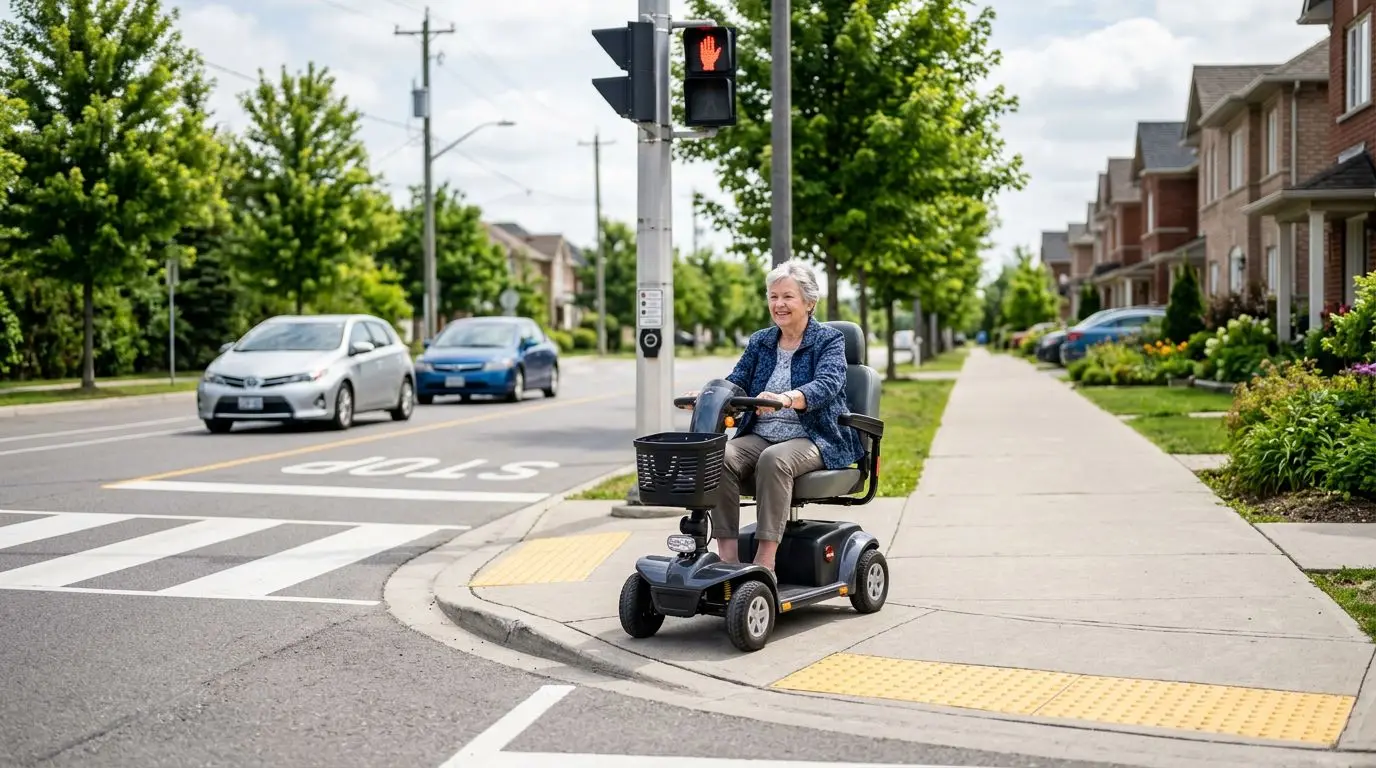
Can You Ride a Mobility Scooter on the Sidewalk or Road? US Rules, Right-of-Way, and Safety Tips
15 min read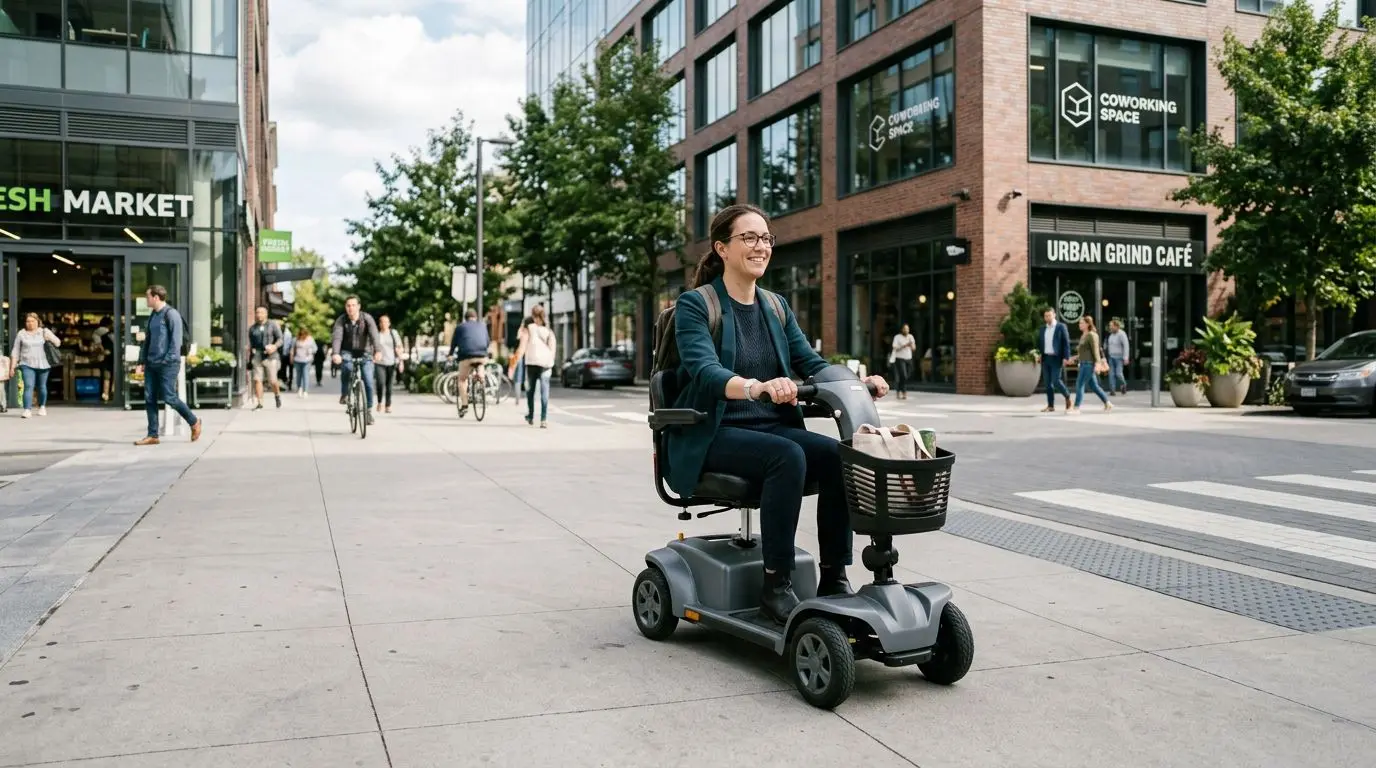
Mobility Scooters for Adults Under 65: Work, Errands, Fatigue, and Long-Term Mobility Needs
13 min read
Mobility Scooter Insurance: Liability, Theft, Damage, and When It May Be Worth Paying For
14 min read