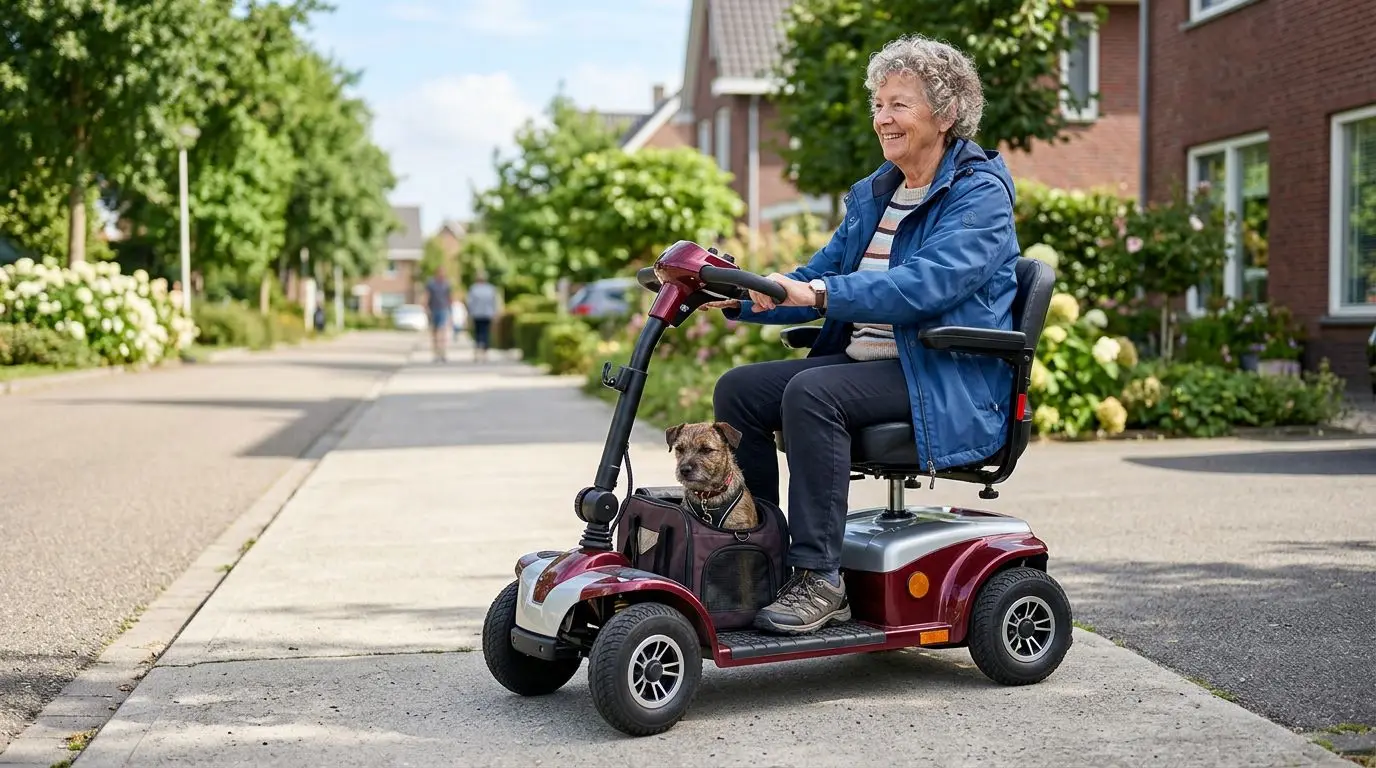
Yes, you can bring a small dog on a mobility scooter if the carrier is secure, the total weight stays within the scooter’s rated limit, and nothing interferes with steering, braking, throttle control, or your view. The safest setups keep the dog low, centered, and restrained, usually in a carrier designed for stable attachment rather than in a loose bag, on a leash, or on your lap.
A pet carrier is not a good idea if your dog is too heavy for the scooter setup, moves unpredictably, blocks your controls, or makes the scooter feel tippy during turns, ramps, or curb cuts. Safety comes before convenience, even for short trips under 10 minutes.
Can you safely carry a small dog on a mobility scooter? Start with 3 rules
The three basic rules are simple: stay within the scooter’s weight rating, keep the carrier from affecting balance, and keep the controls completely clear. If even one of those rules fails, the setup is not safe enough to use in public.
Most mobility scooters have a published maximum user weight capacity, often somewhere between 250 and 500 pounds depending on scooter type. That rating includes the rider and anything else the scooter carries, such as oxygen equipment, groceries, personal bags, and a pet carrier. A 12-pound dog in a 5-pound carrier adds 17 pounds before you count supplies, water bowls, or treats.
Balance matters just as much as weight. A small dog may not sound like much, but placing 15 pounds high on the front tiller or far behind the seat can change how the scooter handles. You may notice heavier steering, wider turns, or a front end that feels less predictable on sloped sidewalks.
Controls must stay untouched and easy to reach. Your dog, leash, carrier straps, or carrier frame should never press against the throttle lever, key, speed dial, horn, brake release lever, tiller adjustment, or any cable. You should be able to make a full left and right turn without the carrier rubbing your knees, hands, or dashboard.
Who a scooter pet carrier is best for: 5 practical situations
A mobility scooter pet carrier works best for riders who use the scooter on predictable routes, at modest speeds, with a calm small dog. Think neighborhood sidewalks, apartment hallways, senior community paths, and quick visits to dog-friendly outdoor areas.
It is usually best for dogs that can sit or lie down quietly for at least 15 to 20 minutes. The dog should tolerate being enclosed or clipped into a harness inside the carrier without barking, lunging, turning circles, or trying to jump out. An 8-pound dog that naps during the ride is very different from a 19-pound dog that shifts suddenly every time it sees another pet.
It is also best for riders with steady hand control, good awareness of curbs and pedestrians, and enough strength to stop and manage the dog if something unexpected happens. A carrier does not remove the need to supervise the pet.
- Short errands on familiar, level routes under about 1 mile
- Calm dogs that already accept crates, carriers, or car travel
- Riders using a scooter with enough remaining weight capacity after body weight and cargo
- Trips where the dog does not need to walk beside traffic
- Apartment, condo, or assisted living settings with elevators and smooth pathways
A carrier is less suitable for long rides in heat, crowded sidewalks, busy parking lots, or uneven trails. It can still be done in some cases, but only if the scooter stays stable and the dog stays contained.
Carrier types compared: 4 common options for small dogs
There are several ways people try to carry a small dog on a mobility scooter, but they are not equally safe. The biggest difference is where the weight sits. A carrier that weighs 6 pounds empty and holds a 10-pound dog can feel very different depending on whether it sits low on the floorboard or hangs high from the tiller.
| Carrier type | Typical dog size range | Balance impact | Best use | Main caution |
|---|---|---|---|---|
| Front basket carrier | Often best for very small dogs, about 5 to 12 pounds | Can make steering feel heavier | Short, slow rides on smooth surfaces | Must not block lights, controls, or forward view |
| Floorboard carrier | Often suitable for small dogs under about 15 pounds if space allows | Usually more stable because weight is low | Indoor corridors, sidewalks, senior communities | Must not crowd feet or pedals, or interfere with turning |
| Rear seat or rear rack carrier | Varies widely; sometimes used for 10 to 20 pounds | Can affect rear stability and turning | Scooters with sturdy rear mounting points | Can increase tip risk on ramps or sharp turns |
| Lap carrier or sling | Very small dogs, often under 10 pounds | Unpredictable if dog shifts suddenly | Only very calm dogs and very short rides | Can block arms, distract rider, or interfere with controls |
A floorboard carrier is often the most stable option when there is enough room because it keeps weight low and between the wheels. Even so, it is not automatically safe. You need enough foot space to sit normally, brace yourself, and turn the tiller without bumping the carrier.
Front carriers are popular because the dog is visible, but that same forward position can change steering feel. If the carrier hangs from the tiller instead of resting on a supported basket or bracket, it can sway. Sway is a warning sign, especially when starting, stopping, or turning.
Balance and weight limits: calculate the load before the first 100 feet
Before riding, add the rider’s weight, the dog’s weight, the carrier’s weight, and any cargo you normally bring. Compare that number with the scooter’s stated maximum capacity in the owner’s manual or label. Do not treat the listed capacity as a target; it is a limit.
Here is a simple example. If the scooter is rated for 300 pounds, the rider weighs 240 pounds, the carrier weighs 6 pounds, and the dog weighs 14 pounds, the total is 260 pounds before groceries or other items. That leaves 40 pounds of margin, but the location of that 20-pound pet-and-carrier load still matters.
Weight placed high or far from the scooter’s center can affect tipping more than weight placed low. That is why a 12-pound dog at knee level may feel manageable while the same dog hanging from the handlebar area can make the front end feel awkward. Three-wheel scooters may also feel more sensitive in tight turns than some four-wheel scooters, especially if weight is added off-center.
Use a slow test before committing to a real trip. Ride 100 feet on a flat, open surface at the lowest speed setting, then practice one full left turn, one full right turn, a gentle stop, and a restart. If the scooter pulls, wobbles, tips, scrapes, or feels harder to control, stop and change the setup.
How to measure your scooter before choosing a carrier: 6 measurements that matter
Measuring first prevents many safety problems. A carrier that looks compact online or in a store can still be too wide for your floorboard, too tall for your line of sight, or too close to your knees when the tiller turns.
Use a tape measure and write down these 6 measurements before buying or attaching any carrier:
- Floorboard width: Measure the usable flat area in inches, not the full outside width of the scooter.
- Floorboard depth: Measure from the seat base area to the front tiller post, leaving room for your feet.
- Knee clearance: Sit normally and measure how much space remains between your knees and the tiller.
- Tiller turning clearance: Turn the tiller fully left and right and note the space it sweeps through.
- Basket or bracket dimensions: Measure inside width, depth, and height if using an existing front or rear basket.
- Dog’s resting size: Measure your dog from chest to rump and floor to shoulder while sitting or lying down.
Your dog should be able to sit or lie down without being compressed. As a practical guide, leave at least 1 to 2 inches of extra room around the dog inside the carrier, while still preventing excessive sliding. Too much open room lets the dog shift weight abruptly; too little room is uncomfortable and can cause the dog to struggle.
Check visibility too. When seated in your normal posture, you should see the floor or ground several feet ahead of the scooter, not just the carrier. If the carrier blocks your view of doorway thresholds, curb cuts, or pedestrians within 6 to 10 feet, it is too tall or poorly placed.
Safer attachment points: use fixed structure, not moving controls
The safest attachment points are stable parts of the scooter that do not move during steering and are intended to support weight or accessories. Examples may include an existing basket bracket, a manufacturer-approved accessory receiver, a sturdy rear cargo mount, or a properly secured floorboard carrier that cannot slide.
Avoid attaching pet carriers to anything that moves, flexes, or operates the scooter. That includes throttle paddles, brake levers, tiller adjustment knobs, cables, mirrors, armrests that flip up, and loose seat upholstery. Even a strap that shifts 1 inch can become a problem if it catches under a throttle lever or wraps around the tiller.
Check strap security carefully. A good setup should pass a gentle shake test: with the scooter turned off, tug the carrier forward, backward, left, and right. It should not swing, rotate, or slide. If it moves more than about 1 inch in any direction, improve the attachment before riding.
Use closed clips, buckles, or hook-and-loop straps only where they cannot loosen into the wheels or steering area. Loose strap tails should be rolled or tied off. Never allow a leash to trail outside the carrier, because it can catch in a wheel, snag on a door, or pull the dog unexpectedly.
Feature checklist: 10 carrier details that protect controls and comfort
A pet carrier for scooter use needs more than a cute shape. It should restrain the dog, resist tipping or sagging, allow airflow, and stay out of the way of scooter operation. Many soft bags made for hand carrying are not stable enough for scooter mounting unless they are well-supported.
| Feature | Why it matters | What to check |
|---|---|---|
| Rigid or semi-rigid base | Reduces sagging and shifting | Base stays flat with dog inside |
| Internal harness tether | Helps prevent jumping out | Clips to a body harness, not a neck collar |
| Top closure or high sides | Contains excited dogs | Dog cannot climb out during stops |
| Ventilation panels | Supports airflow | Mesh or openings on at least 2 sides |
| Low mounting position | Improves stability | Carrier sits near floorboard or supported basket height |
| Non-slip bottom | Prevents sliding | Does not move on smooth plastic floorboards |
| Washable liner | Helps with accidents and dirt | Removable pad or wipeable surface |
| Reflective trim | Improves visibility in low light | Visible from front or sides at dusk |
| Secure strap routing | Keeps controls clear | No strap touches throttle, brake, or wheels |
| Weather protection | Reduces wind and light rain exposure | Does not block airflow or visibility |
If your dog uses a harness, clip the carrier tether to the harness rather than a collar. A sudden stop can put force on the neck if the tether is attached to a collar. The tether should be short enough to prevent jumping out, but not so short that the dog cannot sit or lie down comfortably.
A 7-step test ride plan before taking your dog into public
Do not make the first ride a trip to the store. Give your dog and scooter setup a controlled trial in a driveway, hallway, garage, or quiet parking area. Ten minutes of practice can reveal problems that are hard to fix once you are away from home.
- Let the dog inspect the carrier indoors. Place treats inside and allow calm entry without forcing.
- Load the dog with the scooter turned off. Confirm that the carrier stays stable as the dog shifts.
- Check the controls. Turn the tiller fully left and right, then reach the throttle, horn, speed dial, and key.
- Start at the lowest speed. Travel 20 to 30 feet, then stop gently.
- Practice wide turns. Make slow left and right turns without leaning or rushing.
- Try a small threshold only if safe. A 1-inch doorway lip can feel different with extra weight.
- End before the dog gets restless. A short successful ride is better than a long stressful one.
Watch the dog’s body language. Panting, whining, shaking, trying to stand constantly, pawing at the mesh, or sudden barking can mean the dog is stressed or overstimulated. Watch your own comfort as well. If you feel tense, distracted, or less steady, pause the plan and reassess.
When a pet carrier is not a good idea: 8 warning signs
Sometimes the safest choice is leaving the dog at home, using another transportation option, or walking the dog separately with help. A mobility scooter is a mobility aid first, not a pet vehicle. If the carrier compromises your ability to operate the scooter, it is not worth the risk.
Skip the pet carrier if you notice any of these 8 warning signs:
- The combined rider, dog, carrier, and cargo weight is near or above the scooter’s rated limit.
- The dog weighs more than the carrier’s stated limit or makes it sag.
- The carrier blocks your view of the ground within about 6 feet of the scooter.
- Your knees, hands, or feet hit the carrier during normal steering.
- Straps touch the throttle, brake release, wheels, or charging port area.
- The scooter feels tippy on turns, ramps, or curb cuts.
- The dog tries to jump out, bark at traffic, or lunge at people or animals.
- You need to travel in heavy crowds, rain, high heat, or alongside traffic.
Heat deserves special caution. Small dogs can overheat in enclosed carriers, especially on pavement and in direct sun. On warm days, keep rides short, offer water, and avoid parking the scooter in the sun with the dog inside the carrier. If your dog has breathing, heart, orthopedic, or anxiety concerns, ask your veterinarian whether carrier rides are appropriate.
Road, sidewalk, and indoor etiquette for rides with a dog under 20 pounds
Even a well-secured dog changes how others react around your scooter. People may step closer to pet the dog, other dogs may pull toward you, and children may move unpredictably. Plan for a little extra space.
Keep your speed low around pedestrians. Many scooters can travel faster than a walking pace, but a dog carrier setup is best handled at slow speeds, especially indoors. In stores, lobbies, elevators, and senior housing corridors, use the lowest practical speed and give people at least several feet of passing room when possible.
Do not use a long leash while the dog rides in a carrier. If the dog needs a leash for arrival or bathroom breaks, keep it fully contained until you stop, turn the scooter off, and are ready to unload. A leash that drops to the ground can wrap around a wheel in seconds.
Respect pet rules in buildings and transportation settings. Service animal rules are different from pet rules, and a pet carrier does not automatically make a dog allowed everywhere. When in doubt, call ahead and ask whether pets in carriers are permitted.
Quick setup checklist: 60 seconds before every ride
Once you find a stable setup, repeat the same check before each outing. It takes about 60 seconds and can prevent most common carrier problems.
- Dog and carrier weight are within both scooter and carrier limits.
- Carrier is attached to fixed structure and does not slide more than 1 inch.
- Dog is clipped to a harness or fully enclosed.
- No straps, leashes, or fabric touch wheels, throttle, brakes, or steering.
- You can turn fully left and right while seated normally.
- Your feet have a stable resting place.
- You can see the ground ahead and to both sides.
- Speed is set low before starting.
- Weather is safe for the dog.
- You have a plan to unload the dog without blocking traffic or doorways.
If anything feels different from the last ride, stop and inspect it. Carriers loosen, straps stretch, and dogs change position. A safe setup is something you verify, not something you assume.
FAQ: mobility scooter pet carriers for small dogs
Can my dog ride in the scooter basket?
Only if the basket and carrier are rated for the dog’s weight, the basket is securely mounted, and the dog cannot jump out. Many standard scooter baskets are meant for light personal items, not a moving pet, so check the weight limit and stability before use.
Is it safe to hold my dog on my lap while driving a mobility scooter?
It is usually less safe than using a secured carrier. A dog on your lap can shift suddenly, block your arms, distract you, or interfere with the tiller and throttle, especially during turns or stops.
Where is the safest place to put a pet carrier on a scooter?
The safest location is usually low, centered, and attached to a stable part of the scooter without crowding your feet or controls. A floorboard position can be stable if there is enough room, while high front or rear positions need extra caution.
How heavy is too heavy for a dog on a mobility scooter?
There is no single number because scooter ratings and carrier designs vary. Add the rider, dog, carrier, and cargo weight, then compare the total with the scooter’s maximum capacity and the carrier’s own limit. If handling feels tippy or strained, the dog is too heavy for that setup.
Should I attach the dog’s leash to the scooter?
No. A leash attached to the scooter can catch in a wheel, pull the dog, or affect steering. If the dog is in a carrier, use an internal tether clipped to a body harness or a fully enclosed carrier.
Can I use a pet carrier on ramps and curb cuts?
Use extra caution. Ramps and curb cuts change the scooter’s angle and can make added weight more noticeable. Test slowly on gentle slopes first, and avoid ramps if the scooter feels unstable or the dog moves around.
Frequently asked questions
Can my dog ride in the scooter basket? +
Only if the basket and carrier are rated for the dog’s weight, the basket is securely mounted, and the dog cannot jump out. Many standard scooter baskets are meant for light personal items, not a moving pet.
Is it safe to hold my dog on my lap while driving a mobility scooter? +
It is usually less safe than using a secured carrier. A dog on your lap can shift suddenly, block your arms, distract you, or interfere with the tiller and throttle.
Where is the safest place to put a pet carrier on a scooter? +
The safest location is usually low, centered, and attached to a stable part of the scooter without crowding your feet or controls. Floorboard placement can work well when there is enough room.
How heavy is too heavy for a dog on a mobility scooter? +
There is no single number because scooter ratings and carrier designs vary. Add the rider, dog, carrier, and cargo weight, then compare the total with the scooter’s maximum capacity and the carrier’s limit.
Should I attach the dog’s leash to the scooter? +
No. A leash attached to the scooter can catch in a wheel, pull the dog, or affect steering. Use an internal carrier tether clipped to a body harness, or use a fully enclosed carrier.
Can I use a pet carrier on ramps and curb cuts? +
Use extra caution. Ramps and curb cuts change the scooter’s angle and can make added weight more noticeable. Test slowly on gentle slopes and avoid ramps if the scooter feels unstable.
Related guides
Mobility Scooter Load Safety: Bags, Baskets, Groceries, Pets, and Passengers
14 min read
How to Transport a Mobility Scooter in a Car, SUV, or Van
14 min read
How to Load and Secure a Mobility Scooter in a Vehicle Without Damage or Injury
13 min read