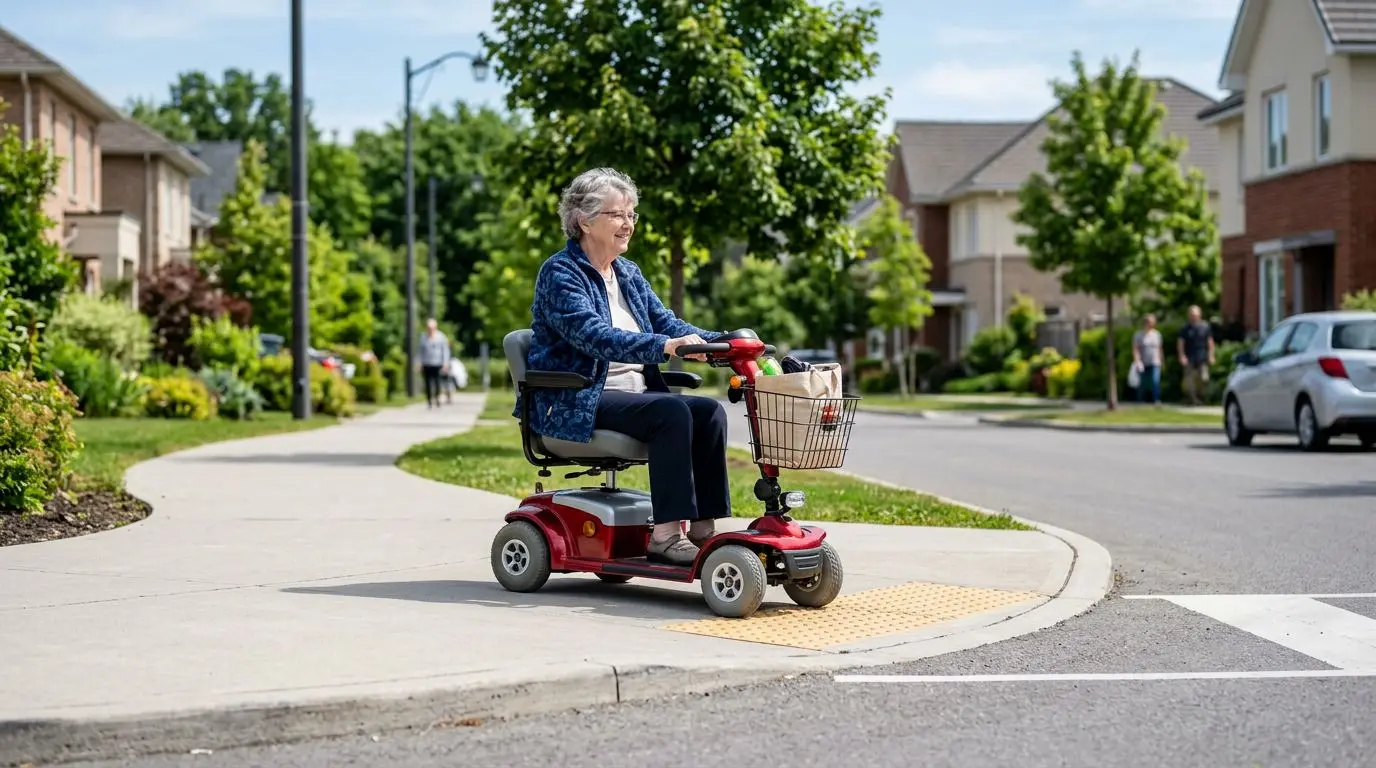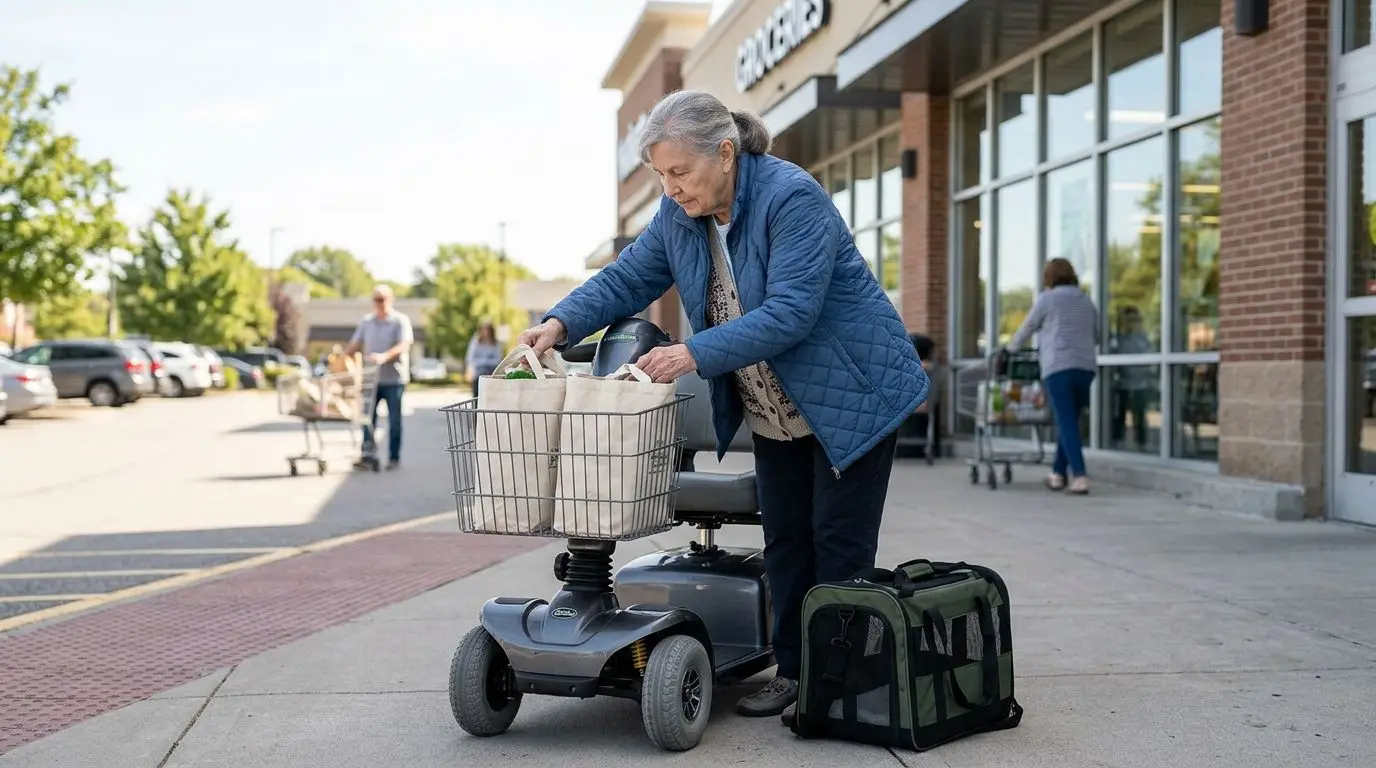
Mobility scooters can safely carry personal items, groceries, and some pet carriers when the total load stays within the scooter’s weight rating and the weight remains low, centered, and secure. The rider’s body weight, bags, baskets, oxygen holder, pet, and accessories all count toward that same limit. Carrying a passenger is usually risky because most scooters are built for one seated rider, not two people shifting weight on a narrow base.
Safe loading is not only about whether the motor can move the scooter. It also affects braking distance, steering control, tire grip, frame stress, and tip risk on ramps, curbs, and uneven pavement. A few pounds in the wrong place can matter more than a heavier load placed correctly.
The 1 rule: total load must stay under the scooter’s weight capacity
Most adult mobility scooters have a published user weight capacity, often around 250 to 500 pounds depending on scooter type. That number is not extra cargo space. It is the maximum combined load the scooter is designed to support in normal use, including the rider, clothing, purse, backpack, groceries, cane holder, rear basket, pet carrier, and anything mounted to the seat or tiller.
For example, if a scooter is rated for 300 pounds and the rider weighs 245 pounds, only 55 pounds remain before reaching the stated limit. A 15-pound rear basket, 20 pounds of groceries, and a 12-pound dog would leave very little margin. Add a heavy winter coat, bottled drinks, or medical equipment, and the scooter may be operating at or above its rating.
That matters because manufacturers set weight limits based on more than seat strength. The rating relates to the frame, suspension, motor controller, tires, brakes, battery performance, and stability testing. Exceeding it can reduce range, make hills harder, increase stopping distance, and may void warranty coverage or shift responsibility to the user if an accident occurs.
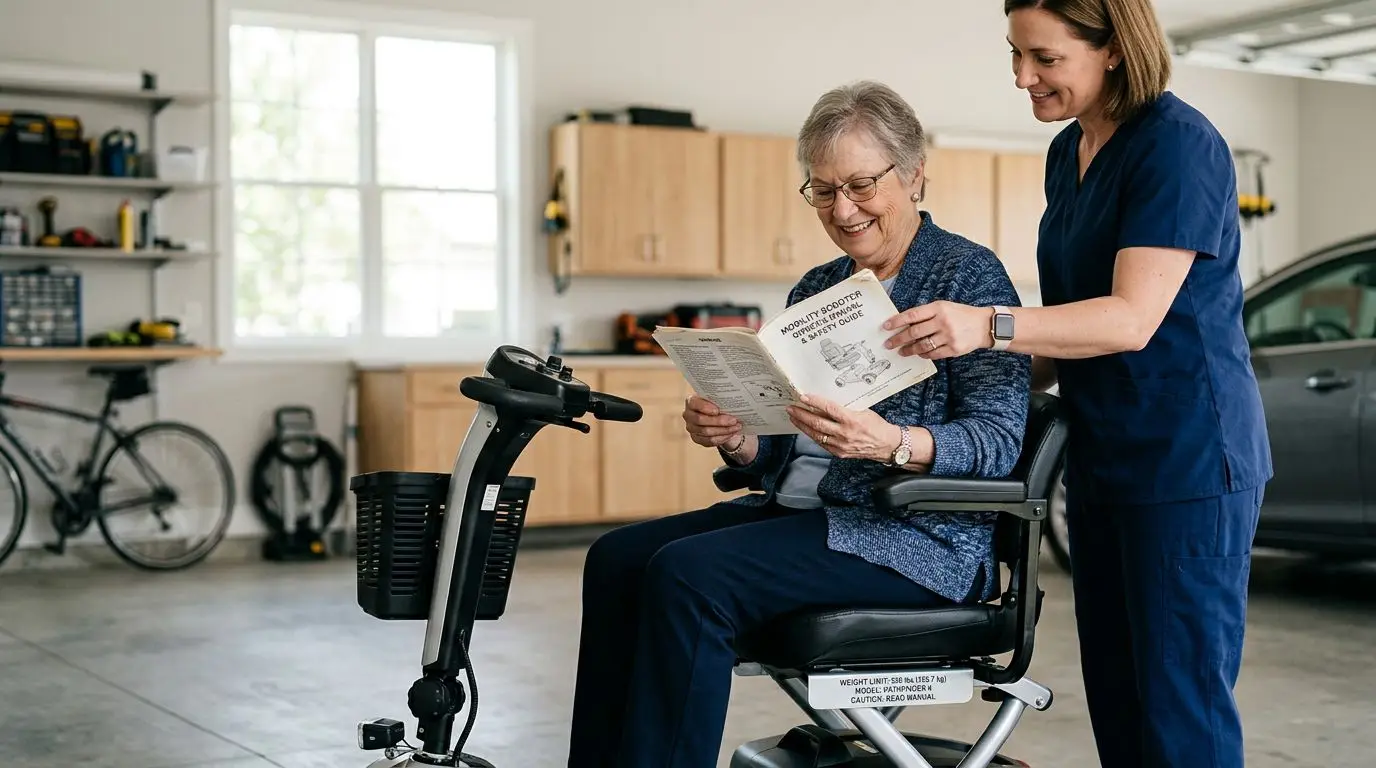
Use the rating printed in the owner’s manual or on the scooter’s identification label. If the scooter has a separate accessory weight limit, follow the lower number. A front basket might be rated for 10 pounds even when the scooter itself can carry several hundred pounds.
Common cargo options: 5 places people put bags, baskets, and groceries
Most scooters offer several possible cargo locations, but they do not affect balance in the same way. A 10-pound bag on the floorboard behaves differently from a 10-pound bag hanging from the handlebars. The lower and closer to the rider’s body the load sits, the less it tends to disturb steering and tipping balance.
| Load location | Typical use | Safety notes |
|---|---|---|
| Front basket | Small purse, mail, light groceries | Best for light items only; too much weight can affect steering and block lights. |
| Floorboard | Small shopping bag or soft tote | Often stable if it does not interfere with feet, pedals, or turning the tiller. |
| Under-seat storage | Wallet, keys, small personal items | Usually low and centered, but space is limited. |
| Rear basket or rear rack | Groceries, oxygen holder, folded cane | Can make the scooter feel rear-heavy, especially on ramps or curbs. |
| Seat-back bag | Light jacket, papers, compact items | Keep it light; heavy bags high behind the seat can raise the center of gravity. |
Front baskets are convenient, but they are not shopping carts. Many are meant for small items, not a gallon of milk, canned goods, and a full handbag all at once. A gallon of milk weighs about 8.6 pounds, and two gallons plus a few canned items can quickly exceed what a small basket should handle.
Rear-mounted cargo may feel easier because it does not crowd your knees, but it changes how the scooter behaves. Heavy weight behind the seat can make the front end feel lighter, especially when going uphill, entering a ramp, or crossing a driveway apron. If the front wheels feel floaty, the load is too heavy or too far back.
Why balance changes with just 10 to 20 pounds
A mobility scooter’s stability depends on its wheelbase, track width, seat height, tire contact, and where the combined center of gravity sits. Adding 10 to 20 pounds high, wide, or far behind the seat can shift that center of gravity enough to affect turns and slopes. This is especially noticeable on 3-wheel scooters, compact travel scooters, and scooters with narrow bases.
Think of the scooter and rider as one moving system. When the rider turns, brakes, or climbs a ramp, weight shifts. A heavy bag hanging from one armrest or one side of the seat pulls the system sideways. A pet leaning out of a carrier can do the same thing suddenly, which is harder to correct than a stable grocery bag.
The highest-risk situations are usually not straight, smooth hallways. They are tight turns, curb cuts, wet store entrances, gravel, elevator thresholds, and ramps steeper than the scooter is designed to handle. Even a mild slope of 5 degrees can feel different when the rear basket is full.
Balance also changes when you reach for items while seated. Leaning forward to grab a bag from a front basket, twisting to reach behind the seat, or lifting a pet from the floorboard can reduce control. Stop fully, turn the scooter off if needed, and avoid stretching beyond your seated balance.
Who it’s best for: carrying 1 to 2 small bags safely
Light cargo carrying is best for riders who can keep both feet positioned properly, steer with both hands while moving, and load items without leaning far to one side. A practical everyday target is 1 to 2 small bags totaling 10 to 20 pounds, depending on the scooter rating, basket limits, terrain, and rider weight.
This type of loading usually works well for trips to the mailbox, pharmacy, community room, farmers market, or a small grocery stop. It is less suitable for bulk shopping, multi-case beverages, large pet carriers, or errands that require several bags hanging from the tiller.
- Best fit: small loads, short trips, smooth surfaces, and riders with a comfortable margin under the scooter’s total weight capacity.
- Use caution: hills, curb ramps, narrow sidewalks, wet pavement, and scooters already close to their weight rating.
- Not a good fit: carrying another adult, heavy cases of drinks, large coolers, loose pets, or oversized bags that block controls.
If you regularly need to carry more than a few items, plan around the scooter instead of forcing the scooter to work like a cart. Use smaller reusable bags, make more frequent trips, use delivery for heavy items, or ask store staff about assistance to your vehicle or building entrance.
How to measure your safe load in 4 steps
You do not need special tools to make a safer loading plan. A household scale, the scooter manual, and 10 minutes are enough to estimate whether your usual cargo is reasonable. The goal is to know your total load before you are halfway up a ramp or leaving a store with more than expected.
Step 1: Find the scooter’s total weight capacity
Look in the owner’s manual, on the product label, or in the manufacturer’s specifications. Write down the maximum user weight or maximum load rating. If the manual lists separate limits for baskets, seat posts, ramps, or accessories, write those down too.
Step 2: Add rider weight plus worn items
Use a realistic number. Shoes, a coat, a handbag, and personal medical equipment can add several pounds. If the rider weighs 230 pounds and regularly carries a 6-pound oxygen cylinder or bag, start with 236 pounds before adding groceries.
Step 3: Weigh typical cargo
Put your usual grocery bag, pet carrier, or basket load on a scale. A small dog may weigh 12 pounds, but the carrier, blanket, leash, and water bowl may bring the load to 17 pounds. A full reusable grocery bag can range from a few pounds to more than 20 pounds if it contains liquids or cans.
Step 4: Leave a safety margin
Avoid planning right up to the published limit. Real life adds surprises: a sloped sidewalk, low tire pressure, a bump at a doorway, or one extra bag from the store. A margin of at least 10 percent is a sensible target when possible, especially for outdoor use.
Here is a simple example. If the scooter is rated for 300 pounds and the rider plus personal items totals 245 pounds, a 10 percent margin is 30 pounds. That leaves about 25 pounds for planned cargo if you want to keep the full margin. If that number feels too low for your routine, the answer is not to overload the scooter; it is to adjust the trip or use a scooter with an appropriate rating.
Pets and dog carriers: keep 4 paws contained
Pets add a special safety issue because they move. A 15-pound dog that shifts suddenly, stands up, or leans toward another animal can change balance faster than a grocery bag. For that reason, pets should be carried only in a secure carrier, basket, or crate designed to keep the animal contained without blocking steering, braking, lights, or the rider’s view.
A pet should not ride loose on the floorboard, on the rider’s lap, or standing in a front basket without restraint. Loose pets can jump, get tangled near the controls, or distract the rider at exactly the wrong moment. Leashes can also create hazards if they wrap around the tiller, wheels, or another pedestrian.
Choose a carrier that fits both the scooter and the pet. The carrier should sit flat, attach securely, and stay within the scooter’s width as much as possible. It should also allow ventilation and a comfortable position for the animal. A carrier that forces the pet to sit high above the basket rim raises the center of gravity and increases the chance of tipping or sudden movement.
Before taking a pet into a busy store or along a sidewalk route, test the setup at home for 5 to 10 minutes. Practice starting, stopping, turning, and entering a doorway. If the pet barks, lunges, shifts constantly, or tries to climb out, the setup is not ready for public use.
Why passengers can be risky on a scooter built for 1 rider
Most mobility scooters are designed for one seated rider. Adding a second person can exceed the weight capacity by 100 pounds or more, but the bigger issue is often geometry: the seat, frame, foot space, and brakes are not designed for two bodies moving independently.
A passenger may sit on the rider’s lap, stand on the floorboard, perch on the back, or use an aftermarket extra seat. Each option creates risk. The passenger can block steering, press against the tiller, shift during turns, or prevent the rider from placing feet correctly. Children are especially unpredictable, even when they are light.
Extra seats deserve careful skepticism. A second seat does not automatically mean the scooter frame, brakes, motor, controller, tires, and stability profile are approved for passenger use. Unless the scooter manufacturer specifically states that the scooter is designed and rated for two occupants, assume it is a single-rider device.
There may also be liability concerns. If a scooter is used in a way the manufacturer does not approve, warranty coverage and accident responsibility can become complicated. Public spaces such as senior communities, stores, transit areas, and sidewalks may have rules against carrying passengers on personal mobility devices.
If another person needs mobility support, the safer approach is usually a separate mobility device, walking aid, wheelchair assistance, or a planned transport option. A scooter should not become a two-person vehicle unless it is expressly designed, rated, and used that way.
Feature choices that make loading safer: 3 wheels, 4 wheels, baskets, and brakes
Different scooter types handle loads differently. A 4-wheel scooter often feels steadier with rear cargo than a compact 3-wheel scooter, while a smaller 3-wheel scooter may be easier to maneuver indoors with only a light front basket. The right choice depends on your load, your route, and how much margin you have under the weight limit.
| Feature | Helps with | Tradeoff to consider |
|---|---|---|
| 4-wheel base | Straight-line stability and outdoor confidence | May have a wider turning radius in tight apartments or stores. |
| Low-mounted storage | Better balance for small cargo | Limited space and may interfere with foot room if overloaded. |
| Rear basket or rack | Groceries and larger bags | Can make the scooter rear-heavy and affect ramp handling. |
| Strong lighting and reflectors | Visibility when cargo is mounted | Bags must not cover lights or reflectors. |
| Effective brakes and good tires | Stopping control with added weight | Worn tires or weak brakes reduce safety margins. |
Accessory fit matters as much as scooter type. Universal baskets, cup holders, cane holders, and rear bags can be useful, but they must attach without wobbling, rubbing tires, pinching wires, or blocking seat rotation. If an accessory uses a receiver hitch or seat-post mount, confirm the mount’s load rating and check it regularly for looseness.
Battery range can also drop with added weight. A scooter that normally handles a 6-mile errand loop may not feel the same with heavy bags, low tire pressure, cold weather, and hills. If you depend on the scooter for return trips, do not treat the advertised range as a guaranteed number under every load.
Pre-ride load checklist: 60 seconds before you go
A quick check before each trip can prevent common loading problems. It takes about 60 seconds and is especially important after shopping, when bags are heavier and less evenly packed than when you left home.
- Confirm the total load. Rider, pet, basket, bags, and accessories should stay under the scooter’s rated capacity.
- Keep weight low and centered. Put heavier items lower and closer to the seat, not hanging from one side.
- Secure every item. Bags should not swing, drag, or bounce out on bumps.
- Protect the controls. Nothing should touch the throttle, brake levers, key, horn, or steering column.
- Keep your feet clear. Do not block foot placement or create a trip hazard when getting off.
- Check visibility. Cargo should not cover lights, reflectors, mirrors, or your forward view.
- Test steering before leaving. Turn slowly in a safe area. If the scooter feels tippy, heavy, or hard to steer, unload and repack.
- Slow down with cargo. Take wider turns and allow more stopping distance, especially on slopes.
After loading groceries, place liquids, cans, and dense items at the bottom of the bag. Keep eggs, bread, and soft items on top, but do not create a tall, unstable stack. If a bag must hang, hang it evenly and lightly, but avoid using the tiller as a hook. The tiller is for steering, not load carrying.
FAQ: 5 practical questions about scooter load safety
Can I hang shopping bags from the handlebars or tiller?
It is not a good habit. Even a few pounds can interfere with steering, press on controls, or swing during a turn. Use a basket, floorboard space that does not affect your feet, or a secure rear storage option within its weight limit.
How much weight can a mobility scooter basket hold?
It depends on the basket and mounting system. Some small front baskets are best treated as light-duty storage for personal items, while larger rear baskets may carry more. Always follow the basket’s stated limit if available, and remember that basket weight counts toward the scooter’s total capacity.
Is it safe for my dog to ride on my mobility scooter?
It can be safe for some small pets if the dog is calm, contained in a secure carrier, and the combined rider-pet-cargo weight stays within limits. A dog should not ride loose on your lap, floorboard, or an open basket where it can jump or shift suddenly.
Can a child ride with me on my scooter?
Usually no. Most mobility scooters are single-rider devices, and a child can block controls, shift weight, or fall. Unless the scooter is specifically designed and rated for a passenger, do not carry one.
What are signs that my scooter is overloaded?
Common signs include slow acceleration, longer stopping distance, steering that feels heavy or light, scraping over thresholds, reduced range, tire bulging, motor strain on hills, or a tippy feeling in turns. If you notice these, reduce the load and check the scooter before continuing.
Frequently asked questions
Can I hang shopping bags from the handlebars or tiller? +
It is not recommended. Bags on the tiller can swing, interfere with steering, or press on controls. Use a secure basket, low floorboard space that does not block your feet, or approved rear storage within its limit.
How much weight can a mobility scooter basket hold? +
Basket capacity varies by basket and mounting system. Follow the stated basket limit if available, and remember that the basket, cargo, rider, pet, and accessories all count toward the scooter’s total weight capacity.
Is it safe for my dog to ride on my mobility scooter? +
Some small, calm dogs can ride safely in a secure carrier if the total load stays within the scooter’s rating. Dogs should not ride loose on a lap, floorboard, or open basket because sudden movement can affect balance and control.
Can a child ride with me on my scooter? +
Usually no. Most mobility scooters are built for one rider. A child passenger can block controls, shift weight, or fall, and may put the scooter over its rated capacity.
What are signs that my scooter is overloaded? +
Warning signs include sluggish acceleration, longer stopping distance, heavy or unstable steering, tire bulging, scraping over thresholds, reduced battery range, motor strain on hills, or a tippy feeling in turns.
Related guides
Can You Add an Extra Seat to a Mobility Scooter? Safety, Weight Limit, and Legal Considerations
14 min read
Mobility Scooter Weight Capacity: How Much Safety Margin Do You Really Need?
12 min read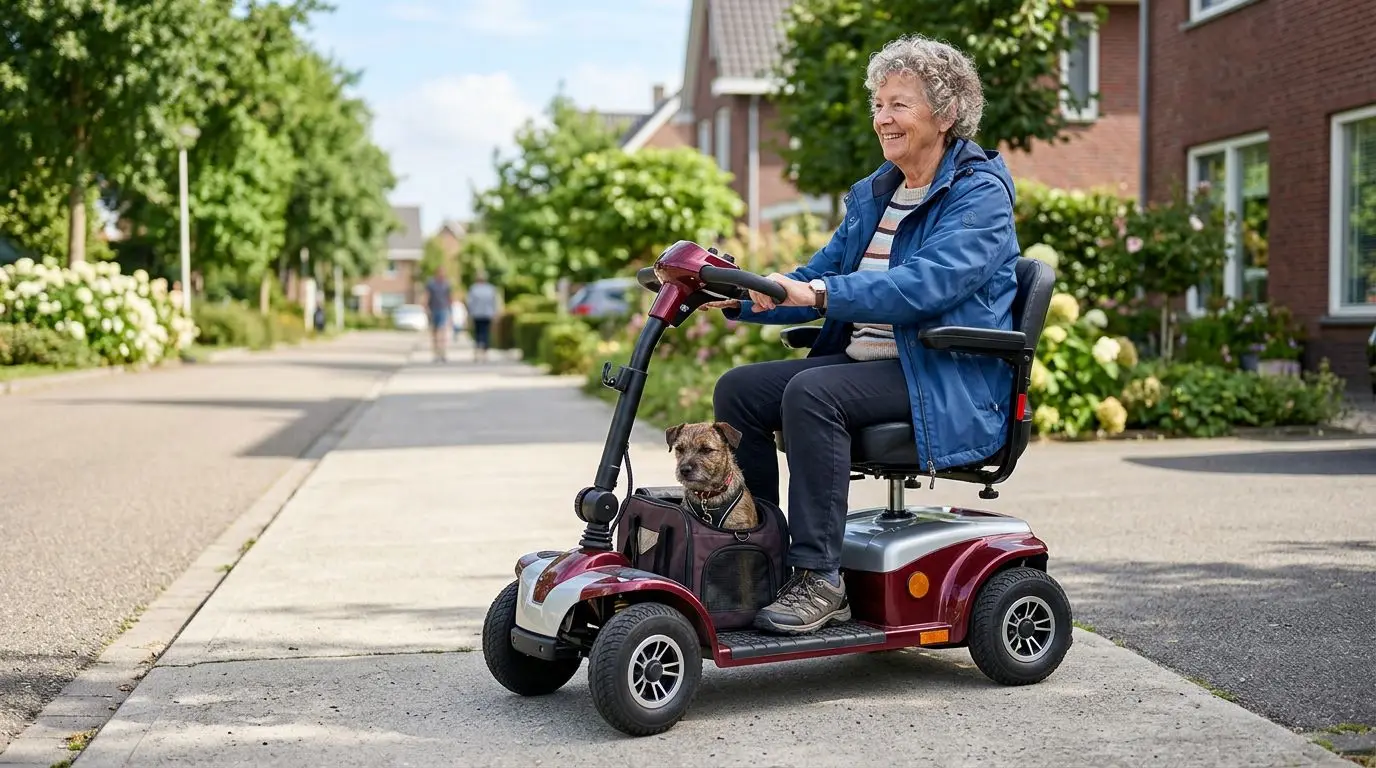
Mobility Scooter Pet Carriers: Safe Ways to Bring a Small Dog Without Affecting Balance or Controls
15 min read