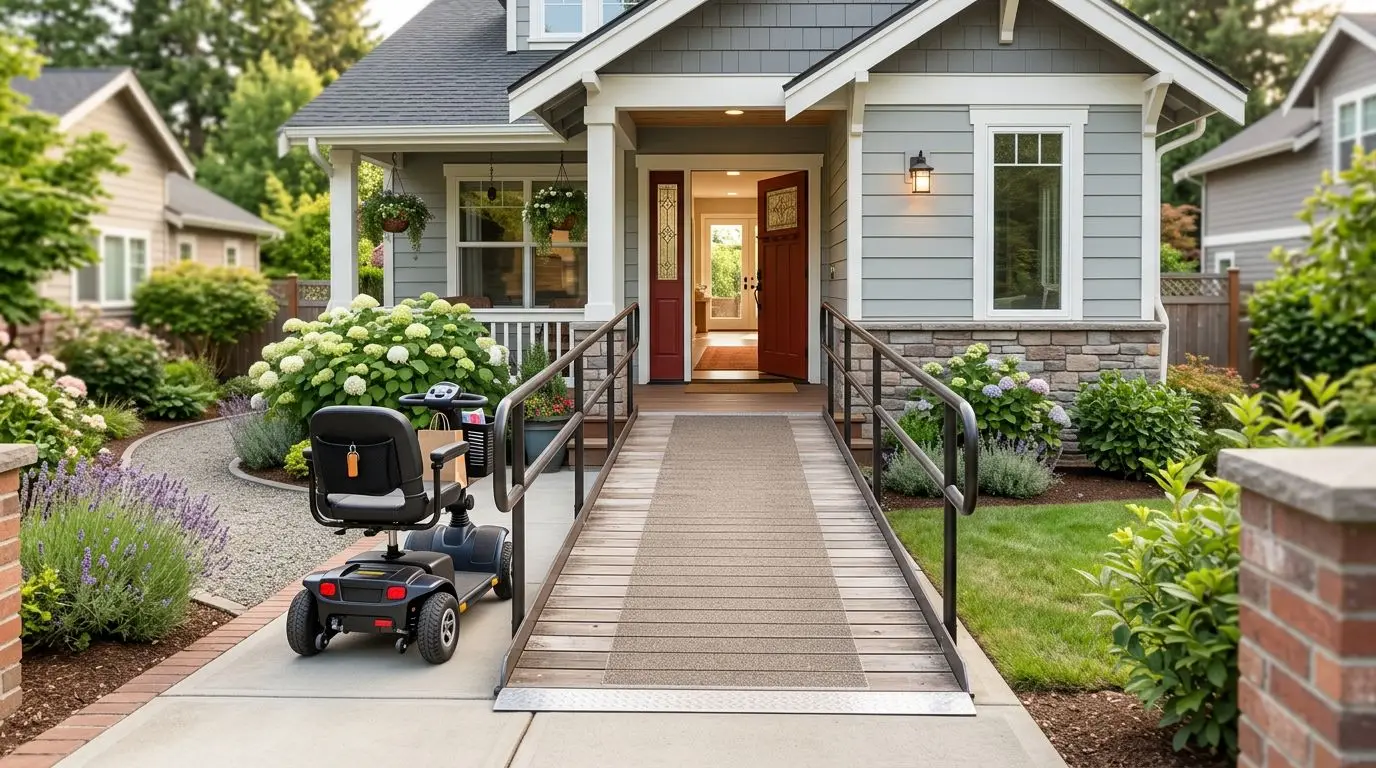
The best mobility scooter ramp for a home entry depends on the height you need to climb, how often you use the doorway, and whether the ramp has to be moved or stored. A portable ramp is usually enough for a 1- to 3-inch threshold or occasional patio and garage use. For daily entry over taller steps, a permanent or semi-permanent ramp is safer and easier.
The key measurements are rise, ramp length, usable width, and weight capacity. For many homes, slope is the best place to start: a gentle 1:12 slope means 12 inches of ramp length for every 1 inch of rise, so a 4-inch step needs about 48 inches of ramp.
Why a 1-inch threshold can stop a scooter
A mobility scooter may roll well on a sidewalk but still struggle at a 1-inch metal door sill, garage lip, or sliding patio track. Height is only part of the problem. Small scooter wheels can catch on abrupt edges, and the front shroud or anti-tip wheels may scrape before the drive wheels gain traction.
Many home barriers are small but frustrating: a 3/4-inch storm door threshold, a 1.5-inch garage-to-house lip, a 2-inch concrete step at a patio, or a single 4- to 7-inch step at the front door. These are exactly the spots where riders often need a ramp, even when they do not need one anywhere else.
A good ramp turns that abrupt edge into a gradual transition. It also gives the scooter tires a surface to grip, helps keep the rider centered, and reduces the need to approach the doorway with speed. That matters. A scooter should climb a ramp slowly and steadily, not by charging at the entrance.
Portable vs. permanent ramps: a 30-second comparison
Portable ramps are movable, usually lighter, and useful when the rise is low or the doorway is used only occasionally. Permanent ramps are fixed or semi-fixed, usually longer, and better for everyday use, especially when the rise is more than about 4 inches or when the rider enters and exits several times a day.
| Ramp option | Best use | Typical strengths | Watch-outs |
|---|---|---|---|
| Threshold ramp | Door sills around 1 to 3 inches | Compact, simple, often left in place | Not meant for full steps or long rises |
| Single-fold portable ramp | Small steps, curbs, garage lips | Easy to carry, quick setup | May be narrow; must be placed securely |
| Multi-fold portable ramp | Higher rises where storage matters | Longer lengths fold down smaller | Heavier to handle; setup takes more care |
| Track-style portable ramp | Straight approaches with matching wheel paths | Compact storage, two separate channels | Requires accurate wheel alignment; not ideal for turning |
| Modular permanent ramp | Daily home entry over steps | Stable, configurable, can include landings | Needs space and proper installation |
| Built-in wood or concrete ramp | Long-term home modification | Durable and custom to the home | May require permits, drainage planning, and maintenance |
For a rider who uses the same entrance every day, convenience matters as much as the ramp itself. A portable ramp that weighs 35 pounds may be technically movable, but it may not be practical if the rider cannot lift, unfold, and align it independently.
Who each ramp type is best for at 1 to 7 inches of rise
For a rise under 3 inches, a threshold ramp often solves the problem with the least disruption. For a single step in the 4- to 7-inch range, a longer portable ramp may work if there is enough landing space, but a semi-permanent ramp is often easier and safer for daily use.
Threshold ramps
Threshold ramps are best for door sills, uneven flooring transitions, patio sliders, and garage entry lips. They are usually short, wedge-shaped, and made to bridge a small vertical change. Some sit on one side of the doorway; others bridge both sides of a raised sill.
They fit riders who can approach straight on and only need to smooth out a small bump. They are not a good substitute for a full ramp when the rise is a true step.
Portable folding ramps
Portable folding ramps work well when one ramp must serve more than one location, such as a front step, a garage entrance, and a visiting relative’s porch. They can also help renters who cannot make permanent changes.
The trade-off is handling. A longer ramp is safer because it reduces slope, but longer ramps are also heavier and more awkward. If the ramp must be moved twice a day, the person doing that lifting should test the real weight and folded size before relying on it.
Permanent and modular ramps
Permanent ramps are best for primary entrances, taller rises, and riders who want the least amount of daily setup. A modular ramp system can include straight sections, turns, platforms, and railings, which can be important when there is not enough straight space in front of the door.
Built-in ramps should be planned like a small construction project. The ramp needs a stable base, a non-slip surface, drainage, edge protection, and a landing at the door so the scooter is not parked on a slope while the rider opens the door.
How to measure rise, slope, and ramp length in 3 steps
Measure the vertical rise first, then choose a slope, then calculate ramp length. A common planning target is 1:12, meaning 12 inches of ramp for each 1 inch of rise. Using that guideline, a 2-inch threshold needs about 24 inches of ramp, and a 6-inch step needs about 72 inches.
Step 1: Measure the rise
Place a straight board or level across the top of the threshold or step, extending outward over the lower surface. Measure straight down from the bottom of the board to the lower floor, sidewalk, garage slab, or porch. That vertical distance is the rise.
Measure in more than one spot. Older concrete and wood porches can slope, and a threshold may be 1 inch on one side and 1.5 inches on the other. Use the taller measurement when choosing a ramp.
Step 2: Choose the slope
A gentler slope is easier on the scooter and more comfortable for the rider. The 1:12 guideline is widely used for accessible routes, but some very low residential thresholds use shorter ramps. Always check the scooter owner’s guidance for maximum incline, especially if the rider is heavier, the scooter has small wheels, or the surface may get wet.
Avoid planning a ramp that requires momentum. If the scooter cannot climb at a slow, controlled speed, the ramp is too steep or the setup is wrong.
Step 3: Check the available space
Ramp length only helps if you have room to place it. A 5-inch rise at 1:12 needs about 60 inches of ramp, plus enough flat space at the top and bottom to line up and stop. A scooter also needs turning space if the doorway is not straight ahead.
At the top of the ramp, plan for a level landing where the scooter can pause while the door opens. A 36-inch by 48-inch area is a practical minimum target for many scooters, though larger scooters may need more.
| Rise | Approx. ramp length at 1:12 | Common situation |
|---|---|---|
| 1 inch | 12 inches | Door sill or interior threshold |
| 2 inches | 24 inches | Sliding patio track or garage lip |
| 3 inches | 36 inches | Raised entry threshold |
| 4 inches | 48 inches | Low porch step |
| 6 inches | 72 inches | Single exterior step |
| 12 inches | 144 inches, or 12 feet | Two low steps or raised porch |
Width, edge protection, and weight capacity: aim beyond 30 inches
Ramp width should match the scooter’s wheelbase and allow safe steering. Many mobility scooters are about 20 to 28 inches wide, so a ramp with at least 30 inches of usable surface is often more comfortable than a narrow track. Larger scooters may need 32 to 36 inches or more.
Do not rely only on the outside width listed for a ramp. Look for the usable inside width, especially if the ramp has raised side curbs. The scooter needs enough room for the tires, plus small steering corrections, without rubbing the edges.
Weight capacity includes more than the rider
Ramp capacity must include the rider, the scooter, and anything carried in the basket or on the rear. A travel scooter may weigh around 80 to 120 pounds, while a larger scooter may weigh 150 to 250 pounds or more. Add the rider’s weight and cargo, then choose a ramp with a clear safety margin.
For example, a 190-pound rider on a 180-pound scooter with 10 pounds of groceries creates a 380-pound load before any movement or uneven pressure is considered. The ramp rating should comfortably exceed the total, not barely match it.
Edges help keep the scooter on track
Raised edges, curbs, or side rails can help prevent a tire from slipping off the ramp. This is especially important when the ramp is narrow, the approach is angled, or the rider has limited upper-body strength for steering corrections.
Track-style ramps need extra attention. Because they use two separate channels, the distance between tracks must match the scooter’s wheel path. They can work well in a straight line but are less forgiving if the scooter must turn while climbing.
Surface, doorway, and landing details that matter after 2 rainy days
A ramp that feels secure when dry can feel very different after 2 days of rain, tracked-in leaves, or winter grit. Look for a textured, slip-resistant surface, and keep the ramp clean enough that the scooter tires can grip without spinning.
Outdoor ramps need drainage. Water should not pool at the bottom, freeze on the surface, or run toward the threshold. If the entry gets snow or ice, the ramp material and placement should allow safe clearing without damaging the surface.
Door swing and threshold fit
Check how the door opens. An outward-swinging storm door may hit a ramp that sits too high or too close. An inward-swinging main door may require the rider to stop on a level landing, open the door, and then proceed. If the scooter has to stop on the slope while the door is opened, the setup needs rethinking.
Threshold shape matters too. Some doorways have a raised center sill with lower surfaces on both sides. In that case, a simple wedge on the outside may not solve the inside drop. You may need a paired threshold solution so the scooter transitions smoothly in both directions.
Garage and patio examples
A garage entry often has a 2- to 4-inch lip designed to keep water out of the house. A patio slider may have a 1- to 2-inch track that is easy to trip over and hard for small wheels. These are good candidates for low-profile threshold ramps, as long as the ramp does not block drainage or prevent the door from locking.
For a front porch with one 7-inch step, a threshold ramp is not enough. At a 1:12 slope, that rise points to about 84 inches of ramp length, plus landing space. If the yard or walkway cannot fit that length straight out, a modular ramp with a turn may be the better route.
Storage, setup, and daily use with ramps from 10 to 40 pounds
Portable ramps can range from light threshold pieces around 10 pounds to longer folding ramps that may weigh 25 to 40 pounds or more. The right ramp is not just one the scooter can climb; it is one the household can place, remove, and store safely every time.
If a ramp is used daily, ask who will handle it. If the rider lives alone, a heavy folding ramp may not support independence unless it can stay in place. If a caregiver must set it up, the ramp should have manageable handles, a predictable folding motion, and a safe storage spot near the doorway.
Portable ramp storage
Measure the folded ramp before buying any portable style. Check trunk space, closet depth, and garage wall clearance. A ramp that folds to 36 inches long still needs a place where it will not become a trip hazard.
Also consider noise and floor protection. Metal ramps can scrape tile, wood, or painted concrete if dragged. Rubber feet or protective contact points can help, but the ramp still needs to sit flat and stable during use.
Permanent ramp upkeep
Permanent ramps need seasonal attention. At least 4 times a year, inspect fasteners, surface wear, drainage, and any transition plates at the top and bottom. Wood ramps may need more maintenance than metal or concrete, especially in wet climates.
Modular ramps should remain level and fully supported. If soil settles under a support or a transition lip lifts, the ramp can create the same problem it was meant to solve: an abrupt edge that catches the scooter wheels.
Safety checklist before the first ride: test at low speed
Before regular use, test the ramp slowly with another adult nearby if possible. The first test should confirm that the ramp does not shift, the scooter does not bottom out, and the rider can stop at the top and bottom without rolling back.
- Confirm the ramp length matches the measured rise and planned slope.
- Check that the ramp’s rated capacity exceeds rider, scooter, and cargo weight.
- Make sure the usable width fits the scooter with room for small steering corrections.
- Verify the ramp sits flat, with no rocking or loose contact points.
- Use the scooter’s lowest practical speed setting.
- Approach straight on whenever possible.
- Keep both hands available for steering.
- Avoid using the ramp when covered with ice, mud, wet leaves, or loose debris.
- Do not stop on the slope to open a door.
- Recheck bolts, hinges, and transition plates every 3 months for frequently used ramps.
Ramps can improve access and daily independence, but they do not make every entrance safe for every rider. If balance, vision, reaction time, or scooter control is uncertain, consider having the setup reviewed by a qualified home accessibility professional or occupational therapist. That is especially wise for taller rises, tight turns, or entries used in bad weather.
Frequently asked questions about scooter ramps: 5 practical answers
Can I use a wheelchair ramp for a mobility scooter?
Often, yes, if the ramp is wide enough, has enough weight capacity, and the slope is within the scooter’s safe operating range. Scooters can be longer and have different turning needs than manual wheelchairs, so check approach space, ground clearance, and usable width before assuming it will work.
What ramp length do I need for a 4-inch step?
Using a 1:12 planning guideline, a 4-inch rise needs about 48 inches of ramp. You also need level space at the bottom to line up and at the top to stop, open the door, and enter safely.
Are portable ramps safe for daily home entry?
They can be safe when the rise is modest, the ramp is long enough, the surface is stable, and the user or caregiver can set it up correctly every time. For daily use over a taller step, a permanent or semi-permanent ramp is often more convenient and less error-prone.
How wide should a scooter ramp be?
Many riders do best with at least 30 inches of usable ramp width, and larger scooters may need 32 to 36 inches or more. Measure the scooter’s widest point and wheel path, then allow room for steering corrections and raised edges.
Do I need handrails on a mobility scooter ramp?
Handrails are useful for walkers and caregivers, but scooter riders usually keep both hands on the controls. For permanent ramps, local building codes may require handrails at certain heights or rises, so check local rules before installing.
Frequently asked questions
Can I use a wheelchair ramp for a mobility scooter? +
Often, yes, if it has enough usable width, weight capacity, and a safe slope for the scooter. Check approach space, ground clearance, and the scooter manual before relying on it.
What ramp length do I need for a 4-inch step? +
Using a common 1:12 planning guideline, a 4-inch rise needs about 48 inches of ramp length, plus level space at the top and bottom.
Are portable ramps safe for daily home entry? +
They can be safe for modest rises when set up correctly every time. For daily use over taller steps, a permanent or semi-permanent ramp is often easier and more dependable.
How wide should a mobility scooter ramp be? +
Many scooters need at least 30 inches of usable width, while larger scooters may need 32 to 36 inches or more. Measure the scooter and allow room for steering corrections.
Do scooter ramps need handrails? +
Handrails may be required by local code for some permanent ramps and can help pedestrians, but scooter riders generally need both hands for steering and speed control.
Related guides

Using a Mobility Scooter on Ramps, Slopes, Curbs, and Uneven Pavement Safely
13 min read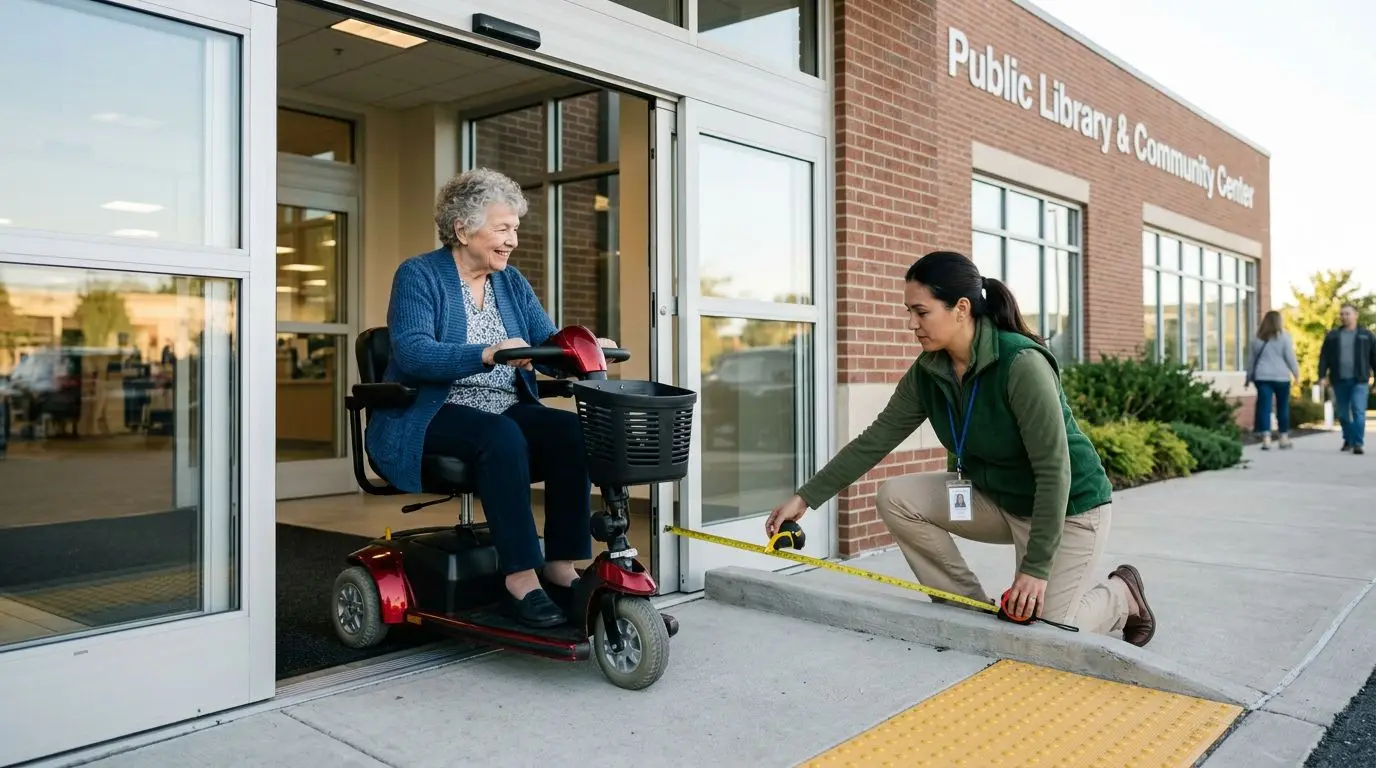
ADA-Accessible Routes for Mobility Scooters: Doorways, Ramps, Elevators, and Turning Space
12 min read
How to Ride a Mobility Scooter Safely on Ramps, Slopes, Driveways, and Curb Cuts
15 min read