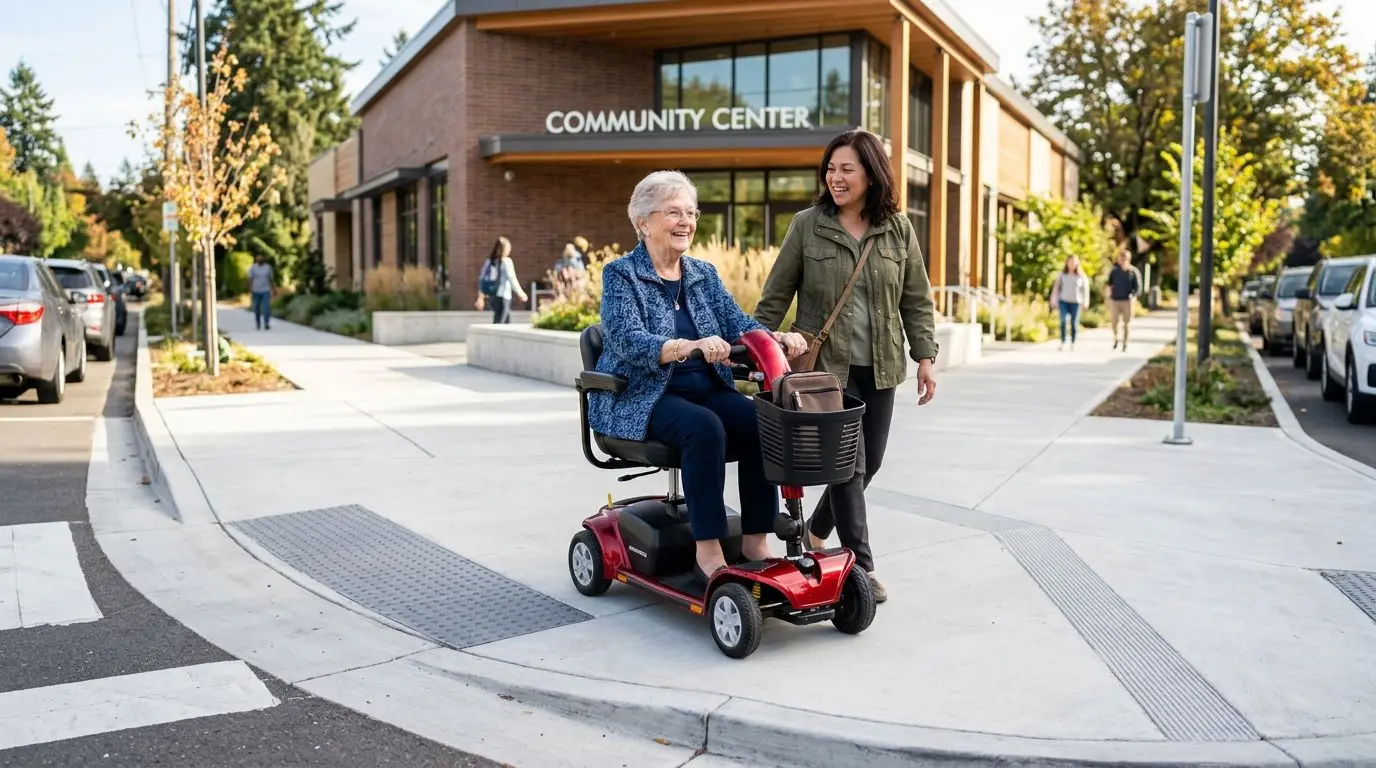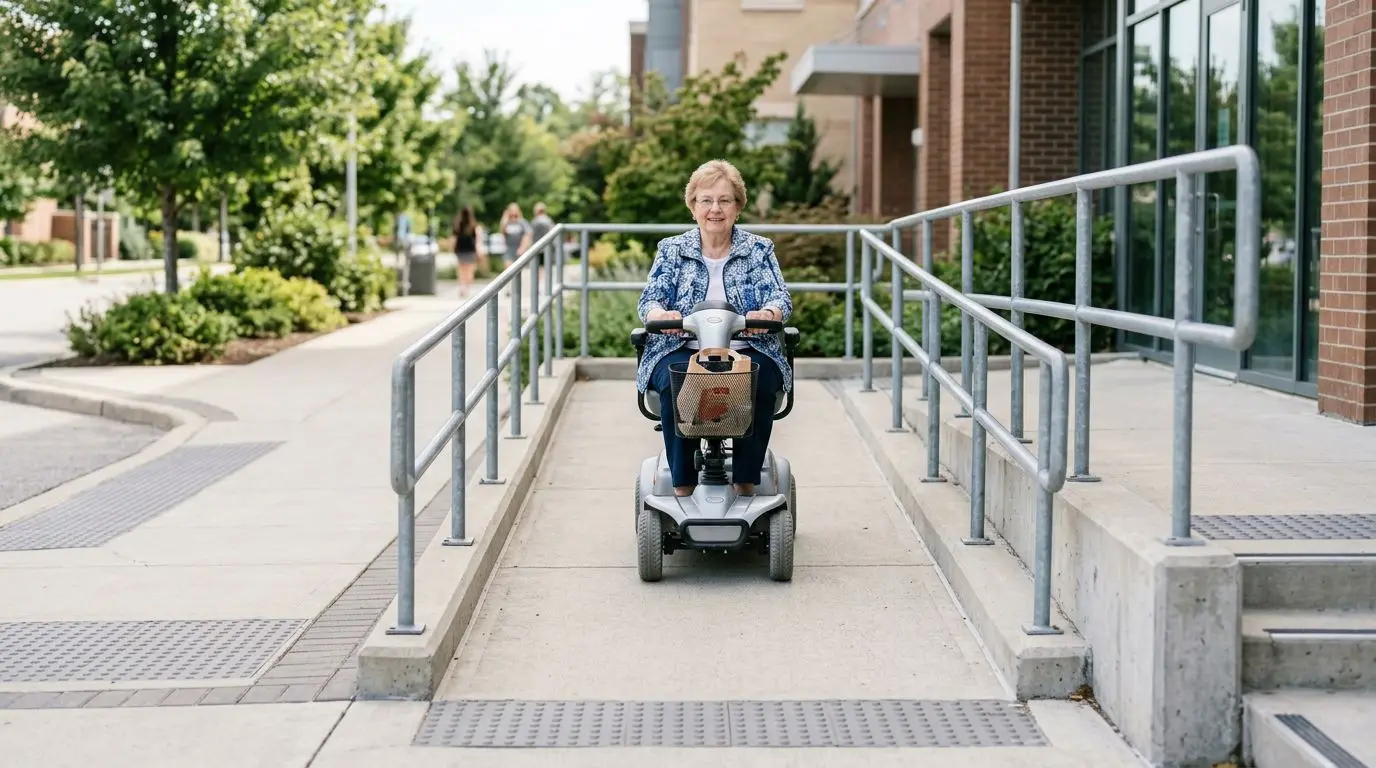
To ride a mobility scooter safely on ramps, slopes, driveways, and curb cuts, keep the scooter straight, slow, and within its rated incline limit. Avoid turning on an incline, approach curb cuts squarely, and never use a hill that makes the scooter feel unstable, underpowered, or hard to stop.
The safest outdoor route is usually the least dramatic one: a gradual ramp, a wide driveway, a dry surface, and enough room to line up before you climb or descend. If a slope is steeper than your scooter is rated for, or if you must turn sharply while tilted sideways, the scooter may not be the right tool for that location.
Know the incline limit before you try a hill
Many mobility scooters are rated for maximum inclines somewhere around 6 to 10 degrees, though the exact number depends on the scooter type, weight capacity, wheelbase, motor, tires, battery condition, and user load. A 10-degree slope is already noticeably steep outdoors; it is not the same as a gentle public access ramp.
Incline ratings are usually listed in degrees, percent grade, or a ratio. These figures describe how steep a slope is, but they are not a promise that every rider can safely use every ramp in every condition. Wet concrete, loose gravel, a low battery, extra cargo, worn tires, and a rider near the scooter weight limit can all reduce real-world performance.
For comparison, many accessible building ramps are designed around a 1:12 ratio, meaning 1 inch of rise for every 12 inches of run. That equals an 8.3% grade, or about 4.8 degrees. Some outdoor driveways are much steeper, especially near garages, alleys, and street aprons.
| Slope description | Approximate grade | What it means for scooter use |
|---|---|---|
| 1:20 walkway | 5% grade, about 2.9 degrees | Often feels gentle, but still requires controlled speed and attention. |
| 1:12 access ramp | 8.3% grade, about 4.8 degrees | Common accessible ramp standard; most outdoor scooters handle this better than steeper slopes when dry and straight. |
| 1:8 short ramp | 12.5% grade, about 7.1 degrees | May be near or above the comfort zone for many scooters, especially with a turn at the top or bottom. |
| 1:6 driveway section | 16.7% grade, about 9.5 degrees | Can be too steep for some scooters and may increase tipping, scraping, or braking risk. |
Always use the scooter manufacturer’s incline rating as the hard reference point. If the route is close to that limit, treat it as a caution zone, not an everyday green light.
Who it is best for: gentle grades, dry surfaces, and straight approaches
Ramp and driveway riding is best suited for riders who can keep both hands on the controls, look ahead at least 10 to 15 feet, and make small speed corrections without panic braking. It is also best for scooters with enough ground clearance, stable tires, working brakes, and a battery that is not near empty.
A mobility scooter can be very helpful for everyday outdoor travel when the route is predictable: a short ramp at a medical office, a curb cut at a crosswalk, a driveway with a moderate slope, or a sidewalk transition with a clear approach. These situations still require care, but they are manageable when you can line up straight and avoid side-tilting the scooter.
Hill riding is not ideal for everyone. If you have delayed reaction time, limited hand control, poor trunk balance, or difficulty judging speed and distance, ask a clinician, therapist, or mobility professional to help assess your setup and environment. That is not a medical guarantee; it is a practical safety step.
- Best suited for: short, dry ramps with a straight path and no sharp turn at the top.
- Use extra caution: sloped driveways, crowned roads, wet curb cuts, and surfaces with leaves, sand, or gravel.
- Often not suited: steep hills that exceed the scooter rating, slopes requiring a sideways turn, or ramps with a raised lip that catches the scooter.
How to measure a ramp, driveway, or curb cut before riding
You can estimate a slope with a tape measure in less than 5 minutes, and that quick check can prevent a bad surprise. Measure the vertical rise and the horizontal run, then divide rise by run to get percent grade. For example, a 6-inch rise over 72 inches of run is 6 divided by 72, or 8.3%.
If you prefer simpler tools, a smartphone level app can show degrees, but it must be used carefully on the steepest part of the route. Place the phone on a flat board, set the board on the slope, and check several spots, including the bottom transition and the top landing. Driveways often change angle within the first 3 to 6 feet.
Do not measure only the center of a curb cut. The edges may be steeper, broken, or tilted toward traffic. A curb cut that looks friendly from 20 feet away may still have a lip, gutter dip, or cross-slope that can twist the scooter as the front wheels enter.
| What to check | Practical measurement | Why it matters |
|---|---|---|
| Steepest grade | Measure rise and run over the steepest 3 to 6 feet | Short steep sections can be harder than the average slope. |
| Clear width | Look for at least about 36 inches of usable space where possible | Narrow paths make it harder to correct without turning sharply. |
| Landing space | Check for a flat area at top and bottom, ideally several feet long | You need room to stop, line up, and regain control. |
| Surface condition | Look for cracks, wet leaves, gravel, ice, or raised lips over 1/2 inch | Small obstacles matter more when the scooter is already tilted. |
If a slope measures close to your scooter’s maximum rating, consider finding a different route. Ratings are not based on every possible real-world condition.
Safe technique for going up a ramp or driveway
When climbing, approach straight on, reduce speed before the slope, and keep a steady pace of about walking speed. Do not accelerate hard at the bottom. Sudden throttle can shift weight rearward and make steering feel light, especially on shorter scooters.
Before you start up, look at the entire path. Is there a door at the top? A turn? A parked car? A child, pet, trash bin, or wet patch? If you cannot see a clear stopping area, wait. It is safer to pause on level ground than to stop halfway up a slope.
Keep both hands on the tiller, sit upright, and avoid leaning far back. Some riders naturally lean forward slightly while climbing, which can help them feel centered, but do not make sudden body movements. Smooth is the goal.
- Line up with the ramp or driveway before the front wheels reach the incline.
- Use a low or moderate speed setting rather than the highest setting.
- Maintain steady throttle; avoid pulsing the control repeatedly.
- Do not stop on the slope unless you must.
- If the scooter slows sharply, slips, or sounds strained, back out only if it is safe and straight; otherwise call for help.
Pay attention to ground clearance at the breakover point, where the surface changes from flat to angled or angled to flat. A scooter with low clearance may scrape at the bottom of a ramp or driveway apron, even if the motor can handle the grade.
Safe technique for going down a slope
Descending is often riskier than climbing because gravity can add speed within 1 or 2 seconds. Start slow before the slope begins, keep the scooter straight, and use the lowest practical speed setting. Never coast downhill with the scooter in freewheel mode.
Most mobility scooters rely on an electric drive system and braking system that are meant to stay engaged while riding. Freewheel mode is generally for pushing the scooter manually over short distances, not for riding. On a slope, freewheel can remove the control you need most.
Keep your thumb or fingers gentle on the throttle. On many scooters, releasing the throttle engages braking, but the stopping feel varies by design and surface. Practice on a very mild slope first, such as a short 2% to 3% grade, before using steeper outdoor routes.
- Slow down before the front wheels tip downward.
- Keep your body centered and your feet fully inside the scooter platform.
- Leave extra stopping distance at the bottom, especially near traffic.
- Avoid carrying loose bags that can swing or catch the controls.
- If the scooter surges, wobbles, or does not slow predictably, stop using that slope.
Do not assume a slope is safe downhill just because the scooter made it uphill. Stopping control matters as much as climbing power.
Turning risks: why side slopes cause rollovers
A turn on a slope can create a side angle of only a few degrees, but that may be enough to make a scooter feel unstable. Three-wheel scooters, short-wheelbase scooters, tall seats, high baskets, and uneven surfaces can all increase the feeling of tip risk during a turn.
The safest rule is simple: go straight up, go straight down, and make turns only on flat landings. If you must turn near a ramp, finish the slope first, stop on level ground, then turn slowly. A 90-degree turn at the top of a ramp is a common trouble spot because the rider is changing direction while speed, slope, and balance are all changing at once.
Side slopes are also common on sidewalks and driveways that drain toward the street. Even a sidewalk that looks level may tilt 2% for drainage. That does not sound like much, but when combined with a driveway apron or a curb cut, the scooter may lean diagonally.
| Risky maneuver | Why it is risky | Safer choice |
|---|---|---|
| Turning halfway up a ramp | Creates sideways tilt while climbing | Back up only if straight and safe, or continue to a flat landing. |
| Crossing a driveway at an angle | One wheel may drop or rise before the others | Cross at the flattest, most direct line available. |
| Turning sharply at a curb cut | Combines a lip, gutter dip, and traffic pressure | Line up squarely, complete the transition, then turn. |
| Reaching for something while tilted | Shifts body weight off center | Stop on level ground before adjusting bags, phone, or clothing. |
If one rear wheel feels light, or if you catch yourself leaning hard to stay balanced, treat that as a warning. Choose another route.
Curb cuts and driveway aprons: small edges can cause big problems
A curb cut may be only 3 to 6 feet long, but it can combine several hazards at once: a short ramp, a gutter dip, a raised seam, traffic, and pedestrians. Approach slowly and as squarely as possible, with both front wheels reaching the transition at nearly the same time.
Watch for the lip between the street and the curb cut. Even a raised edge around 1/2 inch can jolt smaller wheels, especially if you hit it at an angle. If the curb cut is broken, blocked, wet, or filled with leaves, use a different crossing if one is nearby.
Driveway aprons deserve the same respect. The sidewalk may slope down toward the street, then up again into the driveway. That creates a twisting motion across the scooter frame. Slow down before the apron, keep your hands steady, and do not make a sharp turn while crossing the angled section.
- Use marked crossings when available, even if they add a minute to your trip.
- Make eye contact with drivers, but do not rely on it as proof they see you.
- Wait for a full traffic gap; do not rush a curb cut.
- Avoid stopping with only the front wheels on the ramp and rear wheels in the street.
- Give pedestrians room; a scooter needs more space to correct on a slope.
If a curb cut forces you into a diagonal path, consider crossing at a different corner. The safer route is often the one with the straighter approach.
Speed control, braking, and battery condition on hills
A scooter traveling just 4 mph covers almost 6 feet per second, enough to reach the bottom of a short ramp before you can fully react. That is why the right speed setting matters more than confidence. Use the lowest setting that still lets the scooter move smoothly.
Many riders get into trouble by entering a slope too fast, then trying to correct midway. It is better to set your speed before the incline. On a shared sidewalk or building ramp, assume someone could appear from a doorway, parked vehicle, or corner.
Battery condition also affects hill performance. A scooter may feel strong on level ground but slow down on a grade when the battery is low. Cold weather can reduce battery performance too, and hills draw more power than flat travel.
| Feature or condition | Why it matters on slopes | What to check |
|---|---|---|
| Speed control range | Low settings help prevent downhill surging | Confirm the scooter moves smoothly at slow speed. |
| Braking response | You need predictable stopping before the bottom | Test on level ground, then on a mild slope. |
| Battery charge | Climbing uses extra power | Avoid challenging hills when the battery is near empty. |
| Tire condition | Traction affects climbing and stopping | Look for wear, low pressure on pneumatic tires, or damage. |
| Ground clearance | Low frames can scrape at ramp transitions | Check the bottom and anti-tip area after mild test runs. |
If braking feels delayed, grabby, noisy, or inconsistent, stop riding slopes until the scooter is inspected. A hill is not the place to discover a maintenance problem.
When a mobility scooter may not be suited for hills
A scooter may not be suited for hills if the route exceeds its rated incline, requires a turn on the slope, or causes the scooter to lose traction, bottom out, tip, or struggle to stop. One failed attempt is enough information; do not keep testing a risky hill hoping for a better result.
Some scooter types are designed mainly for indoor use or smooth level surfaces. Compact travel scooters can be convenient, but shorter wheelbases and smaller wheels may feel less settled on steep driveways, rough curb cuts, and broken pavement. Larger outdoor-oriented scooters may have better traction and stability, but size does not make any scooter safe on an excessive slope.
Weight matters too. The rated incline may be based on a particular test load and surface. A rider near the scooter’s maximum weight capacity, plus groceries or oxygen equipment, can change climbing and braking behavior. Keep all personal items secured and low, not hanging from the tiller.
- The hill is steeper than the scooter’s stated maximum incline.
- You cannot approach straight or stop on a flat landing.
- The scooter slows dramatically, slips, smells hot, or makes unusual sounds.
- The front end feels too light going uphill.
- The scooter gains speed downhill even at the lowest setting.
- You feel afraid, rushed, or unable to make small corrections.
In these situations, look for a flatter route, arrange assistance, consider a different mobility device for that environment, or ask the property owner about safer access. Safety should come before convenience.
Practice plan: build skill on a 2% to 5% grade first
Practice should start on a mild slope, ideally around 2% to 5%, with a helper nearby and no traffic. A quiet parking lot, long sidewalk, or gentle building approach can work if the surface is dry and clear. Do not begin with the steepest driveway in your neighborhood.
Start by riding straight up and down at the lowest comfortable speed. Then practice stopping before the slope, pausing on level ground, and lining up again. Once that feels easy, practice using a curb cut with no traffic pressure, approaching squarely and stopping after the transition.
Keep early sessions short, around 10 to 15 minutes. Fatigue affects steering and judgment. If your hands, shoulders, neck, or back get tired, stop and rest before trying another ramp.
- Practice on dry pavement only.
- Use a helper as a spotter, not as a person to physically catch the scooter.
- Keep baskets lightly loaded during practice.
- Repeat the same route several times before adding a new challenge.
- Stop if the scooter behaves differently than expected.
Confidence is useful only when it is paired with a realistic route and a scooter capable of handling it.
Quick pre-ride checklist for outdoor slopes
A 60-second check before leaving home can catch many slope-related problems. Make it a habit, especially if your regular route includes a driveway, ramp, or curb cut.
- Battery is sufficiently charged for the full trip plus a reserve.
- Speed dial is set low before the first ramp.
- Tires look sound; pneumatic tires are properly inflated if applicable.
- Seat is locked and not raised higher than necessary.
- Bags are secured low and do not hang from the controls.
- Freewheel lever is fully in drive mode.
- Horn, lights, and reflectors are working if you will be near traffic.
- Weather is acceptable; avoid ice, heavy rain, wet leaves, and loose gravel on slopes.
If you are unsure about a new hill, walk or have someone inspect the route first. A two-minute look can save you from getting stuck halfway.
FAQ: common ramp and slope questions
What is the safest way to go up a ramp on a mobility scooter?
Approach straight, slow down before the ramp, keep both hands on the tiller, and maintain steady speed. Do not turn, accelerate hard, or stop on the incline unless necessary.
Can a mobility scooter tip over on a driveway?
Yes. The risk increases when the driveway is steep, uneven, wet, or crossed at an angle. Turning on a sloped driveway is especially risky because it adds sideways tilt.
How steep is too steep for a mobility scooter?
Any slope steeper than the scooter’s rated incline is too steep. Many scooters fall in the general range of about 6 to 10 degrees, but you must check the specific rating for your scooter and account for surface, weight, battery, and weather.
Should I go faster to climb a hill?
No. Use a controlled, steady speed rather than a fast run-up. Entering too fast can reduce steering control and make it harder to stop or correct at the top.
Are curb cuts safe for mobility scooters?
Many curb cuts are usable, but they are not automatically safe. Look for raised lips, gutter dips, broken pavement, wet leaves, traffic, and diagonal approaches before crossing.
What should I do if my scooter feels unstable on a slope?
Stop on level ground if you can do so safely, avoid turning, and do not repeat the route. Find a flatter path or ask for help assessing whether the scooter and route are a safe match.
Frequently asked questions
What is the safest way to go up a ramp on a mobility scooter? +
Approach straight, slow down before the ramp, keep both hands on the tiller, and maintain steady speed. Avoid turning, sudden acceleration, or stopping on the incline unless necessary.
Can a mobility scooter tip over on a driveway? +
Yes. Tip risk increases on steep, uneven, wet, or angled driveways, especially if you turn while the scooter is tilted sideways.
How steep is too steep for a mobility scooter? +
Any slope steeper than the scooter’s rated incline is too steep. Many scooters are rated around 6 to 10 degrees, but the safe limit depends on the scooter, rider load, surface, battery condition, and weather.
Should I speed up before climbing a hill? +
No. Use a controlled, steady speed. A fast run-up can reduce steering control and make stopping harder at the top.
Are curb cuts safe for mobility scooters? +
Many are usable, but check for raised lips, gutter dips, broken pavement, wet leaves, and traffic. Approach squarely and slowly.
What should I do if my scooter feels unstable on a slope? +
Stop on level ground if you can do so safely, avoid turning, and do not keep testing the same slope. Use a flatter route or ask for help assessing the scooter and location.
Related guides
Using a Mobility Scooter on Ramps, Slopes, Curbs, and Uneven Pavement Safely
13 min read
How to Prevent Mobility Scooter Tip-Overs: Slopes, Turns, Curbs, and Weight Balance Explained
14 min read
Using a Mobility Scooter on Ramps, Grass, Gravel, and Uneven Ground: What’s Safe and What to Avoid
13 min read