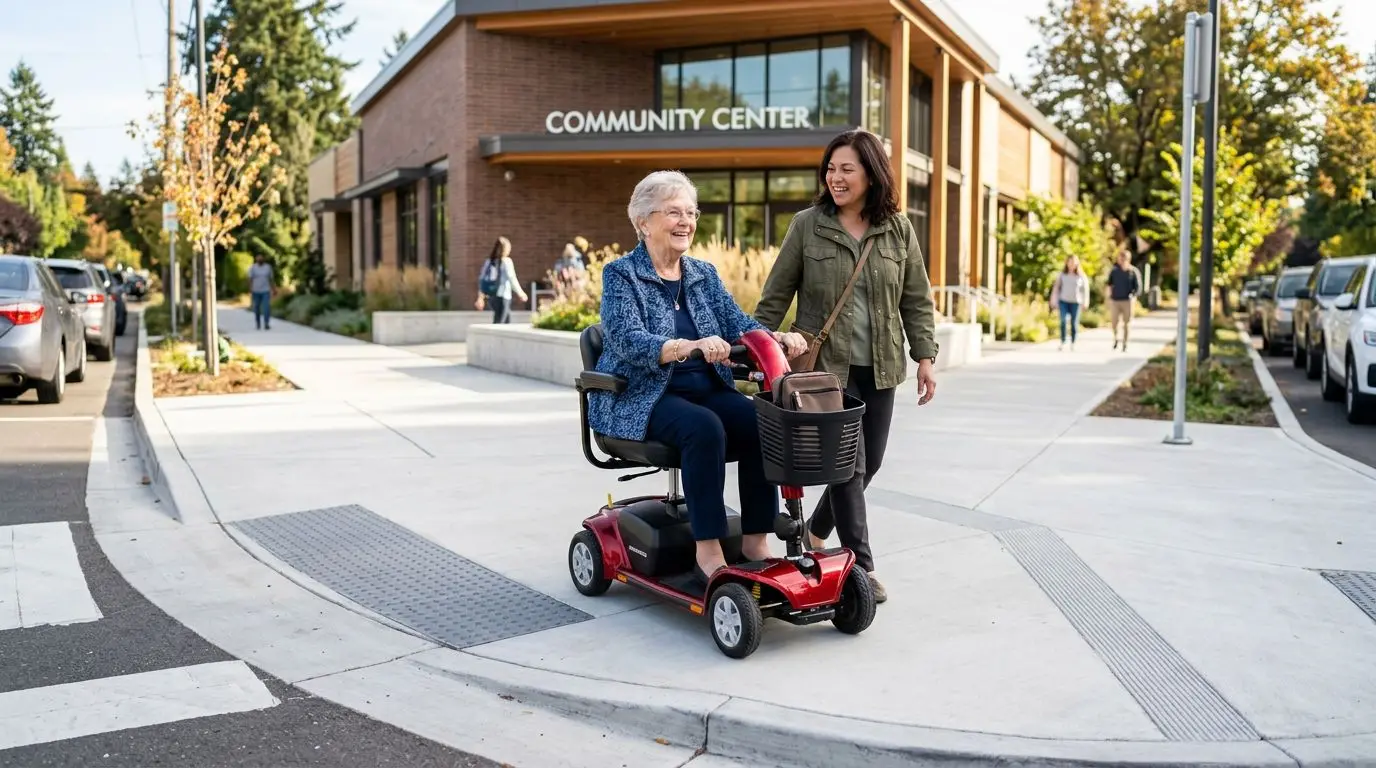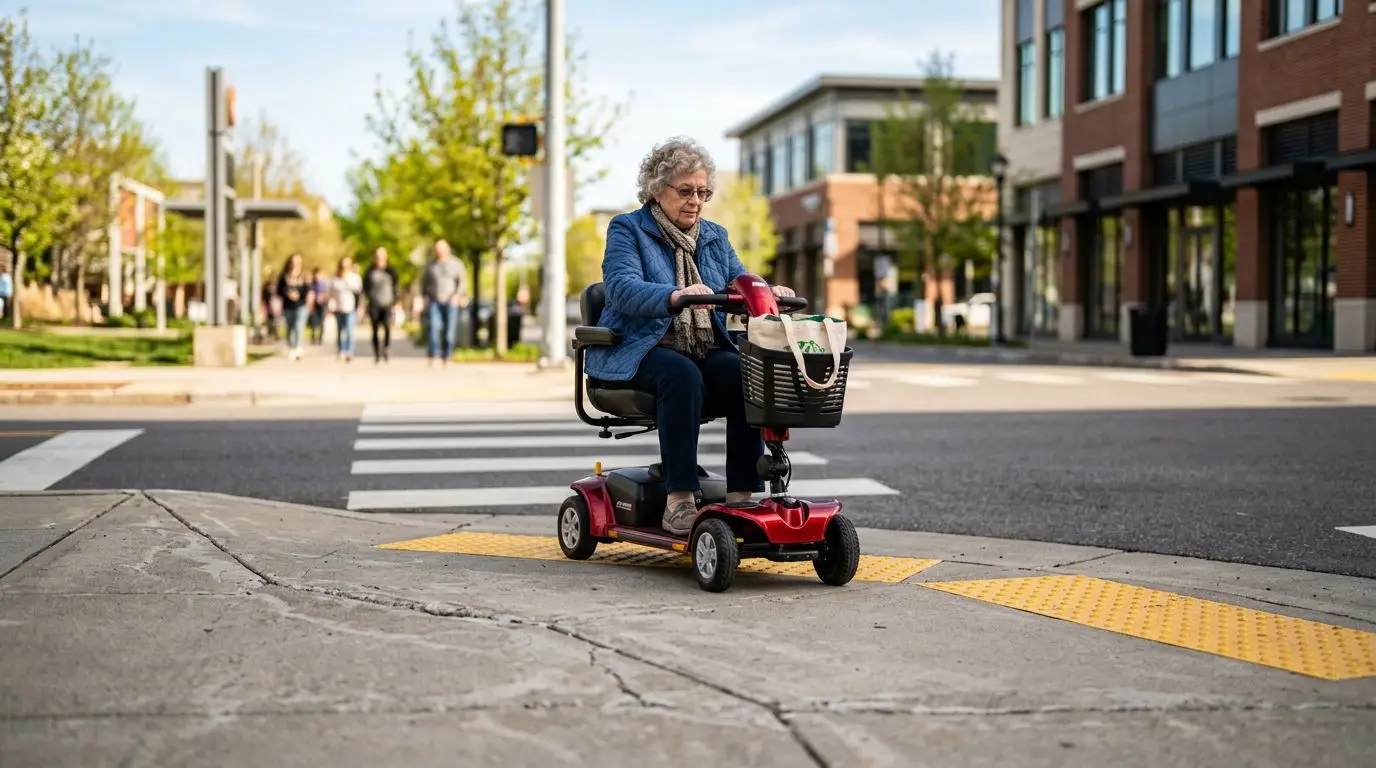
To use a mobility scooter safely on ramps, slopes, curbs, and uneven pavement, keep your speed low, approach straight on, keep your body centered, and avoid turning while the scooter is angled. Stay within your scooter's rated incline and obstacle limits. If a ramp is wet, too steep, broken, or higher than your ground clearance, take another route.
Outdoor hazards are common. Driveway aprons, curb cuts, cracked sidewalks, door thresholds, gravel paths, and sloped parking lots can all affect how a scooter balances. The goal is not to be fearless. It is to make steady decisions before the scooter is already committed.
Why ramps and uneven surfaces increase tip-over risk by 3 inches or less
A mobility scooter is stable when its wheels stay firmly planted and the rider's weight remains inside the base of support. On a flat floor, that often feels simple. On a ramp, curb cut, or sidewalk lifted by tree roots, the scooter can tilt several degrees, and the rider's body weight may shift to one side or toward the rear.
Small height changes matter. A 2-inch sidewalk lip, a 3-inch driveway edge, or a half-settled curb cut may look harmless from a car, but it can jolt a scooter enough to affect steering and traction. The risk rises when the front wheel or wheels meet the obstacle at an angle.
Three things usually cause problems outdoors:
- Angle: The scooter leans forward, backward, or sideways on a slope.
- Traction: Tires can slip on wet concrete, leaves, loose gravel, sand, or painted surfaces.
- Momentum: Too much speed can make a bump or curb cut feel like a launch instead of a roll.
Most loss-of-control events are not caused by one dramatic hazard. They often happen when two or three conditions combine, such as a steep curb cut with wet leaves, or a sloped driveway with a sharp turn at the bottom.
Know your scooter's limits before you face a 6-degree slope
Before using any ramp or slope, check the owner's information for three key limits: maximum incline, ground clearance, and maximum obstacle height. Many scooters list a safe climbing angle or grade. Some may be rated around 6 degrees, while others may handle more or less depending on design, weight capacity, tire type, battery condition, and rider weight.
Do not treat the incline rating as a challenge to beat. It is a controlled-condition guideline, not a promise that every outdoor slope is safe. Real ramps may be wet, uneven, narrow, crowned in the middle, or interrupted by a lip at the top.
| Limit to check | Why it matters | Practical example |
|---|---|---|
| Maximum incline | Helps you avoid slopes that exceed the scooter's stability and motor capability | A driveway that rises 1 foot over 8 feet is steep for many scooters |
| Ground clearance | Determines whether the underside may scrape or hang up | A 2-inch threshold may be too high for a scooter with low clearance |
| Obstacle height | Shows the maximum small lip or bump the scooter is intended to cross | A curb that looks low may still exceed the safe obstacle limit |
| Weight capacity | Affects braking, climbing, steering, and battery strain | Rider plus bags should remain within the stated limit |
| Tire type | Changes traction and shock absorption | Larger air-filled tires often feel smoother on rough pavement than small solid tires |
If you do not have the manual, look for the information in the scooter's manufacturer documentation or on its label. When in doubt, assume less capability, not more.
How to approach ramps and driveway slopes at about 1 to 3 mph
Slow is safer. Many scooter accidents on ramps start with entering too quickly, turning mid-ramp, or braking suddenly on the slope. Use the lowest practical speed setting, often a walking pace of about 1 to 3 mph, and give yourself room to line up before the ramp begins.
Approach ramps straight on. Your front wheel or wheels should meet the ramp squarely, not diagonally. A diagonal approach can put one wheel higher than the other, shifting your center of gravity to the side.
- Before the ramp: Stop or slow on level ground, look at the full ramp, and choose your line.
- Going up: Lean slightly forward from the hips if comfortable, keep both hands on the controls, and maintain steady throttle.
- Going down: Sit upright or slightly back, keep speed low, and avoid sudden braking.
- On the ramp: Do not turn around, reach sideways, or stop unless you must.
- At the top and bottom: Watch for a lip, mat, drainage groove, or change in surface.
A widely used accessibility guideline for permanent public ramps is a 1:12 slope, meaning 1 inch of rise for every 12 inches of run. That equals a ramp rising 6 inches over 6 feet. Many private driveways, portable ramps, and curb cuts can be steeper than that, so your eyes alone may underestimate the angle.
Driveway slopes need special caution because they are often curved or slanted sideways toward the street. If the scooter feels like it is pulling sideways, do not fight it at speed. Stop on the flattest safe spot, reassess, and choose a different path if needed.
Curbs, curb cuts, and thresholds: treat a 1-inch lip as a real obstacle
Curbs and thresholds cause trouble because they combine a height change with a sharp edge. Even a 1-inch lip can stop small front wheels if approached too slowly at the wrong angle or too quickly without control. A standard street curb may be several inches high and should not be climbed unless your scooter is specifically designed and rated for that obstacle, which many everyday mobility scooters are not.
Use curb cuts whenever available, but inspect them first. A curb cut may have a steep center, raised side flares, broken concrete, pooled water, or a gutter dip at the street. The safest line is usually straight through the lowest and smoothest part, not across the sloped side wing.
| Obstacle | Safer action | Warning sign |
|---|---|---|
| Door threshold | Cross straight and slowly, using a threshold ramp if needed | Scooter scrapes underneath or front wheels stop abruptly |
| Curb cut | Line up squarely and avoid the angled side flares | Water, gravel, leaves, or broken concrete in the gutter |
| Street curb | Use a curb cut or another route | Curb is higher than the scooter's ground clearance or obstacle rating |
| Temporary ramp | Confirm it is wide, stable, and secured before use | Ramp shifts, flexes, or has no edge protection |
If a front wheel bumps and stops at a lip, do not keep pressing the throttle. That can increase the risk of tipping or damaging the scooter. Back away carefully if safe, realign, and try again only if the obstacle is within the scooter's stated ability. If not, find another entrance.
Uneven pavement, gravel, grass, and sidewalk cracks over 1 inch
Rough surfaces reduce comfort and control. Cracked sidewalks, raised slabs, loose gravel, grass, brick paths, and worn asphalt can pull the steering one way while the scooter's rear wheels are still on a different surface. A crack or height difference over 1 inch deserves attention, especially with smaller wheels.
On uneven pavement, keep both hands on the tiller and reduce speed before the rough section begins. Look 10 to 15 feet ahead rather than directly at the front tire. This gives you time to choose the smoothest line.
Loose surfaces behave differently from hard bumps. Gravel, sand, wet grass, and mulch can let wheels sink or spin. If the scooter begins to fishtail, dig in, or lose forward motion, ease off the throttle. More power can make the scooter slide or bury itself deeper.
- Avoid wet grass on slopes; traction can disappear quickly.
- Cross cracks as close to a 90-degree angle as possible.
- Do not straddle deep ruts; a wheel can drop unexpectedly.
- Watch for utility covers, tree roots, and uneven brick edges.
- Slow down before textured warning pads at crosswalks.
Outdoor-capable scooters with larger wheels and more ground clearance generally handle rough sidewalks better than compact indoor-focused scooters. Still, no scooter is immune to poor surface conditions. The rider's route choice remains the most important safety feature.
Who it's best for and when to say no within 10 seconds
A safe trip over a ramp or rough pavement starts with a quick yes-or-no decision. If you cannot decide within about 10 seconds whether a slope, curb cut, or sidewalk section is manageable, that uncertainty is useful information. Pause and look for an easier path.
| Situation | Usually reasonable for | Better to avoid when |
|---|---|---|
| Gentle public ramp | Riders who can maintain a straight line and steady throttle | Ramp is wet, crowded, narrow, or has a sharp turn |
| Driveway apron | Experienced riders who know the slope and surface | It has a sideways tilt, loose gravel, or a gutter drop |
| Low threshold | Scooters with enough clearance and a square approach | The scooter catches, scrapes, or requires a running start |
| Rough sidewalk | Riders using low speed and scanning ahead | Cracks, roots, or slab changes exceed the scooter's ability |
| Grass or gravel | Only when firm, level, dry, and necessary | Surface is soft, sloped, wet, or rutted |
Say no to any route that requires speed to get over an obstacle. A mobility scooter should not need a running start to clear a lip or slope. If momentum is the only plan, it is not a safe plan.
Reconsider as well if you are carrying heavy bags on the tiller or rear of the seat. Extra weight can change balance and steering, especially on slopes. Keep loads low, centered, and within the scooter's stated limits.
How to measure slope, clearance, and ramp fit with a 4-foot board
You do not need engineering tools to make better decisions at home. A 4-foot board, a tape measure, and a small level can help you estimate whether a ramp or driveway is likely to be reasonable for your scooter.
To estimate slope, place the board along the ramp or driveway in the direction of travel. Put the level on the board and raise the lower end until the board is level. Measure the vertical distance from the raised end to the ground. If a 48-inch board needs to be raised 4 inches to become level, the slope is about 1:12. If it needs 8 inches, the slope is about 1:6, which is much steeper.
You can also use the rise-over-run method:
- Rise: The vertical height gained, such as 6 inches.
- Run: The horizontal distance traveled, such as 72 inches.
- Ratio: 6 inches of rise over 72 inches of run equals 1:12.
Measure threshold height from the lower surface to the top of the lip. Then compare that number with your scooter's ground clearance and obstacle rating. Leave a safety margin. A 1.5-inch lip may not be safe just because a specification says the scooter can manage a similar height under ideal conditions.
Ramp width matters too. Many scooters are around 22 to 27 inches wide, while larger ones can be wider. A ramp should allow room for the scooter's full width plus steering correction; a narrow ramp with no edge protection leaves little margin for error.
Features that help on outdoor hazards, with 8 practical comparisons
Some scooter features can make ramps and rough pavement easier to manage, but features do not replace judgment. Think of them as risk reducers, not permission to take unsafe routes.
| Feature or design | Helps with | Tradeoff to consider |
|---|---|---|
| Larger wheels | Rolling over small cracks and uneven pavement | May increase scooter size and turning radius |
| Higher ground clearance | Reducing scraping at thresholds and ramp transitions | Can raise the seat height and center of gravity |
| Wider wheelbase | Side-to-side stability | May be harder to maneuver indoors |
| Four-wheel layout | General stability on uneven outdoor surfaces | May turn less tightly than some three-wheel designs |
| Suspension | Comfort over cracks, brick, and rough pavement | Does not eliminate tip-over risk |
| Air-filled tires | Traction and shock absorption on rough ground | Require pressure checks and can puncture |
| Solid tires | No flats and lower maintenance | Can feel harsher and may have less grip on some surfaces |
| Speed limiter | Keeping a controlled pace on ramps and sidewalks | Still requires the rider to slow before hazards |
Brakes are just as important as tires. Test braking in a flat, open area before relying on it outdoors. If stopping distance feels longer than usual, the battery is low, or the scooter rolls after releasing the throttle, do not use slopes until the scooter has been checked.
What to do if you lose traction or feel tipping within 2 seconds
If the scooter starts to slide, lean, or climb unexpectedly, your first response should be calm and small. Sudden steering, sudden throttle, or a hard grab can make a marginal situation worse within 2 seconds.
- If going uphill and losing power: Ease off the throttle, keep the wheels straight, and back down slowly only if you can do so safely.
- If going downhill too fast: Reduce throttle, keep straight, and use controlled braking. Do not swerve across the slope.
- If a wheel hits a lip: Stop pressing forward, back away if safe, and choose a better angle or route.
- If the scooter tilts sideways: Stop if possible, keep your body centered, and avoid reaching downhill.
- If stuck on soft ground: Stop spinning the wheels. Ask for help rather than rocking aggressively.
After any hard jolt, scrape, or near-tip, inspect the scooter before continuing. Check that the seat is locked, the tiller feels secure, the tires look normal, and no parts are dragging. A 30-second check can prevent the next problem.
If you fall, strike your head, or feel pain, seek appropriate help. Do not rush to lift a heavy scooter alone. Personal safety comes first; the scooter can wait.
FAQ: 5 common questions about scooter ramps, slopes, and curbs
Can a mobility scooter go up a driveway?
Sometimes, but it depends on the driveway slope, surface, and scooter rating. A smooth, gentle driveway may be manageable, while a steep driveway with a sideways tilt, gutter dip, or loose gravel may not be safe.
Is it safe to drive a scooter over a curb?
Most everyday mobility scooters should not be driven over standard street curbs. Use a curb cut, ramp, or alternate route unless the curb height is clearly within the scooter's stated obstacle limit and the approach is straight and controlled.
Should I go faster to get over a threshold?
No. A running start increases the chance of loss of control. If a threshold cannot be crossed slowly and squarely, use a suitable threshold ramp or choose another entrance.
Are three-wheel scooters safe on slopes?
Some three-wheel scooters can handle gentle, even slopes when used correctly, but they may feel less stable side-to-side than comparable four-wheel designs. The safest choice depends on the scooter's rating, the surface, and the rider's control.
What should I do if a curb cut is blocked or broken?
Do not force the scooter through a damaged or blocked curb cut. Look for another crossing, ask for assistance if needed, and report the access problem to the property owner or local public works department when appropriate.
Frequently asked questions
Can a mobility scooter go up a driveway? +
Sometimes. A smooth, gentle driveway may be manageable if it is within the scooter's incline rating, but steep driveways, sideways slopes, gutter dips, wet leaves, and loose gravel can make it unsafe.
Is it safe to drive a mobility scooter over a curb? +
Most everyday mobility scooters should not be driven over standard street curbs. Use a curb cut, ramp, or alternate route unless the curb is clearly within the scooter's stated obstacle limit.
Should I speed up to get over a threshold? +
No. A running start can cause loss of control. Cross thresholds slowly and straight on, and use a threshold ramp if the lip is too high for your scooter.
Are three-wheel mobility scooters safe on slopes? +
They can be safe on gentle, even slopes when used within their ratings, but they may feel less stable side-to-side than comparable four-wheel scooters. Avoid turning on slopes with any scooter.
What should I do if my scooter starts slipping on gravel or wet pavement? +
Ease off the throttle, keep the wheels as straight as possible, avoid sudden steering, and stop when safe. If the route remains slippery or soft, back out carefully or ask for help.
Related guides
How to Ride a Mobility Scooter Safely on Ramps, Slopes, Driveways, and Curb Cuts
15 min read
Using a Mobility Scooter on Ramps, Grass, Gravel, and Uneven Ground: What’s Safe and What to Avoid
13 min read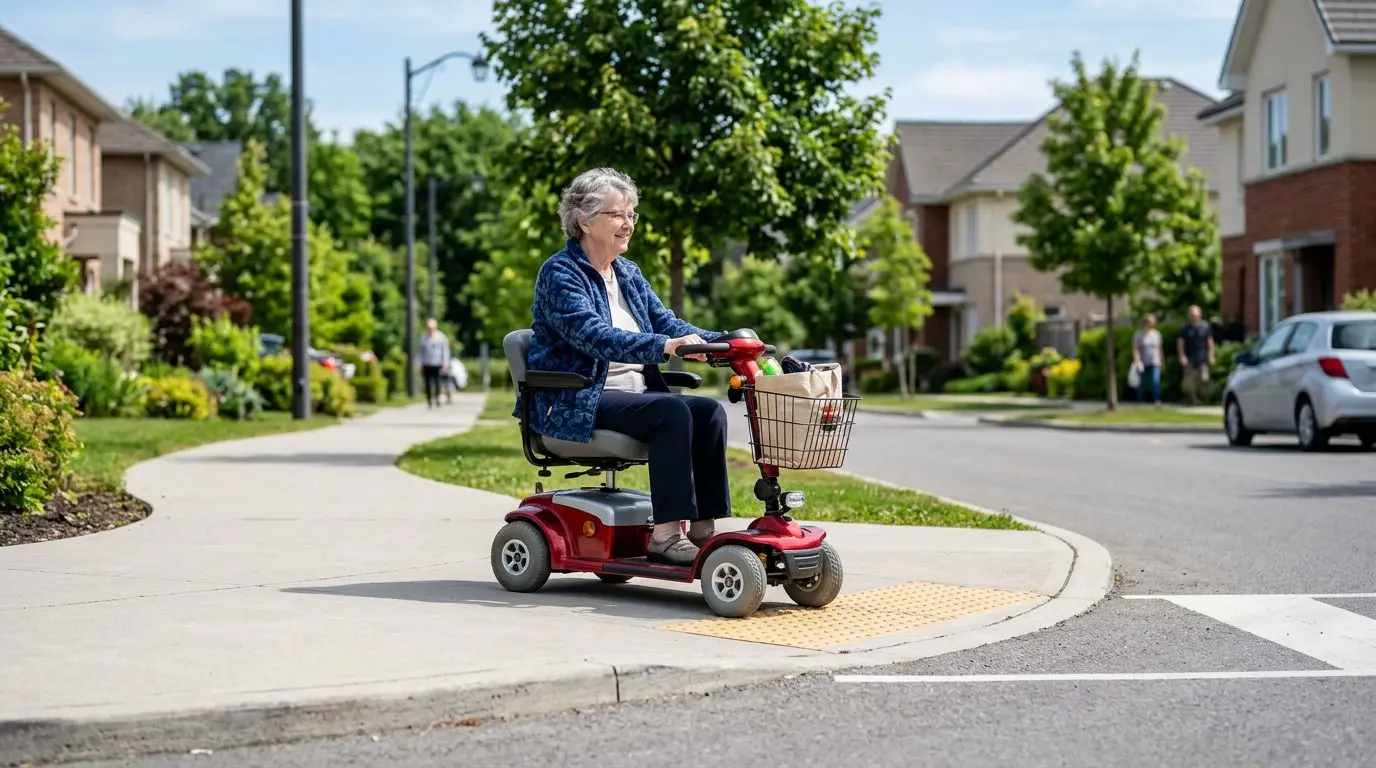
How to Prevent Mobility Scooter Tip-Overs: Slopes, Turns, Curbs, and Weight Balance Explained
14 min read