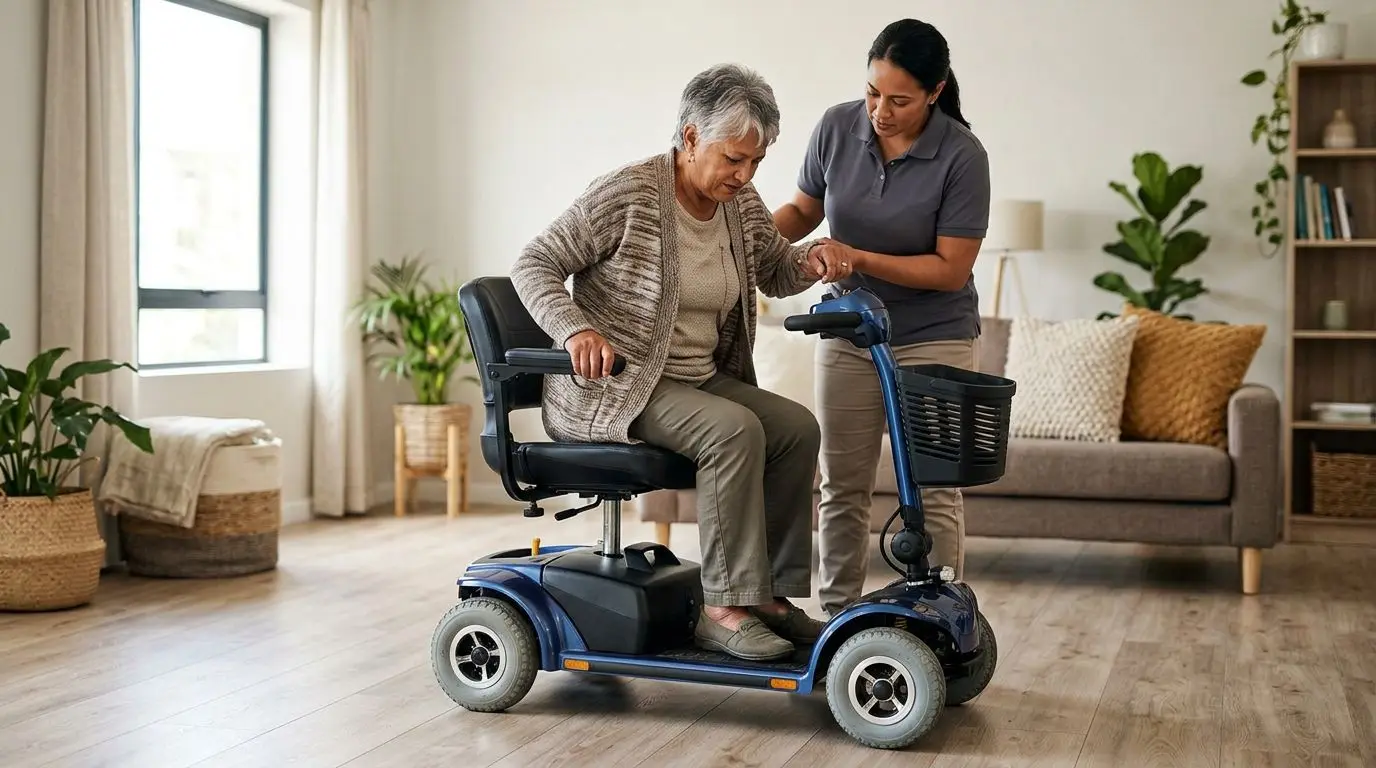
The safest way to transfer onto or off a mobility scooter is to stop on a flat surface, turn the scooter off, lock or steady the seat, move slowly, and keep at least one hand on a stable support. Most falls happen in the first or last few seconds of a transfer, especially if the seat swivels, the scooter rolls, or the rider turns too quickly. A simple step-by-step routine can lower the risk and make sitting, standing, and pivoting feel more predictable.
This guide is for seniors and adults with limited balance who want practical, brand-neutral transfer advice. It covers safe mounting and dismounting, swivel seats, armrests, foot placement, and common fall risks without making medical claims or replacing guidance from a clinician.
Why scooter transfers are risky: the 3-second danger zone
A scooter transfer may look simple, but it brings several movements together at once: standing, turning, backing up, reaching, lowering, and sometimes handling a rotating seat. The highest-risk moment is often the 3-second window when your body weight is between two supports, such as a chair and the scooter seat.
Small details can make a big difference. A front wheel angled 30 degrees can change how the scooter feels under your hands. A seat that swivels 90 degrees can help you avoid twisting, but it can also catch you off guard if it is not locked. A loose floor mat that slides only 2 inches may be enough to disrupt an otherwise careful transfer.
The main goal is not speed. It is control. Before every transfer, ask yourself three questions: Is the scooter stable? Is the seat where I expect it to be? Do I have a firm place for my hands?
Before you move: a 30-second safety check
Take 30 seconds before sitting or standing. This brief pause is one of the best habits you can build because it helps catch the problems that commonly lead to falls.
- Park on level ground. Avoid slopes, curb cuts, gravel, wet grass, or uneven thresholds. Even a slight slope can make standing harder.
- Turn the scooter off. Do not transfer with the power on. Accidental throttle contact can move the scooter unexpectedly.
- Set the speed to the lowest setting before shutdown. This helps if you accidentally turn the scooter back on while repositioning.
- Check the seat position. If the seat swivels, rotate it toward you and confirm it is locked before putting weight on it.
- Move the tiller if needed. Some scooters have an adjustable tiller. Make enough knee room so you do not bump the controls.
- Clear 3 feet of space. Remove bags, oxygen tubing, pet leashes, throw rugs, and loose shoes from the transfer area.
- Use supportive footwear. Shoes with backs and non-slip soles are safer than slippers or socks on smooth floors.
If something feels wrong, stop. Reset the scooter and your body position instead of trying to save a poor transfer halfway through.
How to sit down on a scooter in 6 steps
Use the same sitting routine every time. Repetition reduces hesitation and makes it easier to notice when something is out of place.
- Approach from the side if possible. Stand close enough that the back of your legs can feel the seat edge. A gap larger than about 6 inches can make you reach or twist.
- Turn the scooter off and steady the seat. If the seat swivels, turn it toward you and lock it. If it does not swivel, position yourself so you do not have to twist sharply.
- Place both feet under you. Keep feet about hip-width apart. One foot may be slightly back to help with control as you lower.
- Reach for stable supports. Use the armrests if they are fixed and secure. Do not pull on the tiller as your main support because it is meant for steering, not body weight.
- Back up until you feel the seat. Do not sit until you can feel the seat behind both legs. This helps prevent missing the seat edge.
- Lower slowly, then reposition. Sit down with control. Once seated, slide back, place both feet on the deck or foot area, and bring the seat forward if it was swiveled.
Pause after sitting. Give yourself 5 to 10 seconds to make sure you are centered, your feet are safely placed, and your hands are clear of the throttle before powering the scooter.
How to stand up and dismount in 6 steps
Standing up is often harder than sitting down because it requires leg strength, balance, and a forward weight shift. The key is to prepare before you lift.
- Stop fully and turn the scooter off. Do not stand while the scooter is powered or still rolling.
- Move the seat to the transfer position. If the seat swivels, rotate it toward the side you will exit and lock it before standing.
- Bring your feet back. Place both feet flat on the ground if possible. Feet tucked slightly under your knees make standing easier than feet stretched forward.
- Scoot toward the front of the seat. Move forward only as far as you can control. Keep your hips on the seat until you are ready to stand.
- Push from the armrests or seat, not the tiller. Use both hands if you can. If one side is weaker, plan your stronger side toward the best support.
- Stand, pause, then turn. Once upright, wait 2 to 3 seconds before stepping. This pause helps you check for dizziness, foot placement, and obstacles.
If you feel lightheaded when standing, sit back down if it is safe and wait. Frequent dizziness, repeated near-falls, or a new change in balance should be discussed with a healthcare professional.
Turning and pivoting: use the 45-to-90-degree rule
Many transfer falls happen during the turn, not during the lift. A safe turn is small, planned, and supported. Avoid twisting your upper body while your feet stay planted.
For most transfers, aim to position the scooter seat within 45 to 90 degrees of the surface you are moving from or to. A swivel seat can reduce the body twisting needed, especially when getting in from the side. The safest swivel position lets your feet reach the floor, your knees clear the tiller, and your hands reach stable supports.
Do not spin the seat while half-standing. Sit first, then rotate. Before standing, rotate and lock the seat first, then rise. If the seat has a lever, check that clothing, bags, or a cane strap are not caught near it.
| Transfer angle | What it usually means | Safety note |
|---|---|---|
| 0 degrees, straight on | You face the scooter directly | May require stepping over the deck or reaching around the tiller |
| 45 degrees | A slight angled approach | Often useful in tight indoor spaces |
| 90 degrees | Side approach with a swivel seat | Can reduce twisting if the seat locks securely |
| More than 90 degrees | Over-rotated or awkward approach | Often increases reaching, twisting, or stepping backward |
Armrests, seats, and controls: 7 features that affect transfer safety
Mobility scooter features can make transfers easier or harder depending on your balance, strength, and home layout. The best feature is the one that supports your real transfer routine, not the one that sounds most advanced.
| Feature | How it can help | What to check |
|---|---|---|
| Swivel seat | Reduces twisting when entering from the side | Locks firmly at common positions, such as 45 or 90 degrees |
| Flip-up armrests | Creates side access for transfers | Armrests should not wobble when used for light support |
| Adjustable armrest width | Helps fit shoulders and hips | Too wide may reduce support; too narrow may pinch |
| Height-adjustable seat | Can make standing easier | Seat should allow feet to reach the floor safely |
| Adjustable tiller | Improves knee room | Controls should be clear before standing or sitting |
| Flat foot deck | Gives more room for foot placement | Check whether both feet fit without crowding |
| Stable seat base | Reduces unwanted movement | Listen and feel for looseness before transfer |
Armrests need special attention. Many riders naturally push from them, but not all armrests are built to handle heavy body weight. If an armrest flexes, clicks, or shifts when you press down, treat it as a guide rather than a lifting handle.
How to choose and measure for safer transfers: 4 key measurements
Fit directly affects transfer safety. A scooter that is too tall, too cramped, or too wide for your doorway can turn a routine transfer into a balance challenge. Measure before you buy, borrow, or accept a used scooter.
- Seat height to floor. Sit on a firm chair and note the height that lets you stand with the least strain. Many dining chairs are around 18 inches high, which can be a useful comparison point, though individual needs vary.
- Seat width. Measure your seated hip width and allow extra room for clothing and safe repositioning. You should be able to sit centered without pressing hard against the armrests.
- Foot space. Check whether both feet can rest flat and whether you can bring your feet back before standing. Crowded foot space can force a weak standing position.
- Turning space at home. Measure hallways, doorways, and the area beside your bed or favorite chair. A common interior doorway is about 30 to 36 inches wide, but older homes can be narrower.
Measure the transfer location too, not just the scooter. If you plan to park beside a recliner, bed, or kitchen chair, make sure there is enough room to approach, turn the seat, place both feet down, and stand without stepping over cords or rugs.
Who this transfer approach is best for—and when to get 1-on-1 help
This routine is best for people who can follow simple steps, place at least one foot flat on the floor, and use their arms or legs enough to control a sit-to-stand movement. It can help adults who feel unsteady during turns, people rebuilding general confidence after a near-fall, and caregivers who want a consistent checklist.
It is not a substitute for hands-on training when balance is significantly limited. Ask for help from a physical therapist, occupational therapist, clinician, or trained mobility professional if you have had 2 or more falls in the past year, need another person to lift you, cannot stand for a few seconds without support, or feel dizzy during transfers.
Who it is best for
- Riders who can stand briefly but need a safer routine.
- Adults who use a cane, walker, or grab bar for some transfers.
- Caregivers helping a rider practice the same steps every time.
- People comparing scooter features such as swivel seats and armrests.
When to involve a professional
- You cannot get both feet safely positioned before standing.
- You feel faint, short of breath, or newly weak during transfers.
- Your home setup requires awkward angles or tight turns.
- You need physical lifting rather than standby assistance.
Common fall risks and quick fixes: 10 checks
Most transfer problems follow a pattern. Look for these 10 risks before they become habits.
| Risk | Why it matters | Safer fix |
|---|---|---|
| Scooter left powered on | Accidental throttle contact can move it | Turn power off before every transfer |
| Seat not locked | Unexpected rotation can shift balance | Test the lock before sitting or standing |
| Using tiller as a grab bar | It may turn or move under load | Use armrests, a stable chair, or approved support |
| Feet too far forward | Makes standing harder | Bring feet under knees before rising |
| Loose rugs or mats | Can slide during a pivot | Remove or secure them |
| Poor lighting | Hides cords, edges, and foot placement | Use night lights or a lamp near parking areas |
| Carrying bags while transferring | Occupies hands and shifts weight | Set items down first |
| Rushing to answer a phone or door | Leads to skipped steps | Pause and complete the routine |
| Wet shoes or floor | Reduces traction | Dry the area before transferring |
| Parking too far away | Creates reaching and twisting | Park close, usually within a few inches of the transfer surface |
Here is a simple home example: if you park beside a favorite chair every evening, mark the safest wheel position with a small piece of contrasting tape on the floor, as long as it will not create a trip hazard. That visual cue can help you repeat the same safe angle.
Practice plan: 5 minutes a day
Practice transfers when you are not tired and not in a hurry. Five minutes a day is often enough to build a repeatable routine, as long as practice is safe and supervised when needed.
- Minute 1: Set up the scooter, turn it off, and check the seat lock.
- Minute 2: Practice hand placement without sitting or standing.
- Minute 3: Sit down slowly, pause, and reset your feet.
- Minute 4: Stand up, pause for 2 to 3 seconds, and sit again if safe.
- Minute 5: Review what felt unstable and adjust one thing, such as seat angle or foot position.
Stop practicing before fatigue sets in. Tired legs and rushed repetitions can teach unsafe habits. If you use a walker or cane, ask a clinician how it should be positioned during scooter transfers, because the safest setup can vary by person.
FAQ: 5 common scooter transfer safety questions
Should I use the scooter tiller to pull myself up?
No. The tiller is designed for steering and control access, not as a primary grab bar. Pulling on it can turn the front wheel, shift your balance, or damage the adjustment mechanism. Use stable armrests, a secure transfer surface, or a properly installed support instead.
Is a swivel seat safer than a fixed seat?
A swivel seat can be safer for many people because it may reduce twisting and stepping around the scooter deck. It only helps if it locks securely, is easy to operate, and lets your feet reach the floor. An unlocked swivel seat can increase fall risk.
How close should the scooter be before I transfer?
Close enough that you do not need to lunge, twist, or reach. For many people, the seat edge should be within a few inches of the transfer surface, but the exact distance depends on body size, scooter shape, and the space available.
What should I do if I feel dizzy when standing?
Sit back down if you can do so safely, keep the scooter off, and wait until the feeling passes. If dizziness is frequent, new, or severe, speak with a healthcare professional before continuing independent transfers.
Can a caregiver lift me onto the scooter?
A caregiver should not lift you without proper training and a safe plan. Manual lifting can injure both people. If you cannot transfer with cueing or light assistance, ask a clinician about transfer training, home modifications, or appropriate assistive equipment.
Frequently asked questions
Should I use the scooter tiller to pull myself up? +
No. The tiller is for steering and control access, not as a primary grab bar. Use stable armrests, a secure transfer surface, or an approved support instead.
Is a swivel seat safer than a fixed seat? +
A swivel seat can reduce twisting and make side transfers easier, but only if it locks securely and lets your feet reach the floor. An unlocked swivel seat can increase fall risk.
How close should the scooter be before I transfer? +
It should be close enough that you do not need to lunge, twist, or reach. For many people, the seat edge should be within a few inches of the transfer surface.
What should I do if I feel dizzy when standing? +
Sit back down if you can do so safely, keep the scooter off, and wait. If dizziness is frequent, new, or severe, speak with a healthcare professional before continuing independent transfers.
Can a caregiver lift me onto the scooter? +
A caregiver should not lift you without proper training and a safe plan. If you cannot transfer with cueing or light assistance, ask a clinician about transfer training or assistive equipment.
Related guides
Mobility Scooter Safety Guide for Seniors: How to Ride, Turn, Stop, and Park With Confidence
15 min read
Using a Mobility Scooter After a Foot, Ankle, or Leg Injury: Safety Considerations Before You Ride
14 min read
How to Prevent Mobility Scooter Tip-Overs: Slopes, Turns, Curbs, and Weight Balance Explained
14 min read