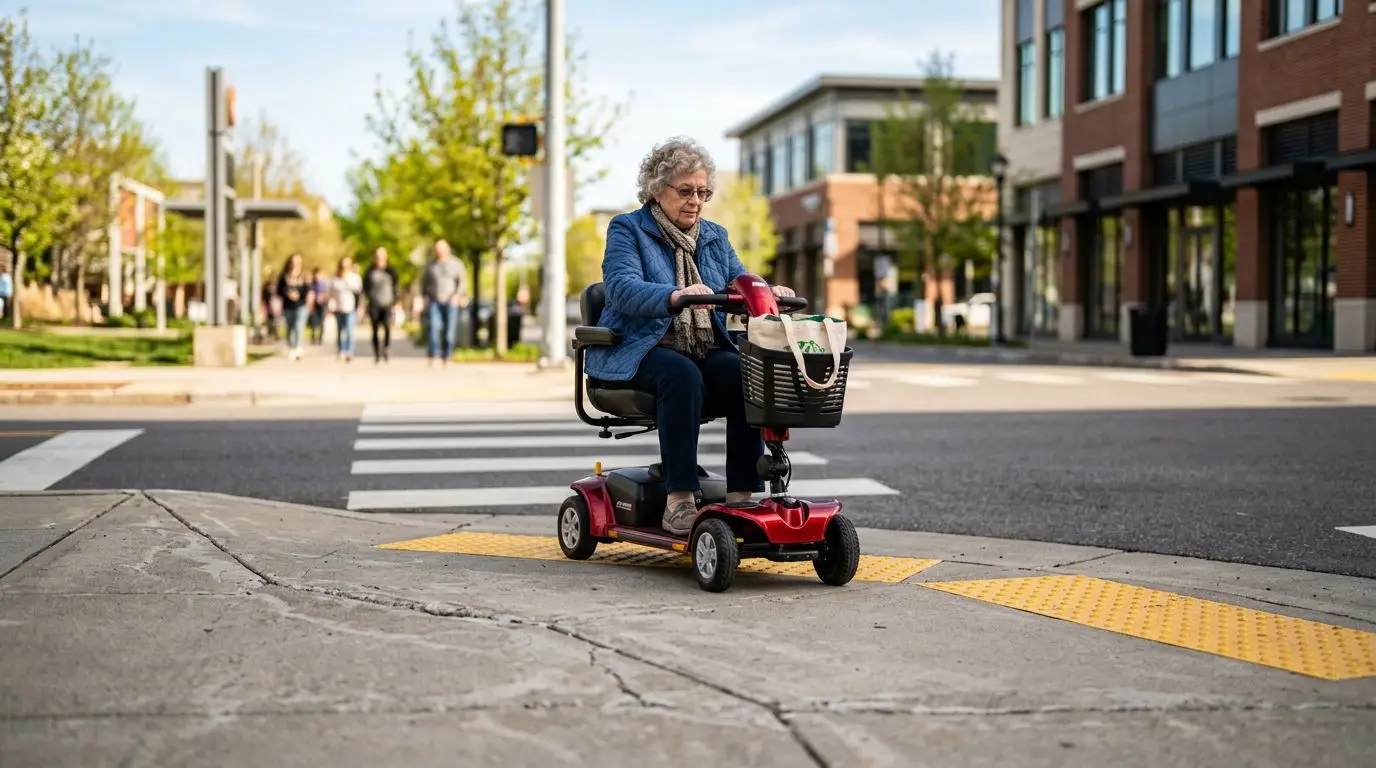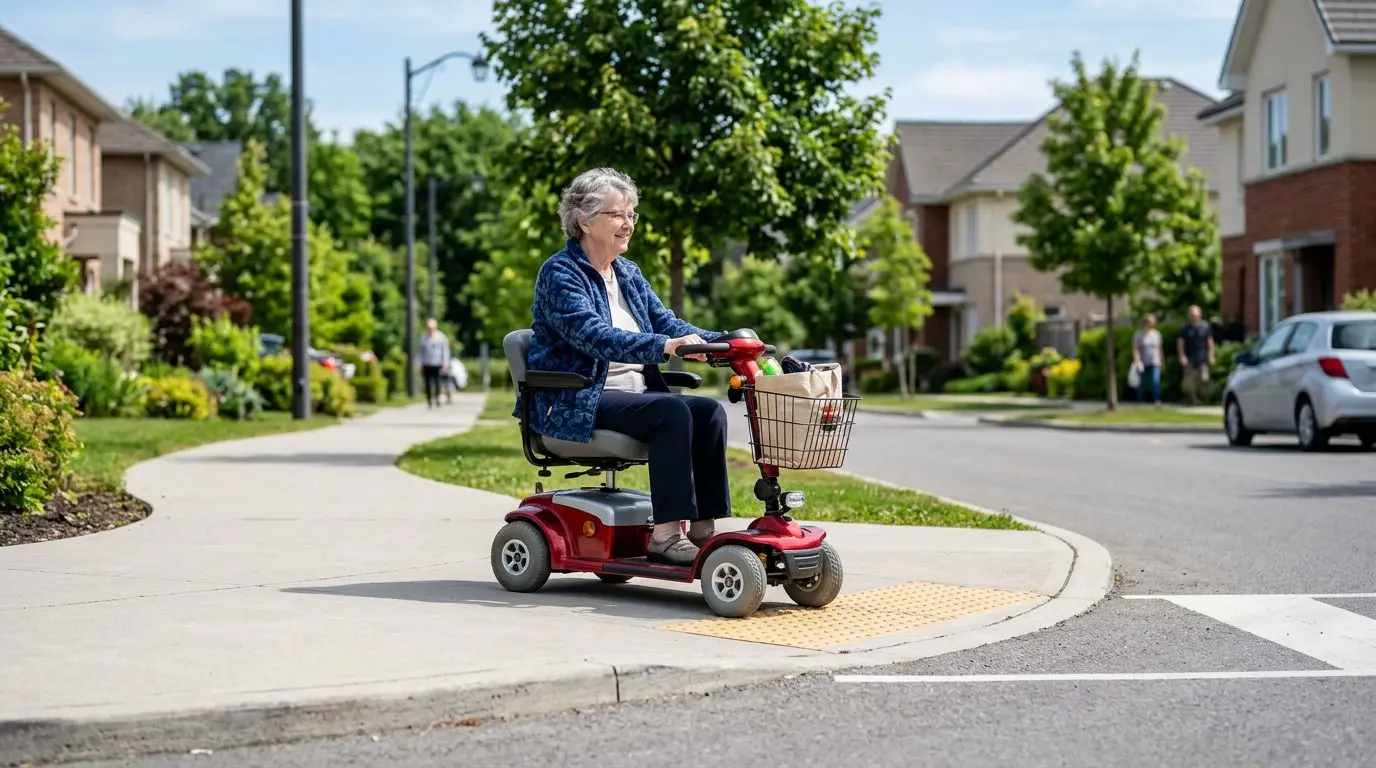
The best way to prevent mobility scooter tip-overs is to control speed, avoid side-slopes, keep weight centered, and match the scooter to the surface you ride on most. Most instability comes from four situations: sharp turns, steep ramps, curb edges, and extra weight carried too high or too far from the scooter’s center. A few careful habits—slowing before turns, approaching ramps straight on, keeping baskets light, and checking ground clearance—can greatly reduce tip-over risk.
Mobility scooters are built for independence, not off-road driving or sudden maneuvers. Even a stable scooter can feel unsafe if the rider turns quickly, drives across a slope, hangs a heavy bag on the tiller, or hits a 2-inch curb at an angle. This guide explains why tip-overs happen and how to make practical, brand-neutral safety decisions before and during every ride.
Why mobility scooters tip: 4 forces to understand
A scooter tips when its center of gravity moves outside its base of support. That sounds technical, but the everyday idea is simple: the combined weight of you, the scooter, and anything you carry needs to stay balanced over the wheels. When speed, slope, turning force, or uneven ground shifts that weight too far to one side, the scooter can lift a wheel or roll over.
Four forces matter most. The first is gravity on slopes. Going uphill shifts weight toward the rear wheels, while going downhill shifts weight toward the front. The second is sideways force during turns. A fast 90-degree turn in a parking lot can feel stable at walking speed but risky at a higher speed setting. The third is impact force from bumps, thresholds, or curb lips. A wheel that stops suddenly can pitch the scooter forward or sideways. The fourth is load placement, such as a heavy basket, a full shopping bag on the tiller, or equipment mounted behind the seat.
Three-wheel and four-wheel scooters can both tip if used outside their limits. Three-wheel designs often have a tighter turning radius, sometimes in the 30- to 45-inch range, which helps indoors but calls for extra care during quick turns. Four-wheel designs usually provide a wider base, but they are not immune to side-slopes or poorly balanced loads. Stability is a system, not a single feature.
| Risk factor | What it does | Safer habit |
|---|---|---|
| Speed in turns | Pushes weight outward | Slow before turning, not during the turn |
| Side-slope | Shifts weight downhill | Go straight up or down when possible |
| Curb or threshold | Stops one wheel suddenly | Approach squarely and slowly |
| High or rear load | Raises or shifts center of gravity | Keep weight low and centered |
Slopes and ramps: stay within a 6° to 10° comfort zone
Many scooters are made for modest inclines, not steep hills. Depending on scooter type, common rated climbing angles may fall roughly around 6° to 10°, though the exact number varies by design, rider weight, battery condition, and surface. The safest rule is to follow the manufacturer’s stated incline limit for the specific scooter and choose a more conservative route when the ramp is wet, uneven, crowded, or unfamiliar.
A ramp that looks mild can still be demanding. A 1:12 ramp, often used as an accessibility guideline, rises 1 inch for every 12 inches of run. That is easier than a short, steep portable ramp that rises quickly over a few feet. Long ramps can also create fatigue and battery strain, especially when carrying groceries or climbing from a parking area to a building entrance.
Approach slopes straight on. Avoid driving across the face of a hill, because a side-slope moves the center of gravity toward the downhill wheels. If you must cross a mild side-slope, slow down and keep both hands steady on the tiller. Do not make sudden steering corrections.
- Uphill: Lean slightly forward, keep speed steady, and avoid stopping halfway if possible.
- Downhill: Use the lowest practical speed setting and allow extra stopping distance.
- On ramps: Enter squarely, keep the scooter centered, and avoid turning at the top or bottom edge.
- On wet surfaces: Treat painted concrete, metal ramp plates, and leaves as higher-risk areas.
If a ramp makes you feel the need to “gun it,” it is probably not the right ramp for that scooter. A steady, controlled climb is safer than a burst of speed that can reduce steering control at the top.
Turns and speed: use a 3-step turning habit
Many tip-over scares happen during ordinary turns: entering an elevator, circling a store aisle, turning from a sidewalk into a driveway, or making a tight U-turn in a hallway. The issue is rarely the turn alone. It is usually the mix of speed, steering angle, surface change, and rider posture.
Use a 3-step turning habit: slow first, turn second, accelerate last. Slowing before the turn keeps the scooter settled. Turning at a steady low speed prevents a sudden outward weight shift. Accelerating only after the scooter is straight again helps all wheels stay planted.
Turning radius matters. A scooter with a 35-inch turning radius may fit tight indoor spaces more easily than one with a 55-inch turning radius, but tighter turning ability can tempt riders to steer sharply. If the scooter has speed settings, use the lower range indoors, in crowds, and near doorways. Outdoors, avoid quick handlebar movements when crossing cracks, gravel, grass edges, or sloped driveways.
| Turning situation | Tip-over concern | What to do |
|---|---|---|
| Store aisle endcap | Sharp turn with limited space | Stop or nearly stop, then make a wide turn |
| Elevator entry | Threshold plus tight steering | Enter straight, then adjust position slowly |
| Driveway apron | Side-slope and curb transition | Cross at the flattest point, straight on |
| Sidewalk corner | Pedestrians and uneven seams | Reduce speed early and scan the exit path |
Body position counts, too. Keep your back against the seat and your feet on the deck or footrests. Reaching far to one side while turning—such as grabbing a mailbox or shopping bag—can shift your weight just enough to make the scooter feel unstable.
Curbs, thresholds, and uneven surfaces: treat 1/2 inch differently than 2 inches
Small edges are not all the same. A 1/2-inch door threshold may be manageable for many scooters when approached slowly and straight. A 2-inch curb, broken sidewalk slab, or raised driveway lip can be a serious hazard, especially for smaller travel scooters with lower ground clearance and smaller wheels.
Ground clearance is the space between the lowest part of the scooter and the surface. Some compact scooters may have only a few inches of clearance, while larger outdoor-oriented scooters may sit higher. Wheel size matters as well. Larger wheels generally roll over small imperfections more easily than small wheels, but they still need a safe approach angle and reasonable speed.
For curbs, the safest advice is simple: use curb cuts and ramps whenever available. Do not attempt to climb or drop off a curb unless the scooter is specifically designed and rated for that type of obstacle. Dropping off even a low curb can pitch weight forward, and striking a curb at an angle can stop one wheel while the other keeps moving.
- Door thresholds: Approach straight, slow down, and avoid turning until all wheels are across.
- Sidewalk cracks: Cross at a near 90-degree angle when possible.
- Gravel: Use very low speed, avoid sudden turns, and watch for hidden ruts.
- Grass: Treat it as uneven unless you know it is firm, dry, and level.
- Curbs: Choose a curb cut instead of forcing the scooter over the edge.
If one wheel drops into a hole or off the sidewalk edge, avoid jerking the tiller. Stop if you can do so safely. Then back out slowly or ask for assistance. A calm correction is safer than a quick twist of the steering column.
Weight balance: baskets, bags, and the 80% load rule
Every scooter has a maximum weight capacity, but safe handling can change before you reach that number. A practical approach is to keep the total everyday load—rider plus carried items—well below the stated limit when possible. Many safety-minded riders use an 80% comfort rule: if a scooter is rated for a certain maximum, staying around four-fifths of that amount leaves more margin for ramps, turns, battery performance, and rough surfaces.
Weight location matters just as much as weight amount. A 10-pound bag low on the floorboard is less destabilizing than the same 10-pound bag hanging from the tiller. Front baskets are useful for light items, but heavy groceries, bottled water, or dense medical equipment can affect steering and braking. Rear accessories can shift weight backward, especially on uphill ramps.
Do not hang bags from the handlebars or tiller. They can interfere with steering and pull the front end off line during turns. If you use a basket, keep items below the basket rim when possible and secure anything that could shift. A swinging load behaves differently than a still load.
| Load location | Better for | Watch out for |
|---|---|---|
| Front basket | Light items under about 10 lb | Heavy loads can affect steering |
| Floorboard area | Small low items that do not block feet | Never block brake access or foot position |
| Rear basket or carrier | Moderate items secured tightly | Rear weight can affect hills and turns |
| Hanging bags | Not recommended | Swinging weight can pull the tiller |
Also check seat position. A seat adjusted too far back can make the scooter feel lighter in front, while a seat too far forward may change steering feel and comfort. Use the position that allows an upright posture, easy tiller reach, and full contact with the seat.
How to choose and measure for stability in 10 minutes
You can learn a lot about scooter stability before buying, borrowing, or using one in a new setting. Spend 10 minutes measuring your real environment: doorway widths, ramp slope, storage space, sidewalk condition, and the tightest turn you need to make. These measurements are more useful than guesses based on photos.
Start with width. Many interior doorways are around 30 to 36 inches wide, though older homes may be narrower. Measure the actual clear opening with the door open, including hinges and trim. A scooter that technically fits but leaves only 1 inch on each side may be stressful to use daily.
Next, measure turning space. In a kitchen, bedroom, or hallway, mark the area where you need to turn around. Compare that space with the scooter’s turning radius or overall turning diameter. Remember that turning while backing up requires coordination and may increase risk near furniture.
For ramps, measure rise and run. Rise is the vertical height from the lower surface to the upper surface. Run is the ramp length. A ramp that rises 12 inches over 12 feet is gentler than one that rises 12 inches over 6 feet. If you are unsure whether a ramp is safe, ask a qualified accessibility professional or the scooter provider to review it.
- Measure doorway clearance: Record the narrowest opening used every day.
- Measure turning areas: Check hallways, bathrooms, elevators, and entryways.
- Measure ramp rise and length: Avoid short, steep ramps that exceed scooter limits.
- Check surface quality: Note cracks, gravel patches, uneven pavers, and drainage slopes.
- Check storage path: Include the route from charger to door, not just the parking spot.
If possible, test a scooter in the same type of environment where you will use it. A smooth showroom floor does not tell you how it will feel on a sloped driveway, a carpet edge, or a crowded sidewalk.
Who it is best for: matching 4 scooter types to common conditions
No scooter type is best for every rider. The safer choice is the one that matches your body size, balance, routes, storage, and surfaces. Four broad categories can help you narrow the decision without focusing on brands or model names.
| Scooter type | Who it is best for | Stability considerations |
|---|---|---|
| Compact travel scooter | Short trips, smooth floors, transport in a vehicle | Smaller wheels and lower clearance need caution outdoors |
| 3-wheel standard scooter | Indoor use and tight turning spaces | Tighter turns require slower steering habits |
| 4-wheel standard scooter | Mixed indoor and outdoor use | Wider base can feel steadier but still needs slope care |
| Larger outdoor-oriented scooter | Longer sidewalks, rougher pavement, higher ground clearance needs | Needs more turning room and careful speed control |
A compact scooter may be best for someone who travels by car and uses it mainly in stores, clinics, and smooth public spaces. A 3-wheel scooter may suit a rider who needs to turn in a small apartment or tight elevator. A 4-wheel scooter is often preferred by riders who want a broader stance for outdoor sidewalks. A larger outdoor-oriented scooter may fit someone who regularly faces uneven pavement, longer distances, or mild slopes, provided they have enough storage and turning space.
Fit matters more than category. The rider should be able to sit upright, reach the controls without leaning forward, keep both feet supported, and look over the tiller comfortably. If a person has recent falls, changing balance, vision concerns, or slower reaction time, it is wise to involve a clinician, therapist, or mobility professional before choosing equipment. A scooter can support independence, but it should be matched to the rider’s abilities and environment.
Daily pre-ride safety check: 7 items before you roll
A quick check before each ride can catch small problems before they become tip-over risks. It does not need to be complicated. Seven items cover most everyday stability concerns.
- Tires: Look for low pressure on pneumatic tires or damage on solid tires.
- Battery: Start with enough charge for the full route, including hills and return travel.
- Seat lock: Confirm the seat is latched and does not swivel unexpectedly.
- Tiller position: Make sure it is locked where you can steer without leaning.
- Brakes: Test stopping at low speed before entering a busy area.
- Load: Secure baskets and remove hanging bags from the tiller.
- Route: Scan for wet leaves, ice, gravel, construction plates, and blocked curb cuts.
Weather deserves special attention. Rain can reduce traction, and low sun can hide cracks or curb edges. If visibility is poor or the surface is slick, choose a flatter route or wait when practical. Safety is not about giving up mobility; it is about keeping control.
What to do after a near tip or fall: 5 checks before riding again
A near tip is useful information. Do not ignore it. Before riding again, take 5 minutes to check the scooter, your route, and your condition.
First, look for obvious damage: bent basket mounts, loose mirrors, cracked plastic, or a seat that no longer locks firmly. Second, test the tiller and steering at very low speed in a safe open area. Third, check whether the load shifted or was placed too high. Fourth, review the surface that caused the scare, such as a driveway slope or raised sidewalk seam. Fifth, consider whether speed, fatigue, distraction, or reaching played a role.
If the scooter actually tipped, do not ride it until you are confident it is functioning normally. When in doubt, have it inspected by a qualified technician. If you hit your head, feel pain, feel dizzy, or are unsure whether you are injured, seek medical advice promptly. A scooter can be repaired; your health comes first.
It may also help to practice in a controlled area. Work on slow starts, straight ramp approaches, wide turns, and stopping before obstacles. Ten minutes of practice in an empty parking lot or community room can build safer habits without the pressure of traffic or pedestrians.
FAQ: 5 common tip-over prevention questions
Are 4-wheel scooters always safer than 3-wheel scooters?
Not always. Four-wheel scooters often have a wider base, which can feel steadier on straight outdoor paths, but they can still tip on side-slopes, sharp turns, and curbs. Three-wheel scooters may turn more tightly indoors, so the safest choice depends on surfaces, turning space, speed habits, and rider fit.
Can a mobility scooter go up a curb?
In most everyday situations, use a curb cut or ramp instead of trying to climb a curb. A 1/2-inch threshold is very different from a 2-inch curb, and hitting an edge at an angle can stop one wheel suddenly. Only attempt obstacles that the scooter is specifically designed and rated to handle.
How fast should I turn on a mobility scooter?
Turn at the lowest speed that allows smooth control, especially indoors, near pedestrians, or on uneven ground. A good habit is slow first, turn second, accelerate last. If you feel your body leaning outward, the turn is too fast or too sharp.
Is it safe to carry groceries in a scooter basket?
Light groceries are usually reasonable if they fit securely and do not affect steering. Heavy items, hanging bags, or loads that shift can make the scooter less stable. Keep weight low, centered, and within the scooter’s stated capacity.
What should I do if my scooter feels unstable on ramps?
Stop using that ramp until you know why it feels unsafe. It may be too steep, too narrow, slippery, or mismatched to the scooter’s incline rating. Measure the ramp, check the scooter manual, reduce carried weight, and ask a mobility or accessibility professional for help if needed.
Frequently asked questions
Are 4-wheel scooters always safer than 3-wheel scooters? +
Not always. Four-wheel scooters often feel steadier on straight outdoor paths, but they can still tip on slopes, curbs, or sharp turns. Three-wheel scooters may work better in tight indoor spaces when driven slowly.
Can a mobility scooter go up a curb? +
Use a curb cut or ramp whenever possible. A curb can stop one wheel suddenly and cause a tip-over, especially if approached at an angle or if the scooter has low ground clearance.
How fast should I turn on a mobility scooter? +
Turn at a very low, steady speed. Slow down before the turn, steer smoothly, and accelerate only after the scooter is straight again.
Is it safe to carry groceries in a scooter basket? +
Light, secured groceries are usually manageable, but heavy or swinging bags can affect steering and balance. Keep weight low, centered, and within the scooter’s stated capacity.
What should I do if my scooter feels unstable on ramps? +
Stop using that ramp until you understand the cause. Check the ramp slope, surface condition, scooter incline rating, battery level, and carried weight before trying again.
Related guides
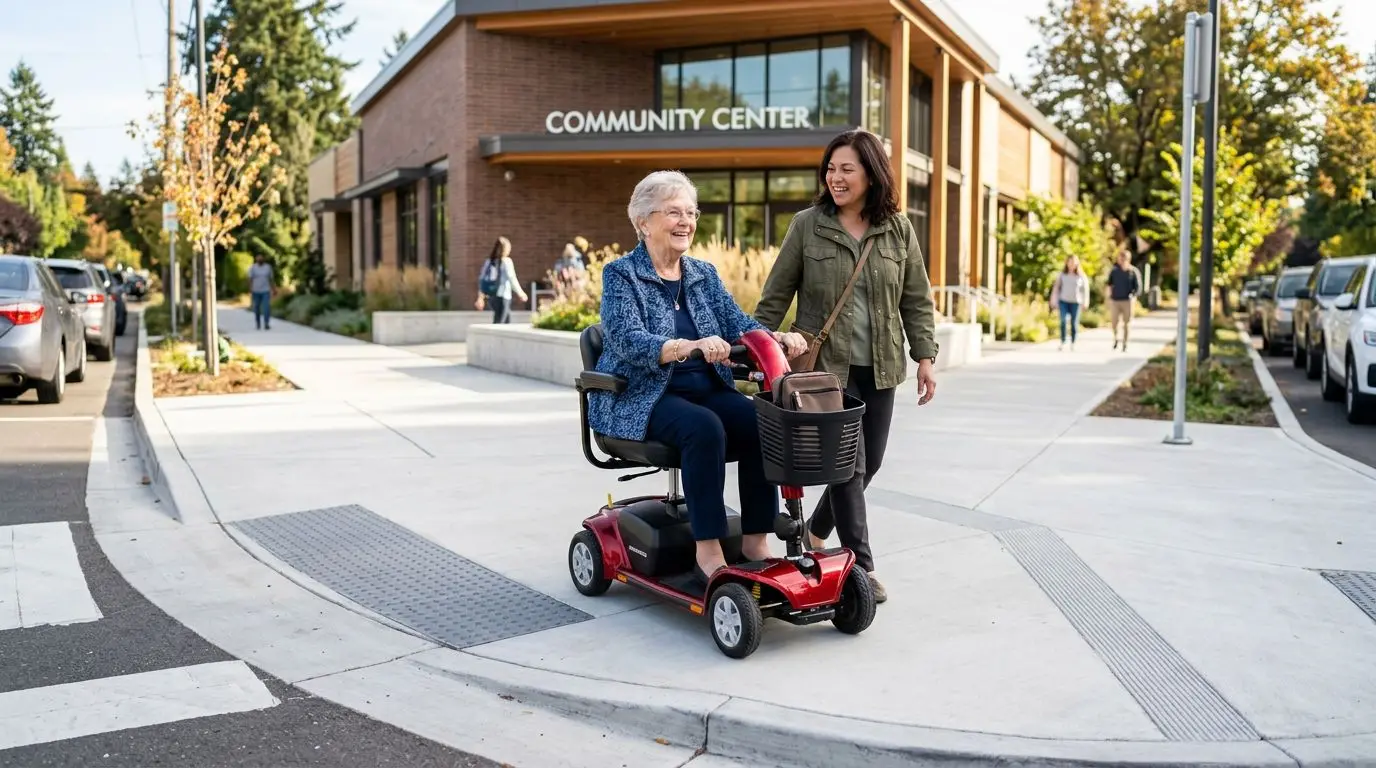
Mobility Scooter Safety Guide for Seniors: How to Ride, Turn, Stop, and Park With Confidence
15 min read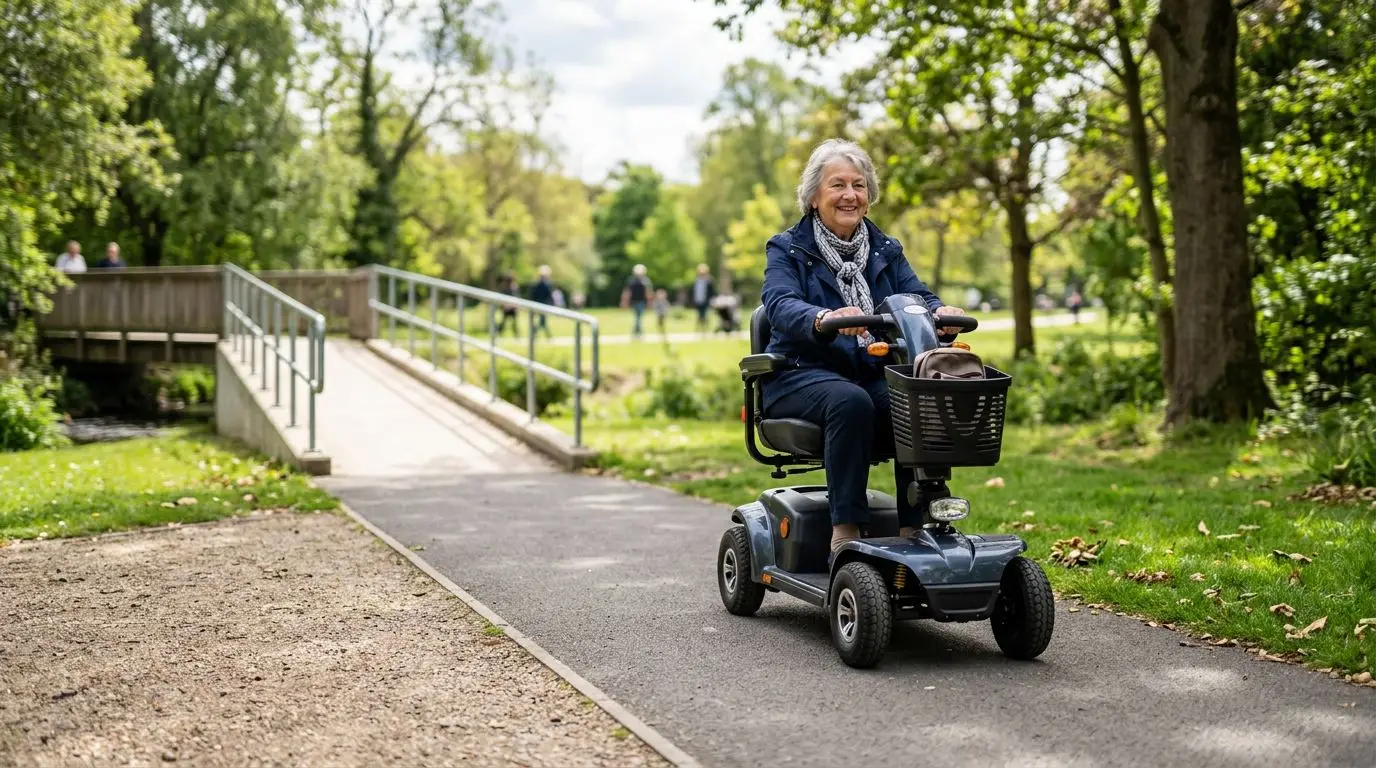
Using a Mobility Scooter on Ramps, Grass, Gravel, and Uneven Ground: What’s Safe and What to Avoid
13 min read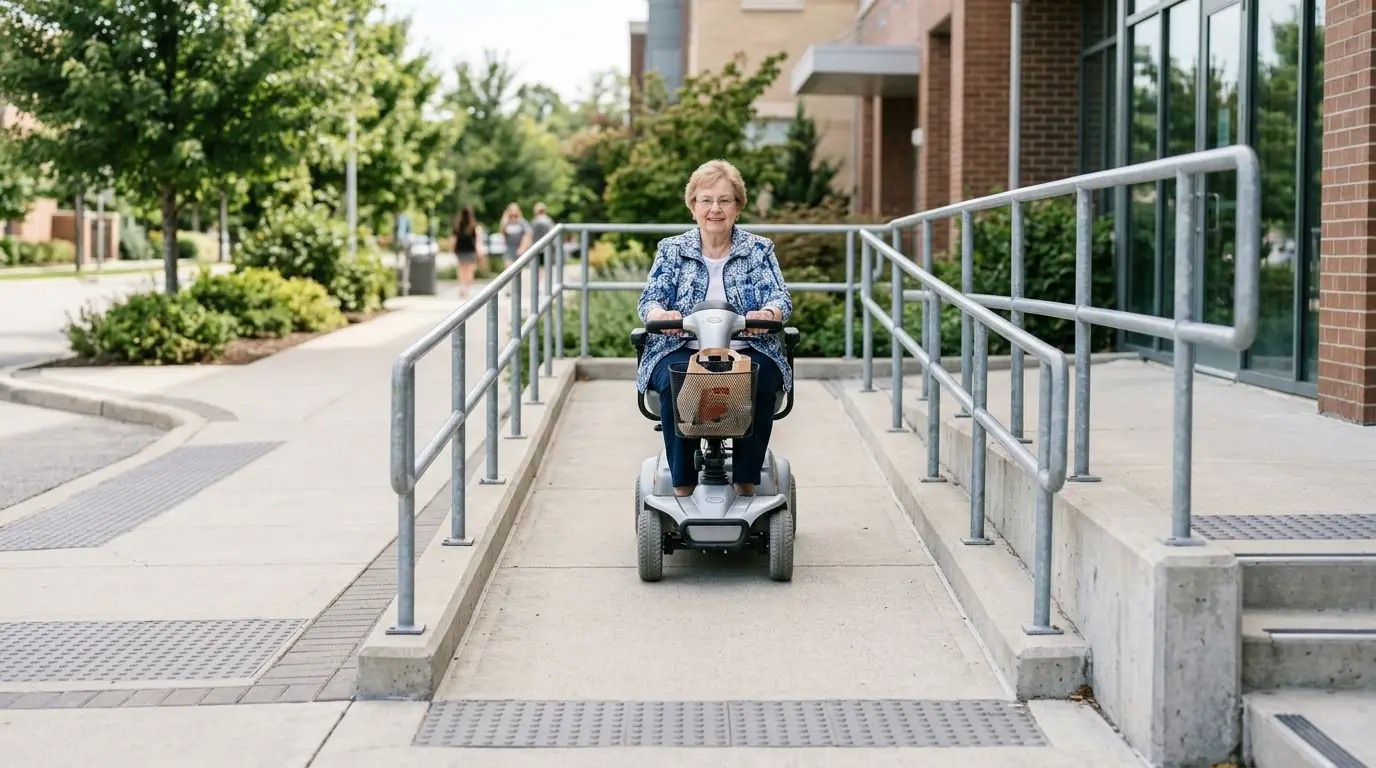
How to Ride a Mobility Scooter Safely on Ramps, Slopes, Driveways, and Curb Cuts
15 min read