Air-filled mobility scooter tires usually provide a smoother, grippier ride, especially outdoors, but they can lose air or go flat. Solid tires are puncture-proof and require less maintenance, though they often feel firmer on cracks, brick, gravel, and uneven sidewalks. The best choice depends on where you ride most, how much maintenance you can manage, and whether comfort or flat prevention matters more.
For many scooter owners, tires are more than a technical detail. They affect how steady the scooter feels at 3 to 5 mph, how much vibration reaches your hands and back, and whether a small nail or thorn can interrupt a trip. This practical, brand-neutral guide covers solid tires, pneumatic tires, inner tubes, ride comfort, traction, and outdoor use.
How solid and air-filled scooter tires differ in 8 to 13 inch sizes
Most mobility scooter tires fall into two broad families: solid and air-filled. Common scooter tire diameters range from about 8 inches on compact travel scooters to 10, 12, or 13 inches on larger outdoor models. Size matters because a larger tire can roll over small sidewalk edges more easily, but construction still changes how the ride feels.
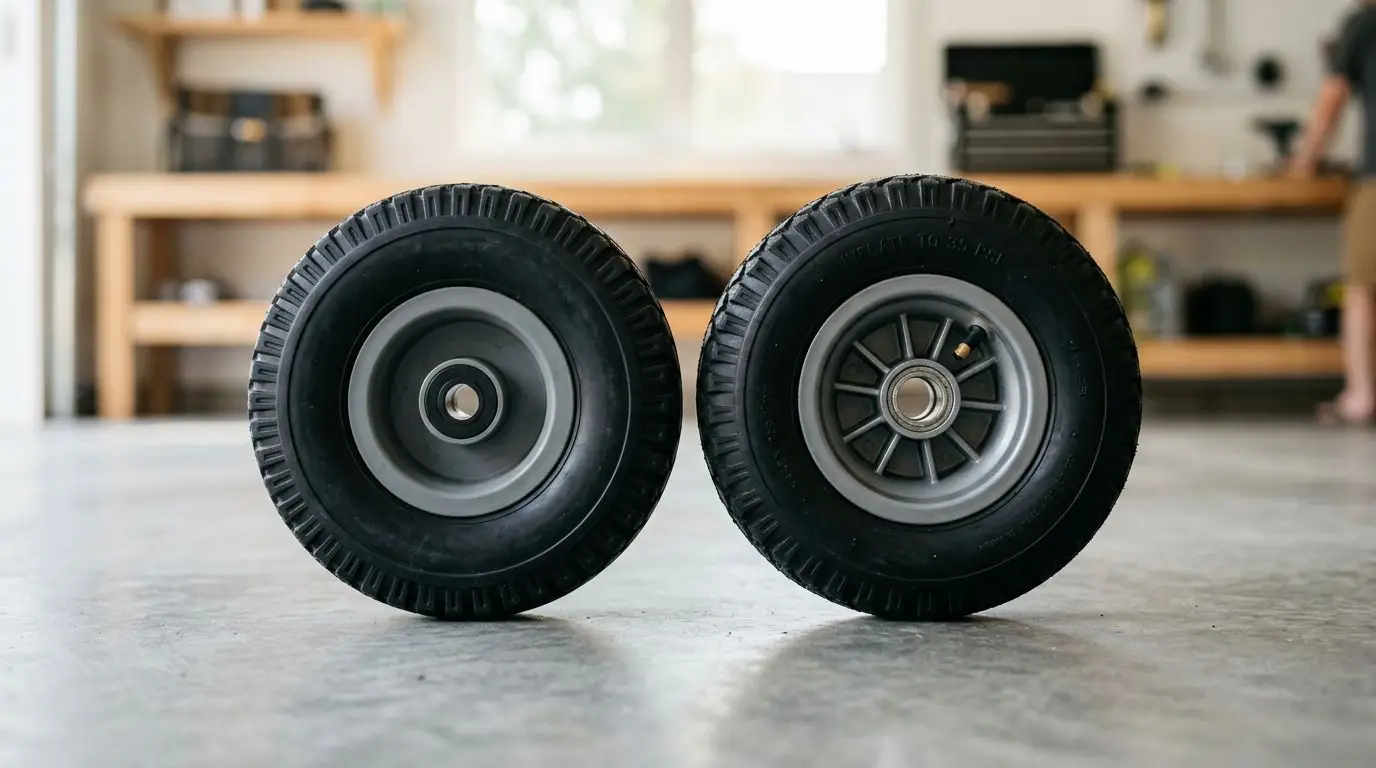
A solid tire is made from dense rubber or a similar resilient compound. It does not need air and cannot get a traditional puncture flat. Some are fully solid; others have molded internal holes or channels to reduce weight and add a little give. They are often called flat-free, puncture-proof, or maintenance-free tires.
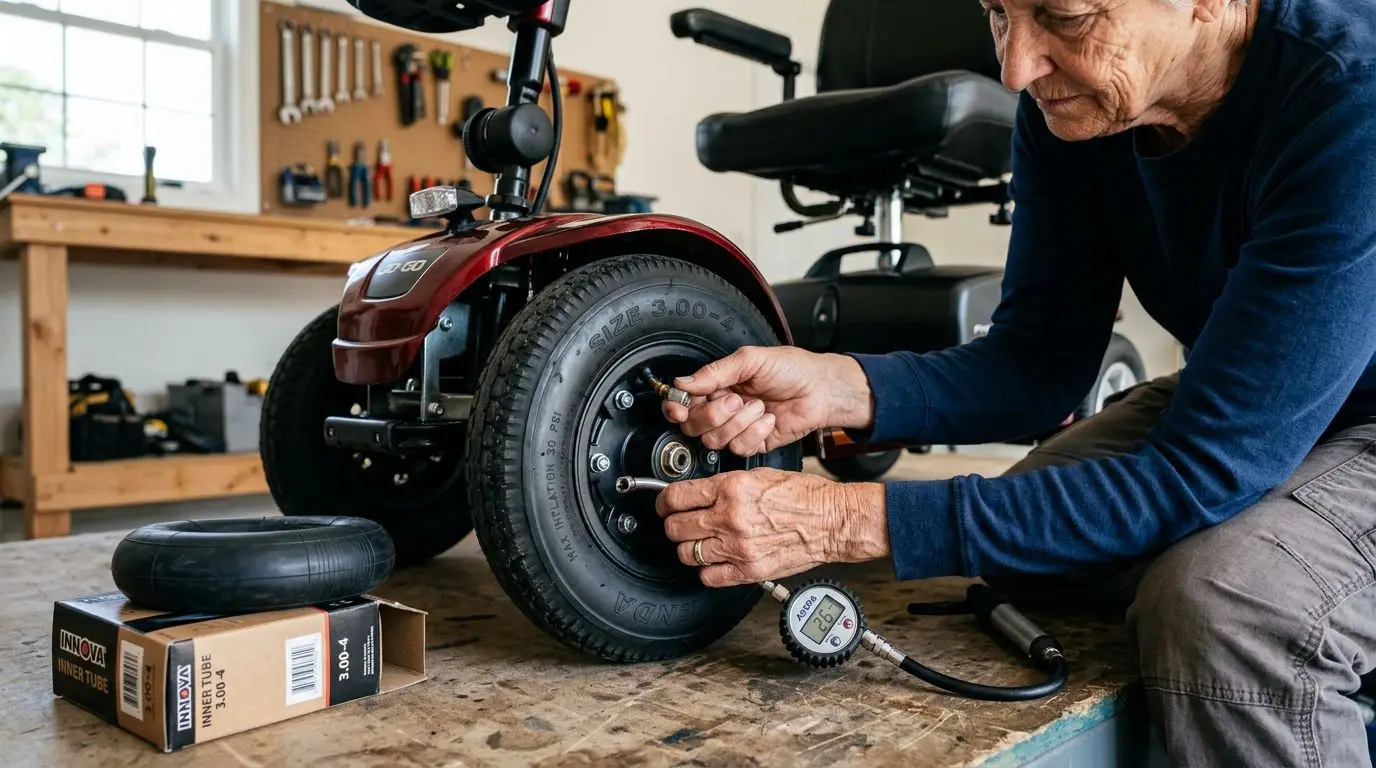
An air-filled tire, also called a pneumatic tire, uses pressurized air to support the scooter and rider. Some scooter pneumatic tires use an inner tube, much like a bicycle tire. Others are tubeless, with the tire sealing directly against the rim. Pneumatic tires are usually marked with a size and often a recommended pressure range, commonly somewhere around 30 to 50 psi depending on tire size and load rating.
| Tire type | How it works | Main advantage | Main tradeoff |
|---|---|---|---|
| Solid tire | Dense rubber or molded flat-free construction | No air pressure to check and no puncture flats | Firmer ride on rough surfaces |
| Pneumatic tire with inner tube | Outer tire plus replaceable air-filled tube | Good cushioning and traction | Tube can puncture, pinch, or leak |
| Tubeless pneumatic tire | Air seals between tire bead and rim | Comfortable ride with fewer tube-related failures | Still needs pressure checks and can leak |
| Foam-filled or semi-solid tire | Tire cavity is filled or supported to resist flats | Flat resistance with more give than some solid tires | Can be heavier and may ride firmer than air |
Not every scooter can use every tire type. Wheel design, rim shape, brake clearance, and manufacturer specifications all matter. If a scooter was designed for pneumatic tires, converting to solid tires may change ride feel, ground clearance, or motor load. When in doubt, match the original tire type and size, or ask a qualified mobility equipment technician.
Ride comfort and vibration over 1 inch cracks
Comfort is where air-filled tires usually do best. Air works like a small shock absorber. When a pneumatic tire rolls over a 1 inch sidewalk crack, expansion joint, brick edge, or shallow pothole, the tire can compress slightly and spread out the impact. That cushioning helps reduce vibration through the deck, seat post, tiller, wrists, shoulders, and lower back.
Solid tires do not compress the same way. They can feel steady on smooth indoor floors, in shopping centers, and on paved pathways, but they may send more sharp bumps through the scooter. Suspension can help, but tire construction still matters. A solid-tire scooter with front and rear suspension may feel acceptable on older sidewalks; a solid-tire scooter without suspension can feel harsh on the same route.
Wheel diameter also affects comfort. A 12 inch pneumatic tire usually rolls over surface imperfections more comfortably than an 8 inch solid tire, but that comparison includes both size and tire type. If two scooters are otherwise similar, the pneumatic version typically feels smoother outdoors.
Rider weight, basket load, and tire pressure also play a role. An underinflated pneumatic tire can feel mushy, reduce range, and increase wear. An overinflated tire can feel bouncy or hard. Staying within the pressure printed on the tire sidewall is the safest general rule.
- Choose air-filled tires if you ride over uneven sidewalks, textured pavement, packed gravel, or older curb cuts several times a week.
- Choose solid tires if your riding is mostly indoors or on smooth pavement and avoiding flats is more important than maximum cushioning.
- Look for suspension if you need solid tires but still want better comfort over bumps.
Punctures, flats, and maintenance over 12 months
Solid tires are the clear low-maintenance choice over a typical 12 month period. There is no air pressure to check, no tube to pinch, and no valve stem to leak. If your scooter sits unused for several weeks, solid tires will not go soft. That helps riders who cannot easily bend down, use a pressure gauge, or arrange repairs.
Pneumatic tires need more attention. At minimum, check pressure about once a month and before longer outdoor trips. Small tires can lose air gradually, even without a visible puncture. A tire that looks only slightly low can still affect steering, braking distance, battery range, and tread wear.
Inner tubes add another service item. A tube can be punctured by glass, wire, nails, or thorns. It can also fail if the tire is run too soft and the tube gets pinched against the rim. Valve stems can crack or separate, especially on older tubes. The advantage is that tubes are often replaceable without replacing the entire wheel, though labor can be inconvenient.
Tubeless pneumatic tires remove the inner tube, but they still depend on an airtight seal at the rim. A small puncture may leak slowly. A damaged rim, worn bead, or old valve can also cause air loss. Some owners use sealant in pneumatic tires, but sealants vary and may not be suitable for every tire, rim, or repair situation.
| Maintenance task | Solid tire | Air-filled tire |
|---|---|---|
| Pressure check every 30 days | No | Yes |
| Puncture repair | Not for normal punctures | Possible with tube, patch, plug, or tire replacement |
| Valve stem care | No | Yes |
| Tread and sidewall inspection | Yes | Yes |
| Risk after rolling over a nail | Usually keeps going | May leak or go flat |
Even solid tires are not maintenance-free forever. They can wear smooth, crack with age, or separate from the wheel in severe cases. Check them at least every few months, especially if you ride outside often.
Traction outdoors on wet pavement, grass, gravel, and 5 degree slopes
Traction depends on tread pattern, rubber compound, tire width, contact patch, scooter weight, and surface conditions. Tire type matters as well. Pneumatic tires often conform better to small surface irregularities, which can improve grip on rough asphalt, packed dirt, and light gravel. The effect becomes more noticeable on mild slopes, such as a 5 degree driveway or a long curb ramp.
Solid tires can perform well on dry, smooth pavement. Many riders use them safely every day on sidewalks, stores, senior communities, and paved paths. Their limitation is that they may skip or chatter more on loose gravel, wet leaves, grass, or broken pavement because they do not flex as much. If the tread is shallow or worn, traction drops further.
Wet pavement calls for caution with any scooter tire. Air-filled tires may offer better contact, but they do not make a scooter slip-proof. Painted lines, metal plates, wet tile near building entrances, and leaf-covered ramps can all reduce grip. Slow down before turns, avoid sudden braking, and cross angled curb cuts carefully.
Grass is another common problem. A scooter tire can sink into soft ground, especially after rain. Pneumatic tires may handle short, firm grass better than solid tires, but neither tire type is ideal for muddy areas. If you need to cross a yard, choose the driest, flattest route and avoid side slopes.
- Best outdoor comfort: pneumatic tires, especially 10 inches or larger.
- Best flat prevention outdoors: solid or foam-filled tires.
- Best for mixed sidewalks and light gravel: pneumatic tires with a practical tread pattern.
- Best for smooth paved errands: either type, depending on comfort and maintenance needs.
Who each tire type is best for on daily trips under 5 miles
If your typical scooter trip is under 5 miles, tire choice should reflect your route more than the distance alone. A 2 mile route with cracked sidewalks and curb ramps can be rougher than a 5 mile route through smooth hallways and paved paths. Think about your most common week, not the best-case day.
| Rider situation | Better fit | Why |
|---|---|---|
| Mostly indoor use in apartments, stores, clinics, or community centers | Solid tires | Flat prevention and easy upkeep matter more on smooth floors |
| Outdoor sidewalks with cracks, brick, or rough curb cuts | Air-filled tires | Better cushioning and surface contact |
| Rider cannot check air pressure or arrange quick tire service | Solid tires | Less routine maintenance and no tube flats |
| Frequent rides on packed gravel paths or older asphalt | Air-filled tires | Improved comfort and traction on uneven surfaces |
| Area has thorns, construction debris, or frequent glass | Solid tires | Reduces risk of being stranded by a puncture |
| Comfort is a top priority due to sensitivity to vibration | Air-filled tires | Air cushioning can soften repeated impacts |
There is no perfect tire for everyone. A rider who values independence and cannot risk a flat may reasonably accept a firmer ride from solid tires. Another rider may gladly check pressure monthly because pneumatic tires make daily outings more comfortable. Both choices can be sensible.
How to choose and measure scooter tires in 10 minutes
Before buying replacement tires or discussing options with a repair shop, take 10 minutes to gather the tire information. The wrong size can affect steering, braking, fender clearance, and safety. Do not assume the front and rear tires are always identical; many scooters use the same size, but some do not.
Start with the sidewall. You may see markings such as 3.00-4, 4.10/3.50-5, 260x85, or a similar size format. The first number often relates to tire width or overall size, and the last number often relates to rim diameter, but formats vary. Write the markings down exactly as printed.
Next, identify the tire type. If there is a valve stem, the tire is air-filled or was designed to be. A valve does not always tell you whether the tire uses a tube or is tubeless, but it confirms that pressure is involved. If there is no valve, it is likely solid or foam-filled.
Measure only if the sidewall is missing or unreadable. With the scooter turned off and parked securely, measure the outside tire diameter from top to bottom, the tire width across the tread, and the rim diameter if accessible. Measurements should be close, but sidewall markings are more reliable than a ruler because tires compress and wear.
- Check the owner documentation for the original tire size and type.
- Write down front and rear tire markings separately.
- Note whether the tire has a valve stem and whether the rim looks split or one-piece.
- Inspect fender clearance before changing to a wider or taller tire.
- Ask a technician before converting from pneumatic to solid or solid to pneumatic.
Rim design is especially important. Some small scooter wheels use split rims that make tube service easier, while others require special tools. Changing tire type without the right rim can create fit and safety problems.
Feature comparison scored 1 to 5 for comfort, upkeep, and outdoor use
The scores below are general, not brand-specific. A high-quality solid tire on a scooter with suspension may outperform a worn pneumatic tire that is 10 psi too low. Still, the 1 to 5 ratings show the usual pattern for adult mobility scooters used on streets, sidewalks, stores, and paved paths.
| Feature | Solid tires | Air-filled tires | What the score means |
|---|---|---|---|
| Ride comfort | 2 to 3 | 4 to 5 | Higher score means less vibration over bumps |
| Puncture resistance | 5 | 2 to 3 | Higher score means less chance of a flat from debris |
| Routine maintenance | 5 | 2 to 3 | Higher score means less checking and servicing |
| Wet or rough-surface traction | 3 | 4 | Higher score means better grip in typical outdoor use |
| Indoor smooth-floor use | 4 to 5 | 4 | Both can work well when floors are level |
| Repair convenience | 3 | 2 to 4 | Depends on wheel design, tube access, and local service |
One important detail: a pneumatic tire only performs well when inflated correctly. If the pressure drops, the ride may feel sluggish and the scooter may use more battery power. Solid tires keep their shape without pressure, making day-to-day use more predictable.
When to replace tires using tread, cracks, and 1/8 inch checks
Inspect scooter tires at least every 1 to 3 months, and sooner if the scooter starts pulling to one side, vibrating, or making a new thumping sound. A quick visual check can prevent avoidable problems. Look at all four sides of each tire if possible, because wear may be uneven.
Tread depth does not need to match a car tire standard, but the tire should still have visible tread appropriate for its use. If an outdoor tire is worn nearly smooth, traction can drop on wet pavement and loose surfaces. As a practical check, if the center tread looks flattened across a wide band or has less than about 1/8 inch of usable pattern, it is time to consider replacement, especially for outdoor riding.
Cracks matter too. Small surface checking can appear as rubber ages, particularly if the scooter is stored in heat, sun, or very dry air. Deep cracks, sidewall splits, bulges, exposed cords, or chunks missing from a solid tire are warning signs. Stop using the scooter until the tire is inspected if damage looks severe.
For pneumatic tires, repeated air loss is also a repair or replacement clue. If you inflate a tire and it drops noticeably within 24 to 48 hours, check for a puncture, valve leak, rim issue, or worn tube. Riding on a soft tire can damage both the tube and tire.
FAQ: 5 practical questions about scooter tires
Are solid mobility scooter tires always safer because they cannot go flat?
Not always. Solid tires reduce the risk of a puncture flat, which is a real safety and convenience benefit. Air-filled tires may provide better cushioning and traction on rough outdoor surfaces. Safety depends on the route, tire condition, tread, speed, weather, and how the scooter is used.
Do air-filled scooter tires always have inner tubes?
No. Some pneumatic scooter tires use inner tubes, while others are tubeless. A valve stem means the tire uses air, but it does not prove there is a tube inside. The wheel design and tire markings, or a technician inspection, can confirm the setup.
Can I replace pneumatic tires with solid tires?
Sometimes, but not automatically. The replacement must match the rim, size, brake clearance, and scooter specifications. Solid tires can also change ride comfort and handling. Check the scooter documentation or consult a qualified mobility repair technician before converting.
How often should I check air pressure?
For pneumatic tires, check pressure about once a month and before longer rides. Use the pressure range printed on the tire sidewall or listed in the scooter documentation. Do not inflate beyond the stated limit.
Which tire is better for outdoor use?
For comfort and traction on uneven sidewalks, packed gravel, and rough pavement, air-filled tires usually have the advantage. For outdoor areas with thorns, glass, or construction debris, solid tires may be more practical because they resist puncture flats.
The simplest way to decide is to match the tire to your real route. Smooth indoor floors and clean sidewalks favor solid tires for convenience. Rough pavement, curb cuts, and longer outdoor trips favor air-filled tires for comfort. If your route includes both, decide which problem would affect you more: a firmer ride every day or the occasional need to repair a flat.
Frequently asked questions
Are solid mobility scooter tires always safer because they cannot go flat? +
Not always. Solid tires reduce the risk of puncture flats, but air-filled tires may provide better cushioning and traction on rough outdoor surfaces. Safety depends on tire condition, route, weather, speed, and scooter setup.
Do air-filled scooter tires always have inner tubes? +
No. Some pneumatic scooter tires use inner tubes, while others are tubeless. A visible valve stem confirms the tire uses air, but the wheel design or tire information determines whether there is a tube.
Can I replace pneumatic tires with solid tires? +
Sometimes, but only if the solid tire is compatible with the rim, size, brake clearance, and scooter specifications. Converting can change ride comfort and handling, so confirm fit before making the change.
How often should I check air pressure in pneumatic scooter tires? +
Check pneumatic tire pressure about once a month and before longer outdoor rides. Use the pressure range printed on the tire sidewall or in the scooter documentation, and do not exceed the stated limit.
Which mobility scooter tire is better for outdoor use? +
Air-filled tires are usually better for comfort and traction on uneven sidewalks, packed gravel, and rough pavement. Solid tires may be better where thorns, glass, or debris make puncture flats a major concern.
Related guides

Mobility Scooter Tire and Wheel Upgrades for Better Traction
15 min read
Flat Mobility Scooter Tire or Inner Tube? Repair Options, Replacement Signs, and Prevention Tips
14 min read
Mobility Scooter Tires, Suspension, and Ground Clearance: Matching Features to Sidewalks, Thresholds, and Rough Pavement
14 min read