Yes, you can usually take a mobility scooter on an airplane in the United States, as long as the airline can load it safely and the battery meets FAA and airline rules. Most travelers ride the scooter to the gate, transfer to an airport or aisle chair if needed, and have the scooter gate checked or loaded as a mobility aid at no extra charge.
The main issues are battery type, scooter size, airline notification, and damage prevention during handling. If your scooter uses a lithium-ion battery, confirm the watt-hour rating before you book. Many travel scooter batteries are designed around the common 300 Wh mobility-aid limit, but you should never assume.
Air travel with a mobility scooter: the 5-step overview
For most US travelers, flying with a mobility scooter comes down to 5 practical steps: check the battery, notify the airline, prepare documentation, use the scooter through the airport, and hand it off for loading at the gate or aircraft door. TSA screens the passenger and the scooter, but the airline decides whether and how the scooter is transported on the aircraft.
Mobility scooters are generally treated as assistive devices, not regular checked baggage. That matters because US airlines typically transport required mobility aids without applying the usual checked-bag limits. Still, the device must fit through cargo doors, be secured safely, and comply with hazardous-materials rules for batteries.
Here is the basic flow:
- Before booking: identify the battery chemistry and watt-hour rating, then check the aircraft size if you are using a small regional plane.
- After booking: add a mobility assistance request and provide scooter dimensions, total weight, and battery type.
- At the airport: arrive early, usually at least 2 hours before a domestic flight and 3 hours before an international flight.
- At TSA: expect screening of the scooter, battery area, storage basket, cushions, and any bags attached to the tiller.
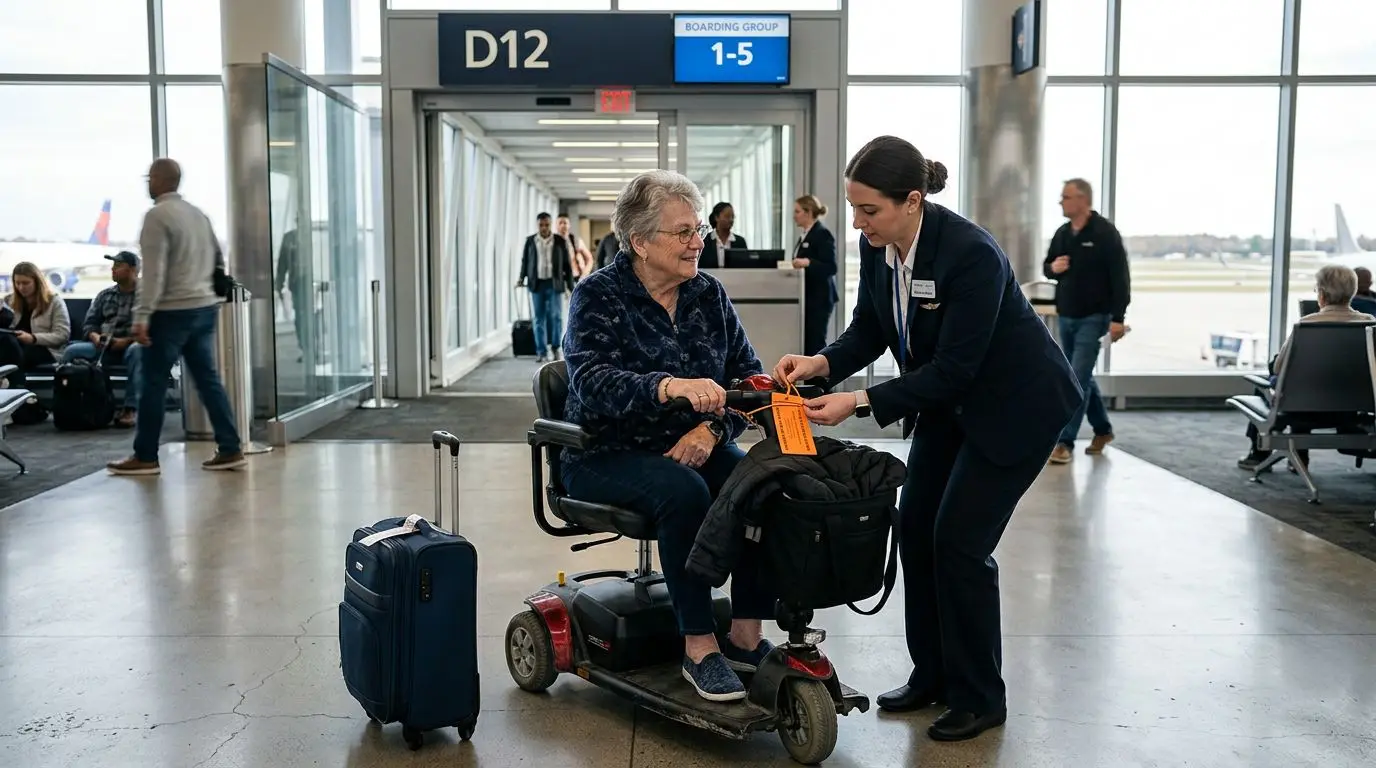
- At the gate: ask for a gate-check or mobility-device tag, remove loose parts, and confirm where you will receive the scooter after landing.
Short answer: it is very doable. The smoothest trips are the ones where battery details and measurements are handled before travel day.
TSA screening: what happens in about 10 to 20 minutes
TSA does not decide whether your scooter can fly as cargo. TSA screens you, the scooter, and the items traveling with it. Many scooter screenings take about 10 to 20 minutes, though busy airports or extra inspections can take longer.
If you can walk through the screening equipment, an officer may ask you to do so while the scooter is inspected separately. If you cannot stand or walk without the scooter, tell the officer clearly. TSA can use alternative screening methods, including a pat-down and explosive trace testing. You may request to remain seated if standing is unsafe for you.
Before reaching the checkpoint, remove items from baskets, under-seat storage, cup holders, cane clips, and tiller bags. Keep a small pouch with medications, ID, and travel documents with you. If a battery is removable and will travel in the cabin, make sure it is accessible for inspection.
Useful TSA tips:
- Label medical equipment and battery packs clearly, but do not rely on labels alone.
- Carry tools only if they comply with TSA rules; many small tools under 7 inches are often allowed in carry-on, but airline and TSA decisions can vary.
- Do not tape over battery labels. Officers and airline staff may need to read them.
- If you have a medical device card or written instructions, bring it, but you are not required to disclose private medical details.
A calm, specific statement helps: “This is my mobility scooter. The battery is nonspillable gel,” or “This is a lithium-ion battery rated at 288 watt-hours.” That one sentence can prevent confusion.
Airline notification: give details at least 48 hours before flying
Notify the airline as soon as you book, with 48 hours before departure as a smart minimum target. Some disability-related services cannot legally be required in advance for every passenger, but airlines often ask for advance information so they can plan safe loading, battery handling, and airport assistance. On smaller aircraft, that early discussion can make or break the plan.
Call or use the airline’s accessibility form. Do not only add a generic wheelchair request if you are bringing a scooter. A scooter has different loading and battery details than a manual wheelchair.
Have these details ready:
- Scooter length, width, and height in inches.
- Total weight in pounds, including battery and seat if attached.
- Battery type: lithium-ion, sealed lead-acid, gel, AGM, or other.
- Battery watt-hours for lithium, or voltage and amp-hours if watt-hours are not printed.
- Whether the battery is removable.
- Whether the scooter folds, disassembles, or must remain assembled.
- Whether you can transfer to an airport wheelchair or aisle chair.
If your trip includes a connection, confirm the request for every flight segment. A 4-leg round trip may involve 4 different aircraft cargo spaces and 4 separate ground crews. Ask the airline to note that the scooter is a mobility aid and to record where you want it returned: aircraft door, jet bridge, or baggage claim. The aircraft-door return is not always possible at every airport, but asking early gives you the best chance.
Battery rules: lithium, gel, AGM, and the 300 Wh question
Battery rules are the most important part of flying with a mobility scooter. For lithium-ion scooter batteries, a common FAA and airline threshold is 300 watt-hours for a battery used in a mobility aid, with limits on spare batteries. If your removable lithium battery is over the airline’s allowed watt-hour limit, it may be refused for air travel.
Watt-hours are usually printed as “Wh” on the battery label. If the label shows volts and amp-hours instead, calculate it this way: volts × amp-hours = watt-hours. For example, a 24 V battery rated at 12 Ah equals 288 Wh. That number is below 300 Wh, which is why many compact travel scooters use batteries in that range.
Battery handling differs by type:
| Battery type | Common scooter use | Air travel considerations |
|---|---|---|
| Lithium-ion | Lightweight folding and travel scooters | Check Wh rating, protect terminals, remove if required, carry removable battery in cabin when directed |
| Sealed lead-acid | Many mid-size and older scooters | Often accepted if nonspillable and securely attached; terminals must be protected |
| Gel cell | Common nonspillable mobility battery | Usually treated as nonspillable if properly labeled and protected |
| AGM | Absorbent glass mat sealed battery | Usually nonspillable; airline may ask for confirmation on the battery label |
| Spillable wet cell | Less common in travel scooters | More restrictions; may need upright loading and special handling, and may not be practical for some flights |
For lithium batteries, spares are more tightly controlled than installed batteries. A common rule allows either 1 spare up to 300 Wh or 2 spares up to 160 Wh each for mobility devices, but airline procedures can vary. Always confirm directly with the airline before travel day.
Protecting terminals is not optional. Use the manufacturer’s battery case, terminal covers, or secure electrical tape where appropriate. The goal is simple: prevent a short circuit if the battery contacts metal.
Gate check and loading: what to expect within the last 30 minutes
Most scooter users keep the scooter until boarding begins, often within the last 30 minutes before departure. At that point, you may transfer to an airport wheelchair, board with assistance, or walk onto the aircraft if you are able. The scooter is then taken down the jet bridge or to the ramp for loading.
Ask the gate agent for a mobility-device tag, not just a standard baggage tag. Confirm that the tag shows your name, phone number, destination, and where the scooter should be returned. If you have a connection, ask whether the scooter will be returned at the connecting gate or checked through to the final destination. This detail matters if you cannot move through the connecting airport without it.
Before handing the scooter over:
- Turn the power off and remove the key.
- Switch to freewheel only if the airline crew specifically needs it, then show them how to re-engage the drive mode.
- Remove baskets, cushions, mirrors, phone holders, flags, bags, and cup holders.
- Fold the tiller down if the design allows it.
- Take the removable battery into the cabin if required by the airline or battery rules.
- Keep the charger with you if it is small enough and important for arrival.
Many scooters are damaged because a part sticks out, not because the main frame is weak. A basket bracket, armrest, or tiller lever can catch during loading. Anything detachable should travel in your carry-on or be packed separately.
Damage prevention: 12 practical steps before handing it over
Airline crews move thousands of mobility devices every year, but scooters can still be damaged during ramp handling. A scooter may weigh 80 to 250 pounds, and some parts are not designed to be lifted by the seat, armrests, or tiller. Preparation reduces the risk.
Use this 12-point damage-prevention checklist:
- Photograph the scooter from all 4 sides before departure.
- Take close-up photos of the tiller, controls, wheels, seat post, and battery compartment.
- Record a 20-second video showing that the scooter powers on and drives.
- Remove the key and keep it with you.
- Attach a laminated instruction card with “brake release,” “freewheel,” and “lift points.”
- Use bright tape or tags to mark safe lift points if they are not obvious.
- Secure the tiller in the folded position with a strap if allowed by the scooter design.
- Remove loose accessories and pack them in a carry-on.
- Protect the joystick or throttle area with padding that does not press the controls.
- Bring a small roll of tape or hook-and-loop straps for last-minute securing.
- Keep the battery documentation with your boarding pass.
- Inspect the scooter immediately when it is returned.
If damage happens, report it before leaving the airport whenever possible. Ask for a written report and take photos at the arrival gate or baggage area. Under US disability air travel rules, mobility aid damage is treated seriously, but claims are much easier when documented immediately.
How to choose or prepare a scooter for flying: measure 4 things
If you already own a scooter, start by measuring it. If you are buying or renting with air travel in mind, focus on 4 numbers: folded length, folded width, folded height, and total weight with the battery. Also note the battery watt-hours.
Use a tape measure while the scooter is in the exact travel configuration. If the seat comes off, measure it both assembled and disassembled. If the tiller folds, measure the folded height. Write the numbers in inches and pounds because US airline agents will usually ask for those units.
| Scooter type | Typical travel advantage | Possible air travel drawback |
|---|---|---|
| Compact folding scooter | Smaller folded dimensions; often easier for tight cargo spaces | May have a lithium battery that needs Wh verification |
| Disassembling travel scooter | Breaks into pieces that are easier to lift | More loose parts to label, protect, and reassemble |
| Mid-size 4-wheel scooter | Often more stable outdoors and more comfortable | Heavier frame and larger turning radius can complicate handling |
| Heavy-duty scooter | Higher weight capacity and larger seating | May be too heavy or tall for some aircraft cargo doors |
| 3-wheel scooter | Tighter turning radius in terminals | May feel less stable on uneven outdoor surfaces than some 4-wheel designs |
Ask the airline about cargo door limits if the scooter is tall or heavy. Regional jets and smaller aircraft can have more restrictive cargo openings than larger planes. Even when the airline accepts mobility aids, physics still matters: a scooter that cannot pass through the cargo door cannot be loaded normally.
A good travel setup is not always the smallest scooter. It is the scooter that supports your mobility needs, has a clearly labeled compliant battery, can be secured without loose parts, and can be handled safely by airline staff.
Who flying with a scooter is best for: 3 common traveler profiles
Flying with a mobility scooter is best for travelers who need reliable mobility across long airport distances, during layovers, and at the destination. A large US airport can easily require a walk of 0.5 mile or more from check-in to gate, and connections can add even more distance.
1. Travelers who can transfer but cannot walk long distances
This is one of the smoothest scenarios. You may use the scooter through check-in, TSA, and the terminal, then transfer to an aircraft seat with minimal extra equipment. The scooter is loaded as a mobility aid and returned after landing.
2. Travelers who need airport assistance plus a scooter at the destination
You may be able to use an airport wheelchair or aisle chair for boarding but still need your own scooter for the hotel, cruise port, family visit, or outdoor activities. In this case, document the scooter carefully and confirm the return location at every stop.
3. Travelers with limited ability to stand or transfer
This is possible, but it requires more planning. Tell the airline whether you need an aisle chair, help transferring, or extra boarding time. Airline staff can assist with access, but they are not medical caregivers. If you need hands-on personal care, consider traveling with a companion.
Flying with a scooter may not be ideal if the scooter has an unlabeled lithium battery, a damaged battery case, loose wiring, or dimensions that exceed what the aircraft can load. Fix those issues before booking a nonrefundable trip.
Documents to carry: 6 items that prevent airport confusion
Good documentation does not need to be complicated. A 1-page packet can answer most questions from airline staff, TSA officers, and ground crews. Keep one copy in your carry-on and attach one copy to the scooter in a clear sleeve.
Carry these 6 items:
- A printed spec sheet with scooter length, width, height, and weight.
- Battery label photo showing chemistry, voltage, amp-hours, and watt-hours if available.
- A simple watt-hour calculation if the label lists only V and Ah.
- Instructions for removing the battery, folding the tiller, and using freewheel mode.
- Your name, phone number, flight number, and destination.
- Photos showing the scooter’s preflight condition.
A sample battery note might read: “Lithium-ion mobility scooter battery, 24 V, 12 Ah, 288 Wh. Terminals protected. Battery removable.” For a nonspillable battery, the note might read: “Sealed nonspillable AGM battery installed in mobility scooter. Terminals protected.” Keep the wording factual. Airport staff need clear information, not a sales brochure.
Feature comparison: 8 details that matter more than looks
When air travel is part of your life, certain scooter features matter more than color, styling, or top speed. A scooter that travels well usually has predictable controls, secure battery access, and parts that can be folded or removed without special tools.
| Feature | Why it matters for flying | What to check |
|---|---|---|
| Battery label | Airline staff may need Wh or nonspillable proof | Readable chemistry, V, Ah, and Wh if lithium |
| Removable battery | Some lithium batteries must travel in cabin | Can you remove it in under 2 minutes? |
| Folded tiller | Reduces height and prevents impact damage | Locks securely without wobbling |
| Seat removal | Can lower cargo height and reduce breakage | Seat comes off without tools |
| Freewheel lever | Ground crew may need to roll the scooter | Clearly marked drive and freewheel positions |
| Lift points | Prevents lifting by fragile parts | Frame has obvious safe handling points |
| Weight | Heavier devices are harder to handle | Total pounds with battery installed |
| Ground clearance | Affects ramps and thresholds at destination | Balance travel size with real-world surfaces |
Speed is rarely the deciding feature for air travel. Battery compliance, measurements, and handling design matter more.
FAQ: 5 quick answers for US flights
Can I ride my mobility scooter all the way to the airplane door?
Usually, yes. Most travelers can use the scooter through the terminal and to the gate or aircraft door, then transfer for boarding. The exact handoff point depends on the airport layout and aircraft.
Do mobility scooters count as checked baggage?
Required mobility aids are generally handled separately from ordinary checked baggage and are typically transported without standard baggage fees. Still, they need tags, battery approval, and safe loading.
Can I bring a lithium scooter battery into the cabin?
If the battery is removable and airline rules require removal, it usually must travel in the cabin with terminals protected. Confirm the watt-hour rating, because lithium mobility-aid batteries are commonly limited to 300 Wh, with separate limits for spares.
What if my scooter is damaged by the airline?
Report it before leaving the airport if possible. Take photos, request a written damage report, and keep receipts for repairs or temporary mobility equipment. Immediate documentation helps your claim.
Should I disconnect the battery before flight?
Do not disconnect or remove anything unless the airline, battery type, or scooter instructions call for it. The key requirement is that the scooter cannot accidentally turn on and the battery terminals are protected from short circuit.
Final preflight checklist: 24 hours before departure
The day before your flight, take 15 minutes to confirm the details. Check in with the airline, charge the scooter according to the battery instructions, print your documentation, and pack removable accessories. Do not wait until the TSA line to discover that the battery label is hidden or unreadable.
- Confirm mobility assistance and scooter notes on the reservation.
- Verify battery type and watt-hours.
- Pack the charger, key, and any required battery case.
- Photograph the scooter before leaving home.
- Attach an instruction card and contact tag.
- Remove nonessential accessories.
- Arrive 2 to 3 hours early, depending on the flight.
Taking a mobility scooter on an airplane is common, but it rewards preparation. Know your battery, measure the scooter, notify the airline, and protect the parts most likely to be damaged. With those steps handled, your scooter can support your independence from curbside check-in to your destination.
Frequently asked questions
Can I ride my mobility scooter all the way to the airplane door? +
Usually, yes. Most travelers can use a mobility scooter through the terminal and to the gate or aircraft door, then transfer for boarding. The exact handoff point depends on the airport and aircraft.
Do mobility scooters count as checked baggage? +
Required mobility aids are generally handled separately from ordinary checked baggage and are typically transported without standard baggage fees. They still need proper tagging, battery approval, and safe loading.
What is the lithium battery limit for a mobility scooter on a plane? +
A common FAA and airline limit for lithium-ion mobility scooter batteries is 300 watt-hours, with separate limits for spare batteries. Always confirm the watt-hour rating on the battery label and verify with the airline before travel.
How far in advance should I tell the airline about my scooter? +
Notify the airline as soon as you book, with 48 hours before departure as a smart minimum target. Provide the scooter’s dimensions, weight, battery type, and whether the battery is removable.
What should I do if my scooter is damaged during a flight? +
Report the damage before leaving the airport if possible. Take photos, request a written damage report, and keep receipts for repairs or temporary mobility equipment.
Related guides
Airline-Approved Mobility Scooters: What the Term Really Means Before You Fly
13 min read
Planning a Road Trip With a Mobility Scooter: Space, Charging, Hotels, and Backup Plans
14 min read
Mobility Scooters, Taxis, and Rideshares: What to Confirm Before You Book a Ride
14 min read