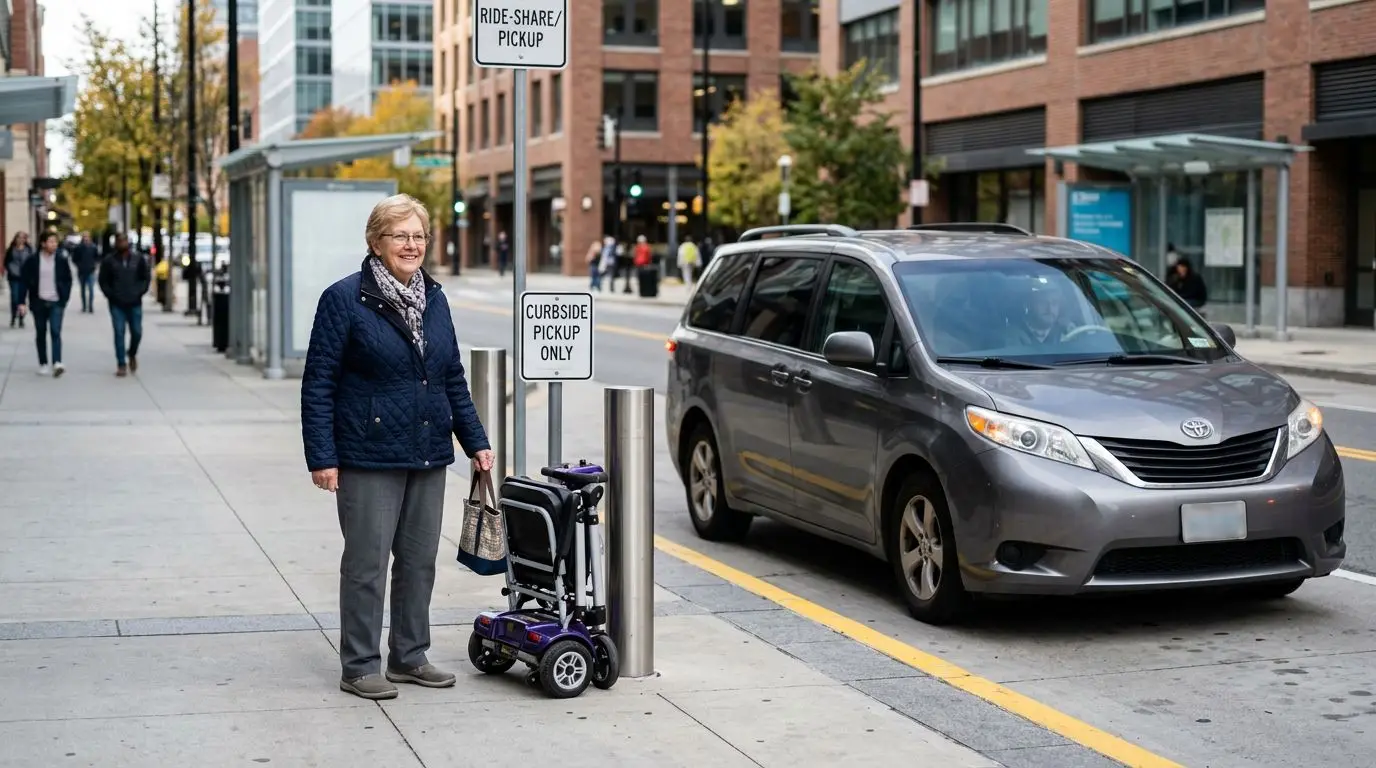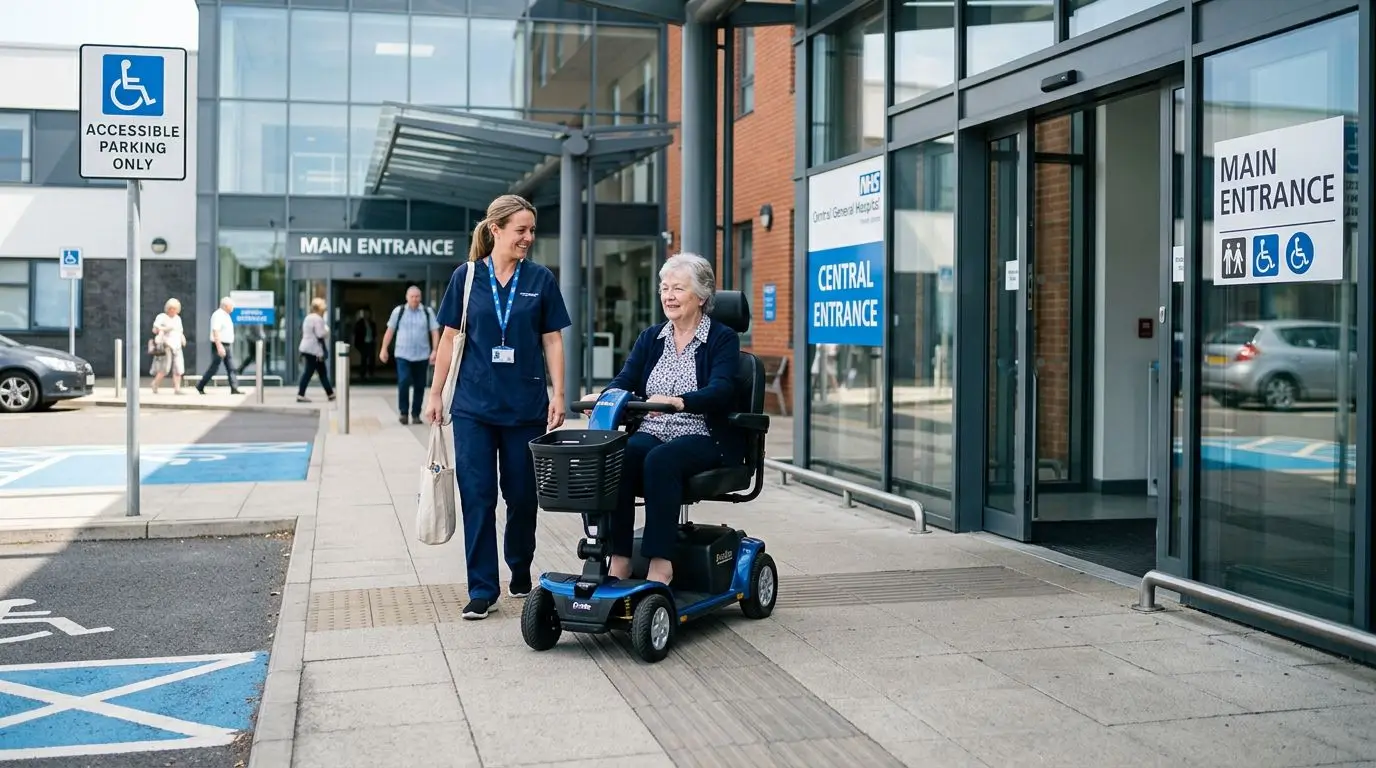
Yes, you can usually use a mobility scooter at medical offices, hospitals, and clinics, though access can vary by building layout, exam room size, and facility policy. The safest approach is to call ahead, confirm accessible parking and entry routes, and ask whether staff can help with doors, check-in, transfers, or patient transport if needed.
Medical facilities are used to accommodating patients with mobility needs, but not every hallway, restroom, imaging area, or exam room works equally well for every scooter. A little planning can prevent a long roll from the parking lot, a tight turn at the reception desk, or an unexpected request to transfer to a wheelchair.
What access usually looks like: 36-inch routes and 32-inch doorways
Most modern medical buildings are designed with accessibility in mind, including step-free entrances, elevators, wide hallways, and accessible restrooms. Under common accessibility standards, an accessible route is often at least 36 inches wide, and many doors provide about 32 inches of clear opening when fully open. In practice, furniture, sign-in kiosks, trash cans, wall-mounted equipment, and waiting-room chairs can make the usable space feel smaller.
Hospitals tend to offer the broadest access because they handle stretchers, wheelchairs, medical carts, and patient transport equipment every day. Smaller clinics and older medical office buildings may be more limited, especially if they were converted from non-medical spaces or have narrow interior exam rooms.
Do not assume the front entrance is the best entrance. Some facilities have a main lobby with a long ramp, while a side entrance near imaging, physical therapy, or specialty care may be shorter and easier. If walking even 50 to 100 feet is difficult, ask where the closest accessible entrance is for your exact department.
Who it is best for: 3 patient situations where a scooter helps most
Using a mobility scooter at a medical visit is especially helpful when the distance from parking to check-in is long, when you need to visit more than 1 department, or when standing in lines increases pain, fatigue, shortness of breath, or fall risk. It is not only about convenience. It is about getting to care safely and still having enough energy for the appointment itself.
| Patient situation | Why a scooter can help | What to confirm before arrival |
|---|---|---|
| Long hospital campus visit | Parking garages, lobbies, elevators, and clinic corridors can add several hundred feet of travel. | Best entrance, elevator location, and whether patient transport is available. |
| Multiple appointments in 1 day | Rolling between lab, imaging, pharmacy, and a specialist can reduce fatigue. | Whether all departments are on an accessible route. |
| Limited standing tolerance | A scooter provides a seated position during check-in, waiting, and discharge instructions. | Whether registration kiosks and counters are reachable from a seated position. |
A scooter may be less practical if the visit involves sedation, a procedure requiring transfer to a stretcher, or an area where powered devices cannot enter for safety or space reasons. In those cases, the scooter can still help you get into the building, but staff may ask you to transfer to a wheelchair, exam chair, or procedure table.
Before your appointment: 7 questions to ask the clinic
A 5-minute phone call can solve most access problems before you leave home. Call the main office number or the department where you are scheduled, not just the general hospital switchboard. Be specific: say you will be arriving on a mobility scooter and ask which route is easiest.
- Which entrance is closest to my department?
- Is there accessible parking or a drop-off area within about 100 feet of that entrance?
- Are there automatic doors or staff who can help with doors?
- Will my scooter fit into the exam room, or should I expect to transfer?
- Is there space to park the scooter safely during the exam?
- Are elevators needed, and are they large enough for a scooter?
- If I arrive tired or have trouble navigating, can patient transport or security assist me?
If your appointment is early in the morning, ask whether the recommended entrance is open at that time. Hospitals often keep the emergency entrance open 24 hours, while specialty clinic entrances may open later. For evening appointments, ask about after-hours exits too. The door you use to enter may not be open when you leave.
For a first visit, request written directions through the patient portal or by email if available. Directions such as “park in Garage B, take Elevator 3 to Level 2, turn left at radiology” are far more useful than “use the main entrance.”
Parking and drop-off: 8-foot spaces, 5-foot aisles, and real-world distance
Accessible parking is one of the biggest factors in whether a medical visit feels manageable. A standard accessible parking space is commonly at least 8 feet wide with a 5-foot access aisle, while van-accessible spaces include a wider access aisle. Those measurements help, but the distance to the door, slope of the route, curb cuts, and weather protection matter just as much.
If you travel with a scooter lift, ramp, or caregiver assistance, look for a space with enough side or rear clearance to unload safely. Do not park over the access aisle unless it is your designated loading space; another patient may need that aisle for a ramp, wheelchair, walker, or scooter.
Hospital garages can be tricky. Some have low clearance, tight turns, and confusing elevator banks. If your scooter is transported in a van, check garage height limits before arrival. If you unload at the entrance instead, ask whether there is a patient drop-off lane and where your driver should park afterward.
| Arrival option | Best use | Access concern |
|---|---|---|
| Accessible parking space | Independent scooter users who can unload and enter safely. | Spaces may be full during peak clinic hours. |
| Covered drop-off | Bad weather, fatigue, or visits requiring caregiver help. | Driver may need to move quickly; ask where waiting is allowed. |
| Valet or patient assistance area | Large hospitals or complex campuses. | Confirm whether staff can handle your vehicle but not your scooter. |
| Emergency entrance | After-hours access or urgent symptoms. | May be crowded and farther from specialty clinics. |
When in doubt, use the drop-off area first. Getting safely inside is the priority. Your driver can park after you are checked in or once staff know where you need to go.
Inside the building: 60-inch turns, elevators, kiosks, and waiting rooms
A scooter that feels easy in a grocery aisle may feel larger in a clinic waiting room. A 60-inch turning circle is a common accessibility benchmark, but many real spaces are interrupted by chairs, side tables, brochure racks, privacy screens, and portable equipment. Move slowly and assume people may step backward without seeing you.
At check-in, look for a lowered counter, accessible kiosk, or staff member who can bring paperwork to you. If the kiosk screen is too high, the card reader is hard to reach, or the signature pad is fixed at an awkward angle, ask for assistance. You should not have to stand to complete registration if standing is unsafe.
Elevators are usually manageable, but timing matters. Let others exit first, enter straight if possible, and avoid sharp last-second turns. If the elevator is crowded, wait for the next car rather than squeezing in. Hospitals often have separate public, staff, and patient transport elevators; staff may direct you to the one with the easiest route.
In waiting rooms, park where you are not blocking the main aisle, fire doors, restroom access, or the path to exam rooms. If chairs are too close together, ask the front desk if a chair can be moved or if there is a better waiting spot. A clear 36-inch path is a practical goal, even when the room is busy.
Exam room navigation: 30-inch scooters and 60-inch turning space
Exam rooms are often the tightest part of the visit. Many scooters are roughly 22 to 30 inches wide, and some are longer than 45 inches. Add a caregiver, a clinician, a rolling stool, a sink cabinet, a trash can, a computer workstation, and an exam table, and the turning space can disappear quickly.
When the medical assistant calls your name, say plainly, “I use the scooter for mobility. Is the room large enough, or would you like me to park it nearby?” This gives staff time to choose a larger room if one is available. Some offices have at least 1 accessible exam room with extra turning space or an adjustable-height exam table.
You may be able to stay seated on your scooter for parts of the visit, such as history-taking, medication review, blood pressure discussion, or discharge instructions. For a physical exam, wound check, injection, imaging prep, or procedure, the clinician may need you on an exam table, chair, scale, or other equipment. Ask what position is required and what help is available before you attempt a transfer.
Never rush a transfer because staff seem busy. Lock the scooter, turn the power off, move footrests or armrests if applicable, and ask for a stable handhold. Medical staff can explain the plan, but they may have rules about how much physical lifting they can provide. If you usually need hands-on transfer assistance, tell the office before the visit so they can prepare.
Facility policies: 2 common limits on scooters in clinical areas
Most clinics allow mobility scooters in public and patient areas, but there may be limits in certain clinical spaces. Two common reasons are space and safety. A powered scooter may not be appropriate in a small procedure room, sterile area, imaging suite, or recovery area where staff need clear access to equipment and the patient.
Policies can also cover battery charging, storage, speed, and where devices may be parked. Do not count on being able to charge your scooter during an appointment. Medical outlets may be reserved for clinical equipment, and staff may not be allowed to plug in personal devices. Arrive with enough battery for the full trip, including parking, waiting, and any unexpected detour.
Keep speed low indoors. Many scooters can travel faster than a normal walking pace, but medical buildings are full of people using walkers, crutches, canes, IV poles, wheelchairs, and service animals. A slow walking speed is more appropriate in hallways and lobbies.
If staff ask you to park the scooter outside a room, ask where it will be visible and out of the path of travel. Take valuables, keys, phone, wallet, and medical paperwork with you. If the scooter has a removable key, remove it before leaving it unattended.
How to choose or measure your scooter for visits: 4 numbers to know
If medical appointments are a major reason you use a scooter, the most useful specifications are not flashy extras. Know 4 numbers: overall width, overall length, turning radius, and total weight if it must be lifted or transported. Write them on a card or save them in your phone so you can give accurate information when a clinic asks.
| Scooter type | Typical access advantage | Possible clinic drawback | Best fit for medical visits |
|---|---|---|---|
| Compact travel scooter | Narrower profile and easier transport. | May have smaller wheels and less comfort for long hospital days. | Short appointments, smaller offices, users with vehicle transport needs. |
| Mid-size scooter | Better comfort and stability than many compact designs. | Needs more turning room in exam rooms and elevators. | Routine clinic visits where hallways and entrances are accessible. |
| Heavy-duty scooter | Higher weight capacity and larger seating area. | Wider, longer, and harder to maneuver in tight rooms. | Large hospitals, wide routes, and users who need stronger support. |
| 3-wheel configuration | Often turns tighter than comparable 4-wheel designs. | May feel less stable for some users on uneven outdoor surfaces. | Indoor navigation and tight clinic layouts. |
| 4-wheel configuration | Often feels steadier outdoors and over uneven pavement. | Usually has a larger turning radius. | Parking lots, ramps, and mixed indoor-outdoor routes. |
To measure width, use the widest point, which may be the armrests, rear wheels, or basket area. To measure length, include any basket or rear accessory that stays attached. Turning radius is harder to measure at home, but you can test whether you can make a 180-degree turn in a hallway or room without backing up several times.
Transport weight matters if a caregiver loads the scooter into a vehicle. Some scooters separate into pieces, but each piece still has weight. If your caregiver should not lift more than 25 to 40 pounds, make sure the heaviest piece falls within a safe range for that person. Do not rely on a clinic to help load or unload personal mobility equipment unless they specifically offer that service.
Features that help in clinics: 6 practical items to look for
The best scooter for medical access is the one you can control precisely in crowded indoor spaces. Small details can make a big difference during a 2-hour appointment day.
| Feature | Why it helps at medical offices | What to watch |
|---|---|---|
| Tight turning radius | Helps with exam room doors, elevators, and reception areas. | Practice slow turns before using it in a crowd. |
| Adjustable seat or armrests | Can make transfers and seated check-in easier. | Loose armrests can be unsafe if used as grab bars. |
| Reliable battery indicator | Reduces the chance of losing power during a long visit. | Charge fully before appointments whenever possible. |
| Good low-speed control | Important around walkers, carts, and waiting-room traffic. | A jerky throttle can be stressful indoors. |
| Basket or storage pouch | Holds paperwork, glasses, medication list, and water. | Do not overload the front and affect steering. |
| Visible lights or reflectors | Helpful in parking garages and early morning visits. | Lights do not replace slow, careful driving. |
If you already own a scooter, you can still improve access by carrying a simple appointment kit: photo ID, insurance card, medication list, phone charger, reading glasses, water if allowed, and a folded note with your scooter measurements and transfer needs.
When to ask for assistance: 5 signs you should not push through
Ask for help early if you feel unsafe, lost, rushed, short of breath, or unsure whether your scooter will fit. Medical facilities would rather assist before a problem occurs than respond after a fall, blocked hallway, or missed appointment.
- You cannot find the accessible entrance or elevator after 5 minutes of searching.
- The route includes a steep ramp, broken pavement, or a heavy manual door.
- The waiting room or exam room does not have a clear path.
- You are being asked to transfer and do not feel steady.
- Your battery is low and you still need to reach parking or another department.
Good places to ask include the front desk, information desk, security desk, valet stand, or nursing station. Use direct language: “I need assistance getting to cardiology,” or “I need a safe place to park my scooter during the exam.” Clear requests get faster help than apologizing or trying to explain too much when you are already tired.
If you have a disability-related access need, it is reasonable to ask for accommodation. That may mean a closer room, more time to transfer, paperwork completed verbally, or patient transport between departments. Staff may not be able to provide every option immediately, but they can usually offer a safer plan when they understand the need.
FAQ: 5 answers about scooters at medical appointments
Can a clinic refuse to let me use my mobility scooter?
A clinic generally should provide accessible service, but it may restrict scooters in specific areas when there is a legitimate safety, space, or infection-control concern. If that happens, ask what alternative is available, such as a wheelchair, larger room, or staff escort.
Should I bring my scooter or use a hospital wheelchair?
Bring your scooter if it is the safest way for you to travel from parking to the appointment. A hospital wheelchair may be useful for tight clinical areas, imaging, or procedures, but availability is not guaranteed at every entrance.
What if the exam room is too small?
Ask whether a larger accessible room is available. If not, staff may ask you to park the scooter nearby and transfer to a chair, wheelchair, or exam table, depending on the visit.
Can I charge my scooter at the hospital or clinic?
Do not assume charging is allowed. Many outlets are reserved for medical equipment, and policies vary. Charge fully before you leave home and bring your charger only as a backup.
What should I do if I have trouble getting from the car to the office?
Call the office from the parking lot or ask your driver to go inside for help. Many hospitals have security, volunteers, or patient transport staff who can assist with directions or provide a wheelchair when appropriate.
Medical visits are easier when access is planned, not guessed. Know your scooter’s size, call ahead for the best route, arrive with extra time, and ask for assistance before a tight doorway, crowded lobby, or difficult transfer becomes a safety issue.
Frequently asked questions
Can a clinic refuse to let me use my mobility scooter? +
A clinic generally should provide accessible service, but it may restrict scooters in specific areas for safety, space, or infection-control reasons. Ask what alternative is available, such as a wheelchair, larger room, or staff escort.
Should I bring my scooter or use a hospital wheelchair? +
Bring your scooter if it is the safest way for you to get from parking to the appointment. A hospital wheelchair may help in tight clinical areas or procedure spaces, but availability is not guaranteed at every entrance.
What if the exam room is too small for my scooter? +
Ask whether a larger accessible exam room is available. If not, staff may ask you to park the scooter nearby and transfer to a chair, wheelchair, or exam table, depending on the type of visit.
Can I charge my mobility scooter at a hospital or clinic? +
Do not assume charging is allowed. Many outlets are reserved for medical equipment, and policies vary by facility. Charge fully before leaving home and bring your charger only as a backup.
When should I ask medical office staff for assistance? +
Ask as soon as you feel unsafe, lost, rushed, short of breath, unsure about a transfer, or concerned that your scooter will not fit. Front desks, information desks, security, valet areas, and nursing stations are good places to ask.
Related guides
Can You Bring a Mobility Scooter to Theme Parks, Stadiums, Museums, and Other Venues?
16 min read
Mobility Scooter Rules at Hotels in the US: Accessibility Requests, Room Fit, Charging, and Storage
15 min read
How to Choose a Mobility Scooter for Everyday Errands, Stores, and Medical Appointments
15 min read