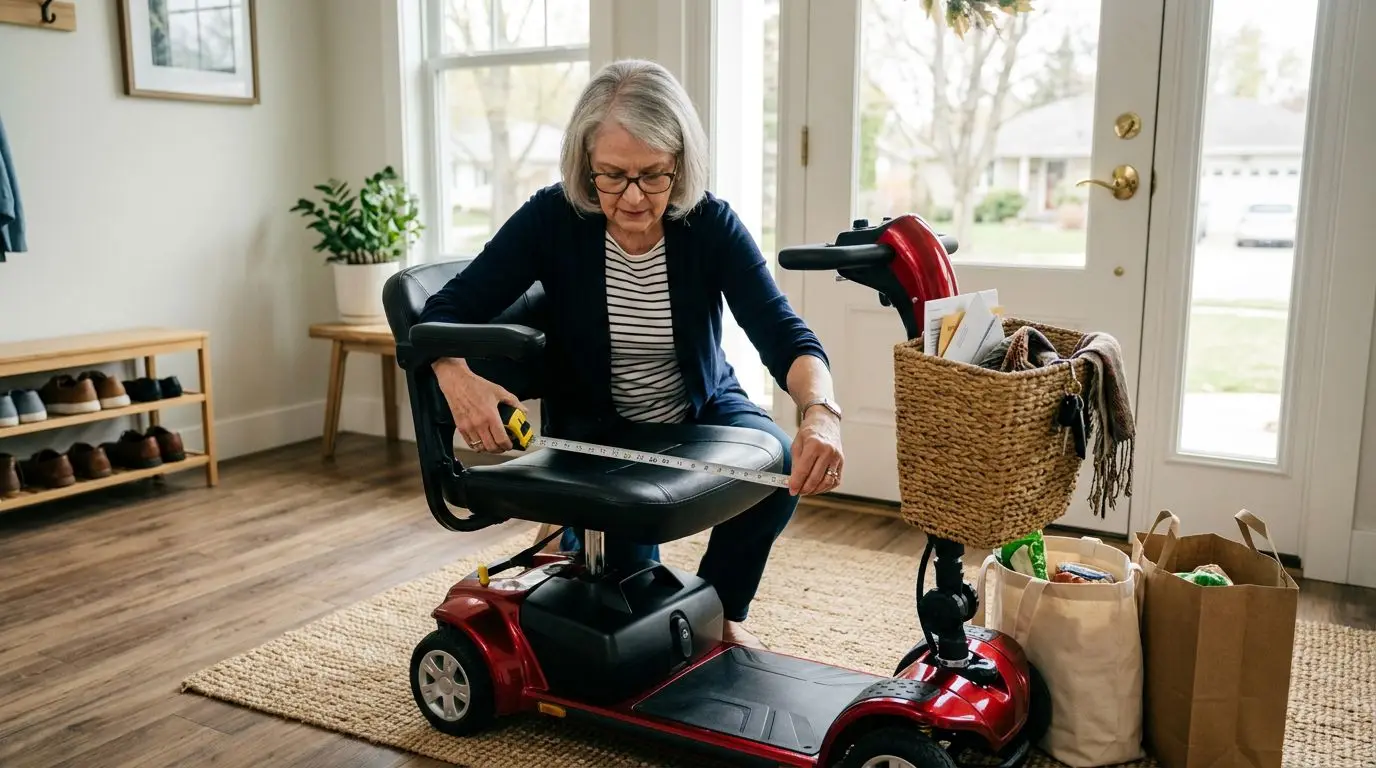
A good rule of thumb is to choose a mobility scooter with at least a 10% to 20% safety margin above your real daily load, and closer to 25% if you ride on hills, carry groceries, or use the scooter outdoors. Your real load is more than your body weight; it includes clothing, bags, oxygen holders, baskets, cane holders, and anything else you regularly carry. If your total load is within about 20 to 30 pounds of the advertised limit, treat that scooter as a poor fit and move up to the next higher capacity class.
Advertised weight capacity matters, but it is not the whole story. Seat width, frame size, battery performance, braking distance, ramp angle, tire size, and suspension all affect whether a scooter feels stable and performs safely in everyday use.
Why a 10% to 25% safety margin matters
Mobility scooter weight capacity is usually listed as a single number, such as 250 pounds, 300 pounds, 350 pounds, or 500 pounds. That number tells you the maximum user load the scooter is designed to carry under controlled conditions. It should not be treated as the ideal everyday operating weight.
A safety margin gives the motor, frame, brakes, battery, and tires room to work without being pushed to their upper limit on every trip. For many buyers, a 10% to 20% margin is a practical minimum. For example, if your real daily load is 270 pounds, a 300-pound scooter gives only about an 11% margin. That may be acceptable on flat indoor surfaces, but it can be tight for outdoor sidewalks, ramps, and cargo.
A 25% margin is more comfortable when the scooter will be used on uneven pavement, mild hills, grass edges, long trips, or repeated curb-cut ramps. The goal is not to buy the largest scooter possible. It is to avoid riding at the top of the machine's capacity day after day.
Think of capacity like the top line on a measuring cup. You can fill it to the brim, but it is easier to carry without spilling when there is room left over.
What counts toward the limit: rider, bags, and 5 to 20 lb accessories
The listed weight capacity includes the rider and anything carried by the scooter. Many people compare capacity only to their body weight and overlook the extras. That is where the numbers can get surprisingly close.
Daily clothing, shoes, a coat, a purse, a backpack, a front basket, a cane holder, a portable oxygen cylinder, groceries, water bottles, or a small pet carrier can add meaningful weight. A light accessory may weigh only 2 to 5 pounds, while a loaded grocery bag can easily add 10 to 20 pounds. Two bags of groceries plus a coat and basket may add 25 pounds or more.
| Item | Typical added weight | Why it matters |
|---|---|---|
| Winter coat and shoes | 3 to 8 lb | Often forgotten during showroom testing |
| Purse or small backpack | 3 to 12 lb | Usually carried every trip |
| Front basket with items | 5 to 20 lb | Adds weight forward of the rider |
| Groceries or pharmacy bags | 10 to 40 lb | Can turn a safe margin into a tight fit |
| Accessory holders | 2 to 10 lb | May also change balance and turning feel |
If you sometimes carry heavier items, plan for the heavier day, not the lightest one. A scooter that feels fine with no bags may feel sluggish or less stable after you add 30 pounds of errands.
Scooter types and typical 250 to 500+ lb ratings
Different scooter categories are built around different use cases. A compact travel scooter may be easy to disassemble and place in a vehicle, but that light frame usually comes with a lower capacity and smaller seat. A full-size or heavy-duty scooter usually supports more weight, but it may be harder to transport and need more storage space.
| Scooter type | Common capacity range | Best use | Tradeoff |
|---|---|---|---|
| Compact travel scooter | About 250 to 300 lb | Indoor use, shopping, short errands, vehicle transport | Smaller seat, shorter range, less ground clearance |
| Mid-size scooter | About 300 to 350 lb | Daily indoor and outdoor use on mostly level ground | Less portable than travel designs |
| Full-size scooter | About 350 to 450 lb | Longer outdoor trips, larger seats, stronger frame feel | Needs more turning room and storage space |
| Heavy-duty scooter | About 450 to 500+ lb | Higher user weight, rougher pavement, added cargo, larger seating | Heavier, wider, and harder to transport |
These ranges are general. Always read the actual specifications for the scooter you are considering. Two scooters with the same capacity can feel very different if one has a wider wheelbase, larger tires, firmer suspension, or a more supportive seat.
Also consider where the scooter will be used. A 4-wheel design commonly feels more stable on straight outdoor paths, while a 3-wheel design may offer a tighter turning radius for indoor spaces. Weight capacity alone does not tell you which layout fits your home, car, or neighborhood.
Seat fit: 2 inches of hip clearance can matter more than the label
A scooter can have enough weight capacity and still be uncomfortable or unstable if the seat is too narrow, too shallow, or too high. For many riders, seat fit is the first real-world test of whether the scooter is suitable.
As a practical starting point, measure your seated hip width and look for a seat that gives about 1 to 2 inches of total clearance. If your seated hip width is 20 inches, a 20-inch seat may technically fit, but it may press against your hips, restrict clothing, or make transfers harder. A 22-inch seat may feel more secure and natural.
Seat depth matters too. A very shallow seat may leave the thighs unsupported, while a very deep seat can press behind the knees. Armrest spacing affects transfers, especially if you slide sideways from a chair or bed. If the armrests are too narrow, the advertised capacity will not solve the fit problem.
Check these seat measurements before deciding:
- Seat width, often listed in inches
- Seat depth from backrest to front edge
- Seat-to-floor height or adjustable seat height
- Armrest width and whether the arms flip up
- Backrest height and lumbar support
- Swivel function for easier transfers
If possible, sit for at least 10 minutes, not just 30 seconds. A seat that feels acceptable in a quick test may feel tight during a full grocery trip.
Hills, ramps, and 6-degree slopes change the equation
Inclines make a scooter work harder. Even a gentle ramp can increase motor load, battery draw, and braking demand, especially when the rider is close to the scooter's weight limit. Many scooters list a maximum climbing angle, often expressed in degrees, but that number assumes proper conditions and should be read carefully.
A 6-degree slope may not look steep, but it can feel very different with a full basket, low battery, or wet pavement. Repeated ramps at apartment entrances, medical offices, stores, or curb cuts can matter as much as one long hill. If your home has a ramp, measure it before buying.
To estimate slope, you need rise and run. If a ramp rises 12 inches over a 12-foot run, that is a 1:12 ramp, which is commonly used as an accessibility reference point. Shorter, steeper ramps place more strain on the scooter and require more caution.
Riders who live in hilly neighborhoods should choose a larger safety margin than riders who use a scooter only inside a level building. If your real load is 300 pounds and your routes include hills, a scooter rated at 300 pounds is not a smart match. A higher capacity class, larger battery, better braking system, and stable 4-wheel base may be more appropriate.
Battery range and motor strain near the last 10% of capacity
Weight affects range. The heavier the load, the harder the motor works and the faster the battery may drain. Advertised range figures are usually based on controlled testing with specific rider weight, speed, surface, and battery condition. Real life is less predictable.
If a scooter is listed for up to 15 miles, that does not mean every rider will get 15 miles on sidewalks, inclines, cold days, and stop-and-go shopping trips. Riding near the top of the weight limit can reduce practical range, particularly when combined with rough surfaces, underinflated tires, frequent starts, or older batteries.
The last 10% to 20% of battery charge is not where you want to be far from home. Voltage may sag under load, and performance can feel weaker on hills or thick carpet. For daily planning, many riders are better served by treating advertised range as an upper estimate and keeping a reserve.
A simple approach is to plan routine trips so they use no more than about half to two-thirds of your expected real-world range. If the trip to a nearby store and back is 4 miles, a scooter that reliably covers 8 to 12 miles in your conditions gives a more comfortable buffer than one that barely completes the trip.
How to measure your real load in 15 minutes
You do not need special equipment to estimate the right capacity class. A bathroom scale, tape measure, and a short list of daily items can give you a much clearer answer in about 15 minutes.
- Weigh yourself in the clothing and shoes you normally wear when leaving home.
- Weigh your purse, backpack, oxygen equipment, cane, walker basket, or other regular accessories.
- Estimate your heaviest routine cargo, such as groceries, laundry, or pet supplies.
- Add 5 to 10 pounds for occasional small items if your trips vary.
- Add the numbers together to get your real daily load.
- Multiply that total by 1.10, 1.20, or 1.25 to see different safety-margin targets.
Here is a real-world style example without using any specific scooter brand. A rider weighs 255 pounds in normal clothing. A purse and front basket add 12 pounds. Typical groceries add 18 pounds. The real load is 285 pounds. With a 20% safety margin, the target capacity is 342 pounds, which points toward a scooter rated above 340 pounds rather than a 300-pound design.
Use the same method for a lighter scenario. A 190-pound rider with 10 pounds of personal items has a 200-pound daily load. A scooter rated for 250 pounds provides a 25% margin, assuming seat fit, terrain, and range also work.
Who it is best for: 4 common capacity decisions
Choosing the right safety margin depends on body weight, cargo habits, terrain, and how often the scooter replaces walking. The same 300-pound capacity can be generous for one rider and too close for another.
Riders using the scooter mostly indoors
If you ride inside a home, senior living community, medical building, or store on flat floors, a 10% to 15% margin may be workable when seat fit is good and cargo is light. Turning radius and overall width may be just as important as maximum capacity.
Riders who shop or carry bags weekly
If you regularly carry 20 to 40 pounds of groceries or personal items, build that into the calculation. A larger basket does not increase the weight rating. It only gives you more room to load the scooter.
Riders in hilly or uneven areas
If your daily route includes ramps, cracked sidewalks, sloped driveways, gravel patches, or grass edges, consider a 20% to 25% margin. Also compare tire size, ground clearance, braking system, and overall stability.
Riders near the listed limit
If your real load is within 20 to 30 pounds of a scooter's advertised capacity, the fit is too tight for most daily use. That scooter may move during a short test, but it may not deliver the range, comfort, or braking confidence you need over time.
Feature checklist: 8 items to compare beyond weight capacity
Capacity is only one line in the specification sheet. Before you buy, compare at least 8 practical features that affect day-to-day safety and comfort.
| Feature | What to check | Why it matters |
|---|---|---|
| Seat width | Hip width plus about 1 to 2 inches | Comfort, posture, transfers |
| Overall width | Doorways, hallways, elevators | A scooter must fit where you live |
| Turning radius | Small rooms and store aisles | Prevents awkward multi-point turns |
| Battery range | Real route length plus reserve | Advertised range may be optimistic |
| Incline rating | Home ramp and neighborhood slopes | Hills increase strain |
| Tire type and size | Indoor floors vs outdoor pavement | Affects ride quality and traction |
| Brakes | Automatic, regenerative, or manual backup features | Heavier loads need dependable stopping |
| Transport weight | Heaviest piece if disassembled | Caregivers may need to lift it |
Measure your doors before assuming a scooter will fit. Many interior doorways are about 28 to 32 inches wide, but usable clearance may be less because of trim, hinges, or tight turns. Also check where the scooter will charge. A scooter that fits your body but blocks a hallway every night can become frustrating quickly.
FAQ: 5 weight-capacity questions buyers ask
Can I use a scooter if I am exactly at the weight limit?
It is not ideal. Being exactly at the limit leaves no room for clothing, bags, accessories, inclines, or battery aging. A higher capacity scooter is usually the more practical choice.
Does a higher weight capacity always mean a safer scooter?
No. Higher capacity can help, but safety also depends on seat fit, braking, wheelbase, tire condition, terrain, speed, and the rider's ability to transfer and operate the controls. Bigger is not automatically better in a small apartment.
How much margin should I allow for groceries?
If you shop with the scooter, add at least 20 to 40 pounds to your load estimate unless you know your typical bag weight. Heavy liquids, canned goods, and pet food can add weight quickly.
Will exceeding the capacity damage the scooter?
Exceeding the listed capacity can increase strain on the motor, frame, seat post, tires, suspension, and brakes. It may also reduce range and stability. It is best to stay below the rating with a sensible margin.
Is seat width part of weight capacity?
No. Seat width and weight capacity are separate specifications. A scooter may be rated for your weight but still have a seat that is too narrow, too shallow, or difficult to transfer onto.
The best capacity choice is the one that fits your real life, not just your weight on a chart. Add your daily cargo, measure your seat needs, account for hills and range, and leave enough margin that the scooter is not working at its limit every time you leave home.
Frequently asked questions
How much safety margin should a mobility scooter have? +
Aim for at least 10% to 20% above your real daily load, including clothing, bags, accessories, and cargo. Use closer to 25% if you ride outdoors, climb ramps, or carry groceries.
Does rider weight include cargo on a mobility scooter? +
Yes. The listed capacity includes the rider plus anything carried on the scooter, such as baskets, bags, oxygen equipment, cane holders, groceries, and personal items.
Can I buy a scooter rated exactly for my body weight? +
It is better not to. A scooter rated exactly at your body weight leaves no allowance for clothing, cargo, hills, or battery strain. Choose a higher capacity class if you are close to the limit.
Does a wider seat mean a higher weight capacity? +
Not always. Seat width and weight capacity are different specifications. Check both, and allow about 1 to 2 inches of total hip clearance for comfort and easier transfers.
Why do hills matter for scooter weight capacity? +
Hills and ramps increase motor load, battery draw, and braking demand. If your route includes slopes or repeated curb cuts, use a larger safety margin and compare stability, tires, brakes, and battery range.
Related guides
Heavy-Capacity Mobility Scooters: What Higher Weight Ratings Mean for Comfort, Range, and Transport
13 min read
Heavy-Duty Mobility Scooters: What Higher-Weight-Capacity Buyers Should Check Before Purchasing
16 min read
Mobility Scooter Load Safety: Bags, Baskets, Groceries, Pets, and Passengers
14 min read