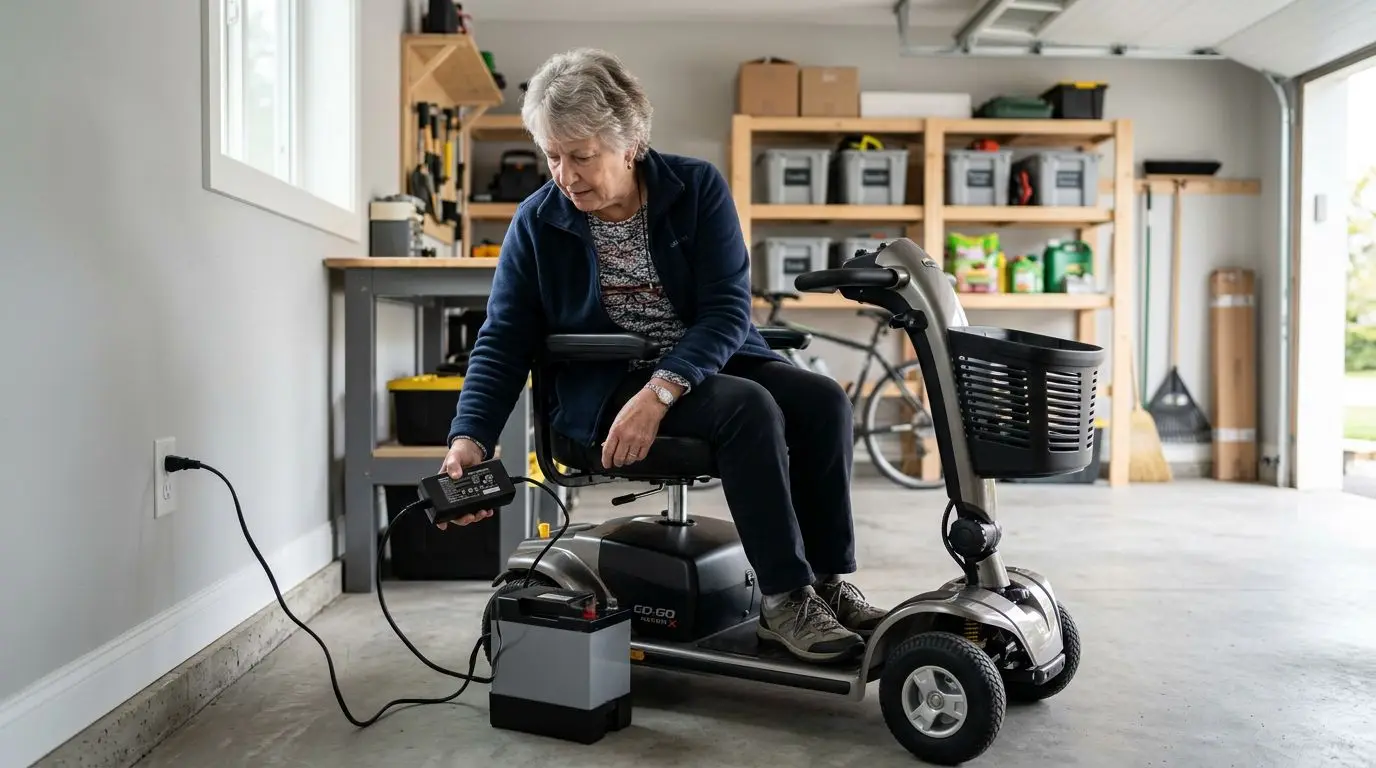
To replace a mobility scooter charger safely, match 4 things: battery voltage, battery chemistry, charger amperage, and plug type. A charger that fits the port is not automatically compatible, so always check the scooter battery label and charger output before plugging it in.
Most mobility scooters use 24V battery systems, while some larger or specialized models may use 36V or 48V systems. The wrong voltage or chemistry charger can damage the batteries, create heat, or keep the scooter from charging at all.
Charger basics: 24V, 36V, and 48V systems
A mobility scooter charger converts household AC power from a wall outlet into DC power the battery pack can accept. In the United States, that usually means the charger takes 120V AC input and sends a controlled DC output to the scooter’s charging port.
The most important number is system voltage. Many scooters use two 12V batteries wired in series, creating a 24V battery pack. A 24V charger is built for that pack, even though its actual output during charging may be higher than 24 volts. That is normal. The label may show an output in the high 20s because the charger must push current into the battery safely.
Some scooters, especially larger outdoor or higher-capacity designs, may use 36V or 48V packs. These need chargers made for that exact system voltage. A 24V charger will not properly charge a 48V pack, and a 48V charger should never be used on a 24V scooter.
| Scooter battery system | Common battery layout | Charger must match | Typical use |
|---|---|---|---|
| 24V | Two 12V batteries in series | 24V charger | Many travel, mid-size, and indoor/outdoor scooters |
| 36V | Three 12V batteries in series or a 36V lithium pack | 36V charger | Some larger or specialty scooters |
| 48V | Four 12V batteries in series or a 48V lithium pack | 48V charger | Some heavy-duty or longer-range scooters |
Voltage is not something to estimate. If the old charger label is missing or unreadable, check the scooter manual, the battery compartment label, or the battery pack label. If those do not agree, stop and have the system checked by a qualified mobility equipment technician.
Battery chemistry matters: SLA, AGM, gel, and lithium chargers
Two scooters can both be 24V and still need different chargers. Battery chemistry is the reason. Mobility scooters commonly use sealed lead-acid batteries, including AGM and gel types, or lithium battery packs. Each chemistry has a preferred charging profile.
Sealed lead-acid batteries are often marked as SLA, AGM, or gel. They are usually rectangular batteries with terminals inside the scooter or inside a removable battery box. A common travel scooter battery pack might contain two 12V sealed lead-acid batteries, often in capacities such as 12Ah, 18Ah, or 22Ah. Larger scooters may use bigger lead-acid batteries, such as 35Ah, 55Ah, or more.
Lithium packs are different. They usually include a battery management system, often called a BMS, that helps control charging and discharging. A lithium scooter charger must be made for the pack’s voltage and lithium chemistry. Do not replace a lithium charger with a lead-acid charger simply because the plug looks the same.
| Battery type | Common label wording | Charger concern | What to verify |
|---|---|---|---|
| Sealed lead-acid | SLA, VRLA, AGM | Needs a lead-acid charging profile | Voltage, amp rating, connector polarity |
| Gel lead-acid | Gel, gel cell | May require a gentler lead-acid profile | Manual or battery label guidance |
| Lithium | Li-ion, lithium-ion, LiFePO4 | Must match lithium pack voltage and chemistry | Battery label, BMS requirements, plug wiring |
If you are unsure which battery type your scooter uses, remove only the cover or battery box according to the owner’s instructions and read the label. Do not open a sealed battery case, cut wires, or bypass the scooter’s charging port.
Amps and charging time: why 2A, 3A, 5A, and 8A matter
Amperage tells you how much charging current the charger can deliver. A 24V 2A charger is slower than a 24V 5A charger, assuming the scooter and batteries can accept the higher current. More amps are not automatically better.
A simple estimate is battery amp-hours divided by charger amps, with extra time added because charging slows near full. For example, a 24V pack made from two 12V 18Ah batteries has an 18Ah capacity at 24V. With a 2A charger, the rough math is 18 divided by 2, or 9 hours, plus time for the final absorption stage. In real life, a full charge may take about 10 to 12 hours.
With a 5A charger, the same pack may charge faster, but only if the scooter’s charging circuit and batteries allow it. Some small travel scooters are designed around lower-output chargers. Using a much higher amp charger can stress wiring, warm the pack, or trip protection circuits.
| Charger output | Typical fit | Charging style | Buyer note |
|---|---|---|---|
| 2A | Small travel scooters and compact packs | Slower, gentle charging | Often suitable for 12Ah to 18Ah packs |
| 3A to 4A | Mid-size scooters | Moderate charging speed | Common for 18Ah to 35Ah packs |
| 5A | Larger battery packs | Faster, if approved | Check scooter manual before upgrading |
| 8A or higher | Large or heavy-duty systems | High-output charging | Use only when specified for the scooter |
The safest replacement is usually the same voltage, same chemistry, same connector, and similar amp rating as the original charger. If you move up from 3A to 5A, confirm that the scooter manufacturer’s charging limit allows it.
Plug types: 3-pin XLR, coaxial barrel, and 2-pin connectors
Mobility scooters do not all use the same charging plug. The connector may be a 3-pin round XLR-style plug, a small coaxial barrel plug, a 2-pin plug, or a scooter-specific connector. Plug shape is only one part of the match.
The 3-pin XLR-style connector is common on many mobility scooters. It has three round pin positions in a circular metal housing. Some scooters use all three pins for positive, negative, and control or sensing functions. Others use only two active pins. Pin wiring can vary, so do not assume every 3-pin charger is wired the same way.
Coaxial barrel plugs look like the round plugs used on many household electronics. They are described by outside diameter and inside diameter, often in millimeters. A small difference, such as 5.5 mm outside diameter with a 2.1 mm center versus a 2.5 mm center, can make a plug loose, tight, or electrically wrong.
Two-pin connectors may look simple, but polarity still matters. Positive and negative must be on the correct pins. Reversed polarity can damage a charger, a battery pack, or the scooter’s charging circuit.
| Connector type | How to recognize it | What to check | Common mistake |
|---|---|---|---|
| 3-pin XLR-style | Round metal plug with 3 pin positions | Pinout and voltage | Assuming all 3-pin plugs are wired alike |
| Coaxial barrel | Small round plug with center hole | Outer size, inner size, center polarity | Using a plug that fits loosely |
| 2-pin connector | Two contacts in a molded plug | Polarity and shape | Forcing a similar-looking plug |
| Dock or battery-box port | Charging jack on removable pack | Pack voltage and approved charger | Charging the pack with the wrong chemistry charger |
Never force a charging plug. A correct connector should seat firmly without twisting, scraping, or pressure. If the port is loose, burned, cracked, or pushed into the scooter body, stop using it until it is repaired.
How to choose a replacement charger in 6 checks
Before buying any replacement charger, gather the details from the old charger label, the scooter label, and the battery label. This takes about 10 minutes and prevents most compatibility problems.
Start with a photo of the old charger’s label if you still have it. Look for output voltage, output amperage, battery type, and polarity. The input line, often 100-240V AC or 120V AC, tells you what wall power the charger accepts. The output line is the one that must match the scooter.
- 1. Confirm system voltage. Match 24V, 36V, or 48V exactly. Do not guess based on scooter size alone.
- 2. Confirm battery chemistry. Lead-acid, gel, AGM, lithium-ion, and LiFePO4 may need different charge profiles.
- 3. Match or safely limit amperage. A similar amp rating to the original charger is usually safest. Higher amps should be used only if approved.
- 4. Match the plug shape. Check 3-pin, barrel, 2-pin, or battery-box style connector.
- 5. Verify polarity and pinout. A plug that fits can still be wired wrong.
- 6. Check safety listings and condition. Use a charger with recognized electrical safety markings, an undamaged cord, and no signs of overheating.
If measuring a barrel plug, use a small ruler or calipers. Measure the outside diameter and the center opening in millimeters if possible. If you do not have calipers, bring the old charger or battery box to a mobility service shop so the connector can be checked without guesswork.
For a 3-pin connector, do not try to test pinout with improvised wires. If the old charger is missing, the scooter manual or a qualified technician is the safest source for the correct wiring.
Safe charging routine: 8 to 12 hours, ventilation, and timing
Many scooter users charge overnight because a depleted pack can take 8 to 12 hours to recharge. That routine can be fine when the charger is correct, the battery is healthy, and the area is safe. The key is to avoid heat, damaged cords, blocked ventilation, and repeated deep discharges.
Place the scooter or battery pack on a hard, dry surface while charging. Keep the charger uncovered, with several inches of open space around it. Chargers normally get warm, but they should not smell hot, melt plastic, discolor the case, or become too hot to touch comfortably.
- Plug the charger into the scooter first, then into the wall outlet, unless your owner’s manual states otherwise.
- Use a standard wall outlet in good condition. Avoid loose outlets and overloaded power strips.
- Keep charging equipment away from rain, sinks, damp garages, and wet floors.
- Do not charge near bedding, paper piles, gasoline, oxygen equipment, or other flammable materials.
- Unplug by holding the plug body, not by pulling the cord.
- Let the battery finish its normal cycle when possible instead of repeatedly charging for only 10 or 15 minutes.
Smart chargers usually change indicator lights during the charge cycle. A common pattern is red or amber while charging and green when full or in maintenance mode. Light colors are not universal, so read the charger label or manual. If a light pattern changes suddenly after months of normal use, it is worth investigating.
For storage, many lead-acid scooter batteries do best when charged at least every few weeks rather than left empty for months. Lithium packs may have different storage recommendations, often including a partial charge range. Follow the battery instructions, especially if the scooter will sit unused for 30 days or longer.
Troubleshooting: 7 common charger problems and what they mean
Charging trouble does not always mean the charger is bad. The issue could be the wall outlet, charging port, battery age, a blown fuse, a loose connector, or a battery pack that has dropped below the charger’s start threshold.
| Symptom | Possible cause | Safe first step |
|---|---|---|
| No charger light | No wall power, bad cord, failed charger | Try a known working outlet and inspect the cord |
| Light stays green immediately | Battery full, no connection, failed battery, open fuse | Check that the plug is fully seated and port is clean |
| Light stays red for over 12 hours | Deeply discharged or aging batteries | Stop if heat or odor appears; have batteries tested |
| Charger clicks on and off | Loose port, intermittent connection, protection circuit | Stop using if the plug wiggles or sparks |
| Scooter runs only a short distance | Weak batteries, undercharging, brake drag, tire issues | Fully charge, then have battery capacity checked |
| Plug or port feels hot | High resistance, loose contact, corrosion | Unplug and arrange service before charging again |
| Burning smell or swelling battery | Serious battery or charger fault | Stop charging immediately and move away from combustibles if safe |
Battery age is a frequent culprit. Many sealed lead-acid scooter batteries last roughly 1 to 3 years depending on use, storage, charging habits, weight load, terrain, and temperature. Some last longer; some fail sooner. A charger cannot restore a battery that has lost capacity from age or sulfation.
Cold weather also affects charging and range. A scooter stored in a 40°F garage may show less range than the same scooter kept at room temperature. Charging very cold or very hot batteries may be restricted by the battery chemistry or BMS, especially with lithium packs.
Who each charger type is best for: travel, mid-size, and heavy-duty scooters
The best charger is not the fastest charger. It is the charger that matches the scooter’s electrical design and the rider’s real routine. Someone who uses a compact scooter for errands twice a week may need a different charging setup than someone who drives a full-size scooter several miles each day.
| Scooter use pattern | Common battery setup | Typical charger range | Best for |
|---|---|---|---|
| Travel scooter used indoors and in stores | 24V pack, often 12Ah to 18Ah | 2A to 3A when approved | Light daily use, easy overnight charging |
| Mid-size scooter for home and neighborhood | 24V pack, often 18Ah to 35Ah | 3A to 5A when approved | Regular errands and moderate outdoor use |
| Larger outdoor scooter | 24V, 36V, or 48V pack with higher Ah capacity | 5A or higher only if specified | Longer rides, heavier loads, more frequent charging |
| Lithium-powered scooter | Lithium pack with BMS | Matched lithium charger only | Users who need lighter packs or specific lithium performance |
If you depend on your scooter every day, consider keeping one compatible charger in a fixed charging spot and another approved charger for travel if your scooter documentation allows it. Label the charger with the scooter voltage and battery type in large print. That small step can prevent a mix-up in a household with more than one mobility device.
When to stop charging and get help within 1 day
Some charging problems should not be watched for another week. If you notice heat, odor, sparking, melted plastic, a swollen battery case, or a charger that repeatedly trips a breaker, stop charging and get help promptly. Same day or next day service is appropriate when there are signs of overheating.
Also get help if the scooter will not power on after a full charge, if the charger light never changes from its initial color, or if the charging port feels loose. These problems can leave a user stranded, and repeated attempts to charge may make an electrical fault worse.
Do not open the charger case. Inside a charger are components that can hold electrical energy even after unplugging. Replacement is usually safer than repair unless the work is performed by a qualified electronics technician using the correct parts and safety procedures.
FAQ: 5 charger compatibility and safety questions
Can I use any 24V charger on a 24V mobility scooter?
No. The charger must also match the battery chemistry, connector type, polarity, pinout, and suitable amp range. A 24V plug-in fit does not prove compatibility.
Is a higher amp charger safe if the voltage is correct?
Only if the scooter and batteries are rated for that charging current. Moving from 2A to 5A without confirmation can create heat or stress the charging circuit.
Why does my charger turn green right away?
The battery may already be full, but it can also mean the charger is not seeing the battery. Check the plug connection, charging port, fuse, and battery condition before assuming the pack is charged.
Should I leave my scooter plugged in all the time?
Many smart chargers switch to a maintenance mode, but storage guidance depends on the charger and battery type. Follow the scooter and battery instructions, and avoid leaving damaged or overheating equipment connected.
Can I charge the battery pack off the scooter?
Yes, if the battery pack is designed with a charging port and you use the correct charger. Do not attach a charger directly to battery terminals unless the manufacturer’s instructions specifically allow it.
A mobility scooter charger is not just a cord. It is part of the scooter’s electrical system. Match voltage, chemistry, amps, plug, and polarity before replacing it, and treat heat or unusual behavior as a warning sign rather than an inconvenience.
Frequently asked questions
Can I use any 24V charger on a 24V mobility scooter? +
No. The charger must also match the battery chemistry, connector type, polarity, pinout, and suitable amp range. A plug that fits is not enough to prove compatibility.
Is a higher amp charger safe if the voltage is correct? +
Only if the scooter and batteries are rated for that charging current. A higher amp charger may charge faster, but it can also create heat or stress the charging circuit if it is not approved.
Why does my charger turn green right away? +
The battery may already be full, but an immediate green light can also mean the charger is not detecting the battery. Check the plug connection, charging port, fuse, and battery condition.
Should I leave my scooter plugged in all the time? +
Many smart chargers have a maintenance mode, but the safest answer depends on the charger and battery type. Follow the scooter and battery instructions, and never leave damaged or overheating equipment plugged in.
Can I charge the battery pack off the scooter? +
Yes, if the battery pack is designed with its own charging port and you use the correct charger. Do not connect a charger directly to battery terminals unless the manufacturer’s instructions specifically allow it.
Related guides
Mobility Scooter Charger Not Working? How to Troubleshoot Charging Problems Safely
15 min read
Mobility Scooter Battery Replacement: How to Match the Right Size, Voltage, and Connector
14 min read
How to Tell If Your Mobility Scooter Battery Is Bad
14 min read