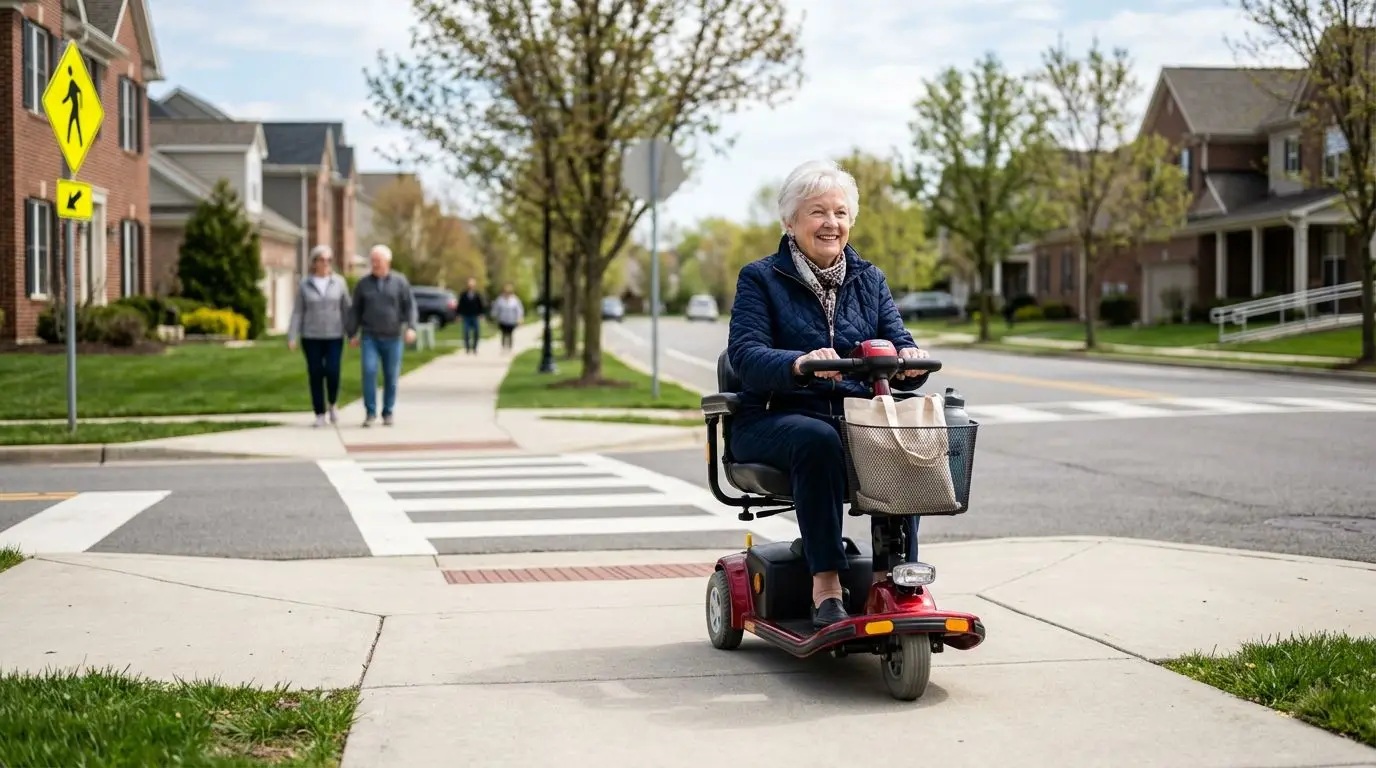
In most US communities, a mobility scooter used by someone with a mobility limitation is treated more like a pedestrian aid than a motor vehicle. That means the safest and most commonly allowed place to ride is the sidewalk, pedestrian path, or crosswalk. Riding in the road is usually limited to brief situations, such as crossing at an intersection, using a road shoulder where no sidewalk exists, or following a specific local rule that permits it. Because traffic laws are set by states, cities, counties, campuses, parks, and transit systems, check your local rules before using a scooter in the street or a bike lane.
The practical answer is simple: use pedestrian space first, travel at walking speed around other people, and treat the road as a last resort. If your route puts you in traffic for even 100 feet, plan it carefully, use visibility gear, and consider whether a different route or transportation option would be safer.
Sidewalk or Road: The 3-Part Rule of Thumb
For daily errands, think in this order: sidewalk, crosswalk, then road only when necessary. Most mobility scooters travel somewhere around 4 to 8 mph, while many pedestrians walk about 3 mph, so the scooter rider needs to slow down in crowded areas.
A mobility scooter is not the same as a car, motorcycle, moped, or recreational stand-up electric scooter. It is designed to help someone with limited walking ability move through public spaces. That distinction matters because many public places treat mobility scooter users as pedestrians, especially on sidewalks, in stores, in medical buildings, at transit stops, and in crosswalks.
Still, there is no single national traffic rule that tells every scooter rider exactly where to ride in every city. The Americans with Disabilities Act, or ADA, affects access to public places and programs, but it does not replace state and local traffic laws. A city may have sidewalk rules, a park may have path rules, and a transit agency may have boarding rules.
| Public space | Typical approach in the US | What to watch for |
|---|---|---|
| Sidewalk | Usually the preferred place for mobility scooter travel | Pedestrians, driveway crossings, uneven slabs, narrow spots under 36 inches |
| Crosswalk | Commonly used like a pedestrian crossing | Turning drivers, short signal timers, curb ramp alignment |
| Road shoulder | Sometimes used when no sidewalk exists | Fast traffic, drainage grates, gravel, poor lighting |
| Traffic lane | Often not appropriate unless local rules specifically allow it or no safer option exists | Speed differences, visibility, lane changes, driver confusion |
| Bike lane | Depends heavily on local law | Bicycles passing at 10 to 20 mph, narrow lanes, debris |
If a sidewalk is usable, it is usually the best choice. If there is no sidewalk, the right answer becomes local and situational. A quiet 25 mph residential street with a wide shoulder is very different from a 45 mph arterial road with no shoulder.
US Law Basics: ADA Access and Local Traffic Rules in 50 States
The United States has 50 states, thousands of local governments, and many public agencies that manage sidewalks, parks, campuses, and transit systems. That is why two towns 20 miles apart may handle mobility scooter road use differently.
At the federal level, the ADA generally protects people with disabilities who use wheelchairs and other powered mobility devices in public accommodations and government services. In plain English, a store, public building, sidewalk program, or public event usually cannot exclude a person simply because they use a mobility scooter, unless there is a legitimate safety or access reason under the law.
Traffic operation is different. Whether you may ride on a roadway, in a bicycle lane, on a multi-use trail, or on a downtown sidewalk can depend on state statutes and local ordinances. Some laws use terms such as “pedestrian,” “personal assistive mobility device,” “electric personal assistive mobility device,” “motorized wheelchair,” or “other power-driven mobility device.” Those words are not always used consistently.
Do not assume that a rule for golf carts, mopeds, e-bikes, or recreational electric scooters applies to your mobility scooter. Those devices may be regulated by speed, motor type, age of operator, licensing, registration, or roadway classification. A medical mobility scooter is usually treated differently, but the exact wording matters.
Where to verify your local rule
- Call your city or county transportation department and ask about mobility scooters on sidewalks, shoulders, and bike lanes.
- Check your state driver handbook for pedestrian and motorized wheelchair language.
- Ask the local police non-emergency number how they handle mobility scooter use where no sidewalk exists.
- For buses, trains, airports, parks, and campuses, check the agency’s accessibility page or call ahead.
- If you live in a homeowners association or senior community, ask for written path and roadway rules.
A 10-minute call can prevent a dangerous misunderstanding. It can also tell you which intersections, trails, or crossings local staff recommend avoiding.
Sidewalk Riding: 36-Inch Clear Width, Pedestrians, and Curb Ramps
A commonly cited ADA minimum for an accessible route is 36 inches of clear width, though real sidewalks may narrow at poles, signs, tree roots, cafe seating, and construction zones. Many mobility scooters can fit through 32- to 36-inch openings, but fitting through a space is not the same as passing safely beside another person.
On the sidewalk, the mobility scooter user should act like a careful pedestrian. Keep right where that is the local custom, slow down before passing, and use a bell or your voice calmly. A simple “Passing on your left” is often enough.
Sidewalk hazards deserve respect. A scooter’s smaller wheels can catch on a raised slab, soft gravel, a curb lip, or a storm drain edge. Even a 1-inch height difference can feel abrupt at the front wheels. Wet leaves, ice, and steep curb ramps can quickly reduce control.
Good sidewalk habits
- Slow to walking speed near doorways, bus stops, schools, and outdoor dining areas.
- Do not assume children, dogs, or distracted pedestrians see you.
- Approach curb ramps straight on when possible, not at a sharp angle.
- Give extra room at driveways; drivers backing out may look for cars before they notice a seated rider.
- Avoid riding with bags hanging from the tiller if they interfere with steering.
Sidewalks are shared space. Even when you have the legal right to be there, courtesy and low speed reduce conflict.
Road Riding: When 25 MPH Streets May Still Be Risky
A scooter that travels 5 or 6 mph is moving much slower than traffic on even a 25 mph residential street. That speed difference is the main reason road riding is risky, even where it may be legally tolerated or necessary for a short stretch.
If there is no sidewalk, look for a safer alternative before entering the road. That may mean using the opposite side where a sidewalk begins, choosing a parallel street, arranging a ride for part of the trip, or crossing once to reach a paved path. A route that is 0.3 miles longer may still be the better choice if it avoids traffic.
When you must use the road or shoulder, follow local pedestrian rules. In many places, pedestrians without sidewalks are expected to travel on the left side facing traffic, but some jurisdictions may treat powered mobility devices differently. The safest position can depend on sight lines, shoulder width, driveways, and curb ramp locations.
Be highly visible. A bright flag, reflective vest, front white light, and rear red light can make a major difference, especially at dawn, dusk, or in rain. Many drivers are not expecting a low-profile mobility scooter in the roadway.
Road-use safety checklist
- Prefer roads posted 25 mph or lower, and avoid multi-lane arterials when possible.
- Use a shoulder or edge of pavement rather than the center of a traffic lane.
- Cross at marked crosswalks or intersections whenever available.
- Do not wear headphones that block traffic sound.
- Never assume a driver has seen you until the vehicle slows or stops.
- Skip the trip if darkness, heavy rain, snow, or poor visibility makes the route unsafe.
Road use should be planned, not improvised. If you feel nervous on a test route, that is useful information.
Right-of-Way at Crosswalks: 2 Rules Riders Should Remember
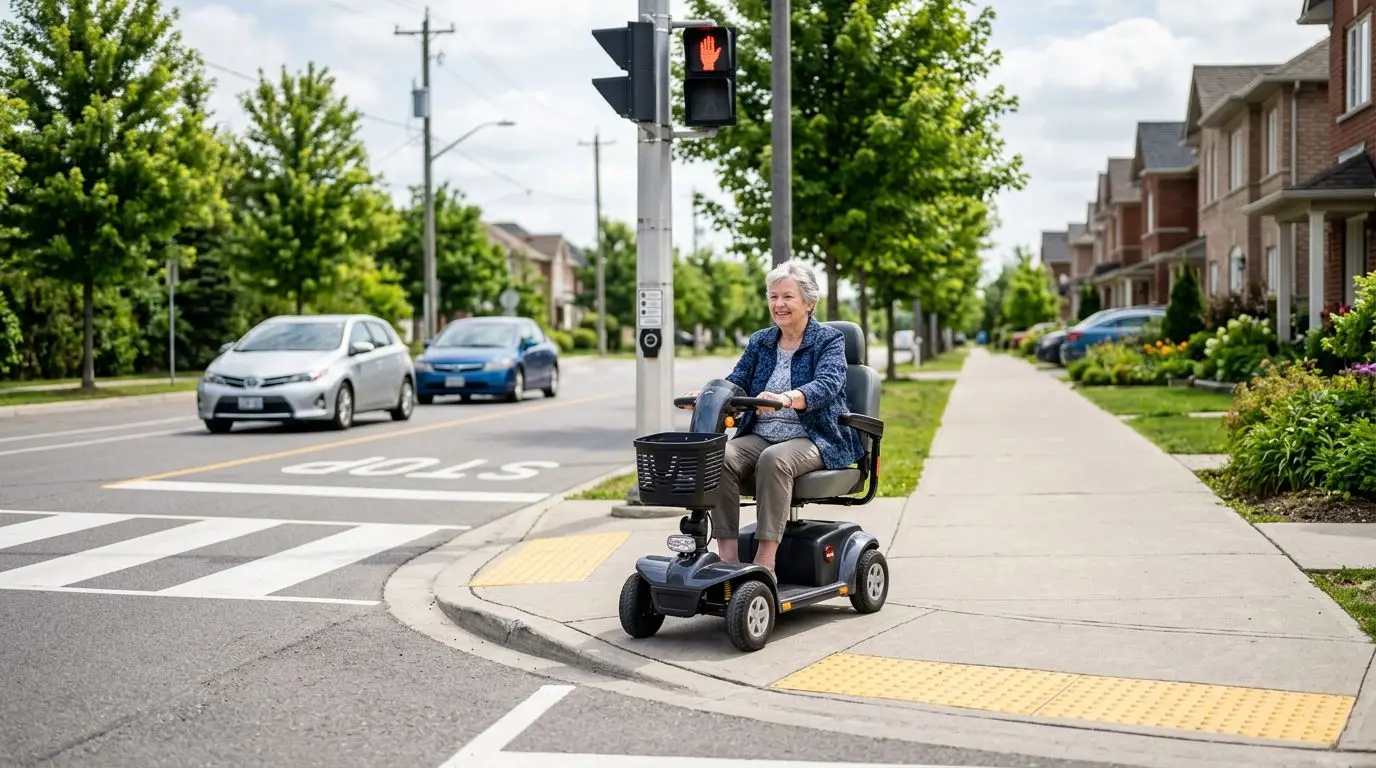
The first rule is that mobility scooter users in crosswalks are generally treated like pedestrians. The second rule is just as important: having the right-of-way does not guarantee that a driver will yield. A 3,000-pound vehicle always wins the physics argument.
Use pedestrian signals when present. If the signal shows “Don’t Walk,” wait. If the walk interval is short, start promptly and continue at a steady, controlled pace. Many signals are timed for walking speeds around 3 to 3.5 feet per second, but local timing varies, and some older crossings feel too short for scooter users navigating curb ramps.
Before entering the crosswalk, look left, right, and left again. Watch for turning drivers, especially those turning right on red or left across the crosswalk. Make eye contact when possible, but do not rely on it; tinted windows and glare can make eye contact impossible.
At driveways and parking lot exits, use the same caution. Drivers often focus on gaps in car traffic and may not notice a scooter approaching from the sidewalk. Slow down before each driveway and be ready to stop within a few feet.
What to do if a crossing feels unsafe
- Use a nearby signalized intersection instead of an unmarked crossing.
- Ask your city about longer pedestrian timing or accessible pedestrian signals.
- Report blocked curb ramps, faded crosswalk markings, or broken pedestrian buttons.
- Choose routes with median islands if you cannot cross a wide road in one signal phase.
Right-of-way is a legal concept. Safety is a practical one. You need both.
Bike Lanes, Trails, Stores, and Transit: 4 Places With Different Rules
A mobility scooter can move through many public spaces, but each setting has its own expectations. A 10-foot-wide multi-use trail is not the same as a 4-foot sidewalk, and a busy grocery aisle is not the same as a bus ramp.
| Place | Usually allowed? | Best practice |
|---|---|---|
| Bike lane | Only if local law or conditions allow | Avoid when bicycle traffic is fast or the lane is narrow |
| Multi-use trail | Often allowed, especially for mobility access | Keep right, pass slowly, and follow posted speed rules |
| Retail store | Generally allowed as a mobility aid | Use low speed and avoid blocking aisles or exits |
| Bus or rail system | Often allowed if the scooter fits lift, ramp, and securement limits | Check size and weight limits before travel |
Bike lanes can be confusing. They look like a protected place away from cars, but they may be used by bicycles moving 12 to 20 mph. Some lanes are also full of glass, gravel, storm drains, or parked-car door zones. Unless your city clearly permits mobility scooters in bike lanes and the lane feels safe, a sidewalk or shared path is usually better.
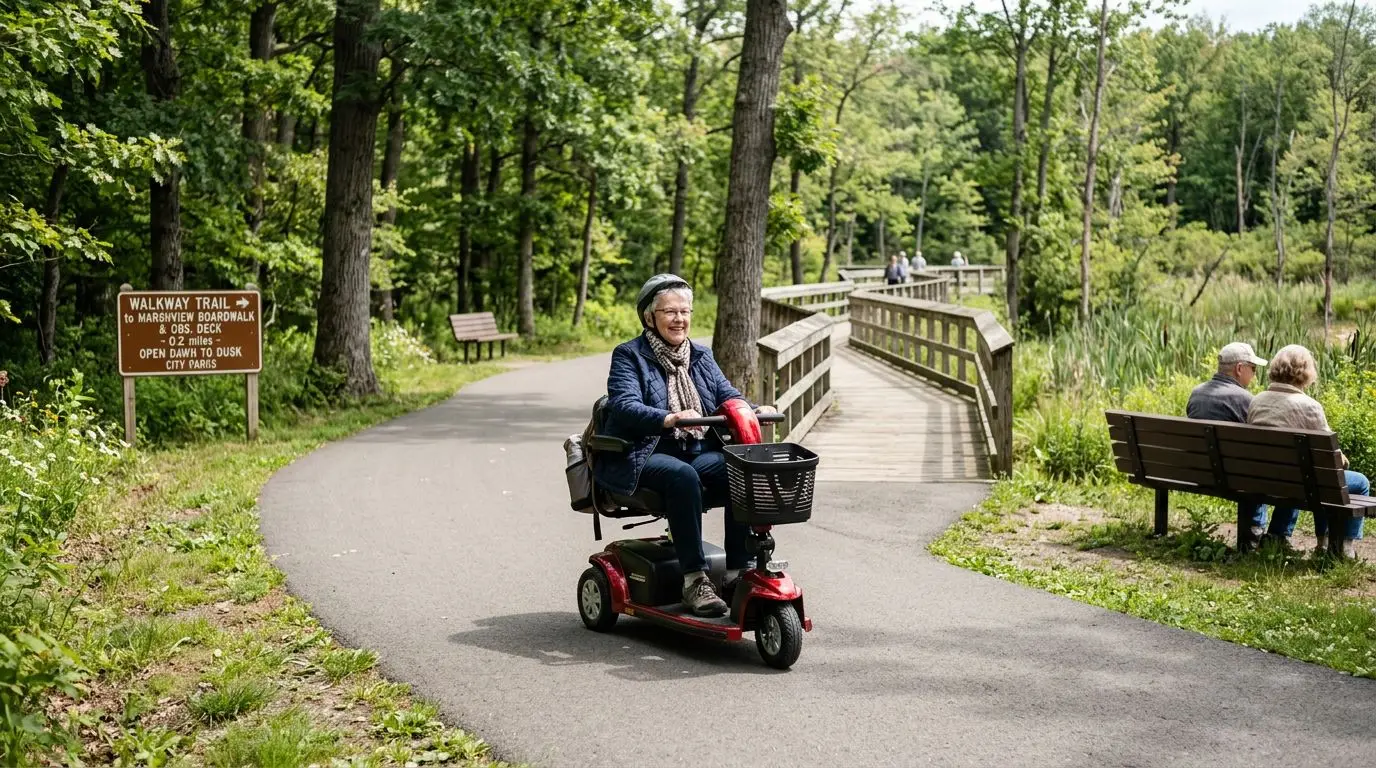
On trails, watch posted rules. Some paths have 10 or 15 mph speed limits, center lines, or separate pedestrian and bicycle sides. Keep your speed modest and announce passes early.
For public transit, size and weight matter. Many bus lifts and ramps are designed around mobility devices, but agencies may publish limits for combined rider-and-device weight, turning ability, braking, and securement. If your scooter is large, call the transit agency before your first trip and ask for travel training if available.
Who It’s Best For: 5 Common Public-Use Scenarios
A mobility scooter in public space is best for people who can operate the controls safely, maintain attention around pedestrians and traffic, and sit upright long enough for the trip. It is not automatically the right tool for every route or every medical condition.
| Scenario | Good fit? | Why it matters |
|---|---|---|
| Sidewalk trip to a nearby store, under 1 mile | Often a good fit | Short distance, predictable route, lower exposure to traffic |
| Downtown errands with curb ramps and signals | Often workable | Requires patience, low speed, and careful crossing habits |
| Suburban road with no sidewalk | Use caution | Shoulders, speed limits, and driver visibility vary widely |
| Rural road with 45 mph traffic | Usually poor fit | High speed difference and limited escape space |
| Transit-connected trip | Can be a good fit | Best when scooter size and agency rules are confirmed in advance |
Public scooter use may be especially helpful for someone who can walk short distances at home but cannot comfortably walk several blocks, stand in long lines, or carry groceries back from a store. It can support independence, but it should fit the route and the rider’s abilities.
If vision, reaction time, memory, dizziness, or medication side effects affect safe operation, talk with a qualified healthcare professional or occupational therapist. That is not about taking independence away. It is about choosing the safest mobility plan.
How to Choose and Measure a Safe Route in 15 Minutes
You can learn a lot about a scooter route in 15 minutes with a phone map, a short walk or drive, and a simple checklist. The goal is to identify narrow points, missing curb ramps, rough pavement, steep slopes, and traffic crossings before you are relying on the scooter.
Start by mapping the shortest route, then map one safer alternative. Look for sidewalks on both sides of the street, marked crosswalks, traffic signals, and driveways. A route with 2 signalized crossings may be safer than one with 1 uncontrolled crossing across a busy road.
Measure these route details
- Sidewalk width: Look for at least 36 inches of clear path, with more room preferred for passing.
- Curb ramps: Confirm there is a ramp at both ends of each crossing, not just one side.
- Surface changes: Note raised slabs, gravel, grass gaps, railroad tracks, and drainage grates.
- Driveways: Count busy entrances, especially gas stations, shopping centers, schools, and parking lots.
- Crossing time: Watch one full signal cycle and see whether the walk phase feels realistic.
- Lighting: Check whether the route is still visible after sunset if you may return late.
If possible, test the route during a quiet time of day before using it for an appointment. Bring a charged phone. Tell someone where you are going on the first trip. Keep the first public ride short, perhaps 10 to 20 minutes, until you know how the scooter handles the route.
Check the scooter too. Tires should be properly inflated if pneumatic, batteries should be charged, brakes should stop smoothly, and the seat should lock in place. A loose basket or dangling bag can become a steering problem at the worst moment.
Safety Gear and Scooter Features: 6 Items That Matter in Public
Public riding is easier when the scooter and rider are visible, predictable, and prepared. Six practical items can make a noticeable difference: lights, reflectors, a flag, a horn or bell, mirrors, and secure storage.
| Feature or item | Why it helps | Useful detail |
|---|---|---|
| Front light | Helps others see you and helps you see pavement changes | White light is easiest for oncoming users to recognize |
| Rear light or reflector | Improves visibility from behind | Red is the standard rear warning color |
| Safety flag | Makes a low scooter more visible near cars and parked vehicles | A flag often rises several feet above seated height |
| Bell or horn | Allows polite warning before passing | Use early, not at the last second |
| Mirror | Helps monitor bicycles, pedestrians, or cars approaching from behind | Still turn your head when safe to confirm |
| Basket or bag | Keeps groceries and personal items stable | Avoid overloading the tiller or blocking controls |
Speed control matters as much as equipment. Use the lowest practical speed in stores, medical offices, apartment hallways, and crowded sidewalks. Save higher speeds for open, smooth paths where you have clear sight lines and enough stopping distance.
Weather changes the risk. Rain can reduce traction and hide potholes. Heat can affect rider stamina. Cold weather can reduce battery performance. If a trip is optional and conditions are poor, waiting an hour may be the safest choice.
5 FAQs About Mobility Scooter Sidewalk and Road Rules
Can I ride a mobility scooter on the sidewalk in the US?
In many places, yes. A mobility scooter used as a mobility aid is commonly allowed on sidewalks and pedestrian routes. You still need to follow local rules, travel at a safe speed, and yield or slow around pedestrians.
Can I ride my mobility scooter in the street if there is no sidewalk?
Sometimes, but it depends on state and local law and the road conditions. If there is no sidewalk, use the safest available shoulder or edge only when necessary, stay highly visible, and avoid high-speed roads whenever possible.
Do mobility scooter users have the right-of-way in crosswalks?
Mobility scooter users in crosswalks are generally treated like pedestrians, so drivers are often required to yield under state law. Still, wait for pedestrian signals, check for turning vehicles, and make sure traffic is stopping before you enter.
Are mobility scooters allowed in bike lanes?
There is no universal US rule. Some localities may allow it, while others may not. Even where it is allowed, bike lanes can be risky because bicycles may pass quickly and the lane may contain debris or drainage grates.
Do I need a license, registration, or insurance for a mobility scooter?
For a mobility scooter used as a mobility aid, a driver’s license, vehicle registration, and motor vehicle insurance are usually not required. Local definitions vary, so check your state or city if your scooter is unusually fast, large, or used mainly on roads.
What speed should I use on sidewalks?
Use walking speed around other people, often about 3 to 4 mph. Slow even more near doorways, curb ramps, driveways, children, pets, and crowded areas.
The Bottom Line: Use Pedestrian Space First and Check 1 Local Source
The safest general rule is to ride a mobility scooter on sidewalks, pedestrian paths, and crosswalks whenever those options are available and usable. Roads and bike lanes require more caution because local laws differ and the speed difference between a scooter and traffic can be dangerous.
Before making a regular trip, check at least 1 local source: your city transportation office, state driver handbook, police non-emergency line, transit agency, park authority, or property manager. Then test the route in daylight, ride at a pedestrian-friendly speed, and make yourself easy to see.
A mobility scooter can be a practical way to reach stores, appointments, parks, and neighbors. The best trips are not just legal. They are planned, visible, courteous, and matched to the rider and the route.
Frequently asked questions
Can I ride a mobility scooter on the sidewalk in the US? +
In many places, yes. A mobility scooter used as a mobility aid is commonly allowed on sidewalks and pedestrian routes. You still need to follow local rules, travel at a safe speed, and slow or yield around pedestrians.
Can I ride my mobility scooter in the street if there is no sidewalk? +
Sometimes, but it depends on state and local law and the road conditions. If no sidewalk exists, use the safest available shoulder or edge only when necessary, stay highly visible, and avoid high-speed roads whenever possible.
Do mobility scooter users have the right-of-way in crosswalks? +
Mobility scooter users in crosswalks are generally treated like pedestrians, so drivers are often required to yield under state law. Still, wait for pedestrian signals, watch for turning vehicles, and confirm traffic is stopping before entering.
Are mobility scooters allowed in bike lanes? +
There is no universal US rule. Some localities may allow it, while others may not. Even where allowed, bike lanes can be risky because bicycles may pass quickly and the lane may contain debris, grates, or parked-car door zones.
Do I need a license, registration, or insurance for a mobility scooter? +
For a mobility scooter used as a mobility aid, a driver’s license, vehicle registration, and motor vehicle insurance are usually not required. Check your state or city if the scooter is unusually fast, large, or used mainly on roads.
What speed should I use on sidewalks? +
Use walking speed around other people, often about 3 to 4 mph. Slow even more near doorways, curb ramps, driveways, children, pets, and crowded areas.
Related guides
Mobility Scooter Rules in Parks, Trails, and Outdoor Public Spaces
13 min read
Mobility Scooter Safety in Crowds: Theme Parks, Events, Airports, and Busy Sidewalks
15 min read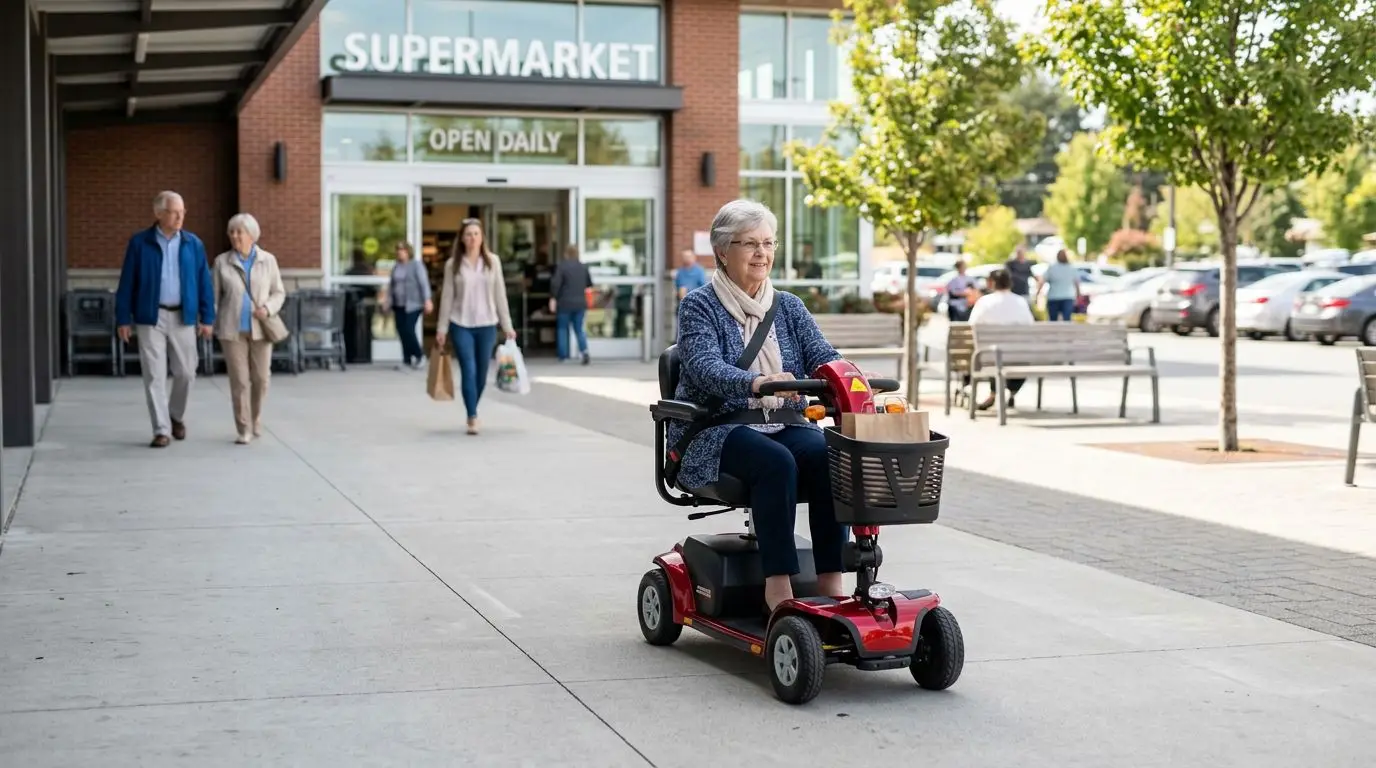
Mobility Scooter Speed and Braking Safety: Choosing the Right Speed for Stores, Sidewalks, and Crowds
12 min read