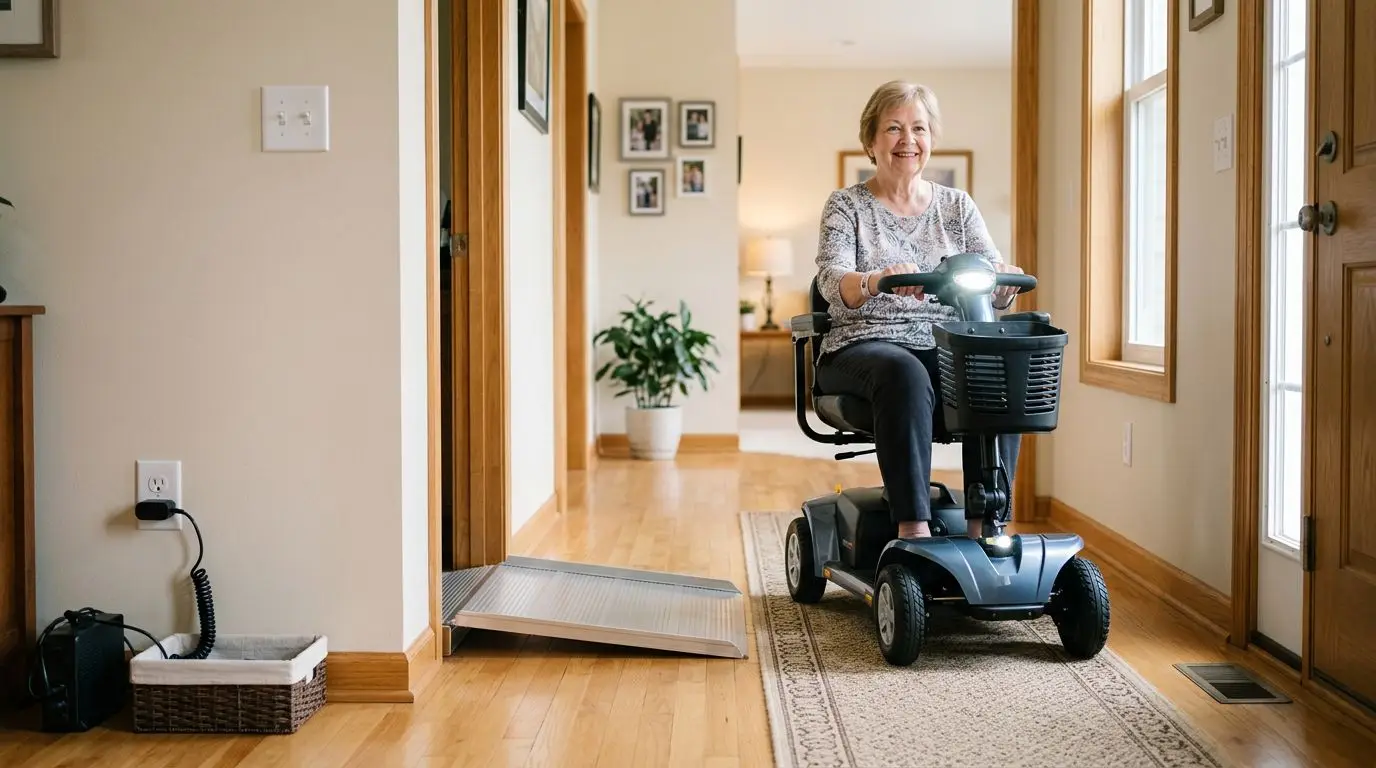
To make a home safer for indoor mobility scooter use, start by measuring the scooter, clearing a predictable travel path, securing or removing trip hazards, and creating a safe charging area. The most common indoor risks are doorframe scrapes, threshold jolts, rug edges, tight turning spaces, and unsafe charging habits. A few simple measurements—door width, turning space, ramp height, and outlet location—can prevent many daily collisions and near misses.
This guide is for people who rely on a scooter inside the home, as well as family caregivers helping with setup. It is brand-neutral and practical: measure first, adjust the home second, and change daily routines only where they truly improve safety.
Start with a 30-minute home safety walk-through
A basic home scooter safety check usually takes about 30 minutes if you move room by room with a tape measure, painter’s tape, and a notepad. The goal is not to remodel the whole house. It is to find the 5 to 10 places where bumps, snags, sharp turns, or charging problems are most likely to happen.
Start at the main entry and follow the exact route used on a normal day: front door to living room, bedroom, bathroom, kitchen, and charging spot. Mark tight areas with painter’s tape. If the scooter clips a doorframe, catches a rug, or requires a three-point turn, write it down while it is fresh.
Many indoor scooters are roughly 21 to 27 inches wide, though measurements vary by type. That width does not include a rider’s elbows, hands on the tiller, baskets, mirrors, oxygen holders, or bags. A doorway that technically fits the scooter may still feel unsafe if there is less than an inch or two of clearance on each side.
Quick inspection checklist
- Measure the scooter at its widest point, including armrests if they are fixed.
- Measure doorways at the narrowest point, not just the trim-to-trim opening.
- Check thresholds higher than 1/2 inch, especially at exterior doors.
- Look for rugs that wrinkle, slide, curl, or sit near a turn.
- Identify turns that need backing up more than once.
- Confirm the charging outlet is not overloaded or blocked by furniture.
Doorways and hallways: aim for at least 2 inches of side clearance
For comfortable indoor scooter use, a doorway should ideally provide at least 2 inches of total clearance beyond the scooter’s widest point, and more is better. For example, if the scooter is 24 inches wide, a 26-inch clear opening may work slowly, while a 28- to 30-inch opening will usually feel easier and less stressful.
Do not rely on the nominal door size. A door called 30 inches wide may have a clear opening closer to 28 or 29 inches once the door thickness, hinges, trim, and stop molding are considered. Open the door fully and measure the narrowest usable space from the face of the open door to the opposite stop.
Hallways need the same attention. A straight hallway that is 36 inches wide may be manageable for many riders, but furniture, laundry baskets, floor vents, pet bowls, and side tables can quickly reduce usable clearance. The safer goal is a consistent route without surprise pinch points.
| Measurement | Why it matters | Practical target |
|---|---|---|
| Scooter width | Sets the minimum door clearance | Measure widest fixed point |
| Clear doorway width | Prevents scraped hands and trim damage | Scooter width plus 2 inches or more |
| Hallway width | Affects steering recovery | About 36 inches clear when possible |
| Approach angle | Angled entries need extra room | Keep 3 feet of straight approach if possible |
Small adjustments can make a major difference. Removing a decorative table beside a doorway may add 4 inches of usable swing space. Reversing a door, removing a door temporarily, or installing offset hinges may help in some homes, but structural changes should be reviewed by a qualified handyman, contractor, or occupational therapist if safety is uncertain.
Thresholds and small level changes: treat 1/2 inch as a warning point
Thresholds are among the most common indoor trouble spots because they combine a bump, a narrow opening, and a steering correction in the same moment. Any raised edge around 1/2 inch or higher deserves attention, especially if the scooter has small front wheels or limited ground clearance.
Approach thresholds straight on whenever possible. Hitting a raised strip at an angle can pull one front wheel up before the other, causing the scooter to twist, scrape, or stop abruptly. Slow speed matters. A scooter should not be used as if it needs momentum to jump a threshold inside the home.
Threshold ramps can help, but they need to match the height, doorway width, and available landing space. A very short ramp on a 1-inch rise may feel steep, while a longer beveled transition can feel smoother. If the threshold is at an exterior door, make sure any ramp solution does not block drainage, weather sealing, or the door’s ability to close securely.
How to measure a threshold
- Place a ruler vertically next to the highest part of the threshold.
- Measure from the lower floor surface to the top edge.
- Measure the depth of the threshold from inside edge to outside edge.
- Check whether both sides are level or if one side has a drop.
- Note the floor surface on each side, such as tile, vinyl, carpet, or concrete.
If the scooter bottoms out, spins a wheel, or jolts the rider every time it crosses a threshold, that is a setup problem—not something to ignore. Repeated jolts can also make a rider less confident, often leading to hesitation in the doorway and more steering corrections.
Rugs, mats, and flooring: keep edges under 1/4 inch and corners flat
Loose rugs are convenient for decorating, but they can be a real hazard around scooter wheels. As a practical rule, rug edges should be low, flat, and secure—ideally under about 1/4 inch at the edge—and any rug that bunches, slides, or curls should be removed from scooter routes.
Small front wheels can catch the edge of a thick rug. Drive wheels can also wrinkle a lightweight mat, especially during a turn. Bathroom mats, kitchen anti-fatigue mats, and entry rugs need special attention because they often sit exactly where a rider is steering, stopping, or crossing a threshold.
Low-pile carpet is often manageable, but deep plush carpet can increase rolling resistance and shorten battery runtime. Transitions from hard flooring to carpet should be smooth and visible. If a strip is loose, sharp, or raised, repair it before it becomes part of a daily route.
| Floor item | Common risk | Safer choice |
|---|---|---|
| Throw rug | Wrinkles under front wheels | Remove from scooter path |
| Entry mat | Catches at threshold | Use a thin, beveled, secured mat |
| Bathroom mat | Slides on tile | Keep outside scooter turning area |
| Deep carpet | More resistance and harder turns | Use clear routes over firmer flooring when available |
| Loose transition strip | Jolt or wheel snag | Repair or replace promptly |
Tape is not always a safe fix. Some tapes leave residue, lose grip, or create a raised edge of their own. If a rug truly needs to stay in place, use a low-profile non-slip pad designed for the flooring surface and check it weekly for movement.
Tight turns: compare turning radius with a 60-inch circle
Indoor scooter safety depends heavily on turning space. Many scooters need a turning radius that can range from roughly 32 inches to over 60 inches depending on size and design, so a 60-inch circle is a useful real-world reference for kitchens, bedrooms, and bathrooms.
Turning radius is the amount of space a scooter needs to make its tightest full turn. A smaller number generally helps indoors, but the rider’s control, speed, seat position, and room layout matter too. A scooter that turns tightly can still be awkward if a bed, dresser, or wall forces the rider to approach at a poor angle.
Use painter’s tape to mark a circle or turning box in the areas where the rider must turn daily. In some homes, a 48-inch open space may be enough for a careful multi-point turn, while a 60-inch open space feels much easier. Bathrooms are often the hardest room because door swings, vanities, toilets, and laundry hampers compete for the same floor area.
Three turning habits that reduce collisions
- Slow before the turn, not halfway through it.
- Keep feet, bags, and clothing inside the scooter footprint.
- Use a planned three-point turn rather than forcing a sharp pivot.
If a route requires backing up, add visual cues. A strip of contrasting tape on the wall, a soft corner guard, or a repositioned chair can help the rider judge distance. Mirrors may help in some layouts, but they should never replace turning the head and checking the path when possible.
Choosing the right scooter setup for indoor safety: 3-wheel, 4-wheel, and compact designs
Indoor safety is easier when the scooter’s size and steering fit the home. A compact scooter with a narrower base and smaller turning radius may work better in a 900-square-foot apartment, while a larger scooter may feel more stable outdoors but harder to manage in a narrow hallway.
There is no single safest scooter type for every home. Three-wheel scooters often turn tighter, which can help indoors. Four-wheel scooters may feel more stable on straight paths and uneven outdoor surfaces, but they commonly need more turning room. Heavy-duty designs can provide higher weight capacity, yet they may be wider, longer, and less forgiving in older homes with narrow doorways.
| Scooter type | Indoor advantage | Indoor tradeoff | Best fit |
|---|---|---|---|
| Compact 3-wheel | Tighter turning in small rooms | May feel less planted on uneven surfaces | Apartments, narrow halls, frequent indoor turns |
| Compact 4-wheel | Balanced feel on straight routes | Usually needs more turning space | Homes with wider halls and open rooms |
| Full-size scooter | More seating room and capacity | Wider frame and larger turning radius | Open floor plans, garage storage, mixed indoor-outdoor use |
| Heavy-duty scooter | Higher capacity and strong drive system | Can be difficult in tight interiors | Large homes with wide entries and reinforced routes |
Look beyond the scooter’s advertised width. Seat width, armrest position, tiller angle, basket depth, anti-tip wheels, and rear shroud shape can affect whether the scooter clears a turn. If possible, test the scooter in the actual home or recreate the tightest doorway and turn with tape before committing to daily indoor use.
Who indoor scooter safety upgrades are best for: 5 common situations
Home safety upgrades are most useful when the scooter is part of daily indoor mobility, not just an occasional outdoor device. If the scooter is used 5 or more days per week inside the home, small setup problems can become repeated hazards.
These changes matter most for people who navigate alone, transfer near beds or toilets, carry items while driving, have pets underfoot, or live in older homes with narrow doors. They also help caregivers by making routes more predictable and reducing the need for last-second assistance.
Best candidates for a home setup review
- Riders who use a scooter between bedroom, bathroom, kitchen, and living area every day.
- Homes with doorways under 30 inches of clear width.
- Homes with two or more raised thresholds on the normal route.
- Riders who have scraped walls, doorframes, or furniture more than once in the past month.
- Anyone charging a scooter in a bedroom, hallway, or cluttered storage area.
A safety review is not a statement that someone is unable to live independently. It is the opposite: a way to make independence more realistic by reducing the small hazards that interrupt normal routines.
How to measure your home: 7 numbers to write down
The best decisions come from measurements, not guesses. Set aside 20 to 30 minutes and write down these 7 numbers before buying accessories, moving furniture, or changing routes.
- Scooter width: Measure the widest point, including fixed armrests or accessories.
- Scooter length: Measure from the front basket or tiller area to the rear edge.
- Turning radius or turning space: Use the manual if available, then verify in the home.
- Clear doorway width: Measure with the door fully open at the narrowest usable point.
- Hallway pinch points: Measure between walls, furniture, vents, and stored items.
- Threshold height: Measure each raised edge in inches.
- Outlet distance from parking spot: Charging cords should reach without crossing a walking path.
Once the numbers are written down, rank fixes by risk. A 1-inch threshold used 10 times a day is usually more urgent than a tight guest room doorway used once a month. A charging cord across a hallway is more urgent than a cosmetic wall scuff.
Charging areas: keep 3 feet of clearance from clutter when possible
A safe charging area should be dry, ventilated, easy to reach, and free of clutter. When possible, keep about 3 feet of clearance from paper, fabric, bedding, curtains, and other combustible items while the scooter is charging.
Use the charger specified for the scooter and battery type. Do not substitute a random charger just because the plug fits. Battery systems differ, and an incorrect charger can damage the battery or create a safety hazard. If the charger, cord, plug, or battery case is cracked, hot, swollen, melted, or smells unusual, stop using it and arrange service.
Avoid running charging cords across walking paths, under rugs, through doorways, or beneath furniture. Extension cords are not ideal for regular charging. If the outlet is too far away, it is safer to move the parking spot or have a qualified electrician install an outlet than to rely on a long cord every night.
| Charging practice | Safer approach | Why it matters |
|---|---|---|
| Charging in a hallway | Use a dedicated corner or alcove | Keeps exits clear |
| Cord across floor | Park within cord length of outlet | Reduces trip risk |
| Covered charger | Leave charger uncovered | Allows heat to dissipate |
| Damaged cord | Stop use until replaced or serviced | Reduces electrical hazard |
| Charging near bedding | Maintain space from fabric when possible | Reduces fire fuel nearby |
Smoke alarms should be present and working in the home. Test them monthly and replace batteries as recommended by the alarm manufacturer. If charging happens in a garage, make sure the area is not near gasoline, paint thinner, oily rags, or other flammable materials.
Daily operation habits: use low speed for the first 10 feet indoors
Home setup matters, but daily habits matter just as much. A simple rule is to start at low speed for the first 10 feet after getting on the scooter, especially near beds, recliners, tables, and doorways.
Keep both hands available for steering when moving through tight areas. Carrying a mug, plate, laundry basket, or phone can affect reaction time and steering control. Use a secure basket or bag only if it does not widen the scooter or block the tiller.
Pets and grandchildren create unpredictable movement. Before driving through a room, pause for a second and make sure the path is clear. Good lighting helps too. A night light that uses less than 1 watt can still make a doorway edge, rug corner, or charging cord easier to see after dark.
Indoor driving habits that help
- Set the speed control low before entering narrow areas.
- Approach doors and thresholds straight whenever possible.
- Stop before adjusting clothing, bags, or oxygen tubing.
- Do not tow carts, chairs, or walkers behind the scooter.
- Park with enough room for a safe transfer, often 24 inches or more beside the seat when possible.
If a rider has a new symptom, recent fall, dizziness, vision change, or medication change that affects alertness, it is wise to speak with a healthcare professional before continuing normal scooter routines. A scooter can support mobility, but it cannot compensate for every medical or environmental risk.
FAQ: 6 home scooter safety questions
What doorway width is best for an indoor mobility scooter?
Measure the scooter first. A doorway should ideally provide at least 2 inches of total clearance beyond the scooter’s widest point, with more clearance preferred for riders who have limited hand strength, vision changes, or tight approach angles.
Are throw rugs safe with a mobility scooter?
Many throw rugs are not safe on scooter routes because they can slide, wrinkle, or catch small front wheels. If a rug edge curls, moves, or sits near a doorway or turn, remove it or replace it with a low-profile secured option.
Can a scooter go over a 1-inch threshold?
Some scooters can handle a 1-inch threshold, but it depends on wheel size, ground clearance, rider weight, approach angle, and surface. Do not force it. Measure the threshold and consider a properly fitted threshold ramp if the scooter jolts or scrapes.
Where should I charge a mobility scooter at home?
Charge in a dry, ventilated, uncluttered area near a suitable outlet. Keep cords out of walking paths, avoid covering the charger, and maintain space from bedding, paper, curtains, and other combustible materials when possible.
Is a 3-wheel or 4-wheel scooter safer indoors?
It depends on the home and rider. A 3-wheel scooter often turns tighter, which helps indoors, while a 4-wheel scooter may feel steadier on straight paths. Measure doorways, turning areas, and thresholds before deciding.
How often should I inspect my home scooter route?
Do a quick route check weekly and a more careful review every 3 to 6 months. Recheck sooner after moving furniture, adding rugs, changing scooters, or noticing new scrapes, bumps, or near misses.
Frequently asked questions
What doorway width is best for an indoor mobility scooter? +
Measure the scooter at its widest point first. A doorway should ideally provide at least 2 inches of total clearance beyond that measurement, and more is better for tight turns or limited steering control.
Are throw rugs safe with a mobility scooter? +
Throw rugs can be risky if they slide, wrinkle, curl, or sit near a turn or threshold. Remove them from scooter routes or use a low-profile secured option that stays flat.
Can a mobility scooter go over a 1-inch threshold? +
Some scooters can, but it depends on wheel size, ground clearance, surface, rider weight, and approach angle. If the scooter jolts, scrapes, or needs speed to cross it, consider a properly fitted threshold ramp.
Where is the safest place to charge a mobility scooter at home? +
Use a dry, ventilated, uncluttered area near a suitable outlet. Keep cords out of walkways, do not cover the charger, and keep the scooter away from bedding, curtains, paper, and other combustible items when possible.
Is a 3-wheel or 4-wheel scooter better for indoor use? +
A 3-wheel scooter often has a tighter turning radius, which can help indoors. A 4-wheel scooter may feel steadier on straight paths but usually needs more turning room. The best choice depends on your doorways, halls, and turning spaces.
How often should I check my home scooter route for hazards? +
Do a quick check weekly and a more detailed review every 3 to 6 months. Recheck sooner after moving furniture, adding rugs, changing scooters, or noticing new scrapes or near misses.
Related guides
Mobility Scooter Safety Guide for Seniors: How to Ride, Turn, Stop, and Park With Confidence
15 min read
3-Wheel vs. 4-Wheel Mobility Scooters: Which Type Is Right for You?
16 min read
How to Drive a Mobility Scooter Safely in Stores, Malls, and Grocery Aisles
13 min read