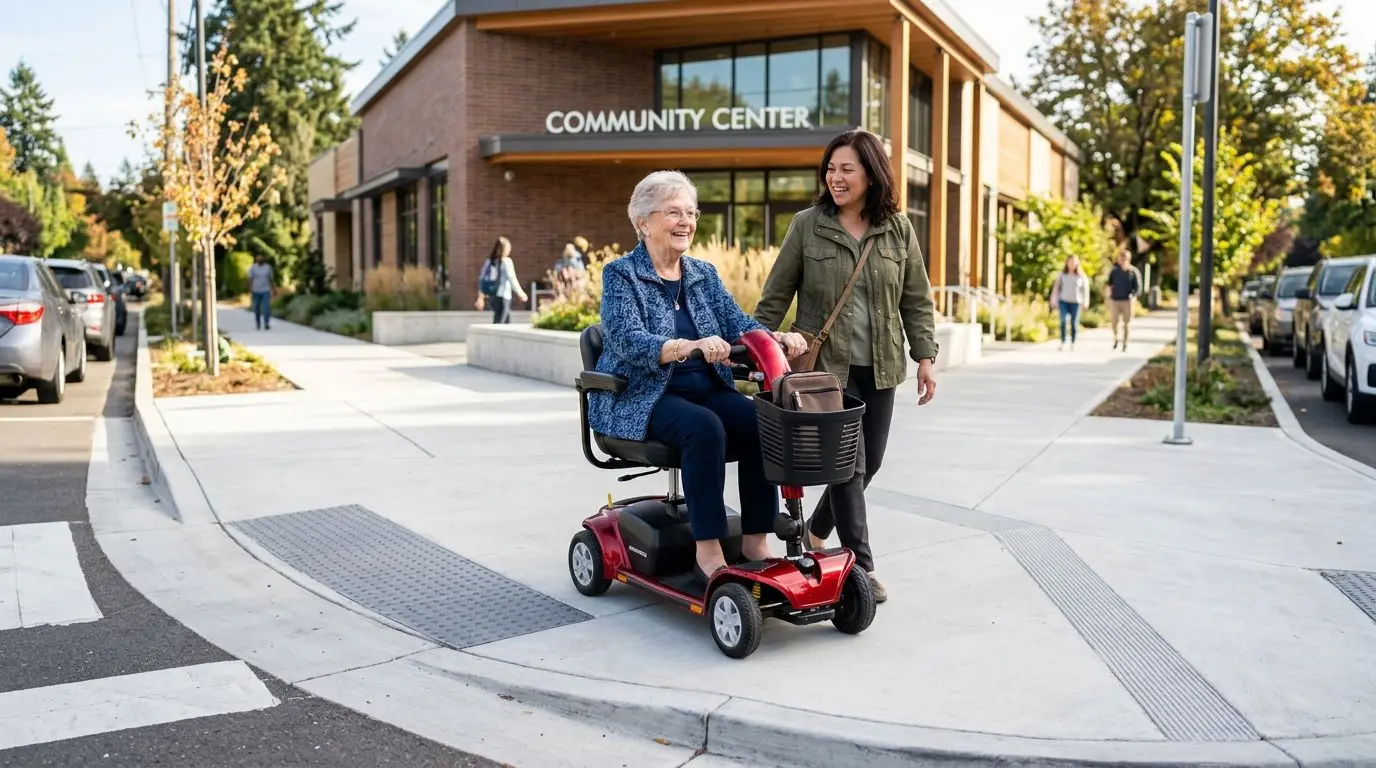
To drive a mobility scooter safely in stores, malls, and grocery aisles, keep your speed low, look 6 to 10 feet ahead, and give pedestrians the right of way. Make wide, slow turns at aisle ends, avoid clipping displays or carts, and come to a full stop before entering checkout lanes, elevators, or crowded intersections.
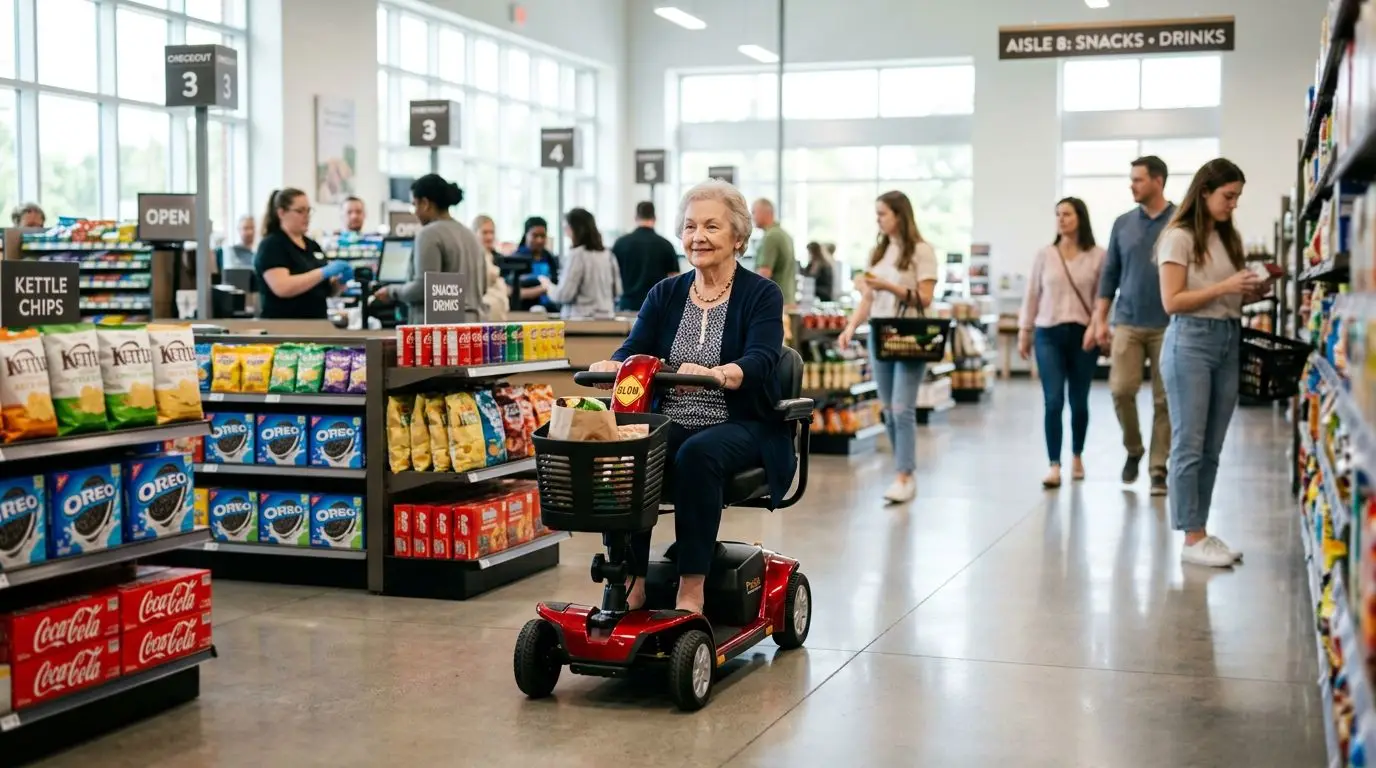
Indoor shopping can be one of the hardest settings for using a scooter because the space changes every few feet. A grocery aisle may be wide enough at the entrance, then suddenly narrow because of a display, a shopper with a cart, or a stock cart parked halfway down. The goal is not simply to get through the store. It is to move predictably, protect your feet and knees, and help other shoppers feel comfortable around you.
Start Before You Enter: A 30-Second Safety Check
Before you roll through the automatic doors, take 30 seconds to check the basics: battery, speed setting, basket load, and clear floor space around you. Many indoor mishaps happen in the first few minutes because the scooter is still set for outdoor travel or the rider is making adjustments while already moving.
Start with the speed control. Set it to the lowest or next-lowest setting before entering a store. If your scooter uses a dial, turn it down. If it uses preset modes, choose the indoor or slow mode if available. You can always increase slightly in an open mall corridor, but grocery aisles and checkout lines call for slow, steady movement.
- Check that your feet are fully on the floorboard.
- Make sure bags, purses, or oxygen tubing are not hanging near the wheels.
- Confirm that the tiller is locked in a comfortable position.
- Test the throttle gently before entering a crowded area.
- Look for wet mats, uneven thresholds, or clutter near the entrance.
If you use a store-provided scooter, take an extra moment to learn its controls. The throttle may respond differently than the one on your personal scooter. Practice one start, one stop, and one small turn in an open area before heading into the aisles.
Use Store-Safe Speed: Usually 1 to 3 mph Indoors
A safe indoor scooter speed is usually close to walking pace, about 1 to 3 mph. That may feel slow, but it gives you enough time to react if a child steps out from behind a display, a shopper backs up with a cart, or an employee crosses the aisle with a pallet jack.
Speed control is not just about top speed. It is also about smooth starts and stops. Squeezing the throttle too firmly can make the scooter lurch, especially in tight spaces. Use light pressure, and release the throttle early when approaching turns, displays, or people.
| Shopping area | Safer speed habit | Why it matters |
|---|---|---|
| Grocery aisles | Lowest setting or slow walking pace | Room may be under 48 inches once carts and displays are present |
| Mall corridors | Slow to moderate only when clear | Pedestrians may change direction without warning |
| Checkout lanes | Crawl speed or stop-and-go | Posts, belts, carts, and feet are close together |
| Entrances and exits | Slow before doors open | Wet mats and oncoming shoppers increase risk |
A good test is this: if you could not stop within 2 to 3 feet, you are probably moving too fast for a crowded store. Keep one hand ready on the control, and avoid coasting through blind spots.
Turning in Grocery Aisles: Use the 36-Inch Rule
Many aisles have enough room for a scooter, but not much extra once carts are involved. A clear path of about 36 inches is a common minimum for accessible routes, but real-world aisles can feel tighter because of end caps, cardboard displays, and shoppers standing sideways.
When turning into an aisle, do not cut the corner. Drive slightly past the aisle opening, slow almost to a stop, turn your front wheel toward the aisle, and enter in a wide arc. This lowers the chance of catching the rear wheel or basket on a shelf edge.
A safer aisle-turn sequence
- Slow down before you reach the aisle, not during the turn.
- Look down the aisle for carts, children, stockers, or floor displays.
- Move slightly wide if space allows.
- Turn the tiller gradually instead of snapping it sharply.
- Watch the rear of the scooter as well as the front.
Three-wheel scooters may turn more tightly, but they can feel less stable if turned sharply at speed. Four-wheel scooters often feel steadier, though they usually need a wider turning path. Either way, the safest turn is slow, deliberate, and predictable.
If an aisle is blocked, avoid squeezing through with less than a few inches on each side. Backing up in a narrow aisle is harder than waiting 10 seconds for another shopper to move.
Pedestrian Awareness: Scan 6 to 10 Feet Ahead
In stores and malls, people rarely move in straight lines. Scan 6 to 10 feet ahead and slightly to both sides, especially near aisle crossings, restrooms, food courts, pharmacy counters, and sale displays. These are common places for someone to step sideways without looking.
Pedestrians may not hear an electric scooter approaching, especially in a noisy grocery store. Do not assume people know you are there. Slow down early, make eye contact when possible, and use a friendly verbal cue if needed.
Helpful phrases include short, calm wording such as: Excuse me, I am just behind you, or Passing slowly on your left. Avoid startling people with a sudden horn unless there is an immediate safety concern. Many scooter horns are louder indoors than riders expect.
| Situation | Safer response | Avoid |
|---|---|---|
| Shopper stops suddenly | Release throttle and stop fully | Swerving into another shopper |
| Child near displays | Slow to a crawl and give extra space | Assuming the child will stay put |
| Busy mall intersection | Pause and make eye contact | Rolling through because you have the path |
| Person using a cane or walker | Wait for a wider passing area | Passing close to their weak side |
Think of yourself as a quiet vehicle in a pedestrian space. The scooter gives you mobility, but the safest riders act more like patient walkers than drivers in traffic.
Displays, End Caps, and Checkout Lanes: Leave at Least 2 Inches of Clearance
Store displays are often the hardest obstacles to judge because they can be low, temporary, and wider at the base than at eye level. Leave at least 2 inches of clearance from shelves, cardboard displays, cart corrals, and checkout posts whenever possible. More is better.
End caps at the ends of aisles need extra attention. They may hold stacked cans, glass jars, or seasonal merchandise that can tumble if bumped. Approach end caps squarely, reduce speed, and make the turn only after you can see the full path.
At checkout
Checkout lanes create a narrow channel with people, carts, bagging stations, and payment terminals. Stop before entering the lane and decide whether your scooter can fit without forcing a turn. Some lanes are easier to use from one direction than the other.
- Keep your basket or front shroud away from the belt edge.
- Pull forward only when the person ahead has cleared the payment area.
- Do not rest bags where they can fall into the controls.
- Ask an employee to scan heavy items from the cart if reaching is unsafe.
- Use wider accessible checkout lanes when available.
If the checkout lane feels too tight, it is reasonable to ask staff for a wider option. You do not need to risk scraping equipment or hitting someone’s ankle just to keep the line moving.
Elevators, Ramps, and Doors: Pause for 5 Seconds
Before entering an elevator, doorway, or ramp, pause for about 5 seconds to check traffic and floor conditions. Indoor ramps may have a gentle slope, but even a 1:12 accessible ramp can feel different when wet shoes, shopping bags, or a crowded doorway are involved.
For elevators, let people exit first. Drive in slowly, and turn only if there is enough floor space. If the elevator is small, it may be safer to back out slowly when you leave instead of attempting a tight turn inside. Keep the speed at the lowest setting and avoid sudden throttle movements.
Automatic doors can create two issues: timing and mats. Wait until the doors are fully open before moving through. Watch for thick entrance mats, curled rug edges, or wet areas from rain and snow. A small front wheel can catch more easily than you might expect.
On ramps, go straight up or down rather than at an angle. Keep both hands steady, maintain a slow speed, and avoid stopping halfway if the ramp is crowded. If you feel uncertain, wait for the path to clear or ask for assistance.
Who It Is Best For: Shoppers Who Need 10 Minutes or More of Support
Using a mobility scooter in a store is best for shoppers who can safely operate the controls but need support for longer trips, often 10 minutes or more of walking or standing. It can help conserve energy and reduce the need to lean on carts, but it is not a substitute for medical care, balance treatment, or supervision when those are needed.
A scooter may be a good fit in stores if you can steer with control, see obstacles at floor and shelf level, understand traffic around you, and stop reliably. It may not be the safest choice if you feel dizzy, cannot keep your feet on the platform, have trouble reacting quickly, or are using medication that affects alertness.
Consider asking for help when:
- You are shopping during peak hours and aisles are crowded.
- You need items from high or low shelves.
- You are carrying fragile, hot, or heavy items.
- The store layout is unfamiliar.
- You feel tired before finishing your trip.
There is no harm in combining tools. Some shoppers use a scooter for the main trip and ask staff for help reaching items. Others bring a companion for checkout or use pickup services on days when symptoms are worse.
How to Choose or Measure a Scooter for Store Use: 35 to 55 Inches Matters
If you are selecting a personal scooter for frequent shopping, pay close attention to turning radius, overall width, and length. Many compact scooters have turning radii in roughly the 35- to 55-inch range, while larger scooters may need more room. A smaller turning radius can make grocery aisles and checkout lanes easier, but stability, comfort, and weight capacity still matter.
Measure your usual shopping environments before deciding what size scooter works best. You do not need a technical survey. A tape measure and a few notes can prevent daily frustration.
What to measure
- Front door or apartment doorway width, often around 32 to 36 inches.
- Vehicle cargo space if you transport the scooter.
- Elevator interior width and depth if you use one regularly.
- Typical grocery aisle width when carts are present.
- Checkout lane width at your favorite stores.
Also consider how the scooter handles at slow speed. A scooter that feels fine outdoors may feel jumpy indoors if the throttle is sensitive. Seat height affects visibility, and armrests can make transfers easier, but they may add width in tight spaces.
| Scooter type | Indoor shopping strengths | Trade-offs to consider |
|---|---|---|
| Travel or compact scooter | Narrower body, easier transport, often better in tight aisles | May have smaller wheels and less legroom |
| Three-wheel scooter | Tighter turning in many indoor spaces | Requires careful slow turns for stability |
| Four-wheel scooter | Often feels steadier on uneven surfaces | Usually needs more turning space |
| Heavy-duty scooter | Higher capacity and larger seating area | May be too wide or long for some checkout lanes |
If possible, test a scooter in a space that resembles a store aisle rather than only in an open showroom or parking lot. Tight turns at low speed tell you more than straight-line driving.
Feature Comparison: 4 Indoor Details That Make Shopping Easier
Four features have an especially noticeable effect indoors: speed control, turning radius, lighting or reflectors, and storage placement. None of these features makes a rider automatically safe, but each can make good habits easier to maintain.
| Feature | Why it helps indoors | What to look for |
|---|---|---|
| Low-speed control | Helps prevent lurching in lines and aisles | Smooth response at the lowest setting |
| Tight turning radius | Makes aisle entries and elevator turns easier | Comfortable turns without tipping or oversteering |
| Clear horn or bell | Useful when someone cannot see you | Audible but not startling when used briefly |
| Secure basket or storage | Keeps items away from controls and wheels | No loose straps near moving parts |
Storage deserves special mention. Do not overload the tiller basket with heavy items that affect steering. Keep bags low and balanced when possible. If the scooter feels harder to steer after loading groceries, stop and rearrange the weight before continuing.
If Something Goes Wrong: Use a 3-Step Reset
If you bump a display, clip a cart, or feel boxed in, use a simple 3-step reset: stop, breathe, and reassess. Staying still for a few seconds is usually safer than trying to fix the problem while moving.
First, release the throttle and let the scooter come to a complete stop. Second, check your hands, feet, and the area around the wheels. Third, decide whether to move forward, back up, or ask someone to clear space. If merchandise fell, do not twist or reach unsafely from the seat. Ask staff for help.
Backing up requires extra caution because pedestrians may not expect it. Look over both shoulders if you can, use the lowest speed, and move only a short distance at a time. If your scooter has a reverse beep, remember that it helps alert others but does not guarantee they will move.
If you feel shaken, park in a safe area and rest. A minor bump can make anyone nervous. It is better to take 2 minutes to reset than to continue tense and distracted.
FAQ: 5 Common Store Scooter Safety Questions
How fast should I drive a mobility scooter inside a store?
Use the lowest practical speed, often about 1 to 3 mph or slow walking pace. In checkout lanes, pharmacy lines, and crowded aisles, move at crawl speed or stop and wait.
Who has the right of way in grocery aisles?
Pedestrians should be treated as having the right of way. Even if you are moving straight down the aisle, slow down or stop for shoppers, children, employees, and anyone using a cane, walker, wheelchair, or cart.
Can I take a mobility scooter through checkout lanes?
Often yes, but only if the lane is wide enough for your scooter and you can enter without scraping posts, belts, or carts. Accessible checkout lanes or staffed assistance may be safer when standard lanes are narrow.
What should I do if an aisle is blocked?
Stop and wait, choose another aisle, or politely ask for space. Do not force your way through a gap that leaves only an inch or two beside displays, carts, or people.
Is a three-wheel or four-wheel scooter better for stores?
Three-wheel scooters often turn more tightly, which can help indoors. Four-wheel scooters may feel steadier for some riders. The better choice depends on your balance, size needs, turning space, and comfort at slow speed.
Frequently asked questions
How fast should I drive a mobility scooter inside a store? +
Use the lowest practical speed, usually slow walking pace or about 1 to 3 mph. Slow to a crawl in checkout lanes, crowded aisles, and entrances.
How do I turn safely in a narrow grocery aisle? +
Slow before the turn, look down the aisle, move slightly wide if space allows, and turn gradually. Avoid cutting the corner because the rear of the scooter can clip shelves or displays.
Should pedestrians have the right of way? +
Yes. Treat pedestrians as having the right of way in stores and malls. Stop or slow early for shoppers, children, employees, carts, and people using mobility aids.
What if a checkout lane is too narrow for my scooter? +
Do not force it. Ask for an accessible lane, employee assistance, or another checkout option. It is safer to wait than to scrape equipment or bump someone.
Is a three-wheel or four-wheel scooter better for shopping? +
Three-wheel scooters often turn more tightly, which can help in stores. Four-wheel scooters may feel steadier. Choose based on turning space, comfort, stability, and your usual shopping layout.
Related guides
Using a Mobility Scooter Safely in Stores, Elevators, Hallways, and Crowded Public Places
14 min read
Mobility Scooter Speed and Braking Safety: Choosing the Right Speed for Stores, Sidewalks, and Crowds
12 min read
How to Choose a Mobility Scooter for Everyday Errands, Stores, and Medical Appointments
15 min read