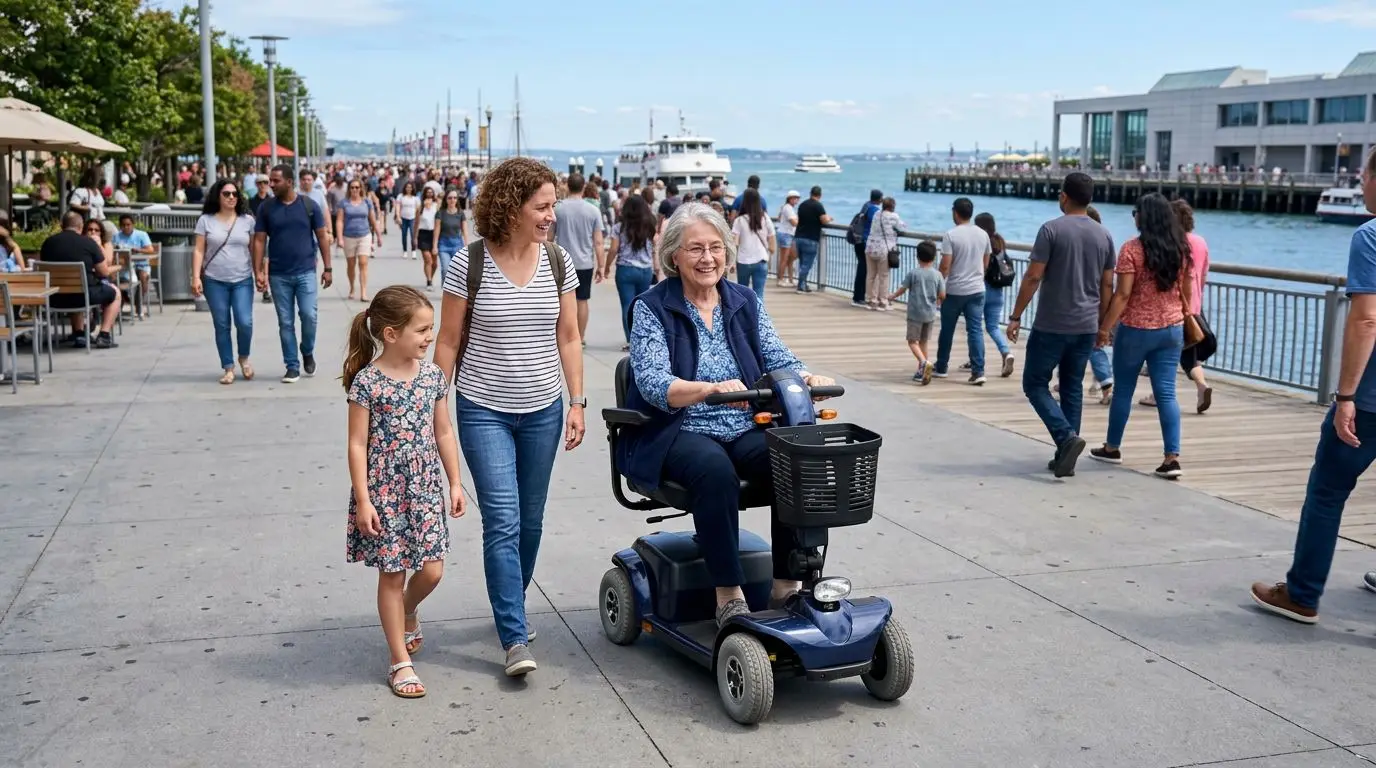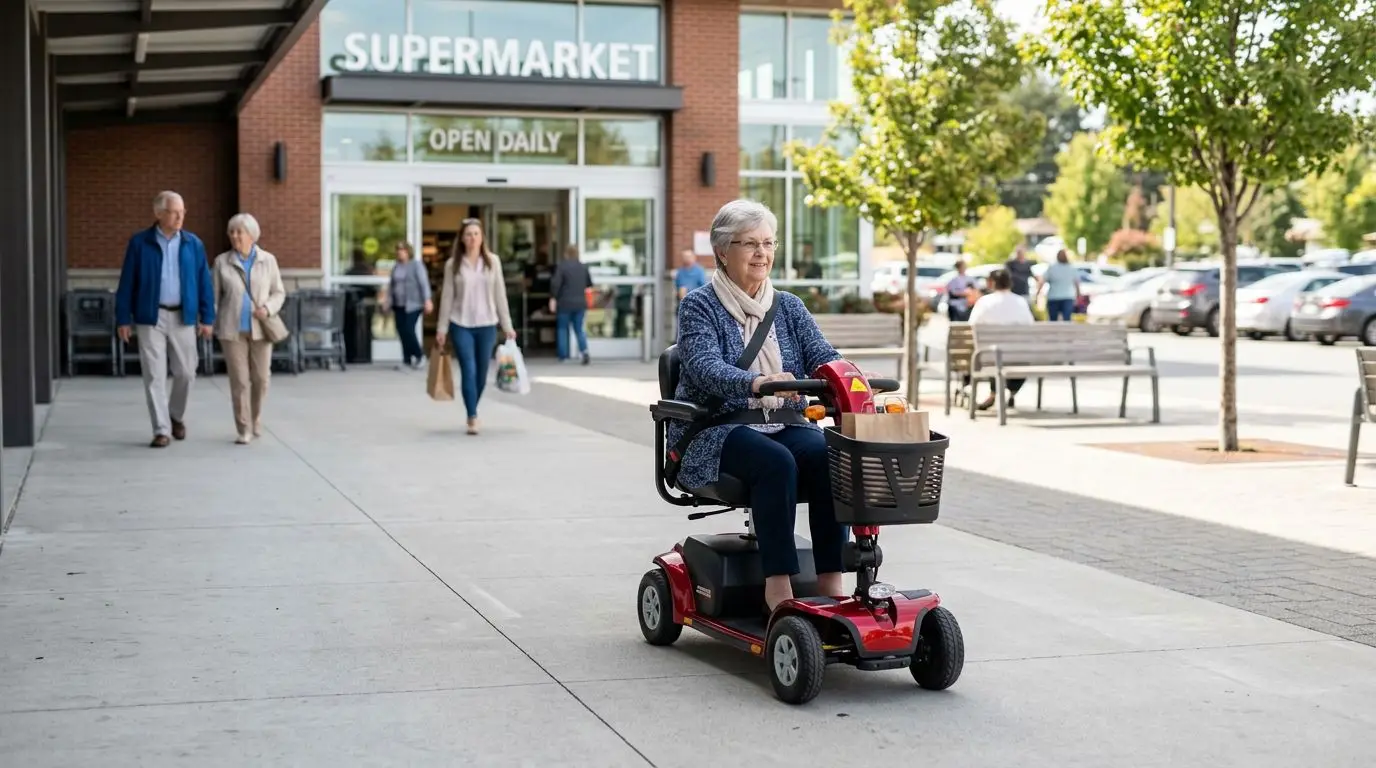
The safest mobility scooter speed is the slowest speed that still lets you stay in full control, stop smoothly, and move with the people around you. In most stores and crowds, that usually means about 1 to 2 mph. On clear sidewalks, many riders feel more comfortable around 2 to 4 mph, depending on space, surface, slope, and visibility.
Speed and braking safety go together. A scooter that feels easy to handle in an empty parking lot can become difficult to stop near a checkout line, doorway, curb ramp, or group of pedestrians. The goal is not to ride as fast as your scooter allows. It is to choose a speed that gives you time to see, react, and stop without startling others.
Recommended speeds: 1 to 5 mph for stores, sidewalks, and crowds
Most mobility scooters are designed for low-speed transportation, often with top speeds in the general range of about 4 to 8 mph. That top speed is not a daily-use target. In public spaces, your safest speed depends on the environment, not the number on the spec sheet.
A simple rule helps: if you would not feel comfortable stopping within a few feet, slow down. Indoors, especially near shelves and corners, even 3 mph can feel fast because people step sideways, carts roll out of aisles, and children may move unpredictably.
Use these general speed ranges as a starting point, then adjust for your scooter, reaction time, surface, and comfort level.
| Environment | Practical speed range | Why it helps |
|---|---|---|
| Grocery aisles and pharmacy aisles | 1 to 2 mph | Gives you time to stop for carts, end caps, and shoppers stepping out of aisles |
| Checkout lines, elevators, and doorways | Under 1 mph or stop-and-go | Reduces bump risk where people are close and space is tight |
| Busy sidewalks | 2 to 3 mph | Keeps you close to pedestrian walking speed |
| Clear, wide sidewalks | 3 to 4 mph | Works when sightlines are open and the surface is even |
| Parking lots and crossings | 2 to 3 mph while scanning | Allows more time to react to vehicles, curbs, and uneven pavement |
| Open outdoor paths | 3 to 5 mph if allowed and safe | May be reasonable when traffic is light and turns are gradual |
Many riders find it safest to turn the speed dial down before entering a store, medical office, apartment lobby, or crowded sidewalk. Do it before you reach the tight space, not after the scooter already feels too quick.
How scooter braking works: plan for 3 seconds, not just inches
Most mobility scooters slow down when you release the throttle lever, and many use an automatic electromagnetic brake that helps hold the scooter in place when stopped. This is different from a bicycle-style hand brake. The scooter may not stop instantly, especially if you are moving downhill, carrying extra weight, or riding on a slick surface.
Think in seconds. A 3-second space gives you time to notice a problem, release the throttle, and let the scooter slow without a hard stop. At only 3 mph, you are moving about 4.4 feet per second. That means a 3-second cushion is roughly 13 feet. Indoors, you may not have 13 feet available, which is why very low speeds matter.
Braking distance is affected by several factors:
- Speed: doubling speed can increase stopping distance more than many riders expect.
- Surface: polished floors, wet pavement, loose gravel, and metal threshold plates can reduce traction.
- Slope: a downhill ramp adds momentum, even at low speed.
- Rider and cargo weight: a loaded basket or oxygen holder can change balance and stopping feel.
- Tire condition: worn tread, low air in pneumatic tires, or hard flat-free tires can affect grip.
Do not count on a last-second stop. Safer scooter control comes from slowing early, releasing the throttle gently, and keeping space around the front wheel.
Who this safety approach is best for: 3 common rider situations
This guidance is useful for nearly every scooter rider, but it is especially important in 3 situations: new riders, riders using a different scooter than usual, and riders visiting crowded public places.
1. New scooter riders
If you are still learning the throttle response, turning radius, and braking feel, use the lowest speed setting in stores and medical buildings. A scooter can move with very little hand pressure, and accidental over-throttling is most likely during the first few trips.
2. Riders who changed scooter type
A compact 3-wheel scooter may turn sharply in a store, while a larger 4-wheel scooter may feel steadier outdoors but need more room to turn. If you switch from one type to another, treat it like a new vehicle for at least the first 2 or 3 outings.
3. Riders in crowded or unpredictable spaces
Farmers markets, stadium concourses, holiday shopping aisles, and school pickup areas can change by the minute. In these spaces, matching walking speed is usually safer than holding a fixed speed. If people are shoulder-to-shoulder, stopping and waiting may be the best choice.
This article is not a substitute for medical or driving advice. If vision, hand strength, reaction time, dizziness, or medication side effects affect safe operation, speak with a qualified clinician or mobility professional before riding in public.
How to choose your speed: measure a 10-foot stopping zone
A practical way to choose a safe speed is to test whether you can stop smoothly within 10 feet on a flat, dry surface. Use an empty hallway, driveway, or quiet parking area. Mark a start point and a stop line with tape, cones, or two small objects that are easy to see.
Begin at the lowest speed setting. Drive toward the stop line, release the throttle at the start point, and see where the scooter actually comes to rest. Repeat the test 3 times. If the scooter rolls farther than expected, reduce speed and practice until stopping feels predictable.
Then repeat the same test with a gentle turn. Many bumps happen while turning into an aisle, lining up with a doorway, or approaching a curb ramp at an angle. You should be able to slow before the turn, turn without leaning hard, and stop without the front wheel drifting into a shelf, wall, or person’s path.
When choosing speed in real life, ask 4 quick questions:
- Can I see at least 10 to 15 feet ahead? If not, slow down.
- Could someone step in front of me within 2 seconds? If yes, ride at walking speed or slower.
- Is the surface wet, sloped, cracked, or shiny? Reduce speed before entering it.
- Do I have enough room to turn without backing up? If not, stop and reposition slowly.
Speed should change often. Safe riders do not use one setting all day. They slow for blind corners, door thresholds, elevator gaps, curb cuts, ramps, and any place where people gather.
Speed settings by environment: 6 practical scenarios
Different places call for different habits. A grocery store at 10 a.m. on a weekday is not the same as a crowded store on the evening before a holiday. The table below gives common US public settings and the control choices that usually reduce collision risk.
| Scenario | Suggested control habit | Safety detail to watch |
|---|---|---|
| Store aisles | Set speed low before entering; keep fingers relaxed on the throttle | Watch for carts backing out and displays at aisle ends |
| Checkout lines | Use stop-and-go movement under 1 mph | Leave space so the foot platform does not touch another person’s heels |
| Automatic doors | Approach slowly and wait for the door to fully open | Thresholds can bump the front wheels or catch small casters |
| Sidewalk with driveways | Travel near walking speed and scan left and right | Cars may cross the sidewalk from driveways and parking lots |
| Curb ramps | Line up straight and slow before the slope | Crossing at an angle can make the scooter feel less stable |
| Elevators | Stop, let people exit, then enter at the lowest setting | Small gaps and sudden crowd movement leave little stopping room |
When space narrows to less than the scooter’s width plus about 12 inches on each side, slow to a crawl. That extra foot of clearance matters because baskets, armrests, and rear wheels are easy to misjudge.
Scooter type comparison: 3-wheel, 4-wheel, compact, and outdoor designs
Scooter type changes how speed feels. A scooter with a tight turning radius can be easier in stores, but it may feel different on uneven sidewalks. A larger outdoor scooter may track well on pavement, yet it can be harder to maneuver in a small shop.
Most scooters fit into broad categories rather than one perfect design. Compare the type with where you ride most often.
| Scooter type | Typical strength | Speed and braking consideration | Best fit |
|---|---|---|---|
| Compact travel scooter | Shorter length and easier transport | Small wheels may feel rough over cracks, thresholds, or gravel | Stores, apartments, short errands, car transport |
| 3-wheel scooter | Tighter turning in narrow aisles | Take turns slowly, especially on slopes or uneven surfaces | Indoor use, shopping, tight hallways |
| 4-wheel scooter | More contact points and a steadier feel for many riders | May need a wider turning path; slow earlier before corners | Sidewalks, mixed indoor/outdoor trips |
| Full-size outdoor scooter | Larger wheels, longer wheelbase, more road presence | Higher top speeds require more stopping distance and more open space | Longer outdoor routes, open paths, uneven pavement |
Match the scooter to your daily environment. If 80 percent of your rides are inside stores and medical buildings, low-speed control and turning space may matter more than top speed. If most rides are on sidewalks with cracks and curb ramps, wheel size, suspension, lighting, and braking feel deserve closer attention.
Braking and control features to compare before you ride: 5 features
You do not need a product catalog to compare safety features. Look at the controls and how they behave at low speed. Five features are especially important in public environments.
| Feature | What to check | Why it matters at 1 to 4 mph |
|---|---|---|
| Speed control dial or buttons | Can you set a clear low-speed range before entering a store? | Prevents accidental high-speed starts in tight spaces |
| Throttle sensitivity | Does the scooter start smoothly with light pressure? | A jerky start can surprise the rider and nearby pedestrians |
| Automatic brake | Does the scooter stop predictably when the throttle is released? | Consistent slowing helps with lines, doors, and elevators |
| Horn or audible alert | Is it easy to reach without looking down? | A gentle alert can be useful, but it does not replace slowing |
| Lighting and reflectors | Are front and rear lights visible in dim areas? | Helps others notice you in garages, dusk, and building entrances |
Also learn where the freewheel lever is. Many scooters have a manual release that allows the scooter to be pushed when power is off. If that lever is left in freewheel mode, the scooter may not drive or brake normally. Check the owner instructions for your scooter type, and never ride until you are sure the brake system is engaged.
Sidewalks, ramps, and slopes: use the 90-degree rule when possible
Sidewalk riding adds variables that stores usually do not have: curb cuts, driveway aprons, tree roots, puddles, and cross slopes. Even a 1-inch pavement lip can feel abrupt on a small-wheel scooter. Slow down before the rough area, not once you are already on it.
When using curb ramps and thresholds, approach as close to 90 degrees as practical. That means the front wheels meet the edge straight on rather than at a sharp angle. A straight approach helps both front wheels climb together and reduces twisting through the frame.
On slopes, avoid sudden turns. If you must turn on a ramp, make it wide and slow. Keep bags low and centered, and do not hang heavy items from the tiller where they can swing or interfere with steering. A small grocery bag may not seem like much, but 5 to 10 lb placed high or off-center can change how the scooter feels during braking.
Wet leaves, snow, ice, sand, and loose gravel deserve extra caution. Mobility scooters are not designed to perform like cars or all-terrain vehicles. If traction looks poor, the safest speed may be zero until the route is clear or another path is available.
Practice routine: 15 minutes before a busy trip
A short practice session can prevent a stressful outing. Set aside 15 minutes in a quiet area before visiting a crowded store, medical campus, event venue, or downtown sidewalk.
Practice these skills in order:
- Start and stop 10 times at the lowest speed setting, aiming for smooth throttle release.
- Make 5 left turns and 5 right turns around a cone, chair, or chalk mark.
- Drive through a doorway-width gap using two boxes or cones placed wider than your scooter.
- Stop before a line from 5 feet away, then from 10 feet away.
- Back up only if needed, and do it at the slowest possible speed while looking behind you.
If any skill feels difficult, reduce speed and repeat it. Confidence should come from predictable control, not from pushing through discomfort. It is also reasonable to choose quieter shopping times, ask a companion to help with doors, or call ahead to ask about accessible entrances.
FAQ: 5 questions about scooter speed and braking
How fast should I drive a mobility scooter inside a store?
Inside most stores, about 1 to 2 mph is a practical range, and checkout lines or crowded aisles may require stop-and-go movement under 1 mph. Set the speed low before entering the store so the scooter does not jump forward unexpectedly.
Is it safe to use the top speed on a sidewalk?
Only use higher speeds when the sidewalk is wide, clear, dry, and legal for scooter use in that area. Around pedestrians, driveways, curb ramps, or blind corners, slow to walking speed, often about 2 to 3 mph.
Why does my scooter keep rolling after I release the throttle?
Many scooters slow electronically and then engage an automatic brake, so they may roll a short distance before fully stopping. Speed, slope, rider weight, tire condition, and surface traction can all affect that distance. If stopping feels abnormal, stop using the scooter and have it checked.
Should I honk when people are walking in front of me?
A horn or bell can be helpful as a polite warning, but it should not replace slowing down. In crowds, reduce speed first, leave space, and use an audible alert only when needed.
What should I do if I feel nervous in crowds?
Turn the speed setting down, pause when people gather close, and choose less busy times when possible. Practicing 10-foot stops and slow turns in a quiet area can also make crowded spaces easier to manage.
Frequently asked questions
How fast should I drive a mobility scooter inside a store? +
Inside most stores, about 1 to 2 mph is a practical range, and checkout lines or crowded aisles may require stop-and-go movement under 1 mph. Set the speed low before entering the store.
Is it safe to use the top speed on a sidewalk? +
Use higher speeds only when the sidewalk is wide, clear, dry, and legal for scooter use in that area. Around pedestrians, driveways, curb ramps, or blind corners, slow to walking speed.
Why does my scooter keep rolling after I release the throttle? +
Many scooters slow electronically and then engage an automatic brake, so they may roll a short distance before fully stopping. Speed, slope, rider weight, tire condition, and surface traction all matter.
Should I honk when people are walking in front of me? +
A horn or audible alert can be useful, but it should not replace slowing down. In crowds, reduce speed first, leave space, and use the alert only when needed.
What should I do if I feel nervous using my scooter in crowds? +
Turn the speed down, pause when people gather close, and choose less busy times when possible. Practice 10-foot stops and slow turns in a quiet area before busy trips.
Related guides
Mobility Scooter Safety Guide for Seniors: How to Ride, Turn, Stop, and Park With Confidence
15 min read
How to Drive a Mobility Scooter Safely in Stores, Malls, and Grocery Aisles
13 min read
Using a Mobility Scooter Safely in Stores, Elevators, Hallways, and Crowded Public Places
14 min read