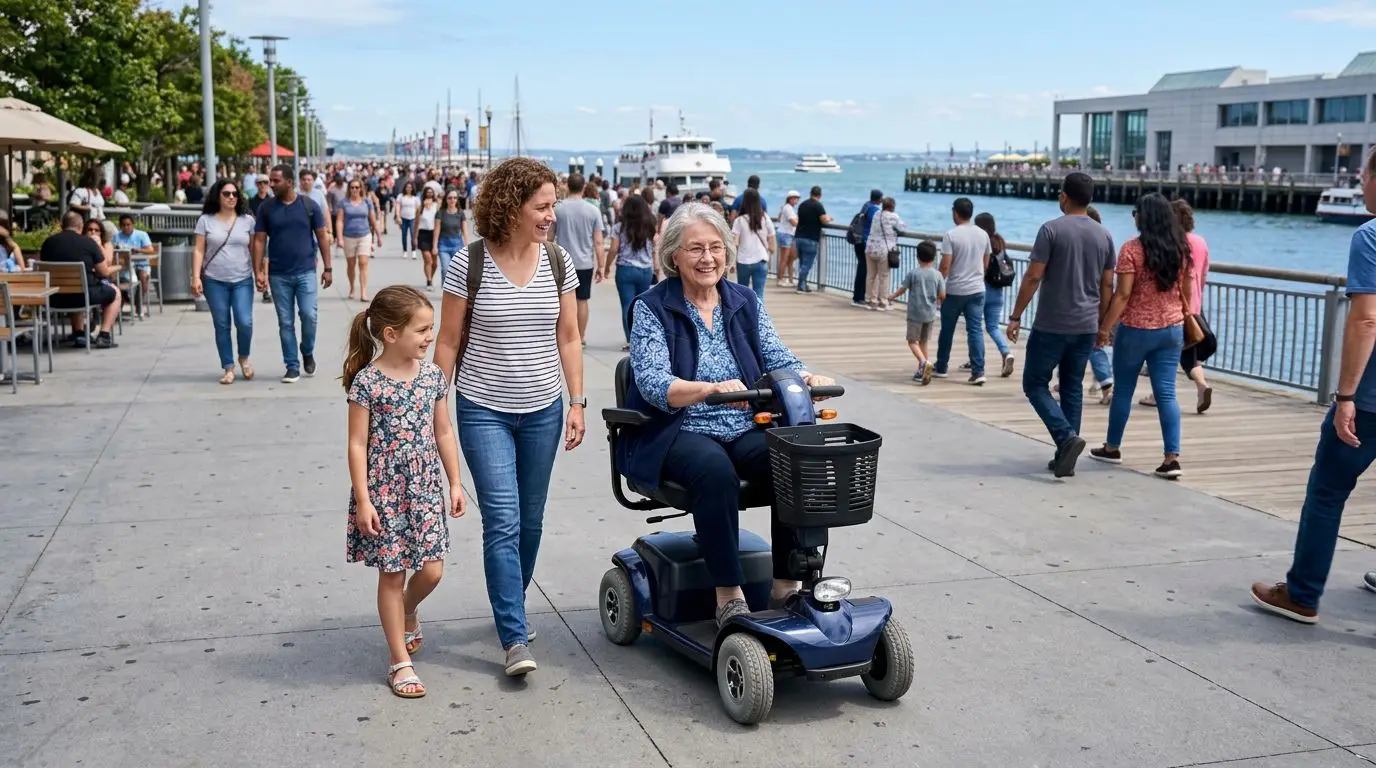
To use a mobility scooter safely in crowds, slow to walking speed, leave extra stopping distance, and move in ways people around you can predict. The safest riders plan their route before entering a busy area, avoid sudden turns, and treat every doorway, queue, curb cut, and crosswalk as a possible conflict point. In places like theme parks, airports, concerts, stadiums, and downtown sidewalks, good scooter safety is less about speed and more about space, visibility, and patience.
Crowded U.S. public places can be manageable on a scooter, but they call for a different mindset than riding through an open parking lot or a quiet store aisle. People stop without warning, children move unpredictably, travelers pull rolling bags, and crowds often tighten near gates, restrooms, food lines, elevators, and exits. This guide explains how to prepare, ride, and communicate so you can protect your safety and the safety of others without giving up independence.
Why Crowds Change Scooter Safety at 3–4 mph
Most mobility scooters can move faster than a person walking, but riding in a crowd should usually stay near walking pace, about 3 to 4 mph or slower. That small number matters. At low speed, you have more time to stop, steer around a dropped bag, or react when someone steps backward into your path.
A mobility scooter is longer and heavier than a person standing still. Many full-size scooters weigh well over 100 lb before the rider is seated, while compact travel scooters are often lighter but still take up more space than a pedestrian. Even at slow speed, a bump can startle someone, bruise a shin, or cause a fall. That is why crowded environments call for defensive riding.
The main safety challenges are straightforward. You need room to turn, room to stop, and room for others to notice you. In a crowd, all three are often limited at once.
| Crowd hazard | Common example | Safer response |
|---|---|---|
| Sudden stops | People pause for photos or directions | Leave at least a few feet of space and keep fingers ready on the brake or throttle release |
| Cross traffic | Guests exit a ride queue or store | Slow before openings, corners, and doorways |
| Low visibility | Crowds block your view of children or luggage | Use lights when available and ride at walking speed |
| Tight turns | Restroom entrances, elevators, restaurant aisles | Make wider, slower turns and avoid clipping ankles or fixtures |
Who This Guide Is Best For: 4 Common Trips
This guide is for scooter users and caregivers who expect heavy pedestrian traffic during real outings, not just quiet indoor errands. Four common examples are a family visit to a theme park, an airport trip, a concert or festival, and a downtown sidewalk route with restaurants, curb ramps, and crosswalks.
It is especially useful if you can drive your scooter independently but feel uneasy around unpredictable crowds. It also helps first-time renters at attractions, older adults using a scooter after surgery or illness, and caregivers who walk alongside a scooter user in busy places.
It is not a substitute for personal medical advice, training, or venue-specific rules. If you have vision changes, slowed reaction time, dizziness, new medication effects, or difficulty operating the controls, speak with a qualified clinician or mobility professional before using a scooter in a dense public setting.
Who benefits most
- People who can steer, brake, and adjust speed consistently for at least 30 minutes at a time.
- Visitors who need seated mobility for long-distance attractions, large terminals, or all-day events.
- Caregivers helping with route planning, elevator access, or crowd navigation.
- Travelers who want to avoid last-minute stress at security checkpoints, boarding areas, or venue entrances.
Choose the Right Scooter Setup Before a 2-Hour Outing
A two-hour crowded outing can reveal scooter problems that do not show up during a short ride at home. Before you go, consider scooter size, battery range, turning ability, seat comfort, lighting, and how well the controls fit your hands. The right setup is the one you can control smoothly at low speed, not the one with the highest top speed.
Compact scooters are often easier in elevators, shuttle areas, and narrow store aisles. Larger scooters may feel more stable outdoors and handle longer distances better, but they can be harder to maneuver through switchback lines, tight food courts, and crowded sidewalks. Three-wheel scooters often turn in less space, while four-wheel scooters may feel steadier on uneven outdoor surfaces. Neither type is automatically safer in every crowd.
| Scooter type | Possible crowd advantage | Possible crowd drawback | Best fit |
|---|---|---|---|
| Compact travel scooter | Easier to maneuver in tight areas and transport | May have smaller wheels and less outdoor comfort | Airports, indoor venues, smooth sidewalks |
| 3-wheel scooter | Typically tighter turning radius | May feel less planted to some riders on uneven surfaces | Queues, stores, elevators, narrow paths |
| 4-wheel scooter | Often feels more stable on outdoor routes | Usually needs more turning space | Parks, event grounds, longer paved routes |
| Heavy-duty scooter | Higher weight capacity and stronger outdoor performance | Larger footprint in crowds and tighter spaces | Long outdoor distances where space allows |
Before a major outing, test the scooter in a controlled area. Practice starting without lurching, stopping within a few feet, making a slow U-turn, backing up, and holding a straight line at very low speed. If the scooter has a speed dial or indoor mode, set it low before entering the crowd instead of trying to adjust it once you are surrounded.
How to Measure for Crowds: Width, Turning Space, and 36-Inch Paths
Measure the scooter before you depend on it in a crowded place. The most useful numbers are overall width, total length, turning radius, ground clearance, seat height, and the rider’s comfortable reach to the controls. A common accessible route benchmark in many U.S. settings is 36 inches of clear width, but real-world crowd flow can make even a wide path feel narrow.
Use a tape measure at home. Measure the widest point of the scooter, often the armrests or rear wheels. Then measure the full length from the front basket or tiller area to the rear anti-tip wheels, if present. A scooter that is only a few inches wider can be noticeably harder to position in elevators, ride queues, security lanes, and restroom approaches.
Quick measuring checklist
- Overall width: Compare it with doorways, shuttle lifts, hotel room entries, and narrow indoor aisles.
- Total length: Think about elevator depth, ride queues, and waiting areas where people stand close behind you.
- Turning radius: Practice turning in a driveway or empty room using cones or boxes set several feet apart.
- Seat and armrest fit: Make sure you can sit upright and reach controls without leaning forward.
- Battery plan: Know your expected range, then allow a cushion for detours, ramps, and stop-and-go riding.
If you are renting a scooter at a venue, ask for the approximate width, weight capacity, battery range, and whether the controls can be slowed down. Do this before arrival if possible. It takes only a few minutes and can prevent a long day with equipment that feels awkward in crowds.
Safe Riding Habits in Crowds: 10 Practical Rules
Good crowd riding depends on repeatable habits. These 10 rules are simple, but they make a real difference when people are moving in every direction.
- Ride at walking speed. In dense areas, assume 3 mph is fast enough.
- Keep a cushion. Leave space in front whenever possible, even if people step into it.
- Look 10 to 20 feet ahead. Watch for openings, strollers, service animals, rolling luggage, and children.
- Slow before corners. Doorways and blind turns are common conflict points.
- Use gentle starts. A sudden launch can surprise nearby pedestrians.
- Avoid weaving. Choose a line and move predictably.
- Make eye contact. If a person sees you, they are less likely to step directly in front of you.
- Use a clear voice. Say excuse me or coming through on your left in a calm tone.
- Stop when unsure. It is safer to pause than to force a tight gap.
- Park out of the flow. Do not block curb ramps, doorways, emergency exits, or queue entrances.
Horns and bells can help, but they should not replace slowing down. A short alert is reasonable when someone is about to back into you. Repeated horn use in a crowd can create confusion or irritation, and it may not be heard in a noisy venue.
Watch your hands, too. Keep bags, jackets, and souvenirs away from the throttle and tiller. A dangling strap can interfere with control. If you need to check a phone or map, stop in a safe spot first.
Theme Parks and Large Events: Plan Around 30-Minute Surges
At theme parks, stadiums, fairs, and festivals, crowds often surge in predictable 30-minute windows: right after opening, before shows, after fireworks, at meal times, and when a major event ends. Planning around those waves can make scooter use safer and less stressful.
Start by reviewing the venue’s accessibility information before arrival. Look for entrance procedures, accessible parking or drop-off zones, rental rules, queue policies, companion restroom locations, charging guidance, and emergency information. Policies vary by venue, and staff instructions should be followed even when an area looks open.
Large attractions often have narrow choke points: security screening, ticket gates, bridge crossings, ride entrances, gift shops, food pickup counters, and transportation stops. Slow down before each one. If you are with family or friends, ask one person to walk slightly ahead and help identify the clearest path, but do not let them pull you into a gap that feels too tight.
Safer event strategies
- Arrive early enough to avoid rushing through entry screening.
- Choose meeting spots away from exits, restrooms, and food lines.
- Take breaks before fatigue affects reaction time.
- Use the lowest comfortable speed setting in shops, queues, and indoor exhibits.
- After a show or fireworks, wait 10 to 15 minutes if the exit path is packed.
Parking matters, even when you are not leaving the scooter. If you transfer to a seat at a show or attraction, park only where staff direct you. A scooter left in the wrong place can block evacuation routes or create a trip hazard in dim lighting.
Airports and Transit Hubs: Allow 45–60 Extra Minutes
Airports combine long distances, tight lines, elevators, moving walkways, escalator alternatives, security checkpoints, and travelers distracted by flight times. If you are using your own scooter, allowing 45 to 60 extra minutes is a practical buffer, especially during holidays or early morning departures.
Before flying, contact the airline and review its mobility device procedures. You may need to provide battery type information, dimensions, and instructions for disconnecting power or placing the scooter in freewheel mode. Battery rules can differ depending on whether the battery is sealed, spillable, non-spillable, or lithium-based. Do not guess. Confirm before travel.
At the airport, keep speed low near check-in counters, security lanes, boarding gates, and baggage claim. Rolling suitcases can swing into your path with no warning. Children may sit on the floor near outlets. Lines can shift sideways when an agent opens a new lane.
Airport crowd checklist
- Label the scooter with your name and phone number.
- Bring written instructions for folding, braking, freewheel mode, and battery access if applicable.
- Remove loose baskets, cup holders, or personal items before gate-check or transport.
- Ask for help early if you need assistance through security or to the gate.
- Use elevators instead of escalators, and wait for an emptier elevator if needed.
Use caution on jet bridges and ramps. Surfaces may slope, and the space can be narrow. If staff ask you to transfer to an aisle chair or airport wheelchair, take your time and ask questions before moving. A safe transfer is more important than a quick one.
Busy Sidewalks and Downtown Areas: Watch the 3-Foot Zone
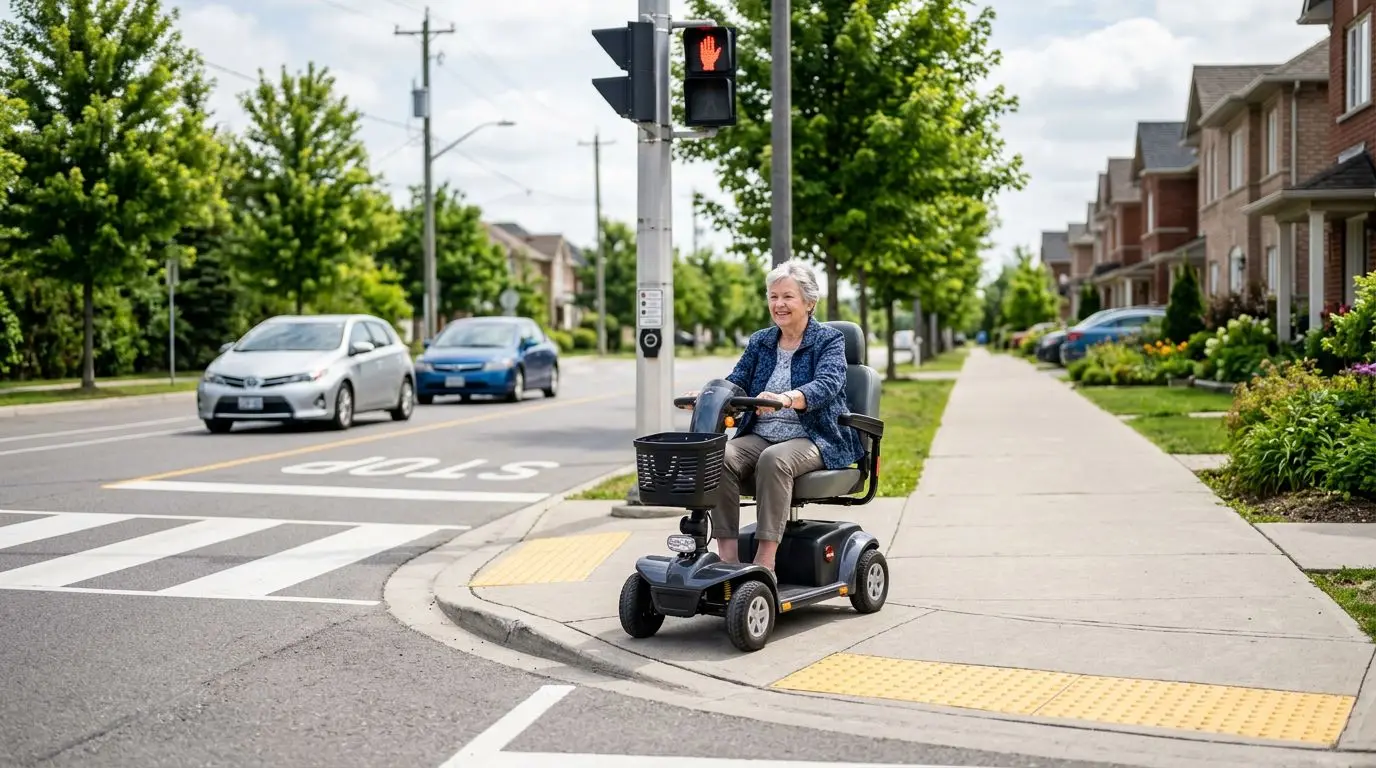
On busy sidewalks, the most important safety space is often the 3-foot zone directly in front of and beside your scooter. That is where pedestrians cut across, dogs wander, car doors open near curbside dining, and delivery workers step out from storefronts.
Sidewalks add hazards that controlled venues may not have. Expect uneven pavement, curb ramps, driveway crossings, outdoor seating, signboards, trash cans, construction barriers, puddles, and cyclists or e-scooters in places where they should not be. A mobility scooter can handle many paved sidewalk routes, but small wheels may catch on sharp lips or broken pavement. Slow before transitions.
At crosswalks, position yourself where drivers can see you. Wait for the walk signal when present, and do not assume a turning driver has noticed your scooter. If a curb ramp is crowded, pause before descending. Rolling into a blocked ramp can leave you stuck in the street or angled awkwardly at the curb.
Sidewalk habits that reduce risk
- Use lights or reflectors in low light, rain, parking garages, and shaded areas.
- Pass pedestrians only when you have clear room to do so.
- Avoid riding too close to storefront doors that may swing open.
- Approach curb cuts straight on rather than at a sharp angle when possible.
- Do not carry oversized bags where they widen the scooter or block your view.
If the sidewalk is blocked, do not automatically move into the street. Look for a safer alternate route, ask nearby staff for an accessible entrance, or wait until the path clears. Street riding can expose scooter users to vehicles, drainage grates, and faster traffic, and local rules vary.
Communication and Courtesy in a 6-Foot Shared Space
A scooter user and nearby pedestrians often share the same 6 feet of space, especially in lines, elevators, and narrow hallways. Clear communication prevents many problems. Most people are willing to make room when they understand what you need.
Use short, polite phrases. Try: Excuse me, may I pass on your left? Or: I am going to stop here for a moment. If someone is blocking a curb ramp or elevator door, ask calmly rather than crowding them with the scooter. Courtesy works both ways, and it also helps protect you if a tense situation develops.
When riding with companions, agree on roles before entering the crowd. One person can navigate, one can carry bags, and one can stay near the scooter user without walking directly in front of the wheels. Companions should avoid grabbing the tiller unless the rider asks for help or there is an immediate safety issue.
Elevators deserve special care. Let people exit first, enter slowly, and turn only if there is enough room. If the elevator is packed, wait for the next one. Saving 2 minutes is not worth scraping doors, bumping ankles, or getting trapped at an awkward angle.
Emergency Planning: 3 Items to Keep Within Reach
In a crowd, small problems get bigger when you cannot reach what you need. Keep three items within easy reach: a charged phone, essential medical or emergency contact information, and any scooter-specific key or battery information needed by staff or a caregiver.
Do not overload the tiller, basket, or armrests. Heavy bags can affect steering and make the scooter wider. If you need to carry medical supplies, water, a jacket, or event items, pack them so they do not touch the controls or dangle near the wheels.
Plan for battery and fatigue. Stop-and-go riding, ramps, rider weight, cold weather, and rough surfaces can reduce practical range. If the battery indicator drops faster than expected, turn back early or ask staff about safe waiting areas. Avoid waiting until the scooter is nearly dead in the middle of a crowd.
If the scooter stops moving, turn on lights or hazard flashers if available, set the brake, and ask for help moving out of the main path. Do not let strangers push the scooter unless you understand how freewheel mode works and can do so safely. A scooter in freewheel can roll unexpectedly on a slope.
FAQ: 5 Crowd-Safety Questions
Can I take a mobility scooter into a theme park or major attraction?
Many U.S. attractions allow mobility scooters, but each venue sets its own procedures for rentals, queues, parking, transfers, charging, and restricted areas. Check the venue’s accessibility page before your visit and follow staff directions on site.
How fast should I drive a scooter in a crowd?
Use walking speed or slower, commonly around 3 mph in dense pedestrian areas. If you are near children, lines, doorways, food counters, elevators, or security checkpoints, slow down even more and be ready to stop.
Is a 3-wheel or 4-wheel scooter safer in crowds?
It depends on the setting and the rider. A 3-wheel scooter may turn more tightly in queues and indoor areas, while a 4-wheel scooter may feel steadier outdoors. The safer choice is the one you can control smoothly at low speed in the space available.
What should I do if people keep stepping in front of my scooter?
Slow down, increase following distance, and use calm verbal cues such as excuse me or passing on your left. Avoid tailgating or using the horn repeatedly. In very dense areas, stop and wait for a safer opening.
Can I use a mobility scooter at an airport?
Yes, many travelers use mobility scooters at airports, but you should contact the airline ahead of time. Be ready to provide battery type, scooter dimensions, and handling instructions, and allow extra time for check-in, security, and boarding.
Frequently asked questions
Can I take a mobility scooter into a theme park or major attraction? +
Many U.S. attractions allow mobility scooters, but rules vary for rentals, queues, parking, transfers, charging, and restricted areas. Check the venue’s accessibility information before you go and follow staff directions on site.
How fast should I drive a mobility scooter in a crowd? +
Use walking speed or slower, often around 3 mph in dense pedestrian areas. Slow further near children, doorways, elevators, security lines, food counters, and crosswalks.
Is a 3-wheel or 4-wheel scooter better for crowded places? +
A 3-wheel scooter may be easier to turn in tight indoor spaces, while a 4-wheel scooter may feel steadier outdoors. The better choice is the one you can control smoothly at low speed in the spaces you expect to use.
What should I do if people keep stepping in front of my scooter? +
Slow down, leave more space, and use calm verbal cues such as excuse me or passing on your left. If the crowd is too dense, stop and wait for a safer opening instead of forcing your way through.
Can I use my mobility scooter at an airport? +
Yes, many travelers use mobility scooters at airports, but you should contact the airline ahead of time. Be ready to provide battery type, dimensions, and handling instructions, and allow extra time for check-in, security, and boarding.
Related guides

Using a Mobility Scooter Safely in Stores, Elevators, Hallways, and Crowded Public Places
14 min read
Can You Bring a Mobility Scooter to Theme Parks, Stadiums, Museums, and Other Venues?
16 min read
Mobility Scooter Speed and Braking Safety: Choosing the Right Speed for Stores, Sidewalks, and Crowds
12 min read