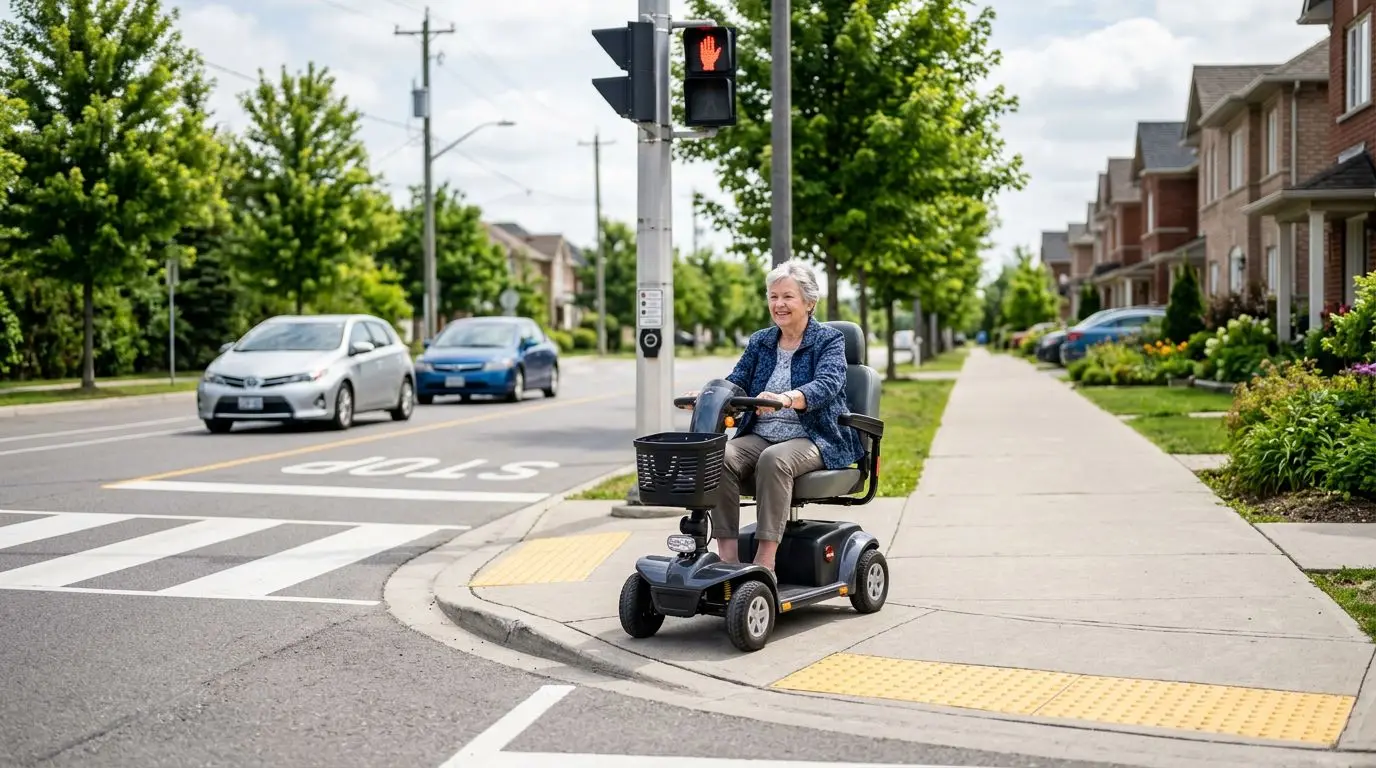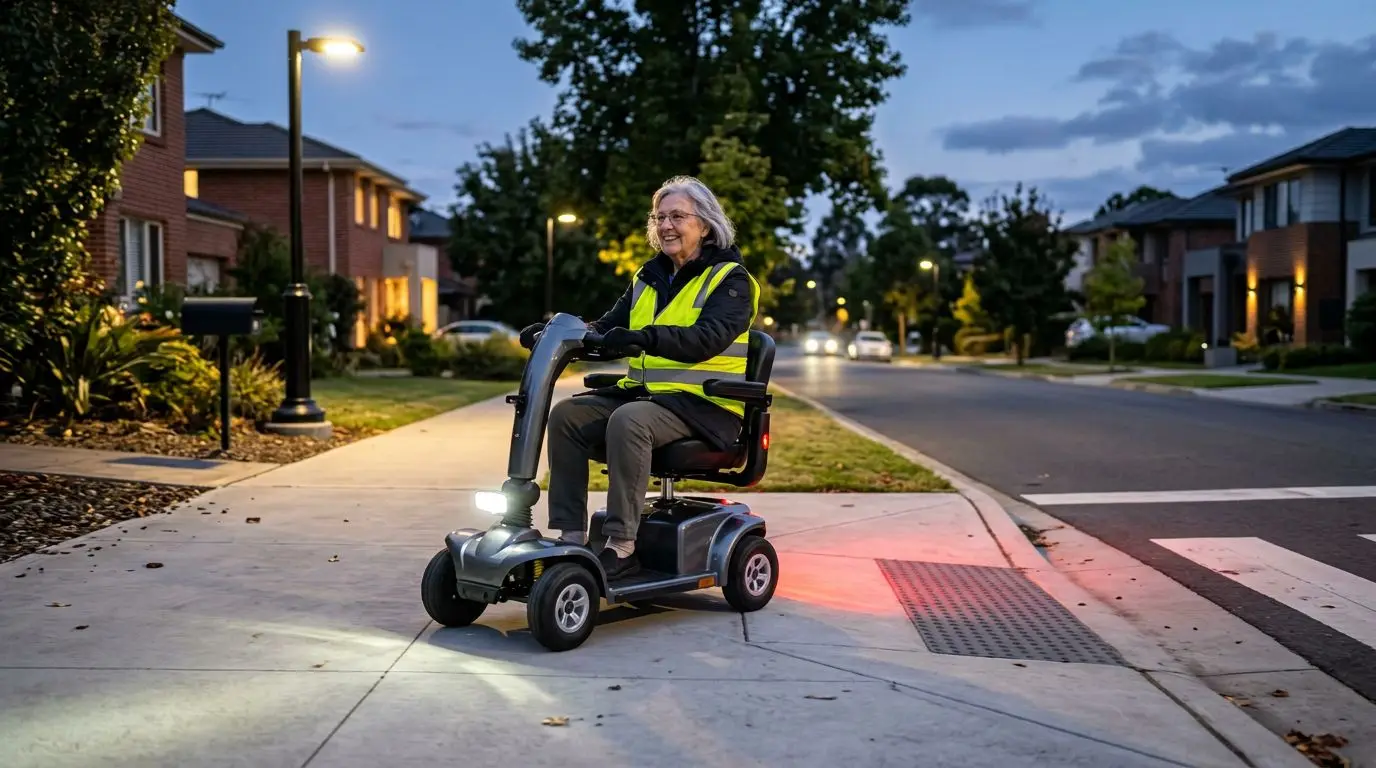
Nighttime mobility scooter safety comes down to one main goal: make yourself easy to see from the front, rear, and sides before a driver, cyclist, or pedestrian gets too close. Use a bright white front light, a red rear light, reflective materials, and a route with good lighting, smooth surfaces, and predictable crossings.
If you ride near dusk or after dark, plan the trip before you leave and watch for low-visibility hazards such as unlit curb cuts, wet leaves, potholes, and poorly marked driveways. A few minutes of preparation can make a short evening ride calmer, safer, and easier to manage.
Why visibility matters most in the first 30 minutes after sunset
Dusk can be harder than full darkness because eyes are adjusting and contrast is poor. A gray scooter, dark jacket, and shaded sidewalk can blend into the background just as drivers are turning on headlights and watching traffic signals.
Many mobility scooters travel around 4 to 8 mph, depending on the class, setting, and surface. That may feel slow, but it still leaves very little time to react if someone does not see you at a driveway, parking lot entrance, or crosswalk. A car turning across a sidewalk can cover the distance from a driveway apron to the street in seconds.
Nighttime safety is not only about the rider seeing the road. It is also about being seen by others from multiple angles. A front light helps you spot cracks and curb ramps, while side reflectors and bright clothing help a driver notice you when you cross in front of them.
Think in 3 directions: front, rear, and side. If any one of those is weak, you have a blind spot in your visibility plan.
Lights and reflectors: the 3-zone visibility setup
A practical scooter visibility setup covers 3 zones: a white light facing forward, a red light or reflector facing backward, and reflective material visible from both sides. Together, these help other road and sidewalk users understand your direction of travel.
A front light should be mounted where it shines ahead without pointing directly into the eyes of oncoming pedestrians. On many scooters, that means aiming the beam slightly downward so it lights the path 10 to 20 feet ahead. If the light is too low, baskets, bags, or your knees may block it. If it is too high, it can glare.
The rear zone should be clearly red. Red is widely recognized as the back of a moving vehicle or device. A steady red rear light is easy to identify, while a flashing mode may attract attention in some environments. Use judgment: a slow flash can help in a parking lot, but a very bright strobe may be uncomfortable or distracting around pedestrians.
Side visibility is often the missing piece. A scooter can be nearly invisible from the side if it has only front and rear lights. Amber side reflectors, reflective tape on the frame, reflective wheel accents, or a light-colored bag can help someone notice the scooter when it crosses a driveway or intersection.
| Visibility zone | Best safety purpose | Practical setup |
|---|---|---|
| Front | Helps you see hazards and helps others see you approaching | White light aimed about 10 to 20 feet ahead |
| Rear | Shows your direction of travel from behind | Red light or red reflector mounted at the back |
| Sides | Makes you more visible at crossings and driveways | Amber reflectors or reflective strips on both sides |
| Body level | Adds visibility above parked cars or low landscaping | Reflective vest, sash, jacket, or bright upper clothing |
Before adding accessories, check your scooter manual for safe attachment points. Do not cover vents, block controls, interfere with folding parts, or add anything near moving wheels.
Reflective clothing and markings for 360-degree visibility
Reflective material works best when it creates a visible outline from all sides. A small reflector on the rear is useful, but it does little if a driver approaches from the side. Aim for 360-degree visibility by placing reflective elements on your upper body, scooter sides, and rear storage area.
Upper-body reflectivity is especially helpful because it sits higher than the scooter deck. A reflective vest, sash, jacket trim, or shoulder strap may be easier to see over low shrubs, parked cars, and sidewalk furniture. Bright colors help in daylight and dusk, while reflective materials shine back when headlights hit them after dark.
On the scooter itself, reflective tape can work well on the tiller, rear panel, armrests, and side shrouds if the surface is clean and dry. Use short, neat strips rather than covering large areas that may peel or collect dirt. Even 2 strips on each side can make the scooter easier to recognize in profile.
Pay attention to bags and baskets. A dark rear basket or black under-seat pouch can hide a rear reflector. If you carry groceries or a cane holder, make sure they do not block lights. A reflector that is covered for half the ride is not doing its job.
| Visibility item | Strength | Limit to remember |
|---|---|---|
| Reflective vest or sash | High placement and visible body outline | Must be worn every time, not left in storage |
| Reflective tape | Low-cost way to add side and rear visibility | Adhesive may fail on dirty, curved, or textured surfaces |
| Battery lights | Active visibility even without headlights shining on you | Batteries or charging must be checked regularly |
| Bright clothing | Helpful at dusk and in parking lots | Not a replacement for reflective material after dark |
How to choose lights in 5 practical steps
Choosing scooter lights is easier when you focus on placement, run time, controls, weather resistance, and mounting. You do not need complicated gear. You need equipment you can operate comfortably on every ride.
First, choose a front light that illuminates the surface ahead without washing out your view. If your scooter already has a built-in headlight, check whether it is bright enough on the darkest part of your usual route. Some built-in lights are designed mainly to make the scooter noticeable, not to light a cracked sidewalk.
Second, confirm the rear light can be seen from behind when you are seated. If a seatback bag or oxygen carrier blocks it, move the light to a visible location using a safe mount. Never attach wiring where it can catch on the seat swivel, tiller adjustment, or wheels.
Third, consider run time. If your normal evening trip is 30 minutes, a light should last well beyond that, not just barely cover the ride. A practical rule is to start with enough charge for at least twice your expected trip time. For a 30-minute outing, plan for 60 minutes of dependable light.
Fourth, look for controls you can use with your hands, gloves, or limited dexterity. Tiny buttons can be frustrating in cold weather. A simple on-off control may be safer than multiple modes if mode switching is confusing.
Fifth, think about rain and splashes. Many riders do not plan to ride in bad weather, but wet pavement and light drizzle happen. Lights and mounts should stay secure over bumps and curb ramps.
- Check that front and rear lights are visible from at least the direction they are meant to cover.
- Aim the front light down enough to reduce glare.
- Keep spare batteries or a charging routine if using add-on lights.
- Use red only at the rear and white only at the front to avoid confusing others.
- Test everything while seated, not just while standing next to the scooter.
How to measure your visibility in 10 minutes before a night ride
A quick visibility check can be done in about 10 minutes with a helper, a driveway, or a quiet parking area. The goal is to see your scooter the way others see it, not the way it looks from the seat.
Start at dusk if possible. Turn on your lights and sit on the scooter in your normal riding position with your usual bag, jacket, basket, and accessories. Ask a helper to stand about 25 feet in front, 25 feet behind, and 25 feet to each side. If you do not have a helper, park safely and walk around the scooter yourself after setting the brake and turning it off.
Check for blocked lights. A coat hanging from the seat, a backpack, or a full basket can hide reflectors. Turn the tiller left and right to see whether the front light remains useful when steering. Look at the scooter from a low angle too, since drivers in smaller cars may see you from below your shoulder height.
Next, do a short roll test in a safe, private area. Move 10 to 15 feet forward and stop. Make sure any added lights do not shake loose and that reflective tape does not interfere with turning, braking, folding, or the seat swivel.
Use this simple scoring method: front visible, rear visible, left side visible, right side visible, body visible. Give yourself 1 point for each clear yes. A score of 5 out of 5 is the target for evening rides. If you score 3 or lower, fix visibility before riding after dark.
Route planning: choose paths with at least 4 safer features
A good nighttime route is usually not the shortest route. It is the route with fewer surprises. Before you leave, look for at least 4 safer features: lighting, smooth surfaces, curb cuts, low traffic conflict, and familiar crossings.
Streetlights matter, but consistency matters more. A route with one bright block followed by 2 dark blocks can be difficult because your eyes keep adjusting. If you have a choice, pick the route with steadier lighting, even if it adds 5 minutes.
Sidewalk condition matters just as much. Cracks, raised tree roots, broken curb ramps, gravel, wet leaves, and uneven driveway aprons are harder to see after dark. A bump that feels minor in daylight can jolt the scooter when you do not see it coming.
Crossings deserve special attention. Marked crosswalks, pedestrian signals, curb ramps, and median islands can reduce confusion, but they do not remove risk. Make eye contact when possible, pause before entering the crossing, and assume a turning driver may not have seen you yet.
Parking lots are a common nighttime hazard because vehicles move in several directions at low speed, brake lights blend together, and drivers may be looking for spaces rather than pedestrians. If you must travel through a parking lot, stay to the most predictable edge, avoid cutting between parked cars, and use extra rear and side visibility.
| Route feature | Why it helps after dark | What to avoid |
|---|---|---|
| Continuous lighting | Improves contrast and hazard detection | Long unlit stretches or deep shadows |
| Smooth sidewalk or path | Reduces jolts and sudden steering corrections | Broken concrete, gravel, potholes, wet leaves |
| Accessible curb ramps | Allows predictable street crossings | High curbs, steep lips, blocked ramps |
| Simple intersections | Fewer turning conflicts | Multi-lane crossings without clear signals |
| Familiar landmarks | Makes navigation easier in low light | New shortcuts through alleys or lots |
Riding habits after dark: 8 adjustments that reduce risk
Night riding calls for a calmer riding style. Even if you know the route well, visibility changes how much time you have to notice and respond to hazards.
Use a lower speed setting when light is poor, especially on sidewalks with trees, signposts, or narrow curb ramps. A scooter moving at 6 mph covers about 9 feet per second. Slowing down gives you more time to see a crack, react to a dog leash, or stop before a driveway.
Keep both hands available for steering unless your scooter is specifically designed for one-handed operation and you can control it safely. Avoid carrying loose bags on the tiller where they can swing, cover controls, or block a light. If you use a phone for directions, stop in a safe place before checking it.
Give extra space around pedestrians. People may not hear an electric scooter approaching, especially with headphones, traffic noise, or wind. A bell or horn can help, but use it politely and early rather than at the last second.
- Turn lights on before dusk, not after it feels dark.
- Reduce speed on unfamiliar or uneven surfaces.
- Pause before driveways and parking lot exits.
- Stay predictable; avoid sudden diagonal moves.
- Keep bags, coats, and blankets away from lights and wheels.
- Use marked crossings whenever practical.
- Watch for wet metal plates, leaves, sand, and glossy pavement.
- Do not ride if you feel rushed, fatigued, or unsure of the route.
Weather adds another layer. Rain, fog, and mist scatter light and make reflective surfaces less distinct. Cold temperatures can also reduce battery performance, so do not start a long nighttime trip with a low scooter battery.
Who night riding is best for, and when to avoid it
Evening scooter use can make sense for riders who have a familiar route, dependable lighting, charged batteries, and a destination close enough to manage without rushing. For example, a 10-minute ride on a well-lit sidewalk to a nearby community room is very different from a 45-minute trip across unfamiliar intersections.
Night riding is best for people who can operate their scooter confidently, judge surface conditions, and make safe route decisions. It is also better when the scooter is properly maintained, the lights are working, and someone knows where you are going if the trip is longer than usual.
It may be better to avoid riding after dark if you cannot see curb edges clearly, if rain or fog reduces visibility, if your route requires traveling in the road, or if your scooter battery is low. Do not treat lights as permission to ride anywhere at any time. They are one part of a safety plan.
If you have changes in vision, balance, reaction time, medication effects, or alertness, ask a qualified healthcare professional for personalized guidance. A mobility scooter can support independence, but safe use depends on the rider, equipment, environment, and conditions on that specific day.
Maintenance checklist: inspect visibility gear every 30 days
Visibility equipment needs regular attention. A light that worked last month may have a weak battery, a loose mount, or a dirty lens today. Set a 30-day reminder to inspect scooter lights, reflectors, and markings.
Wipe lenses and reflectors with a soft damp cloth. Road dust, pollen, and dried water spots can reduce visibility. Check that reflective tape is not peeling at the corners, especially near curved plastic surfaces or areas where clothing rubs.
Test light mounts by gently wiggling them. They should not rotate downward when the scooter rolls over small bumps. If a front light slowly points toward the ground, it may leave you with only a few feet of useful illumination.
Review charging habits too. If you use rechargeable add-on lights, pair charging with another routine, such as charging your phone or scooter. If you use replaceable batteries, keep spares at home and replace them before they are fully dead.
- Every ride: turn lights on and confirm front and rear visibility.
- Every week: check that mounts are tight and not blocked by bags.
- Every 30 days: clean lenses, reflectors, and reflective tape.
- Every season: review your route because lighting, construction, and sidewalk conditions change.
FAQ: 5 nighttime mobility scooter safety questions
Should I use flashing or steady lights on a mobility scooter?
A steady front light is usually best for seeing the path ahead. A rear light may be steady or slowly flashing, depending on the setting, but avoid harsh strobe patterns around pedestrians or in crowded areas.
Is reflective tape enough for riding after dark?
No. Reflective tape only works well when light shines on it, such as from headlights. Use it with active lights, including a white front light and red rear light, for better all-around visibility.
Where is the safest place to mount a rear light?
Mount it where it is visible from behind while you are seated and while your normal bags or baskets are in place. Avoid locations where clothing, storage items, seat movement, or folding parts can block or damage it.
How slow should I ride at night?
Use a speed that lets you stop comfortably within the distance you can clearly see. On dark, uneven, or crowded sidewalks, that may mean using a low speed setting even if your scooter can go faster.
What should I do if part of my usual route is unlit?
Choose a better-lit route if one is available, even if it takes a few extra minutes. If you cannot avoid the area, slow down, use strong front and rear lighting, watch for surface hazards, and consider traveling before full darkness.
Frequently asked questions
Should I use flashing or steady lights on a mobility scooter? +
A steady front light is usually best for seeing the path ahead. A rear light may be steady or slowly flashing, but avoid harsh strobe patterns in crowded pedestrian areas.
Is reflective tape enough for riding after dark? +
No. Reflective tape helps when headlights shine on it, but it should be used with active lighting, including a white front light and a red rear light.
Where should I place reflectors on my scooter? +
Use reflectors or reflective material at the rear and on both sides, and make sure bags, baskets, or clothing do not cover them while you are seated.
How can I check if drivers and pedestrians can see me? +
At dusk, turn on your lights and view the scooter from about 25 feet in front, behind, and from each side. Check again while seated with your usual bags and clothing.
What routes are safest for nighttime scooter rides? +
Choose familiar routes with continuous lighting, smooth sidewalks, accessible curb ramps, marked crossings, and fewer driveway or parking lot conflicts.
Related guides
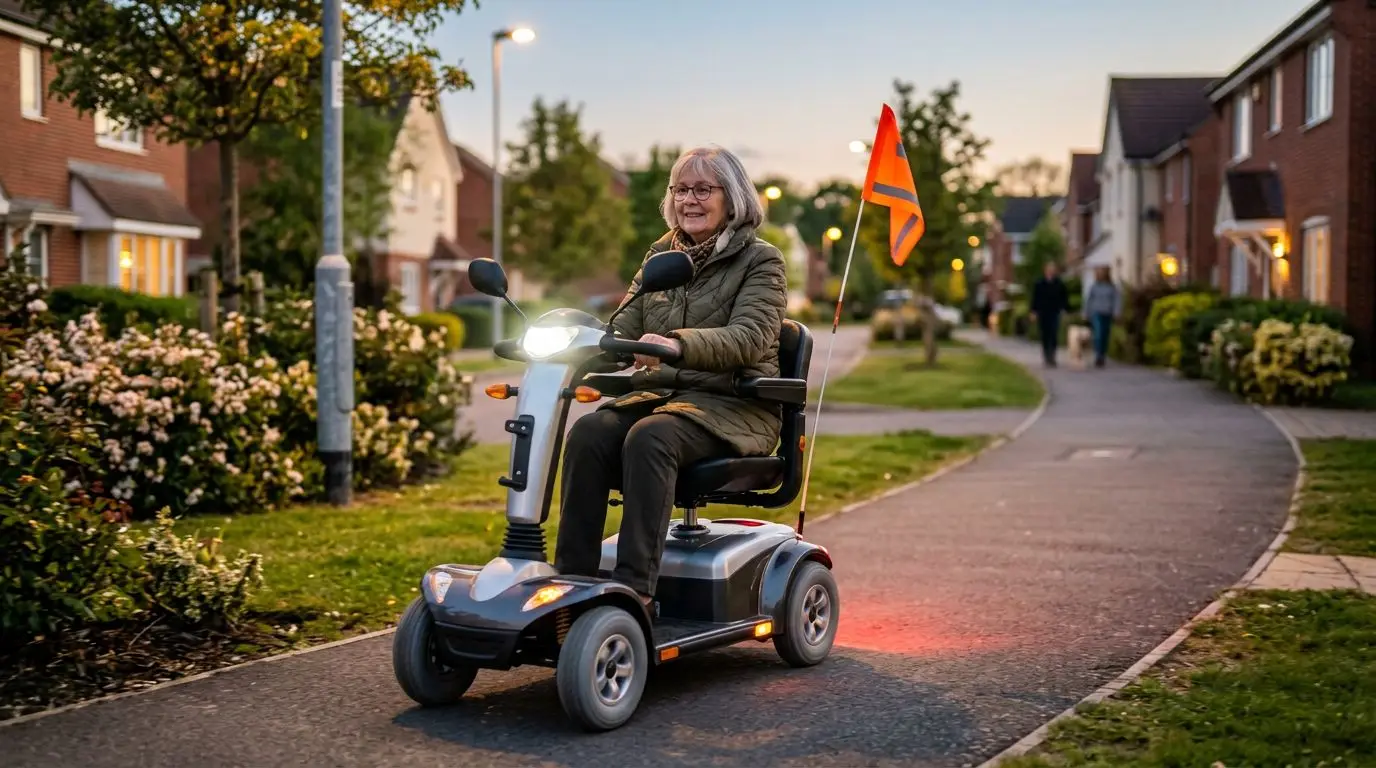
Mobility Scooter Visibility Safety: Lights, Reflectors, Mirrors, Flags, and Night Riding Tips
16 min read
Mobility Scooter Weather Safety: Riding in Rain, Heat, Cold, and Low Visibility
13 min read
Mobility Scooter Safety Guide for Seniors: How to Ride, Turn, Stop, and Park With Confidence
15 min read