Yes, you can usually take a mobility scooter on US public transportation if it can board safely, fit in the accessible space, and be secured or parked according to the transit agency's rules. A useful planning target is a scooter that fits within about 30 inches wide by 48 inches long and remains within the lift or ramp weight capacity, often at least 600 pounds including the rider.
The safest way to plan is to look at three things for each trip: the vehicle, the stop or station, and your scooter's measurements. Buses, trains, and paratransit each work a little differently, but the basics are the same: confirm accessible boarding, know your scooter's size and weight, and allow extra time for elevators, ramps, securement, or transfers.
ADA basics: the 30-inch by 48-inch and 600-pound numbers
The Americans with Disabilities Act sets accessibility requirements for public transportation, but riders still need to know how those rules work in daily travel. On fixed-route buses and rail systems, accessible vehicles and stations are designed around a wheelchair space commonly described as at least 30 inches wide by 48 inches long. Many mobility scooters fit within that footprint, though some full-size scooters can be longer than 48 inches, especially with a front basket, rear accessory, or extended foot platform.
Another important number is 600 pounds. ADA vehicle lift standards have historically used a minimum design load of 600 pounds, including the rider and the mobility device. Some modern ramps, lifts, and vehicles may handle more, but do not assume they will. If your combined body weight, scooter weight, bags, and accessories approach that number, call the transit agency before your first trip.
Transit providers generally must accommodate mobility scooters and other mobility devices when they can be transported safely on the vehicle. They cannot deny service simply because a device is a scooter rather than a manual wheelchair. They may, however, enforce legitimate safety rules, such as not blocking aisles, not exceeding lift capacity, and positioning the scooter where it will not interfere with other passengers or emergency movement.
| ADA planning point | What it means for scooter users |
|---|---|
| 30 inches wide | A useful maximum width target for fitting ramps, lifts, and securement areas |
| 48 inches long | A common accessible floor-space reference; longer scooters may need extra planning |
| 600 pounds | A common minimum lift design load including rider, scooter, and carried items |
| Accessible route | Elevators, curb ramps, bridge plates, or level boarding may be needed at both ends |
Who public transportation works best for: trips with 1 to 2 transfers
Public transportation can be a good option for scooter users who can follow a planned route, wait at stops, and handle transfers with enough battery range. It is often most practical when the trip has no more than 1 or 2 transfers, the weather is manageable, and both the origin and destination have accessible sidewalks or station paths.
It works especially well for riders who use compact or mid-size scooters, can board a ramp at a slow, steady speed, and feel comfortable asking an operator for help with securement. It may be more stressful if local bus stops lack curb cuts, rail station elevators are often out, or your scooter is long, heavy, or hard to maneuver in tight spaces.
- Best fit: routine medical appointments, shopping trips, work commutes, community centers, and visits near accessible stations.
- May need extra planning: trips after dark, routes with steep sidewalks, stations with only 1 elevator, or transfers in bad weather.
- Consider alternatives: if you cannot reach a fixed-route stop safely or if your disability prevents you from using buses or trains for some trips.
Independence matters, but predictability matters too. A 20-minute ride can turn into a 60-minute trip if an elevator is out or the accessible bus bay is blocked, so build in a cushion until you know the route well.
Buses: boarding, securement, and a 2-minute ramp routine
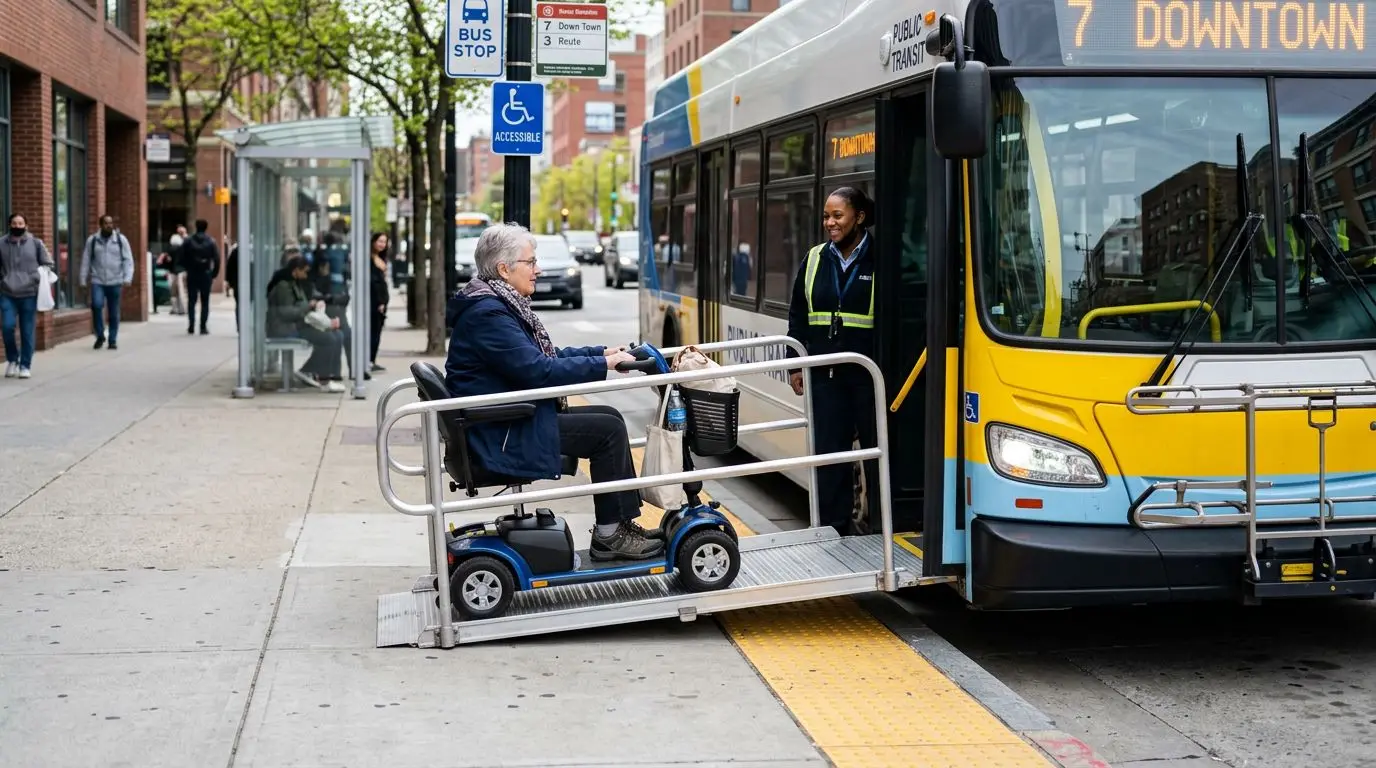
Most city buses use either a low-floor ramp or a lift. The operator typically deploys the ramp, asks other passengers to clear the securement area, and may help position the scooter. Boarding usually goes more smoothly when you approach the ramp straight on, reduce speed, and keep both hands on the tiller. A calm 2-minute routine is better than rushing.
Before the bus arrives, wait where the driver can see you. If the stop has a marked boarding area, position your scooter near it without blocking the sidewalk. When the ramp deploys, let it fully touch down before moving. Drive up slowly, avoid sharp turns on the ramp, and follow the operator's directions for where to park.
Securement varies by bus design. Some buses have belts, hooks, or straps that attach to solid points on a wheelchair or scooter frame. Others use a designated wheelchair space with a backrest or barrier. Operators are generally trained to assist, but scooter frames are not all built the same way, and some have plastic shrouds that are not appropriate securement points.
You may be asked whether you can transfer to a regular seat. Transferring can reduce movement during sudden stops, but it is not always possible or safe for every rider. If you do transfer, set the scooter's brake or power off as directed and keep personal items from falling into the aisle.
| Bus issue | What to do before the ride | What to do on board |
|---|---|---|
| Ramp angle | Use stops with curb access when possible | Board slowly and straight |
| Securement space | Know your scooter length in inches | Park only in the designated area |
| Operator assistance | Signal early that you need the ramp | Answer simple questions about brakes and tie-down points |
| Crowding | Avoid peak trips when you can | Wait for the next bus if the space is already occupied and agency policy requires it |
Trains and subways: check 3 access points before leaving
Rail trips can be easier than buses because platforms are often larger and rides are smoother, but station access is the deciding factor. Before leaving home, check 3 access points: the entrance station, any transfer station, and the exit station. One elevator outage can make an otherwise accessible route unusable.
Look for accessible station information on the transit agency's website, app, phone line, or station alert page. Confirm whether the station has elevators, ramps, level boarding, mini-high platforms, bridge plates, or a gap between train and platform. A horizontal gap of just a few inches can feel significant on a scooter with small front wheels, especially when the platform is crowded.
At the platform, stay behind the tactile warning strip until the train stops. Let passengers exit first. If the system has a designated accessible boarding area, use it because the train operator may be better able to see you there. Board at a controlled speed, and avoid turning until all scooter wheels are on the train.
On commuter rail, light rail, and some subway systems, accessible boarding may be available only at specific cars or doors. Some trains use bridge plates or portable ramps placed by staff. That can add 5 to 10 minutes, especially if staff must be contacted. For important appointments, choose an earlier train until you understand the timing.
- Check elevator status before both the outbound and return trip.
- Confirm whether your destination station has an accessible exit on the correct side of the tracks.
- Keep a backup station in mind within 1 or 2 stops if elevator outages are common.
- Use lights or reflective gear if your trip includes dark station entrances or parking areas.
Paratransit: the 3/4-mile rule and next-day service basics
ADA complementary paratransit is a shared-ride service for people whose disabilities prevent them from using fixed-route buses or trains for some or all trips. It is not the same as a private taxi, and it usually requires eligibility approval before you can book rides. The service area generally follows the fixed-route system, commonly within 3/4 mile of a bus route or rail station during the same days and hours that fixed-route service operates.
Paratransit can be the right alternative if you cannot get to a bus stop safely, cannot navigate the station environment, cannot manage transfers, or have a disability-related condition that makes fixed-route travel impossible under certain circumstances. Eligibility may be unconditional, conditional, or temporary. For example, someone may qualify for paratransit only when snow blocks curb ramps, when heat creates a disability-related safety issue, or when a route requires an inaccessible transfer.
Under ADA rules, paratransit reservations generally must be available for next-day service. Agencies may negotiate pickup times within a limited window, and shared rides can take longer than direct car trips. Fares may be higher than regular transit but are limited under ADA rules, often no more than twice the comparable fixed-route fare for the same trip.
Application processes vary. Many agencies use a written form, healthcare or professional verification, an in-person assessment, or a functional travel interview. If an agency does not make an eligibility decision within 21 days after a completed application, ADA rules provide for presumptive eligibility until a decision is made.
| Option | Typical use | Planning need |
|---|---|---|
| Fixed-route bus | Short to medium trips with accessible stops | Know ramp access and securement space |
| Rail or subway | Longer trips along accessible stations | Check elevators and platform boarding |
| ADA paratransit | When disability prevents fixed-route use | Apply for eligibility and reserve rides |
| Community shuttle | Local senior centers, clinics, or shopping | Ask about scooter lift size and scheduling |
How to measure your scooter in 10 minutes
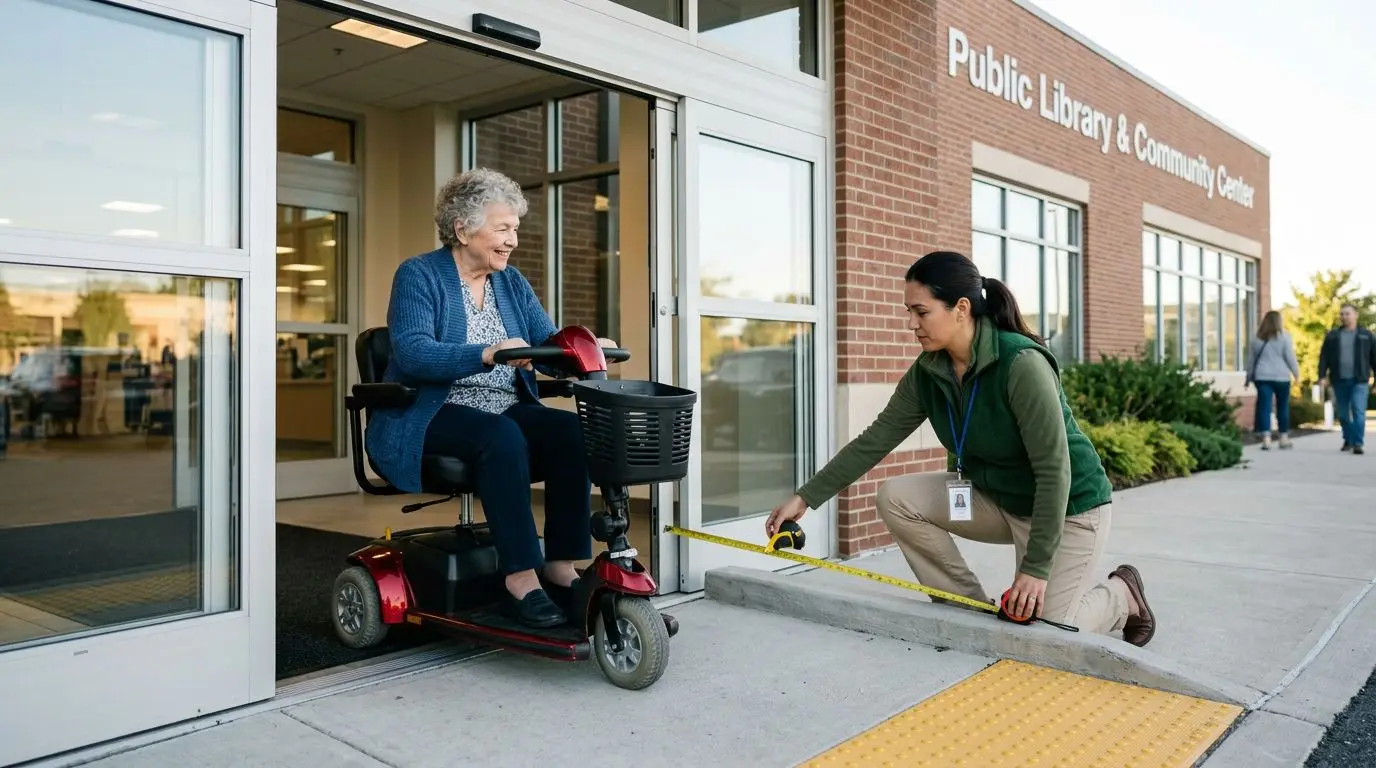
You do not need special equipment to measure your scooter. A tape measure, a notepad, and 10 minutes are enough. Measure the scooter the way you actually travel, including baskets, oxygen holders, cane clips, rear bags, flags, and any other attachments.
Start with length. Measure from the farthest front point to the farthest rear point. If your basket sticks out 3 inches past the front shroud, include it. Next, measure width at the widest point, often the armrests, rear wheels, or mirrors. Measure height only if you use low-clearance vans, station elevators, or storage areas; for most buses and trains, length and width matter more.
Weight is just as important. Find the scooter's listed weight in the owner's manual or on the manufacturer's information plate if available, then add your body weight and anything you carry. A 20-pound grocery bag, a spare battery, and personal medical equipment all count toward the load on a ramp or lift.
- Overall length: front-most point to rear-most point, in inches.
- Overall width: widest point, usually armrests or rear wheels.
- Turning space: practice a 3-point turn in a hallway or parking space.
- Total travel weight: scooter plus rider plus cargo.
- Battery confidence: know whether a round trip uses 25%, 50%, or more of your charge.
Write these numbers on a small card or save them in your phone. When you call a transit agency, you can ask a clear question: My scooter is 25 inches wide, 47 inches long, and the combined weight is about 430 pounds. Will it fit on your buses and rail vehicles?
Choosing transit-friendly scooter features: 5 practical specs
If you are choosing a scooter with public transportation in mind, focus on maneuverability and fit rather than speed. A scooter that feels comfortable in a parking lot may feel bulky inside a bus securement area. The most transit-friendly scooters usually have moderate width, predictable low-speed control, a tight turning radius, and a braking system that is easy to explain to an operator.
Three-wheel scooters often turn more tightly, which can help in bus aisles and elevators, while four-wheel scooters may feel more stable outdoors. Neither is automatically better for every rider. The right choice depends on your balance, route conditions, sidewalk quality, and the size of the transit vehicles you use most often.
| Feature | Why it matters on transit | Practical target |
|---|---|---|
| Width | Affects ramps, doors, and securement spaces | About 30 inches or less when possible |
| Length | Determines whether the scooter fits the onboard space | Close to 48 inches or less is easier |
| Turning radius | Helps with elevators and bus positioning | Practice turning within a small room or hallway |
| Ground clearance | Helps with curb transitions but can affect stability | Enough for sidewalks without making the scooter feel top-heavy |
| Battery range | Covers detours, elevator outages, and return trips | Plan to finish with a safety reserve, not at 0% |
Accessories matter too. Large rear baskets, canopy covers, trailers, and wide armrest bags can create problems even when the scooter itself fits. If you ride transit often, keep the travel setup as compact as you safely can.
Trip planning checklist: 24 hours before, 1 hour before, and on board
Good transit trips usually start before you leave home. For a new route, check accessibility 24 hours before the trip, then check service alerts again about 1 hour before leaving. That may sound cautious, but elevator outages, detours, and construction can change quickly.
24 hours before
- Confirm the route, transfer points, and accessible stations or stops.
- Look up elevator, escalator, ramp, or platform alerts.
- Check the weather and sidewalk conditions at both ends.
- Charge your scooter fully and inspect tires, brakes, and lights.
- Pack only what you can secure without blocking aisles.
1 hour before
- Recheck real-time alerts and vehicle arrival information.
- Give yourself extra time for boarding and transfers.
- Bring the paratransit or customer service number if you may need help.
- Make sure your phone is charged.
On board
- Follow the operator's instructions for parking or securement.
- Power down or set the brake when stopped in the securement area.
- Keep bags, cane tips, oxygen tubing, and coat edges out of the aisle.
- Ask for assistance early if you need the ramp, bridge plate, or lift.
If something goes wrong, document the route, vehicle number if visible, station, time, and what happened. Transit agencies usually have an ADA coordinator or customer service process for accessibility concerns. Clear details help them fix the problem.
FAQ: 5 common scooter transit questions
Can a bus driver refuse my mobility scooter?
A driver generally should not refuse a scooter simply because it is a scooter. Refusal may be allowed if the device cannot be transported safely, exceeds the lift or ramp capacity, cannot fit in the vehicle's accessible space, or would block aisles and emergency movement. If you believe you were wrongly denied, record the route, time, stop, and vehicle number, then contact the transit agency's ADA office.
Do I have to transfer from my scooter to a bus seat?
Operators may recommend transferring to a regular seat when it is safer, but many riders cannot transfer safely. Policies can vary in how securement is handled, so ask your local agency. If you stay on the scooter, use the designated area, set the brake or power off when directed, and allow securement if the system requires it.
What scooter size is best for trains and buses?
A scooter near or under 30 inches wide and 48 inches long is usually easier to manage because those numbers match common accessible-space planning dimensions. Smaller is not automatically safer, though. You still need a scooter that supports your body, works on your sidewalks, and has enough battery range for the whole trip.
Can I use paratransit if buses are just inconvenient?
Paratransit is for disability-related inability to use fixed-route service, not general inconvenience. You may qualify if your disability prevents you from reaching stops, boarding vehicles, navigating transfers, or using the system under certain conditions. The local transit agency decides eligibility through its application process.
What should I do if an elevator is out at my station?
Check for an alternate accessible route, a nearby accessible station, shuttle service, or instructions from the transit agency. If you are already in the system, contact station staff or customer service before boarding farther into a route you cannot exit. For recurring outages, consider filing an accessibility complaint with specific dates and times.
Frequently asked questions
Can a bus driver refuse my mobility scooter? +
A driver generally should not refuse a scooter simply because it is a scooter. Refusal may be allowed if the device cannot be transported safely, exceeds lift or ramp capacity, cannot fit in the accessible space, or blocks aisles and emergency movement.
Do I have to transfer from my scooter to a bus seat? +
Operators may recommend transferring when it is safer, but many riders cannot transfer safely. Ask your local agency about its securement policy. If you remain on the scooter, use the designated area and set the brake or power off when directed.
What scooter size is best for buses and trains? +
A scooter near or under 30 inches wide and 48 inches long is usually easier to manage because those dimensions match common accessible-space planning standards. Your scooter still needs to fit your body, route conditions, and battery needs.
Can I use ADA paratransit if buses are inconvenient? +
Paratransit is for disability-related inability to use fixed-route service, not general inconvenience. You may qualify if your disability prevents you from reaching stops, boarding vehicles, navigating transfers, or using the system under certain conditions.
What should I do if a rail station elevator is out? +
Check the transit agency's alerts for an alternate accessible route, nearby accessible station, shuttle, or staff assistance. If outages keep affecting your trips, report the issue with the station name, date, and time.
Related guides
Mobility Scooters, Taxis, and Rideshares: What to Confirm Before You Book a Ride
14 min read
Can a Business Refuse a Mobility Scooter? ADA Rights, Safety Exceptions, and What to Do If Access Is Challenged
13 min read
Can You Bring a Mobility Scooter to Theme Parks, Stadiums, Museums, and Other Venues?
16 min read